















Can Women Travel Alone for Ardh Kumbh 2027?
Can women travel alone for Ardh Kumbh 2027? A honest, heartfelt guide to safety, preparation, challenges, and spiritual rewards for solo female pilgrims.
Can Women Travel Alone for Ardh Kumbh 2027?
Let me start with a story that will give you hope. I met a woman at the last Ardh Kumbh. Let us call her Meera. She was sixty-two years old. A widow. Her children lived in different countries. She had no one to travel with. But she had promised her late husband that she would take a dip in the Ganges during a Kumbh. So she came alone. She booked a small room in a dharamshala three months in advance. She arrived two days before the main bathing day. She made friends with the women running the dharamshala kitchen. She walked to the ghat with a group of other women she met there. She took her dip. She cried. She came home. And she told me: "I was scared. But I was more scared of dying without keeping my promise." That is the spirit of millions of solo women pilgrims who come to the Kumbh every cycle. They are not fearless. They are faithful. And their faith, combined with good planning, carries them through. So can women travel alone for Ardh Kumbh 2027? Yes. But let me give you the full picture — the challenges, the resources, the tips, and the truths.
The Reality – What Solo Women Pilgrims Face
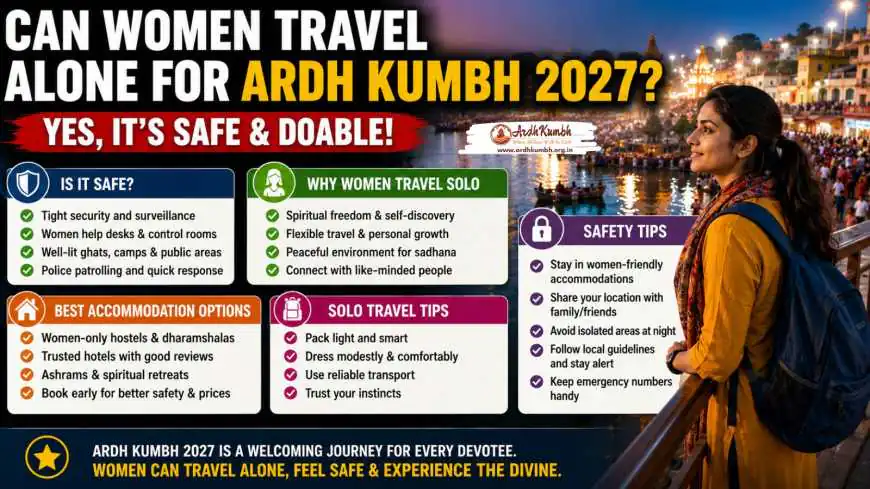
Let me be honest about the challenges. A solo woman traveler at the Kumbh will face the same challenges as any solo traveler: the crowds, the cold, the exhaustion, the risk of getting lost, the language barriers, the logistical nightmares. But there are additional challenges specific to women. Unwanted attention. Staring. Catcalling. These exist, especially in crowded spaces, especially in India, especially in gatherings where millions of men are present. It is not fair. It is not right. But it is real. The Kumbh authorities are aware of this. The Uttarakhand Police has made women's safety a priority for the 2027 Mela . There will be women-only police squads, women-only help desks, and women-only security checkpoints . The government is deploying modern technology, including CCTV surveillance and AI-based crowd monitoring, to enhance safety . But technology and police cannot be everywhere. Your personal awareness is your first line of defense.
The Resources – What the Authorities Are Doing
Let me give you the good news. The Uttarakhand government and Uttarakhand Police are taking the Ardh Kumbh 2027 very seriously. The Director General of Police (DGP) Deepam Seth has personally reviewed preparations and issued instructions for a concrete action plan to ensure the safety and convenience of all devotees . The Inspector General of Police (IG) Nilesh Anand Bharane is serving as the Nodal Officer for the Kumbh Mela 2027, overseeing security, traffic management, and crowd control . The meeting at the Mela Bhawan focused on learning from past challenges and implementing better strategies . What does this mean for you as a solo woman traveler? It means there will be more police presence, more CCTV cameras, more emergency response teams, and better coordination between departments than ever before . The Mela area has been expanded to 1,454 hectares across four districts, with the main area covering 670 hectares from Haridwar to Devprayag . The temporary city will be divided into 32 sectors, each with police outposts, hospitals, and information kiosks . This is not a small village fair. This is a well-planned mega-event with safety as a top priority.
Women-Only Services – What You Need to Know
Let me highlight the specific women-only services that will be available. Women-only police squads will be deployed throughout the Mela area . Women-only help desks will be set up at key locations, including the railway station, bus stands, and major ghats. Women-only security checkpoints will be available at entry points. Local trains and metros have ladies compartments that only admit women . Most bus stations have ladies queues for tickets. Waiting rooms for women only are available at railway stations for long-distance journeys. Some accommodations, including dharamshalas and camps, offer women-only dorms or separate sections . The key is to ask. Do not assume. When you arrive, ask the nearest volunteer or police officer: "Where is the women-only help desk? Where is the women-only waiting area?" These resources exist. Use them.
Trending Guides Now

Ardh Kumbh vs Maha Kumbh: The Real Difference Explained
Read Guide →
Can Women Take Shahi Snan at Ardh Kumbh?
Read Guide →
Are Women Allowed in All Ritual Areas at Kumbh?
Read Guide →
Can Ardh Kumbh Be Experienced Online or Virtually?
Read Guide →
Ardh Kumbh 2027 Dates (Official) - Haridwar Snan Schedule
Read Guide →
Dharamshala Stay During Ardh Kumbh: Free & Budget Guide
Read Guide →
Official Progress Report of Haridwar Ardh Kumbh 2027 Infrastructure Projects
Read Guide →
Where to Find 24-Hour Pharmacies in Haridwar During Ardh Kumbh 2027 Emergencies
Read Guide →Accommodation – Where Should You Stay?
Let me talk about accommodation, because this is the most critical decision for a solo woman traveler. Do not arrive without a place to stay. Book your accommodation months in advance . The options range from luxury tent cities to budget dharamshalas to ashrams to government-run camps. For a solo woman, I strongly recommend one of three options. First, a women-only dormitory in a reputable ashram or hostel. These exist, but you need to search for them online and book early. Second, a small room in a family-run dharamshala where the owners are on-site. Read reviews specifically from solo female travelers. Third, a guided group tour for solo women. Several travel companies now offer "women-only Kumbh packages" that include accommodation, transport, and a guide. This is more expensive, but it is the safest option for first-timers. Avoid arriving without a booking and trusting a "helpful stranger" to find you a room. That is how scams happen.
Dress Code – Blending In for Safety
Let me talk about dress, because this is a sensitive but important topic. You are traveling to a conservative religious gathering in a small Indian city. You are not at a beach resort. You are not at a nightclub. The women around you — local pilgrims — will be dressed modestly. Most will wear saris, salwar kameez, or long skirts with dupattas (scarves) . If you dress similarly, you will attract less unwanted attention. That is not fair. That is not "right." But it is practical. A salwar kameez is comfortable, breathable, and easy to move in. You can buy one for as little as INR 300-500 . Pair it with a dupatta that you can use to cover your head when entering temples or to shield your face if you feel uncomfortable. Avoid low-cut tops, shorts, miniskirts, and body-hugging clothes . This is not about "blaming" women for how they dress. It is about reducing risk in an environment where you are already vulnerable as a solo traveler. You can be fashionable at home. At the Kumbh, be practical.
Transport – Getting There and Moving Around
Let me talk about transport. The Haridwar railway station will be extremely crowded. Book your train tickets well in advance — at least 120 days before your travel date. When traveling by train, book a three-tier AC compartment rather than a non-AC general compartment . Try to get an upper berth for more privacy. Use the ladies compartment if available. For local transport within Haridwar, use official shuttle services or prepaid taxis from the railway station . Do not get into an unmarked vehicle with a stranger who approaches you at the station. Uber and Ola operate in Haridwar and are generally safer than street taxis because the driver is tracked . If you must take an auto-rickshaw, agree on the fare before you start the journey. Keep your phone's GPS on so you can see where you are being taken. Share your live location with a friend or family member back home.
Timing – When to Go and When to Avoid
Let me talk about timing. The Ardh Kumbh 2027 runs from January 14 to April 20, 2027 . That is 107 days. The Amrit Snan (royal bath) days are the most crowded — specifically March 6 (Mahashivratri), March 8 (Phalguna Amavasya), April 14 (Mesh Sankranti), and April 20 (Chaitra Purnima) . On these days, the crowd can exceed 5 to 7 crore people. I strongly advise against attending these peak days as a solo woman traveler, especially if it is your first Kumbh. The crowd pressure is intense. The risk of getting separated from safety resources is higher. Instead, come on a non-peak day — a regular bathing day, not an Amrit Snan. The experience will still be deeply spiritual. The crowd will still be huge (millions, not tens of millions). But you will have more breathing room, more access to police and help desks, and less physical risk. Avoid arriving after dark . Plan your travel so that you reach Haridwar before sunset. Navigating a new city, finding your accommodation, and orienting yourself in the dark is stressful and more dangerous.
Your Phone – Your Best Safety Tool
Let me talk about technology. Your smartphone is your lifeline at the Kumbh. Before you leave, do the following. Save the Indian emergency number 112 on your phone . Save the local police station number for Haridwar. Download offline maps of Haridwar (Google Maps allows this). The mobile network will be congested on peak days, but offline maps work without internet. Carry two power banks — fully charged. You may not find a charging point for hours. Keep your phone charged at all times. If you feel unsafe, call the emergency number immediately. Do not hesitate. Do not worry about "overreacting." Your safety is more important than politeness. If you are lost, do not wander aimlessly. Find a police officer, a volunteer, or a woman at a help desk. Ask for help. Most Indians are genuinely helpful, especially to pilgrims .
Building a Trust Network – You Are Not Alone
Let me talk about community. You may be traveling alone, but you are not alone. At the Kumbh, you will meet thousands of other women pilgrims. Some will be solo like you. Some will be in groups. Strike up conversations. Sit next to a grandmother at the Bhandara. Ask a group of women if you can walk with them to the ghat. Share your chai with a stranger. Build a temporary trust network . The women you meet at the Kumbh are not enemies. They are fellow pilgrims. They will help you if you ask. And you will help them if they ask. That is the spirit of the Kumbh. Also, consider joining a women-only travel group before you go. There are Facebook groups, WhatsApp groups, and online forums for solo female travelers in India. Join them. Ask questions. Get recommendations for women-friendly accommodations. Find a travel buddy for part of your journey if you want. The internet can be a tool for safety, not just for scrolling.
Trust Your Gut – The Most Important Rule
Let me end this section with the most important rule. Trust your instincts. If a situation feels wrong, it probably is. If a person makes you uncomfortable, leave. If a path feels unsafe, take another. You do not owe anyone your time, your attention, or your politeness at the expense of your safety. The Sixth Sense that women develop over years of navigating unsafe spaces is real. Use it . If a stranger offers you food or drink, politely decline. If a stranger offers to show you a "shortcut" or a "special place," say no firmly and walk away . If you are being followed, walk toward a police officer, a crowd, or a well-lit area. Shout if you need to. Make noise. Indian men, as a general rule, will back off when they know you can raise your voice and attract attention . You are not being "rude." You are being safe.
The Verdict – Yes, But Prepare
So let me give you my final answer. Yes, women can travel alone for Ardh Kumbh 2027. But "can" does not mean "should without preparation." The Kumbh is not a casual trip. It is a pilgrimage. And for a solo woman, it requires double the preparation and triple the awareness. Book your accommodation months in advance. Dress modestly. Avoid peak Amrit Snan days. Arrive before dark. Use women-only services. Keep your phone charged. Trust your gut. And most importantly, go with a spiritual purpose, not just a travel checklist. The women who have the best solo experiences at the Kumbh are not the ones who are fearless. They are the ones who are faithful. They trust the Ganges. They trust the crowd (carefully). They trust their own preparation. And they come home transformed, not traumatized. That can be you. The river is waiting. But the river also demands respect. Give it that respect — in your planning, in your awareness, and in your heart.
Frequently Asked Questions