








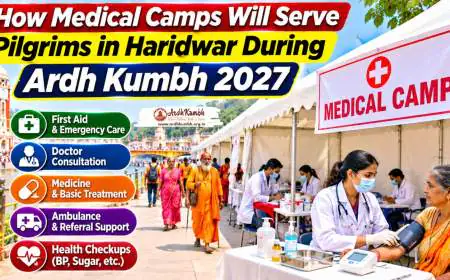



























































How Medical Camps Will Serve Pilgrims in Haridwar During Ardh Kumbh 2027
Discover how medical camps, temporary hospitals, boat ambulances and 1,800 health workers will serve pilgrims in Haridwar during Ardh Kumbh 2027 with free treatment and emergency care.
How Medical Camps Will Serve Pilgrims in Haridwar During Ardh Kumbh 2027
Quick Answer ⚡
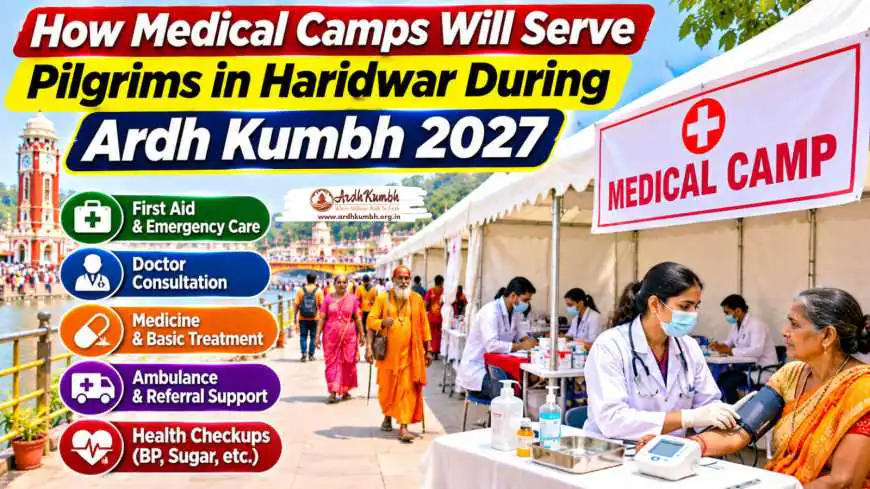
During Ardh Kumbh 2027 in Haridwar, medical camps will serve pilgrims through a multi-layered healthcare grid planned by the Mela administration and Health department. The plan includes 45 temporary hospitals across the Mela area and surrounding districts, with a combined target of 3,486 beds — of which approximately 436 beds will be in temporary hospitals and 1,101 beds reserved across 13 government hospitals. Around 1,800 doctors and paramedical staff will be deployed, including 29 specialist medical officers, 271 other medical officers, 481 paramedical staff, and 1,020 outsourced employees, with the services of 43 specialist doctors also available. Emergency transport will include 31 Basic Life Support (BLS) ambulances, 2 Advanced Life Support (ALS) ambulances, 20 bike ambulances, and proposed boat ambulances for the Ganga region. The entire Mela area is divided into 4 zones and 32 sectors to ensure prompt medical assistance, and the Mela Hospital and Bhupatwala Hospital are being upgraded with CSR-funded medical equipment. The target is to complete all health-related arrangements by December, with a budget proposal of approximately ₹36.7 crore, of which about ₹28 crore is expected to be approved.
At a Glance 🔎
| Detail | Information |
|---|---|
| Total Temporary Hospitals | 45 across Mela area and surrounding districts |
| Total Bed Target | 3,486 beds in the Kumbh area |
| Beds in Temporary Hospitals | Approximately 436 |
| Beds Reserved in Government Hospitals | 1,101 across 13 hospitals |
| Total Health Staff | Approximately 1,800 (doctors, paramedics, outsourced) |
| Specialist Medical Officers | 29 |
| Other Medical Officers | 271 |
| Paramedical Staff | 481 |
| Outsourced Employees | 1,020 |
| Additional Specialist Doctors | 43 |
| BLS Ambulances | 31 |
| ALS Ambulances | 2 |
| Bike Ambulances | 20 |
| Boat Ambulances | Proposed for Ganga region |
| Mela Zones | 4 |
| Mela Sectors | 32 |
| Budget Proposal | Approximately ₹36.7 crore (₹28 crore expected approval) |
| Upgraded Hospitals | Mela Hospital and Bhupatwala Hospital |
| Target Completion | December (before Mela) |
| Ambulance Helpline | 108 |
| Medical Control Room | District Hospital |
The Scale of the Challenge: Why Medical Camps Matter
The Ardh Kumbh 2027 in Haridwar is expected to draw anywhere from 5 crore to 20 crore devotees over its four-month duration. Haridwar is geographically constrained — hills on two sides and the Ganga on one — making the delivery of healthcare to millions within a limited space a significant logistical challenge.
The Pressure Points
-
Snan Parv days: Crowd pressure spikes dramatically on major bathing dates, increasing the risk of health emergencies, injuries, and stampede-related trauma.
Trending Guides Now

How Security Screening Works at Ardh Kumbh 2027 Entry Points
Read Guide →
How CCTV and Security Monitoring Work in Haridwar During Ardh Kumbh 2027
Read Guide →
How Public Transport Changes in Haridwar During Major Bathing Days at Ardh Kumbh 2027
Read Guide →
How Volunteers Assist Pilgrims in Haridwar During Ardh Kumbh 2027
Read Guide →
Ardh Kumbh 2027 Dates (Official) - Haridwar Snan Schedule
Read Guide →
Dharamshala Stay During Ardh Kumbh: Free & Budget Guide
Read Guide →
Official Progress Report of Haridwar Ardh Kumbh 2027 Infrastructure Projects
Read Guide →
Where to Find 24-Hour Pharmacies in Haridwar During Ardh Kumbh 2027 Emergencies
Read Guide → -
Limited geography: The Mela area is compact. Pilgrims cannot easily be transported long distances for primary treatment.
-
Elderly and infirm pilgrims: A significant proportion of pilgrims are senior citizens with chronic conditions who require regular medication and emergency care.
Expert Tip 💡: The Mela administration has acknowledged that providing timely treatment when a pilgrim falls ill, is injured, or needs sudden medical help is one of the most critical tasks of the entire event. The 45 temporary hospitals are being planned precisely to ensure that primary treatment is available on-site, without pilgrims having to travel far.
The 45 Temporary Hospitals: A Distributed Healthcare Grid
The temporary hospitals are not concentrated in one location. They are distributed across the Mela area and surrounding districts to create a layered healthcare grid.
Hospital Sizes and Locations
The hospitals are being built in different capacities to match the expected pilgrim density in each zone.
| Location | Hospital Capacity | Notes |
|---|---|---|
| Gaurishankar | 50 beds | High-density zone |
| Bairagi Camp | 50 beds | High-density zone |
| Rodi Sector | 40 beds | Sector-level facility |
| Pantdweep | 40 beds | Sector-level facility |
| Saptasarovar | 20 beds | Mid-sized facility |
| 14 other sectors | 10 beds each | Covering Muni Ki Reti, Dakshindweep, Satidweep, Laljiwala, Chandidweep, Kangra Island, Belwala, Dhirwali, Motichur, and other key areas |
Source: Temporary hospital capacities as per the Mela Health Officer's proposal.
What These Hospitals Will Offer
-
General medical care for common ailments.
-
Emergency treatment for injuries and acute conditions.
-
First aid for minor cuts, dehydration, and heat-related issues.
-
Referral services to larger hospitals for serious cases.
Pro Tip 🧭: The 10-bed hospitals in 14 sectors are the first point of contact for most pilgrims. If you or a family member feels unwell at the ghats, ask a volunteer or police officer for the nearest sector hospital. They are designed to be close to the crowd, not on the outskirts.
The Zone and Sector System
The entire Mela area has been divided into 4 zones and 32 sectors to ensure prompt medical assistance in case of any emergency. Each sector has its own hospital, police outpost, and sanitation hub. This decentralised structure means that a pilgrim in Motichur does not need to travel to Har Ki Pauri for basic medical care.
Local Insight 📍: The sector-level hospitals are the quiet workhorses of the Kumbh healthcare system. They will not make headlines, but they will treat thousands of pilgrims for dehydration, exhaustion, minor injuries, and infections — the everyday realities of a mass pilgrimage.
The Human Resource: 1,800 Health Workers on Duty
Infrastructure alone does not save lives. People do. The Health department is deploying a substantial workforce across the Mela area.
The Deployment Breakdown
| Role | Number |
|---|---|
| Specialist Medical Officers | 29 |
| Other Medical Officers | 271 |
| Paramedical Staff | 481 |
| Outsourced Employees | 1,020 |
| Total | Approximately 1,800 |
| Additional Specialist Doctors | 43 |
Source: Deployment figures as per the Mela Health Officer.
What This Means for Pilgrims
-
More hands on deck: The 1,020 outsourced employees will handle logistics, registration, crowd management at medical camps, and patient transport, freeing up doctors and paramedics to focus on clinical care.
-
Specialist access: The 29 specialist medical officers and 43 additional specialist doctors mean that pilgrims with cardiac, respiratory, or other specialist needs have a better chance of on-site assessment rather than a long referral chain.
-
Round-the-clock presence: With 1,800 staff across 45 facilities, the Mela administration can maintain 24/7 coverage in high-density zones.
Expert Advice ✨: If you have a pre-existing medical condition, carry a written medical card listing your diagnosis, medications, and allergies. In an emergency, this card can dramatically speed up treatment and prevent medication errors by health workers who do not know your history.
Emergency Transport: BLS, ALS, Bike, and Boat Ambulances
Reaching a hospital is only half the battle. Getting the patient to the hospital is the other half. The Kumbh 2027 plan includes a multi-modal ambulance fleet designed for the unique geography of Haridwar.
The Ambulance Fleet
| Ambulance Type | Number | Purpose |
|---|---|---|
| Basic Life Support (BLS) | 31 | Standard emergency transport with basic equipment |
| Advanced Life Support (ALS) | 2 | Critical care transport with advanced equipment |
| Bike Ambulances | 20 | Rapid response through narrow lanes and crowded ghats |
| Boat Ambulances | Proposed | Emergency medical aid in the Ganga region |
Source: Ambulance deployment plan as per the Mela Health Officer.
Why Bike Ambulances Matter
Bike ambulances are a game-changer for the Kumbh. The ghats, markets, and approach lanes of Haridwar are too narrow for a standard ambulance during peak crowds. A bike ambulance can weave through the crowd, reach the patient, provide basic life support, and stabilise them until a BLS or ALS ambulance can take over.
Expert Tip 💡: The Chief Minister has specifically directed that boat and bike ambulances be arranged to transport sick devotees to the nearest health centres. This is a direct response to the geographical constraints of the Mela area.
Boat Ambulances: A First for Kumbh
The boat ambulances are proposed for the Ganga region. If a pilgrim falls ill or is injured near the river or on a boat, a boat ambulance can reach them faster than a road vehicle. This is particularly relevant for the Kalpwasis and sadhus who live close to the river.
Pro Tip 🧭: If you are near the river and need emergency help, call 108 and clearly state your location — "near the Ganga, at [landmark]". The medical control room can dispatch the appropriate ambulance type based on your location.
Upgraded Hospitals: Mela Hospital and Bhupatwala Hospital
Two government hospitals are being specifically upgraded for the Kumbh.
Mela Hospital, Bilkeshwar Road
Mela Hospital is the primary government healthcare facility for the Mela area. It is being equipped with medical and health equipment provided under the Corporate Social Responsibility (CSR) initiative of the Agriculture and Industry Development Council.
-
Role: Referral hospital for serious cases from the temporary hospitals.
-
Location: Bilkeshwar Road, accessible from the Mela area.
-
Contact: 9410990670 (as per public listings).
Bhupatwala Hospital
Bhupatwala Hospital is the second government facility being upgraded with CSR-funded equipment. It serves the Bhupatwala area and the Rishikesh Road corridor.
-
Role: Secondary referral centre and community hospital.
-
Location: Bhupatwala, on the Haridwar–Rishikesh route.
-
Upgrade: Medical equipment for emergency care.
Expert Advice ✨: The Mela Hospital and Bhupatwala Hospital are government facilities. Treatment is free or highly subsidised for pilgrims. If you are referred from a temporary hospital, carry the referral slip — it speeds up admission and ensures continuity of care.
The Medical Control Room and 108 Ambulance Service
The Medical Control Room is the nerve centre of the Kumbh healthcare system.
Location and Contact
-
Location: District Hospital, Haridwar.
-
Key Services: Health emergencies, ambulance dispatch, coordination with temporary hospitals.
-
Ambulance Helpline: 108.
Source: Medical Control Room details as per official Kumbh information.
How the Control Room Works
When you call 108:
-
The control room receives the call and records your location.
-
The dispatcher identifies the nearest available ambulance (BLS, ALS, bike, or boat).
-
The ambulance is routed to your location, with real-time traffic and crowd information.
-
The receiving hospital is alerted to prepare for the patient.
Local Insight 📍: The Medical Control Room operates through the District Hospital system and coordinates 108 ambulance response during the Mela period. Save 108 on your phone before you travel — network congestion can make live searches unreliable.
Health Budget and Timeline: What the Numbers Reveal
The Health department has submitted a proposal totaling approximately ₹36.7 crore, with approval for approximately ₹28 crore expected.
What the Budget Covers
-
Temporary hospital construction and equipment.
-
Ambulance procurement and deployment.
-
Staff salaries and honoraria.
-
Medicines and consumables.
-
Training and orientation for Mela-specific emergency protocols.
The Timeline
The target is to complete all health-related arrangements by December, ahead of the Mela starting on 14 January 2027. The Chief Minister has set a firm October deadline for completing all preparations, including temporary hospitals, ambulances, and mobile medical teams.
Expert Advice ✨: The budget and timeline are public commitments. If you are a local stakeholder or volunteer, you can track progress through official Mela administration channels. For pilgrims, the key takeaway is that the health infrastructure is being built to a plan, not improvised.
What Pilgrims Should Know: Accessing Medical Camps
The medical camps are designed to be accessible, but pilgrims need to know how to use them.
Before You Travel
-
Save 108 and 112 offline. 108 is the ambulance helpline; 112 is the unified emergency number.
-
Carry your regular medicines with extra stock and a written prescription.
-
Carry a medical card listing your conditions, medications, and allergies.
-
Note the nearest sector hospital to your accommodation on arrival.
During the Mela
-
For minor ailments (dehydration, exhaustion, minor cuts): Visit the nearest 10-bed sector hospital or first-aid camp.
-
For serious emergencies (chest pain, breathing difficulty, trauma): Call 108 immediately. Do not attempt to walk to a hospital.
-
For women and elderly pilgrims: Seek assistance at women and child help centres or ask a police volunteer to guide you to the nearest medical facility.
Pro Tip 🧭: The temporary hospitals are not just for emergencies. If you have a fever, infection, or digestive issue, visit a sector hospital early. Treating a minor issue promptly prevents it from becoming a major emergency in the crowded Mela environment.
Frequently Asked Questions