
















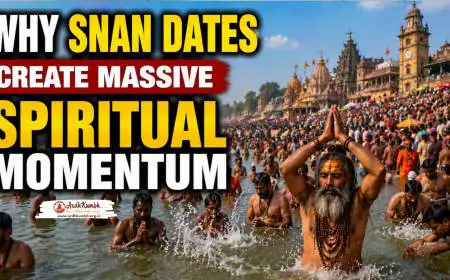


















































How Snan Timings Shape the Entire Event
Discover how snan timings shape the entire Kumbh Mela. From astrological precision to crowd movement, akhara processions, and pilgrim planning, explore why the sacred bathing hour is the gravitational center around which everything revolves.

The Celestial Clock: Muhurta as the Master Schedule 🌌
The snan timings at the Kumbh are not set by a human committee. They are dictated by the precise, mathematical movements of the heavenly bodies. The most sacred days, the Shahi Snan (royal bath) dates, occur when Jupiter (Brihaspati) enters specific zodiac signs, and the Sun and Moon align in configurations that the ancient rishis, through millennia of observation, identified as moments of maximum spiritual receptivity. At the Prayagraj Kumbh, the most potent moment is when Jupiter is in Aquarius (Kumbha Rashi) and the Sun is in Aries (Mesha Rashi). This is the Kumbh Muhurta, and it is calculated to the second by generations of astronomer-priests who maintain the Panchang (Hindu almanac) with an accuracy that has survived the collapse of empires. This cosmic clock is the master schedule. It dictates not just the day, but the hour, and often the minute, when the spiritual potency of the river is at its peak. The entire Kumbh Mela is, in essence, a massive logistical operation designed to deliver as many human souls as possible to the water at this precise, non-negotiable appointment with the divine.
Because the timing is cosmic, it is also democratic. A king cannot reschedule it to suit his convenience. A prime minister cannot delay it for a political rally. The stars do not bow to human power. This celestial authority is what gives the Kumbh its immense, independent power. Every pilgrim, from the poorest farmer to the wealthiest industrialist, is equal before the Muhurta. All must arrive at the same time, strip away their worldly identities, and step into the same cold water. The snan timing is the great equalizer. It shapes the event by creating a single, unified, and unchangeable focal point that commands the attention and the movement of millions. The entire temporary city is designed around getting people safely and efficiently to the water at this specific hour.
The Pilgrim's Countdown: How the Sacred Dates Create a Pan-Indian Rhythm 📅
Long before the first tent is pitched, the snan timings begin their invisible work of shaping the event in the hearts and minds of pilgrims across the subcontinent. When the official dates are announced, a vast, synchronized countdown begins. The primary bathing dates, especially the Shahi Snan days, are the anchors around which every pilgrim plans their journey. Leave is applied for at work. Savings are unlocked. Train tickets are booked the very moment reservations open, exactly 120 days before the travel date. The entire pilgrimage economy—the transport networks, the accommodation sector, the local markets—operates on a timeline that is dictated entirely by these sacred dates. The weeks leading up to the main snan days see a massive surge in arrivals, and the days immediately following see a mass exodus. The snan timings create a rhythmic pulse of arrival, peak, and dispersal that is the heartbeat of the Mela.
For the individual pilgrim, the snan timing becomes a psychological and spiritual focal point. The months of preparation—the physical training, the saving of money, the refining of the sankalpa (sacred intention)—are all oriented toward this single, approaching moment. This long, focused build-up is what gives the snan its extraordinary personal power. By the time the pilgrim stands at the water's edge, they are not a casual visitor. They are a focused vessel of intention, their entire being aligned with the cosmic moment. The timing shapes the internal landscape of the pilgrim as much as it shapes the external landscape of the Mela. It transforms a simple bath into the culmination of a long, sacred journey, a moment that carries the accumulated weight of months of preparation and a lifetime of longing.
Trending Guides Now

When Is the Next Ardh Kumbh Mela in Haridwar?
Read Guide →
Ardh Kumbh Mela Dates & Shahi Snan Schedule Guide
Read Guide →
Why Shahi Snan Is the Most Sacred Ritual of Kumbh
Read Guide →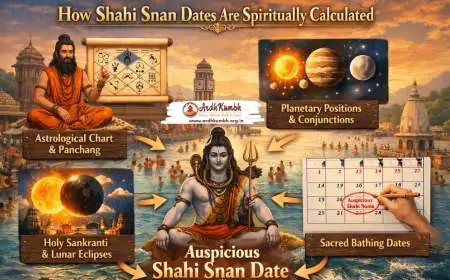
How Shahi Snan Dates Are Spiritually Calculated
Read Guide →
Best Routes to Reach Haridwar for Ardh Kumbh Mela
Read Guide →
Ardh Kumbh 2027 Dates (Official) - Haridwar Snan Schedule
Read Guide →
How Ardh Kumbh Sustained Leadership Traditions
Read Guide →
How Kumbh Became a Platform for Social Reform
Read Guide →The Akhara Choreography: Timings That Order the Sacred Processions 🔱
The spectacular Shahi Snan processions of the akharas are the visual and spiritual climax of the Kumbh, and their entire choreography is dictated by the snan timing. The order in which the great monastic orders—the Juna, Niranjani, Mahanirvani, and others—march to the river is not random. It is a carefully negotiated, centuries-old hierarchy, and each akhara is given a specific, pre-assigned window of time within the overall Muhurta period. The most prestigious akharas are granted the closest proximity to the exact peak of the auspicious moment. The entire day's schedule is a cascading sequence of processions, each one timed to enter the water, perform its ritual bath, and clear the ghats before the next akhara arrives. This is a masterpiece of choreographed movement, where spiritual precedence and precise timekeeping merge into a single, sacred performance.
This time-bound choreography is what allows millions of people to witness the spectacular processions and then, in a controlled, phased manner, gain access to the water for their own bath. The akharas are the spiritual aristocracy, and they bathe first, during the most potent period. After the last akhara has completed its snan, the ghats are thrown open to the general public in carefully managed waves. This system, governed entirely by the clock, prevents chaos and ensures that the sacred moment is honored by all. The snan timing, in this context, is a tool for maintaining both the sacred hierarchy and the physical safety of the masses. It transforms a potential free-for-all into an ordered, sacred sequence.
The Logistics of Grace: How Timings Dictate Crowd Management 🚶
The most tangible way that snan timings shape the entire event is in the realm of crowd management. On the peak bathing days, the entire temporary city is transformed into a highly controlled, time-sensitive circulatory system. Hours before the designated Muhurta, the Sacred Core Zone around the ghats is sealed off. The pontoon bridges are assigned one-way directions—some exclusively for incoming pilgrims, others for outgoing. The vast network of barricades and holding areas is activated according to a precise schedule that is synchronized with the approaching auspicious moment. The entire security apparatus—the police, the volunteers, the AI-powered surveillance—is focused on a single objective: to deliver the maximum number of pilgrims safely to the water during the specific snan window.
The timing dictates everything. The "gating" system on the bridges, where the flow of pilgrims is periodically halted to prevent overcrowding, is calibrated to the rhythm of the approaching peak. The holding areas are filled and emptied in a controlled sequence that is designed to release waves of pilgrims into the bathing zone at a manageable rate. The public address system issues constant, time-specific guidance. The entire machinery of the Mela reaches its peak operational intensity in the hours immediately surrounding the Muhurta. After the main snan window passes, the system slowly unwinds, the one-way restrictions are relaxed, and the city returns to a more normal flow. The logistics of the Kumbh are not static; they are a dynamic, time-driven response to the gravitational pull of the sacred moment.
The Spiritual Arc: Why the Pre-Dawn Hours Carry the Greatest Potency 🌅
Within the overall architecture of the snan timings, the most spiritually charged period is the Brahma Muhurta, the time approximately ninety minutes before sunrise. This is considered the most sattvic, the most pure and luminous, time of the entire day. The mind, after a night's rest, is naturally calm and introverted. The external world is quiet and still. The ancient sages taught that the veil between the material and the spiritual realms is at its thinnest during these pre-dawn hours. The Kumbh's most important snan moments are deliberately scheduled to coincide with this sacred window. The pilgrim who forces themselves out of a warm bed and walks through the freezing dark to the river at 4 AM is not performing a penance; they are aligning themselves with the most potent spiritual current available.
This pre-dawn timing shapes the entire character of the Kumbh experience. It creates the unique, unforgettable atmosphere of millions of people moving in silence through the dark, their breath misting in the cold air, their faces illuminated only by the occasional flicker of a distant lamp. It is a time of intense, focused, and deeply personal devotion. The sensory deprivation of the darkness amplifies the inner experience. The shock of the cold water is felt more intensely, and the subsequent, gradual lightening of the sky as the sun rises becomes a powerful, embodied metaphor for spiritual awakening. The Kumbh's daily rhythm, with its 3 AM wake-up calls and its 4 AM walks to the ghats, is entirely shaped by the spiritual imperative of the Brahma Muhurta. It is a schedule that is ruthlessly demanding but, for the sincere pilgrim, infinitely rewarding.
The Economic Pulse: How Snan Dates Drive the Mela's Financial Engine 💰
The snan timings are not just a spiritual and logistical force; they are also the primary driver of the Kumbh's massive, temporary economy. The prices of accommodation, transport, and even basic goods surge dramatically in the days immediately surrounding the main bathing dates. The bhandaras (community kitchens) scale up their operations to handle the peak demand. The flower sellers, the boatmen, the rickshaw pullers, the tea vendors—all of their livelihoods depend on the rhythm of the snan calendar. The economic pulse of the Mela beats in perfect synchrony with the cosmic clock. The weeks of the Shahi Snan are the peak of economic activity, and the subsequent weeks see a gradual decline.
For the pilgrim, this means that the timing of their visit has a direct financial impact. Attending the Kumbh during the off-peak days is significantly cheaper and less crowded. Attending on a Shahi Snan day is the spiritual pinnacle but comes with a premium price tag and immense logistical pressure. The snan timings, therefore, create a tiered economic structure within the Mela. This allows pilgrims of different means and different spiritual priorities to choose the experience that best suits them. The cosmic clock, in its own way, regulates not just the flow of grace but the flow of commerce, ensuring that the entire temporary city is economically viable.
The River's Rhythm: Why Some Days Are More Potent Than Others 🌊
Not all days at the Kumbh are equal. The snan timings create a hierarchy of spiritual potency. At the apex are the Shahi Snan days, the royal baths, when the planetary alignment is at its most powerful and the akharas process in their full, magnificent glory. These are the days of the most intense spiritual energy and the largest crowds. Below them are the other major bathing days, still astrologically significant but without the full ceremonial grandeur of the Shahi Snan. And then there are the ordinary days, when the river is still sacred, the atmosphere is quieter, and the pilgrim can bathe in relative peace. This rhythm, dictated entirely by the celestial calendar, gives the Kumbh its dynamic, fluctuating character. It is not a single, static event. It is a living organism whose intensity waxes and wanes with the movement of the stars.
This rhythm of potency allows the Kumbh to serve different kinds of pilgrims. The spiritual warrior, seeking the maximum possible charge, will brave the crushing crowds of the Shahi Snan. The contemplative seeker, seeking a quieter, more personal encounter with the river, will choose an off-peak day. The elderly pilgrim, who cannot withstand the physical pressure of the peak, will come a week before or after the main event. The snan timings, therefore, shape the entire event by creating a diverse, inclusive spiritual ecosystem that can accommodate every level of physical capacity and spiritual aspiration.
The Moment Passes: The Transition After the Peak 🕊️
One of the most profound ways that snan timings shape the entire event is in what happens after the main moment has passed. There is a palpable shift in the atmosphere. The immense, focused tension of the approaching Muhurta suddenly releases. The crowds begin to thin. The loudspeakers, which were issuing urgent crowd-control instructions, now play gentle bhajans. The police and volunteers, who were on high alert, visibly relax. The river, which was churned by millions of bodies, begins to flow with its usual, quiet majesty. The pilgrim who stays after the peak days experiences a completely different Kumbh—one that is quieter, more reflective, and in many ways, more intimate. The post-peak Kumbh is a time for integration, for absorbing the grace that was received, and for engaging in the deeper, slower practices of pilgrimage: long, silent sits by the river, unhurried conversations with sadhus, and the quiet joy of seva (selfless service).
This transition is a crucial part of the Kumbh's design. The intense, ecstatic peak is not the whole journey. The silence that follows the thunder is where the real inner work is done. The snan timing creates both the storm and the calm. It structures the pilgrimage as a complete spiritual arc: a long, slow preparation, a dramatic, powerful climax, and a gentle, integrative descent. The pilgrim who only experiences the peak has missed half the story. The pilgrim who stays for the quiet days afterward often finds that this is when the deepest, most lasting transformations occur.
The Eternal Return: How the Cycle Itself Shapes the Pilgrimage 🔄
The snan timings do not just shape a single Kumbh; they shape the entire, multi-generational relationship that a pilgrim has with the sacred river. The Kumbh occurs in a regular, predictable cycle—every six years for the Ardh Kumbh, every twelve for the Poorna Kumbh. This cosmic rhythm, dictated by the orbits of the planets, creates a spiritual cadence that can mark an entire human life. A child's first Kumbh at age six, a young adult's return at twelve, a householder's pilgrimage at thirty, an elder's final journey at seventy-two—the snan timings provide the sacred punctuation marks for a lifetime of spiritual growth. The pilgrim does not just attend the Kumbh once. They return, again and again, each time a different person, each time meeting the same river at the same cosmic moment.
This cyclical pattern is the deepest way in which the snan timings shape the event. They transform the Kumbh from a single occurrence into an eternal, recurring invitation. The stars will align again. The river will flow again. The opportunity for purification and liberation will be offered again. The Kumbh is not a once-in-a-lifetime spectacle; it is a recurring, sacred appointment, a cosmic rhythm that the pilgrim can build their entire life around.
The Clock That Connects Heaven and Earth
At 4 AM on the Shahi Snan day, as the first conch shell sounds and the naga sadhus roar and charge into the freezing water, the entire, immense machinery of the Kumbh Mela—the logistics, the economy, the personal journeys of millions—converges on a single, perfect, astrologically precise moment. This is the power of the snan timing. It is the invisible thread that weaves together the celestial and the earthly, the individual and the collective, the ancient and the present. It is the clock that connects heaven and earth, and it is the reason the Kumbh is not just a gathering but a cosmic event, a meeting of the human soul with the divine that is scheduled, with infinite precision and love, by the stars themselves.
Frequently Asked Questions