







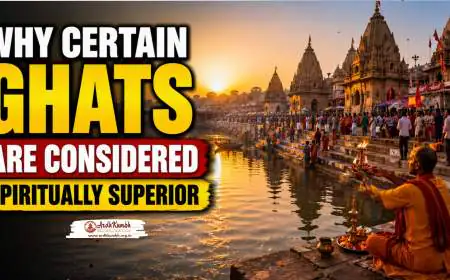

















































Why Certain Ghats Are Considered Spiritually Superior
Discover why certain ghats are considered spiritually superior at Kumbh Mela. Explore the divine footprints, celestial alignments, accumulated devotion, and eternal flames that make some riverbanks more potent than others.
The Divine Footprint and the Power of Origin Stories 🦶
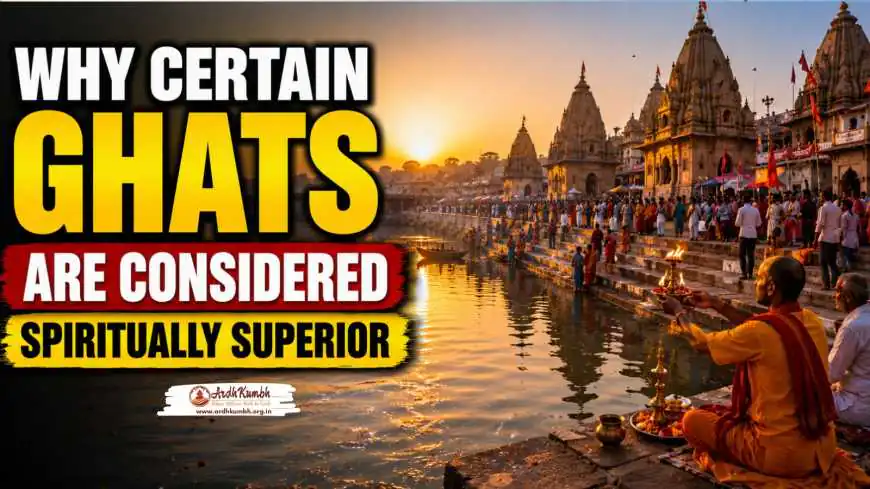
The most immediate and universally understood reason certain ghats are spiritually superior rests on their origin story, specifically the belief that a divine being physically touched the earth at that spot. The archetypal example is Har Ki Pauri in Haridwar, whose name itself means "Footsteps of the Lord." At the heart of this ghat is Brahmakund, a precise spot where a stone is believed to bear the actual footprint of Lord Vishnu, left behind during the great cosmic churning, the Samudra Manthan. This is not a metaphor. For the devout, the physical depression in the stone is the literal signature of the divine, making it a place of primal contact. Bathing here is not just about immersing oneself in the Ganga; it is about touching the very point where the preserver of the universe once stood.
This principle of a theophanic origin applies across the sacred landscape. At Nimishamba Ghat on the Godavari in Nashik, the spiritual potency is linked to a legend of Lord Rama performing his father's funeral rites. At Ram Ghat in Ujjain on the Shipra River, the central bathing area is forever linked to the belief that Lord Rama himself performed the Pind Daan there. These origin stories are not just colorful myths. They are the foundational reason for a ghat's spiritual superiority. They identify a place not as a generic sacred space, but as a specific, consecrated point where the narrative of the divine intersected directly with the geography of the earth. A ghat with a divine footprint, a divine act, or a divine presence in its founding story possesses, in the spiritual imagination, a unique and non-replicable sanctity.
The Confluence That Multiplies Grace 🌊
If a single sacred river is a powerful purifying force, then the meeting point of two, or especially three, such rivers is understood to be exponentially more potent. This is the logic behind the supreme spiritual status of the Sangam at Prayagraj, arguably the most spiritually superior ghat in all of India. The visible confluence of the Ganga and Yamuna is already a sacred marvel, but it is the belief in a third, invisible river—the Saraswati, which is said to flow underground and join the other two at this exact point—that creates the Triveni Sangam, a triply powerful spiritual vortex.
The science of tirthas (sacred crossings) holds that the meeting of waters is not just a physical phenomenon but an energetic one. The distinct properties, subtle vibrations, and presiding deities of each river collide and combine, creating a unique spiritual field that is not merely the sum of its parts but their multiplication. The brown, sediment-rich waters of the Ganga, the clear, greenish-blue waters of the Yamuna, and the unseen, mythic current of the Saraswati are seen as representing the three great channels of the subtle body—Ida, Pingala, and Sushumna. To bathe at the Sangam is to immerse oneself in a macrocosmic representation of perfect internal spiritual alignment. This is why, even within the vast Kumbh Mela grounds, the most desirable, dangerous, and spiritually charged snan is always at the exact point of the confluence, a spot that a thousand other perfectly good ghats along the same riverbank cannot replicate. The confluence is spiritually superior because it is where divine rivers, and thus divine energies, meet and mingle.
Trending Guides Now

Why Only Certain Ghats Are Chosen for Kumbh Snan
Read Guide →
Haridwar Ghats Guide: Har Ki Pauri & Sacred Spots
Read Guide →
Why Har Ki Pauri Becomes the Heart of Ardh Kumbh
Read Guide →
Best Routes to Reach Haridwar for Ardh Kumbh Mela
Read Guide →
Ardh Kumbh 2027 Dates (Official) - Haridwar Snan Schedule
Read Guide →
How Kumbh Keeps India’s Civilizational Memory Alive
Read Guide →
Why Yagya Fires Burn Throughout Kumbh
Read Guide →
Essential Rules Every Ardh Kumbh 2027 Pilgrim Must Follow
Read Guide →Death and Liberation: The Ghats That Promise Moksha 🔱
The ultimate spiritual goal in the Indic traditions is moksha, liberation from the cycle of birth and death. Certain ghats are considered spiritually superior because they offer not just purification of sins, but a direct path to this final release, particularly at the moment of death or through post-death rituals. These are the great burning ghats, the Moksha Dayini ghats, where a good death or the proper offering of ashes can break the karmic chain forever.
The supreme example is Manikarnika Ghat in Varanasi, a site that is ancient and operates independently of the Kumbh cycle but whose logic illuminates the hierarchy of all ghats. The legend holds that this is the spot where Lord Vishnu dug a great pit with his discus to create a sacred fire for Lord Shiva, a fire that has been burning there, without cessation, for thousands of years. To die at Manikarnika, or to have one's body cremated there, is to receive the Taraka mantra—the boatman's mantra of crossing over—directly from Lord Shiva himself, a guarantee of liberation. The ghat is not just a riverbank; it is a portal to the afterlife, a place where the physical element of fire and the spiritual water of the Ganga combine to consume the last karmic debts.
Other ghats, like the main bathing ghats at the Sangam during the Kumbh, are considered spiritually superior for the ritual of asthi visarjan, the immersion of a deceased loved one's ashes. The logic is the same: a spiritually superior ghat, charged with divine presence, astrological timing, and accumulated devotion, is a more effective launchpad for the soul's final journey. The offering made at such a ghat carries a far greater spiritual weight, accelerating the deceased's path to liberation in a way that an offering in a less potent location cannot.
The Energy of Unbroken Ritual and the Eternal Flame 🔥
Spiritual superiority is not just a function of a founding legend; it is also a continuous, living reality sustained by human action. Some ghats are considered superior because they are the focal points of akhanda (unbroken) ritual practice. A ghat where the Ganga Aarti has been performed every single evening for centuries, without a single lapse, accumulates a different quality of energy than a ghat where rituals are sporadic. The ghat becomes not just a physical structure but a living entity, kept awake and spiritually vibrant by the continuous, rhythmic offering of light, sound, and intention.
The most powerful example is the presence of an eternal dhuni, a sacred fire that has been burning for centuries. The akhara camps at the Kumbh will often establish their temporary headquarters next to a specific ghat, and the dhuni they light is not a new flame. It is a fresh kindling from an original fire that may have been burning for three hundred years at the akhara's home monastery. A ghat that hosts such a fire, even temporarily, becomes spiritually superior. The fire of a dhuni is not just for warmth; it is a deity, a witness, and a powerful purifier of the subtle atmosphere. The ghats where these fires are established, where ghee and samagri are offered into them with precise Vedic mantras, become temporary powerhouses. The continuous offering of the yagya, performed by sadhus whose entire lives are dedicated to this practice, creates a spiritual "pressure" that a quiet, unadorned ghat lacks. It is the difference between a plain wire and one that is connected to a live, humming power source.
Astrological Alignment and the Science of Muhurta ⏳
The spiritual geography of India is intimately connected to the sky. Certain ghats are considered spiritually superior because they are aligned with specific celestial events that magnify their inherent power at particular moments. The entire Kumbh Mela is a testament to this principle: the ghats of Prayagraj are sacred all the time, but they become spiritually colossal when Jupiter enters Aquarius and the Sun enters Aries. The ghat is the fixed receiver, and the planetary alignment is the cosmic broadcast. The two must meet for the maximum spiritual signal to be received.
This astrological science, called Muhurta, is the precise calculation of auspicious moments. A spiritually superior ghat is like a perfectly tuned instrument that is played at the exact moment the cosmic conductor raises his baton. At the Brahmakund in Haridwar, for instance, the inherent sanctity of Vishnu's footprint is amplified infinitely during the Kumbh's specific astrological window. The footprint is the hardware, and the planetary alignment is the software update that unlocks its highest function. This is why pilgrims will travel thousands of miles to take their snan at a particular ghat on a specific day. They know that bathing at a spiritually superior ghat on an ordinary day is powerful, but bathing at that same ghat on the astrologically mandated shahi snan day is an act of total spiritual alignment, one that can alter the trajectory of a soul.
The Accumulated Devotion of Centuries 🧘
Perhaps the most tangible reason certain ghats feel spiritually superior is the simplest and most profound: they have absorbed the devotion of millions of souls over centuries. Every tear of repentance that has fallen on those stones, every joyous cry of liberation, every whispered, desperate prayer, and every silent, profound moment of gratitude has left an energetic residue. A new marble ghat might be physically beautiful, but it feels spiritually empty. An ancient, uneven, worn-smooth stone ghat feels alive because it is saturated with samskaras, the subtle impressions of countless spiritual acts.
This is a recognized principle in the science of sacred space. The stone itself becomes charged. When you sit at a ghat where saints are known to have meditated, where Adi Shankaracharya or Chaitanya Mahaprabhu is said to have bathed, you are not sitting on inert minerals. You are sitting in a field of heightened spiritual receptivity that has been cultivated and reinforced by generations of the holiest beings. This is why pilgrims will often touch the steps of a ghat to their forehead before bathing. They are not just honoring a stone; they are making a physical connection to a lineage of devotion. This accumulated devotional energy is what makes some ghats feel different the moment you approach them—a palpable sense of peace, power, and presence that cannot be faked or manufactured. It is a sacred inheritance, passed down not through deeds or titles, but through the silent, loving, repeated touch of human hands and human hearts.
How to Approach a Spiritually Superior Ghat 🙏
The very power of a spiritually superior ghat demands a correspondingly conscious approach. To rush in, take a quick dip, and rush out is to stand before a roaring fire and complain that you didn't feel any heat. The external form of the ghat is just the doorway; your inner preparation is the key that unlocks it. Before approaching such a ghat, a pilgrim is meant to quiet the mind. A period of silence, or mauna, even if brief, allows you to become aware of the subtle atmosphere. Formulating a clear sankalpa, a sacred intention, focuses the ghat's diffuse power into a laser-like beam directed at your spiritual need.
The ritual of the snan itself is a form of worship. Many pilgrims will first bow to the river, seeking permission, and may even circumambulate the most sacred spot before entering. The act of immersion at a superior ghat is not a physical cleaning but a conscious act of receiving. You are not just washing your body; you are opening the vessel of your being to be filled by the divine grace that is uniquely accessible at that crossing point. The moments after the snan are equally crucial. Lingering at the ghat, sitting in silence, allowing the absorbed energy to integrate, and offering a simple prayer of gratitude completes the sacred circuit. To treat a spiritually superior ghat with the same casualness as any other place is to miss its entire purpose. It is a holy of holies, and it responds to the quality of your devotion, humility, and presence.
The Ghat That Chooses You
In the vast, chaotic, and profoundly democratic spiritual landscape of a Kumbh Mela, there is a beautiful mystery at play. While the most famous, spiritually superior ghats pull the largest crowds, it is often a quieter, less storied ghat that works its magic on a pilgrim's heart. The old pandas will tell you that your ghat has chosen you, not the other way around. The place where you find yourself sitting in an unexpected moment of silence, where your tears fall without reason, where a stranger's blessing cuts through your defenses—that is, for you, the most spiritually superior place on earth.
The hierarchy of ghats is real, mapped by legend, stars, and the accumulated devotion of millennia. But this hierarchy is a guide, not a prison. The ultimate spiritual superiority of a ghat is revealed in a private, inner alchemy. The ghat that was good for your father might leave you cold. The famous Brahmakund might feel overwhelming, while a nameless set of steps a mile downstream opens a door inside you that you never knew was locked. The pilgrimage is a conversation between the individual soul and the sacred geography. The river flows equally at all ghats. The grace is everywhere. The spiritually superior ghat, in the end, is the one where you are finally able to receive it.
Frequently Asked Questions