










































































How Ardh Kumbh Survived Thousands of Years
Discover how Ardh Kumbh survived thousands of years through akhara lineages, unbroken oral traditions, genealogical records, and an astrological calendar that kept the ancient pilgrimage alive against all odds.

The Akhara System: The Institutional Backbone That Withstood Centuries 🔱
The single most important reason the Ardh Kumbh survived millennia is the akhara system. The akharas are not just gatherings of sadhus. They are decentralized, self-governing monastic orders that have functioned as the custodians of the Kumbh tradition since at least the time of Adi Shankaracharya in the eighth century. Their organizational structure was designed, whether by accident or by genius, to withstand exactly the kind of pressures that destroy most human institutions.
The decentralization is crucial. There is no single akhara that controls all the others. There is no pope of the Kumbh whose death or defection would throw the system into chaos. The Dashanami orders—Juna, Niranjani, Mahanirvani, and the others—operate as independent spiritual republics, each with its own leadership, its own internal succession process, and its own physical and economic resources. If one akhara is weakened or suppressed, the others continue. This distributed structure meant that no political power, however hostile, could decapitate the Kumbh by targeting a single leader or a single organization.
The akhara warrior tradition also played a direct role in physical survival. During the periods of Islamic rule and later under the British, armed naga sadhus defended pilgrimage routes and sacred sites. Their martial training was not a contradiction of their spiritual calling but an extension of it. They understood that the freedom to bathe at the Sangam, to chant the Vedas openly, to maintain the dhuni fires, sometimes had to be protected with more than prayers. The akharas ensured that the Kumbh had its own defenders, answerable to no outside authority.
The akhara camps at Kumbh are not temporary shelters but mobile monasteries. The akharas carry their entire institutional memory—their lineage records, their ritual manuals, their sacred fires—to the Mela and back. This mobility allowed the tradition to survive even when the physical infrastructure of temples and ashrams was destroyed. The Kumbh could be held on an open floodplain, with no permanent buildings, because the akharas themselves were the infrastructure.
Trending Guides Now

Who Are Naga Sadhus and Why They Lead Kumbh
Read Guide →
Biggest Crowds Ever Recorded at Ardh Kumbh
Read Guide →
Why Haridwar Is Spiritually Central to Ardh Kumbh
Read Guide →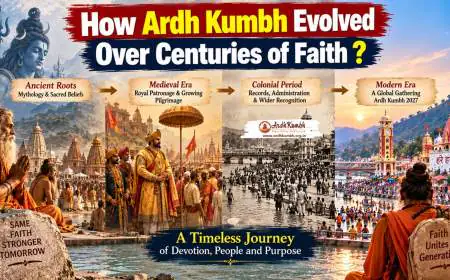
How Ardh Kumbh Evolved Over Centuries of Faith ?
Read Guide →
Ardh Kumbh 2027 Dates (Official) - Haridwar Snan Schedule
Read Guide →
Dharamshala Stay During Ardh Kumbh: Free & Budget Guide
Read Guide →
Official Progress Report of Haridwar Ardh Kumbh 2027 Infrastructure Projects
Read Guide →
Where to Find 24-Hour Pharmacies in Haridwar During Ardh Kumbh 2027 Emergencies
Read Guide →The Pandas and Their Vahis: The Genealogical Glue That Bound Families to the River 📜
If the akharas provided the organizational backbone, the pandas and their vahis provided the social glue that kept millions of ordinary families connected to the Ardh Kumbh across generations. This system of hereditary priesthood and genealogical record-keeping is one of the most extraordinary and underappreciated reasons for the Kumbh's longevity.
When a pilgrim family visits the Kumbh, they are traditionally received by the panda whose family has served their family for centuries. The panda opens a handwritten ledger—the vahi—and finds the names of the pilgrim's ancestors, recorded in faded ink, sometimes going back ten or fifteen generations. The current visit is added to the page. The connection is renewed. This is not a mere transaction. It is a ritual of continuity that transforms an individual pilgrimage into a multigenerational commitment.
The psychological power of the vahi is immense. When a person sees their great-great-grandfather's name written in a book that has been kept at the Sangam for two hundred years, the Kumbh ceases to be an optional religious event. It becomes a family responsibility, an inheritance to be honored and passed on. Even during periods when pilgrimage was dangerous or difficult, the pull of the vahi brought people back. The pandas and their records created a self-renewing cycle of return that no external disruption could fully break.
The pandas also served as information networks. They knew which families were coming, which routes were safe, which local rulers were hostile or welcoming. They maintained relationships with pilgrim communities across the subcontinent, functioning as a distributed communication system long before modern postal services or telecommunications. When the Kumbh was suppressed or restricted in one location, the pandas could redirect pilgrims to alternative gathering points or advise them on safer times to travel.
Oral Transmission: The Knowledge That No Book Could Burn 🕉️
A library can be burned. A text can be lost. But a mantra carried in the memory of a thousand sadhus, taught from guru to disciple in an unbroken chain, is almost impossible to destroy. The oral transmission of sacred knowledge is one of the deepest reasons the Ardh Kumbh survived across millennia, and it is a technology of preservation that the modern world, with its dependence on external storage, struggles to understand.
The Vedic mantras chanted at the Sangam today are chanted with the same intonation, the same rhythm, and the same precise pronunciation as they were three thousand years ago. This is not an exaggeration. The oral tradition of Vedic recitation includes elaborate error-correction mechanisms—multiple recitation patterns, cross-checking between students, and the requirement that every mantra be learned from a living teacher, not from a written page. The result is a fidelity of transmission that no written text can match. The Kumbh tradition carries within its soundscape the authentic voice of the ancient rishis.
The yogic and tantric knowledge preserved within the akharas is also primarily oral. The specific practices of hatha yoga, the techniques of meditation, the use of mantra and mandala—these are taught directly from guru to disciple, often under conditions of strict secrecy. Much of this knowledge has never been written down, which means it could never be seized, censored, or misinterpreted by hostile outsiders. During periods of persecution, when written scriptures were targeted, the oral knowledge survived in the minds of the sadhus and was transmitted quietly, patiently, until the external pressure passed.
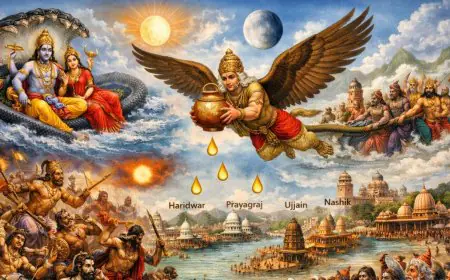
The storytelling tradition at the Kumbh is also an oral archive. The myths of the Samudra Manthan, the tales of the founding saints of the akharas, the local legends of the sacred rivers—these are told and retold at the Mela, not from books but from memory, in the voices of the pandas, the sadhus, and the elderly pilgrims who have heard them since childhood. This living narrative tradition ensures that the Kumbh is not just an event but a story, and stories are harder to kill than institutions.
The Astrological Calendar: Why No King Could Cancel the Kumbh ⏳
The timing of the Ardh Kumbh is not set by human authority. It is set by the movement of planets—specifically, the transit of Jupiter into Aquarius and the Sun's entry into Aries. This astrological determination has profound implications for the survival of the gathering. No king, no invader, no colonial administrator, and no modern government could decree that the Kumbh was canceled. The stars would still move. The auspicious moment would still arrive. And the pilgrims would still come.
This cosmic independence gave the Kumbh a resilience that festivals tied to a specific ruler's birthday or a historical event could never possess. A political power might ban the gathering, might station soldiers at the ghats, might punish those who attended. But it could not remove the reason for the gathering, which was written in the sky. Pilgrims who were prevented from attending in one cycle would wait, would remember, and would return in the next cycle, when the planets once again aligned and the sacred time returned.
The astronomical knowledge required to calculate the Kumbh dates was itself preserved through the same decentralized networks that preserved everything else. There was no central observatory that could be destroyed. The calculations were maintained by multiple lineages of astronomers and priests, working independently, cross-checking each other, and transmitting their knowledge orally and through practice. When the Kumbh was suppressed in one region, the knowledge of when it should next occur survived in another.
The calendrical rhythm also created a regular, predictable cycle of renewal. Every six years, the faithful knew that the sacred period would return. This cyclical pattern embedded the Kumbh into the cultural DNA in a way that a linear, one-time event could never achieve. The cycle itself became a teacher—a reminder that endings are not final, that what is suppressed in one era can flourish in the next, that the human spirit, like the planets, moves in patterns of return.
Sacred Geography: The Rivers That Could Not Be Conquered 🌊
The Ardh Kumbh survived because its central shrine—the Sangam, the confluence of the Ganga, Yamuna, and the invisible Saraswati—could not be captured, destroyed, or desecrated. A temple can be demolished. An idol can be shattered. But a river, especially a river of the Ganga's scale and significance, can only flow. The sacred geography of the Kumbh was, in a literal sense, unconquerable.
This does not mean the ghats were never contested. They were. Foreign rulers and hostile administrations periodically tried to restrict access, to impose taxes, to station soldiers at the bathing places. But the river itself remained. The belief in its purifying power remained. And as long as pilgrims could reach the water, even if they had to walk further, even if they had to come in smaller numbers and at greater risk, the essential ritual could be performed. The Kumbh could be diminished but not destroyed.
The fourfold rotation of the Kumbh among Prayagraj, Haridwar, Ujjain, and Nashik was itself a survival mechanism. If one site became too dangerous—because of war, because of political repression, because of natural disaster—the others remained accessible. The sacred geography was distributed across the subcontinent, ensuring that the suppression of the gathering in one place did not end the tradition entirely. Pilgrims could redirect their journeys. The Kumbh could shift its center of gravity.
Adaptability: How the Kumbh Changed Without Losing Its Soul 🔄
The Ardh Kumbh has survived for thousands of years not because it remained frozen in time but because it adapted, constantly and often imperceptibly, to changing circumstances. The Kumbh that Hiuen Tsang witnessed in the seventh century was not identical to the Kumbh of today, and yet it was recognizably the same gathering. This combination of deep continuity and surface flexibility is the hallmark of living traditions everywhere.
The incorporation of new technologies is a visible example. The Kumbh of the ancient world was organized through personal networks and oral communication. The Kumbh of the colonial period incorporated the printing press, the railway, and the telegraph. The Kumbh of today uses satellite imaging, mobile apps, and social media. None of these technologies changed the core ritual. They simply made it more accessible. The tradition absorbed them without being absorbed by them.
The akharas themselves are products of adaptation. The original Dashanami orders were created by Adi Shankaracharya in a specific historical context—the need to organize and protect Hindu monasticism at a time when Buddhism was ascendant and Vedic traditions were fragmented. The akharas evolved again during the Mughal period, developing their martial dimension in response to new threats. They are evolving again today, navigating the challenges of modernity, declining recruitment, and changing public perceptions. The form changes. The essence continues.
The Ardh Kumbh also adapted to the democratization of pilgrimage. In the ancient past, long-distance pilgrimage was the privilege of the wealthy and the determined. The development of roads, railways, and affordable transport opened the Kumbh to the masses. The tradition did not resist this expansion. It embraced it. The scale of the gathering grew exponentially, and the organizational structures grew with it. The Kumbh proved that a spiritual tradition could be both ancient and modern, both exclusive in its deepest teachings and radically inclusive in its public rituals.
The Ordinary Pilgrim: The Silent Force That Kept the Tradition Alive 🙏
For all the importance of the akharas, the pandas, and the sacred geography, the deepest reason the Ardh Kumbh survived is the simplest one: ordinary people kept coming. Farmers and merchants, weavers and carpenters, widows and widowers, the young and the old—millions of people whose names appear in no chronicle walked incredible distances, often at great risk and expense, to bathe in the sacred rivers. They came during times of peace and times of war. They came when the ruling powers welcomed them and when the ruling powers tried to stop them. They came because their parents had come and because they wanted their children to come after them.
This grassroots faith is the ultimate engine of the Kumbh's survival. It cannot be decreed from above. It cannot be manufactured by a religious institution. It arises from the deepest layers of Indian culture—from the stories told in childhood, from the rituals observed in the home, from the unshakable conviction that the Ganga's water is not ordinary water and that bathing in it at the astrologically determined moment is one of the most meaningful acts a human being can perform. This faith has been dismissed as superstition by its critics, but its historical resilience suggests that it answers a need that rationalist critiques cannot touch.
The collective memory of ordinary pilgrims is also a form of preservation. When the texts were burned and the temples were destroyed, the stories survived in the minds of the people. The route to the Sangam was remembered by those who had walked it. The mantras were remembered by those who had heard them. The sacred dates were remembered by those who had observed them. The Kumbh lived in the people before it lived in the institutions, and it was from the people that the institutions were continually renewed.
The River That Remembers When Everything Else Forgets
The Ganga does not know that empires have risen and fallen along her banks. She does not know that the language of the pilgrims has changed from Prakrit to Hindi, that the boats on her waters have changed from wooden oars to motorized ferries, that the city on her shore has changed from a sacred town to a sprawling temporary metropolis. She flows as she has always flowed, from Gaumukh to the sea, carrying the prayers of the dead and the hopes of the living, receiving every offering with the same silent, complete, and unconditional embrace.
The Ardh Kumbh survived for thousands of years because it is ultimately a relationship between this river and the people who love her. The akharas, the pandas, the oral traditions, the astrological calendar, the sacred geography—all of these are the containers that hold and protect this relationship. But the relationship itself is older than any container. It predates the akharas. It predates the Kumbh. It is the primordial human response to the mystery of water that cleanses not only the body but something deeper, something that no scientific analysis of H2O can capture.
When a pilgrim stands at the Sangam before dawn, shivering in the February cold, cupping the sacred water in their hands and offering it back to the rising sun, they are participating in a chain of identical gestures that stretches back beyond the reach of history. The same cold water. The same mantras. The same faith that this act matters, that it connects the individual to something larger than the self, that it cleanses not just the skin but the soul. The Ardh Kumbh has survived because this experience is real, because it transforms those who undergo it, and because those who have been transformed will always find a way to return—and to bring their children with them.
The river will continue to flow. The planets will continue to move. And when the astrological moment arrives again, as it has arrived every six years for millennia, the pilgrims will come. The tents will rise. The dhuni fires will be lit. The mantras will fill the air. And the ancient, undying, unbreakable gathering will resume, as it has always resumed, a living testimony to the truth that some things are too deep, too real, and too beloved to ever be lost.
Frequently Asked Questions