











































































Complete Haridwar Ardh Kumbh 2027 Travel Budget for Students and Young Travelers
Complete Haridwar Ardh Kumbh 2027 travel budget for students and young travelers. Dharamshala rates, ₹100 thalis, train fares, e-rickshaw costs and money-saving tips.

Complete Haridwar Ardh Kumbh 2027 Travel Budget for Students and Young Travelers
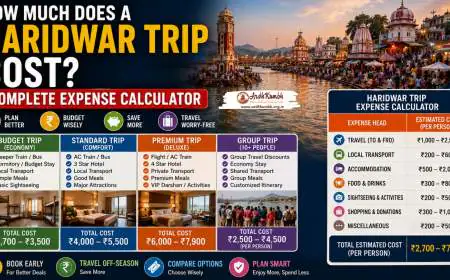
Quick Answer ⚡ A student or young traveler can complete a three-night, four-day Haridwar Ardh Kumbh 2027 trip on a realistic budget of ₹4,500–₹8,000 per person (excluding travel to Haridwar), or ₹1,500–₹2,700 per day on the ground. The biggest cost lever is accommodation: dharamshalas start at ₹100–₹300 per night for a basic room , hostel dorm beds run ₹350–₹500 ($4–6) , and budget tents start at ₹800–₹1,500 per night . Food is remarkably cheap: unlimited Gujarati thalis at ₹130–₹150, student thalis at ₹120, and basic thalis at ₹100 are widely available . Local transport costs ₹10–₹20 per e-rickshaw hop if you insist on the metered rate . Train travel from Delhi to Haridwar in sleeper class costs roughly ₹185 . The total depends on whether you sleep in a dorm, a dharamshala room, or a tent — and whether you eat at thali joints or cafes .
At a Glance 🔎 Three Budget Tiers for Kumbh 2027
| Expense Category | Ultra-Budget (₹) | Balanced (₹) | Comfort (₹) |
|---|---|---|---|
| Accommodation (per night) | ₹100–₹300 (dharamshala, shared) | ₹350–₹800 (hostel dorm or budget room) | ₹800–₹1,500 (budget tent or private budget hotel) |
| Food (per day) | ₹150–₹250 (thalis, street food) | ₹250–₹450 (thalis + one cafe meal) | ₹450–₹700 (restaurant meals) |
| Local transport (per day) | ₹40–₹80 (shared e-rickshaw, walking) | ₹80–₹150 (e-rickshaw hops) | ₹150–₹250 (autos, occasional taxi) |
| Entry fees / donations | ₹0–₹50 | ₹50–₹150 | ₹150–₹300 |
| Miscellaneous | ₹50–₹100 | ₹100–₹200 | ₹200–₹400 |
| Daily total (on ground) | ₹340–₹780 | ₹780–₹1,750 | ₹1,750–₹3,150 |
| 3-night, 4-day total | ₹1,360–₹3,120 | ₹3,120–₹7,000 | ₹7,000–₹12,600 |
Local Insight 📍 The single biggest mistake young travelers make is booking a “Kumbh package” before checking dharamshala and hostel rates directly. During non-Shahi Snan periods, Haridwar’s dharamshalas and ashrams offer clean, basic rooms at ₹200–₹400 that undercut every online package . The trade-off is no online booking and simple amenities — but for students, that is a fair exchange.
Accommodation: The Biggest Line Item and How to Cut It
Accommodation will consume 30–50% of your budget. The type you choose determines whether your trip costs ₹1,500 or ₹8,000.
Dharamshalas: The Cheapest Roof in Haridwar
Dharamshalas are charitable guesthouses run by religious trusts, and they are the backbone of budget pilgrimage in Haridwar.
Trending Guides Now

Ardh Kumbh Budget Guide: Travel, Stay And Food Costs
Read Guide →
Exact Budget Needed for Ardh Kumbh Mela Pilgrims
Read Guide →
Cash, UPI or Cards? Choosing the Best Payment Method in Haridwar
Read Guide →
Seven-Day Haridwar Ardh Kumbh 2027 Trip Budget Planner: Estimated Daily Expenses
Read Guide →
Ardh Kumbh 2027 Dates (Official) - Haridwar Snan Schedule
Read Guide →
Dharamshala Stay During Ardh Kumbh: Free & Budget Guide
Read Guide →
Official Progress Report of Haridwar Ardh Kumbh 2027 Infrastructure Projects
Read Guide →
Where to Find 24-Hour Pharmacies in Haridwar During Ardh Kumbh 2027 Emergencies
Read Guide →| Dharamshala Type | Indicative Rate (Per Night) | What You Get | What You Do Not Get |
|---|---|---|---|
| Basic trust dharamshala | ₹100–₹250 | Simple room, shared or basic attached bathroom, fan | AC, hot water on demand, online booking |
| Mid-tier dharamshala | ₹250–₹500 | Cleaner room, attached bathroom, hot water at fixed hours | Room service, flexible check-in |
| AC dharamshala room | ₹500–₹800 | AC, better furnishings, central location | Hotel-style service |
| Ashram room | ₹400–₹1,000 | Quiet campus, sattvic food nearby, spiritual atmosphere | Late-night entry, modern amenities |
News18’s survey of Haridwar’s cheapest dharamshalas found rooms starting at ₹100, with 4-bed rooms at ₹1,000, and AC rooms from ₹500 . Jaipuria Yatri Niwas is cited with ₹100 rooms . Other dharamshalas near Har Ki Pauri charge ₹200–₹300 per night . Prem Nagar Ashram offers 2-bed non-AC rooms from ₹400 and AC rooms up to ₹1,000 .
Hostels and Dormitories: The Backpacker Option
Haridwar has a small but growing hostel scene. BedHubs, near Ram Ghat and Har Ki Pauri, is the most affordable, with dorm beds from $3.50–$5 (₹300–₹450) . Other hostel listings show dorm beds from $4–$6 (₹350–₹500) . Private rooms in hostels cost $18–$22 (₹1,500–₹1,900) .
Hostel advantages for students: WiFi, lockers, common areas for meeting other travelers, and online booking — which dharamshalas rarely offer.
Budget Tents: The Kumbh-Specific Option
The tent cities at Shyampur, Gandikhata and Chandighat are not the cheapest option, but they are the most “Kumbh” option.
| Tent Category | Capacity | Price Range (Per Night) | Amenities | Best For |
|---|---|---|---|---|
| Standard Tent | 1–2 persons | ₹800–₹1,500 | Basic bedding, common washroom, fan | Solo pilgrims, budget travelers |
| Dormitory Tent | 6–10 persons | ₹2,800 per person (group pricing) | Bunk beds, common toilets | Groups, backpackers |
| Economy / Budget Tent | Shared (4–6 persons) | ₹1,500–₹3,000 | Community washrooms, meals available separately | Groups, students |
| Deluxe Tent | 2–3 persons | ₹1,500–₹3,000 | Proper beds, nearby washroom, fan | Couples, small groups |
Pro Tip 🧭 For students traveling in groups of 4–6, a shared budget tent can work out to ₹250–₹750 per person per night — competitive with hostels, but with more atmosphere. Book only after the vendor empanelment list is public, and confirm whether meals are included.
Food: How to Eat Well on ₹150–₹250 Per Day
Haridwar is a vegetarian food paradise where a full meal costs less than a coffee in most cities.
The Thali Economy
| Eatery / Type | Dish | Indicative Price | Notes |
|---|---|---|---|
| Hotel Raghuvanshi Gujrati Bhojanalay | Unlimited Gujarati thali | ₹130–₹150 | Near railway station; fully satisfying |
| Guru Vaishnav Bhojanalay | Thali (kadhi, dal, sabji, 2 roti, rice) | ₹100 | Moti Bazar Road |
| Amritsari Vaishnav Hotel | Unlimited thali | ₹150 | Budget-friendly and hygienic |
| Gera’s Kitchen (delivery) | Student Thali | ₹120 | Dal, sabji, matar paneer, rice, 4 roti |
| Tiffin 24/7 (delivery) | Basic Thali | ₹130 | Jwalapur |
| Raj Dhaba | Plain Thali | ₹140 | BHEL Township |
| Chotiwala | Thali | ₹150 | Har Ki Pauri Marg; iconic but touristy |
| Kwality Mysore Restaurant | South Indian thali / dosa | ₹50–₹80 | Upper Road |
Breakfast on a Student Budget
-
Bedmi puri or kachori-sabzi at a street stall: ₹30–₹60.
-
Puri-sabzi plate at Sindhi Halwai: ₹80.
-
Chai and rusk at a local stall: ₹10–₹20.
-
Fruit (banana, apple) from a street vendor: ₹20–₹40.
Expert Tip 💡 Eat your main meal at lunch, when thali joints are fresh and cheap, and eat light at night — street food and fruit can keep your evening food cost under ₹80. Carry a refillable water bottle; packaged water costs ₹20 per litre, and RO water is available at many ashrams and hotels.
Local Transport: Beating the E-Rickshaw Overcharge
Haridwar’s e-rickshaws are the default local transport, and overcharging is systematic.
The Official Rate vs. What You Will Be Asked to Pay
-
The official local e-rickshaw fare is approximately ₹10–₹12 per kilometre .
-
The fixed local route fare between Laltara Pull and the railway station is ₹10, but drivers routinely charge ₹20 .
-
Short hops (railway station to Har Ki Pauri) should cost ₹20–₹30, but drivers may ask ₹50 .
-
Cycle-rickshaws charge ₹15 for short distances and ₹50 for longer hauls such as station to Har Ki Pauri .
-
Autos charge ₹35–₹50 per passenger for shared routes .
How to Avoid Overpaying
-
Agree on the fare before boarding — not after.
-
Quote the official rate (“₹10–₹12 per km”) if the driver demands more.
-
Walk the short distances — Har Ki Pauri to Moti Bazar is walkable in 10–15 minutes, and the ghat path is pleasant.
-
Use shared autos for longer hops like station to Kankhal.
-
Carry small notes — drivers rarely have change for ₹500.
Local Insight 📍 During Kumbh 2027, road closures and pedestrian zones will make e-rickshaws both more necessary and more expensive. Build a ₹50–₹100 buffer per day for local transport, and walk whenever the route is safe and short.
Getting to Haridwar: Train, Bus and Shared Travel
Train Fares from Delhi (Sleeper and 3A)
| Class | Indicative Fare (Haridwar–Delhi) | Notes |
|---|---|---|
| Sleeper (SL) | ₹185–₹190 | Cheapest, book early |
| 3A (AC 3-tier) | ₹495–₹515 | Comfortable, popular with students |
| 2A (AC 2-tier) | ₹700–₹720 | More space |
| General (unreserved) | ₹50–₹100 (approximate) | No seat guarantee; avoid for long journeys |
Train booking opens roughly two months ahead; IRCTC bookings for Kumbh dates will fill fast . For students, the sleeper class is perfectly adequate for an overnight journey and keeps the travel cost under ₹400 return.
Bus Options
-
Delhi to Haridwar by UPSRTC or private bus: ₹300–₹600 depending on AC/non-AC.
-
Haridwar to Rishikesh by local bus: ₹73–₹100 (cheapest); shared auto/vikram: ₹20–₹35 . Avoid FlixBus and premium AC buses if you are budget-focused; the local bus is frequent and cheap.
The Complete Budget: Three-Day, Four-Day and Week-Long Scenarios
| Trip Duration | Ultra-Budget | Balanced | Comfort |
|---|---|---|---|
| 2 nights, 3 days | ₹900–₹2,000 | ₹2,200–₹4,800 | ₹4,800–₹8,500 |
| 3 nights, 4 days | ₹1,360–₹3,120 | ₹3,120–₹7,000 | ₹7,000–₹12,600 |
| 5 nights, 6 days | ₹2,000–₹4,500 | ₹4,500–₹10,000 | ₹10,000–₹18,000 |
| 7 nights, 8 days | ₹2,800–₹6,000 | ₹6,000–₹13,500 | ₹13,500–₹24,000 |
Add travel to Haridwar: ₹370–₹1,030 return by sleeper train from Delhi, or ₹600–₹1,200 by bus.
Money-Saving Strategies That Actually Work
Before You Go
-
Book train tickets 60 days in advance — sleeper and 3A fares are cheapest early, and Kumbh dates will sell out.
-
Shortlist 3–4 dharamshalas and call them directly — many do not list online, and a phone call can secure a room.
-
Avoid “Kumbh packages” unless they include confirmed accommodation and meals — DIY is cheaper.
-
Travel in a group of 3–4 — shared rooms, shared autos and shared thalis cut per-person costs by 30–40%.
On the Ground
-
Eat at thali joints, not restaurants — ₹100–₹150 for unlimited food is standard.
-
Drink RO water from ashrams and hotels instead of buying bottled water.
-
Walk the ghat circuit — Har Ki Pauri to Mansa Devi base is walkable, and the ropeway is optional.
-
Use shared autos for station transfers.
-
Avoid Shahi Snan dates if you are purely budget-focused — accommodation prices spike, and the cheapest rooms are booked first.
-
Carry a student ID — some museums and facilities offer concessions, though temple entry is free.
Expert Advice ✨ The cheapest Kumbh trip is not the one with the lowest headline cost. It is the one where you do not overspend on the first day and do not run out of money by the third. Budget ₹1,000 per day as a baseline, track your spending, and keep a ₹1,000 emergency reserve for transport surprises or a room upgrade if the dharamshala does not work out.
A Sample Three-Day Itinerary with Costs
| Day | Activity | Transport Cost | Food Cost | Entry / Misc | Daily Total (Ultra-Budget) |
|---|---|---|---|---|---|
| Day 1 | Arrive, check in, Har Ki Pauri evening Aarti | ₹30 (station to ghat) | ₹180 (thali lunch + street dinner) | ₹0 | ₹210 |
| Day 2 | Morning snan, Mansa Devi (walk up, ropeway down), Chandi Devi | ₹80 (e-rickshaw + ropeway one-way) | ₹200 | ₹50 (ropeway) | ₹330 |
| Day 3 | Kankhal temples, local market, departure | ₹50 | ₹150 | ₹0 | ₹200 |
| Accommodation (3 nights) | Dharamshala @ ₹250/night | — | — | — | ₹750 |
| Total (on ground) | — | ₹160 | ₹530 | ₹50 | ₹1,490 |
Add return train from Delhi (sleeper): ₹370.
Grand total: ₹1,860 for a three-night Kumbh trip — realistic for a disciplined student traveler.
What to Skip and What Not to Skip
Skip If You Are on a Tight Budget
-
Ropeway both ways — walk up Mansa Devi, ropeway down (or vice versa). Saves ₹80–₹165.
-
Restaurant breakfasts — street puri and chai cost one-third.
-
Private autos — shared e-rickshaws are cheaper.
-
AC dharamshala rooms — fan rooms are adequate in January–March.
-
Kumbh merchandise — buy nothing on impulse at the mela stalls.
Do Not Skip
-
The evening Ganga Aarti at Har Ki Pauri — free, and the emotional highlight of the trip.
-
A morning snan at a designated ghat — the core ritual, free.
-
One ropeway ride — the view is worth one splurge.
-
A thali at a heritage shop — ₹100–₹150 for a cultural experience.
-
Travel insurance if you are prone to illness or injury — basic policies are cheap.
Expert Tip 💡 The best money-saving decision is traveling with 2–3 friends. A 4-bed dharamshala room at ₹1,000 splits to ₹250 per person, a shared auto costs ₹10–₹15 per head, and a group thali order often gets free refills. Solo travel is cheaper emotionally; group travel is cheaper financially.
Final Budget Checklist for Students and Young Travelers
-
Book train tickets 60 days ahead — sleeper class is ₹185 from Delhi.
-
Call 3–4 dharamshalas directly — ₹100–₹400 rooms exist .
-
Carry a student ID — useful for concessions and identification.
-
Budget ₹1,000 per day on the ground — adjust up for tents, down for dharamshalas.
-
Eat thalis for lunch — ₹100–₹150 unlimited.
-
Drink RO water, not bottled — save ₹40–₹60 per day.
-
Walk short distances, share autos for long ones.
-
Avoid Shahi Snan dates if budget is the priority — prices spike and rooms vanish.
-
Keep ₹1,000 emergency reserve — for transport or a room upgrade.
-
Do not book a “package” without comparing DIY costs — the savings can be 50% or more.
Expert Advice ✨ The Haridwar Ardh Kumbh 2027 is one of the cheapest major pilgrimages in India for students and young travelers. A dharamshala bed, a ₹130 thali, a shared e-rickshaw and a free ghat snan cost less than a day in a metro city. The discipline is in the planning, not in the sacrifice.
Frequently Asked Questions