




















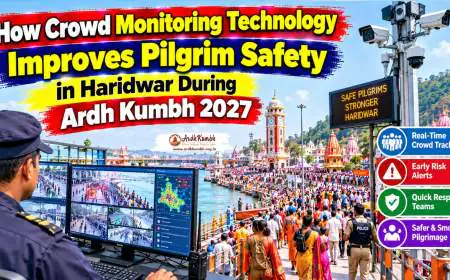

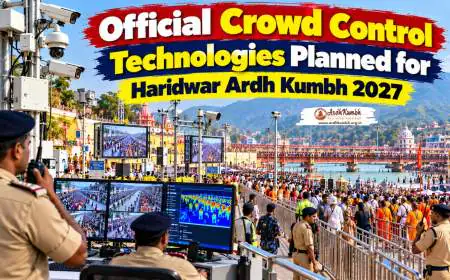


















































How Crowd Monitoring Technology Improves Pilgrim Safety in Haridwar During Ardh Kumbh 2027
Discover how AI crowd monitoring technology protects pilgrims in Haridwar during Ardh Kumbh 2027. 27,500 cameras, drones, IoT sensors and real-time alerts explained.

How Crowd Monitoring Technology Improves Pilgrim Safety in Haridwar During Ardh Kumbh 2027
Quick Answer ⚡
Crowd monitoring technology improves pilgrim safety in Haridwar during Ardh Kumbh 2027 by combining 27,500 AI-enabled CCTV cameras, dual Command and Control Centres (CCR and CCR-2), drone surveillance, IoT sensors and facial recognition into a single real-time safety ecosystem. The system detects dangerous crowd density before it becomes critical, generates automated alerts to police and medical teams, helps reunite lost pilgrims with their families through digital lost-and-found portals, and enables faster emergency response through a ₹50.27 crore command centre with a rooftop helipad. For pilgrims, this means earlier warnings at crowded ghats, faster medical help on Amrit Snan days, and a digital safety net that did not exist at previous Kumbh gatherings.
At a Glance 🔎
| Technology Component | Scale or Feature | Pilgrim Safety Benefit |
|---|---|---|
| AI-enabled CCTV network | 27,500 cameras across the Mela area | Real-time crowd density analysis and unusual activity detection |
| Integrated Command Centre (CCR-2) | ₹50.27 crore facility near Har Ki Pauri | Centralised monitoring of security, health and traffic |
| Rooftop helipad on CCR-2 | Emergency helicopter deployment | Faster medical evacuation during critical incidents |
| Drone surveillance | Aerial monitoring of ghats and approach roads | Wide-area crowd flow visibility where cameras cannot reach |
| Facial recognition systems | CNN-based matching for missing persons | Faster reunification of lost children and elderly pilgrims |
| IoT-enabled sensors | Traffic and crowd movement monitoring | Predictive alerts before congestion becomes dangerous |
| Digital Khoya Paya Kendra | AI-powered lost-and-found registration | Cross-database tracking of missing persons and items |
| Cyber police station | Dedicated cybercrime response unit | Protection against digital fraud and misinformation |
The Evolution from Manual Crowd Control to AI-Powered Surveillance
The crowd monitoring technology Haridwar Ardh Kumbh 2027 represents a quantum leap from earlier Kumbh gatherings. Before 2010, crowd management relied almost entirely on manual supervision, basic CCTV coverage and radio communication. The 2010–2016 period saw initial digital monitoring and expanded camera networks. By 2027, the system integrates artificial intelligence, IoT sensors, drone surveillance and advanced command centres into a unified security ecosystem.
This shift matters because manual crowd control has inherent limits. Human observers can only watch so many points at once. They cannot calculate density per square metre in real time. They cannot predict where a surge will build. AI crowd density alerts Haridwar systems can do all three — continuously, across the entire Mela area, without fatigue.
Expert Tip 💡: The scale of 27,500 CCTV cameras is unprecedented for an Ardh Kumbh. For context, this is a larger camera network than many mid-sized cities deploy for routine urban surveillance. It reflects lessons learned from previous Kumbh gatherings and the integration of cutting-edge technology into public safety infrastructure.
Trending Guides Now

Ardh Kumbh Crowd Management & Facilities Guide
Read Guide →
How Crowd Discipline Is Planned for Ardh Kumbh 2027
Read Guide →
Official Parking Map for Cars, Buses and Bikes at Ardh Kumbh 2027
Read Guide →
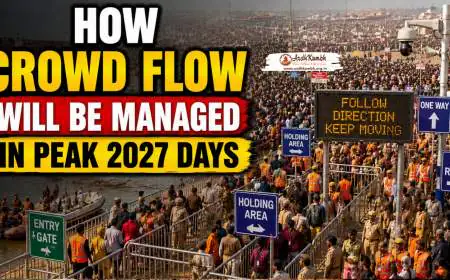
How Crowd Diversion Routes Work During Peak Ardh Kumbh 2027 Days
Read Guide →
Ardh Kumbh 2027 Dates (Official) - Haridwar Snan Schedule
Read Guide →
Dharamshala Stay During Ardh Kumbh: Free & Budget Guide
Read Guide →
Official Progress Report of Haridwar Ardh Kumbh 2027 Infrastructure Projects
Read Guide →
Where to Find 24-Hour Pharmacies in Haridwar During Ardh Kumbh 2027 Emergencies
Read Guide →The Integrated Command and Control Centres: The Brain of Kumbh Security
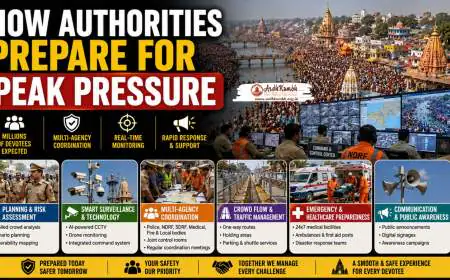
The Integrated Command Control Centre CCR-2 Haridwar is the nerve centre of the entire safety operation. Two facilities work in tandem.
CCR: The Existing Control Centre
The existing Command and Control Centre (CCR) in the Mela Control Building has been upgraded with modern technology for 2027. It continues to serve as the operational hub for daily monitoring and coordination.
CCR-2: The New High-Tech Facility
The new CCR-2 is a ₹50.27 crore facility located near Har Ki Pauri. It serves as an integrated command centre for security, health services and traffic management. Key features include:
-
Real-time monitoring of the entire Mela area from a single location.
-
Rooftop helipad for emergency helicopter deployment and medical evacuation.
-
AI-based crowd management and IoT-enabled monitoring systems.
-
Replacement of the existing control system with a more advanced platform.
The facility is designed to enable quick helicopter deployment during emergencies and rescue operations, while allowing VIPs to land without disrupting pilgrim movement.
Local Insight 📍: The helipad on CCR-2 is not a luxury feature. In a crowd emergency at Har Ki Pauri, road access can become impossible within minutes. A rooftop helipad gives authorities an evacuation route that does not depend on clearing crowded streets.
The 27,500-Camera AI Surveillance Network
The 27500 CCTV cameras Haridwar Kumbh network is the backbone of the safety system. These are not ordinary cameras. They are AI-enabled surveillance devices capable of video analytics, crowd density estimation and unusual activity detection.
What the Cameras Do
-
Crowd density analysis: Cameras calculate how many people are in a given area and compare it against safe capacity thresholds.
-
Unusual activity detection: AI flags behaviour patterns that suggest a problem — a sudden stop in crowd movement, someone falling, or a surge in one direction.
-
Real-time alerts: When thresholds are crossed, automated alerts are sent to the control room and field officers.
-
Video recording and storage: All footage is stored for investigation and review.
Where the Cameras Are Deployed
-
Major ghats, including Har Ki Pauri and Brahma Kund.
-
Approach roads and walking corridors.
-
Railway stations between LDR–HW and HW–RKSH, covered under a separate ₹29.13 crore e-surveillance order that includes IP-based CCTV cameras, video analytics and face recognition systems.
-
Holding areas and parking zones.
-
Key intersections and transit points.
Pro Tip 🧭: The camera network is most effective in open, well-lit areas. In narrow lanes where cameras cannot see everything, the system relies on drone surveillance and field officers. Pilgrims should still treat crowded side lanes with caution, regardless of how much technology is overhead.
Drone Surveillance and Aerial Monitoring
Drone surveillance Kumbh 2027 adds a dimension that ground-based cameras cannot provide: a bird’s-eye view of crowd flow across the entire Mela area. Drones are integrated into the control room network and provide real-time aerial imagery to decision-makers.
What Drones Monitor
-
Crowd flow patterns across ghats and approach roads.
-
Bottlenecks where crowds are slowing or stopping.
-
Route conditions for emergency vehicles.
-
Drone-based mapping of the entire Kumbh area with GPS-based coordinates.
Thermal Imaging and Night Monitoring
Some drone systems are expected to carry thermal imaging capabilities, allowing monitoring even in low light or after sunset. This is particularly valuable during evening aarti when crowds peak and visibility on the ground becomes difficult.
Limitations Pilgrims Should Understand
Drones are not everywhere at all times. They are deployed strategically based on crowd predictions and real-time needs. They supplement, rather than replace, ground-level monitoring.
Expert Advice ✨: If you are in a crowd and see a drone overhead, it is a sign that the area is being actively monitored. This should give you confidence — but it does not remove your personal responsibility to follow crowd instructions and keep your family together.
AI-Powered Crowd Density Analysis and Alert Systems
The AI crowd density alerts Haridwar system is where technology translates directly into pilgrim safety. Here is how it works in practical terms.
How the Alert System Functions
-
Cameras capture crowd images continuously.
-
AI video analytics estimates the number of people per square metre.
-
The system compares the current density against pre-set safety thresholds for that location.
-
When a threshold is crossed, an automated alert is generated.
-
The alert is sent to the control room, police officers and medical teams on the ground.
-
Field teams respond — by opening additional routes, slowing incoming crowds, or deploying medical assistance.
Crowd Heatmaps
AI systems generate crowd heatmaps — visual representations of where density is highest. These heatmaps help authorities see congestion building before it becomes visible on the ground. Crowd heatmap detection Kumbh Mela is particularly valuable at ghats where the physical layout hides the scale of the crowd from individual officers.
Predictive Analytics
Predictive crowd analytics Kumbh systems go one step further. By analysing historical data and real-time movement patterns, they can forecast where congestion is likely to occur next. This allows authorities to act before a problem develops, rather than reacting after it has already formed.
Expert Tip 💡: The value of predictive analytics is highest on Amrit Snan days, when millions of pilgrims move toward the same ghats within a few hours. Early warnings allow route diversions and holding-area management that would be impossible with manual observation alone.
Facial Recognition and Digital Lost and Found
One of the most emotionally significant applications of facial recognition lost persons Kumbh technology is the reunification of separated families.
The Digital Khoya Paya Kendra
The digital lost and found portal Kumbh 2027 transforms the traditional Khoya Paya Kendra into an AI-powered system. Based on the model used at Maha Kumbh 2025, the system uses AI technology to match photos, translate regional dialects, and track missing persons across various databases.
When a pilgrim reports a missing person:
-
The complaint is digitally registered into a central system.
-
A computerised receipt is issued for reference.
-
The information is shared across all centres in real time.
-
AI-powered matching compares photos and descriptions against found persons.
-
LED screens at each centre display live updates about lost and found cases.
The KumbhRakshak Framework
The KumbhRakshak AI policing framework is a proposed system that uses AI-powered cameras and computer vision to monitor crowd density, detect unusual activities, and generate real-time alerts. It includes CNN-based facial recognition to identify missing persons and stores all event data securely in a database.
The system supports:
-
Instant notifications to police and help centres.
-
Safer route suggestions for pilgrims.
-
Predictive analysis for resource allocation.
-
Real-time communication between administrators, police and emergency teams.
Local Insight 📍: For families, the most practical takeaway is this: register your child or elderly parent with a child tracking wristband and a recent photograph at the nearest help centre on the day you arrive. The technology works best when it has data to work with.
IoT-Enabled Traffic and Route Monitoring
IoT sensors crowd management Kumbh systems extend monitoring beyond the ghats to the roads and transit routes that feed them.
What IoT Sensors Monitor
-
Vehicle movement on approach roads and parking areas.
-
Pedestrian flow at key intersections.
-
Environmental conditions that may affect crowd safety.
-
Capacity levels at holding areas and transit points.
How the Data Is Used
When IoT sensors detect rising traffic pressure or pedestrian congestion on a route, the system generates alerts to the control room. Authorities can then:
-
Divert traffic to alternate routes.
-
Open additional holding areas.
-
Deploy additional shuttle buses or e-rickshaws.
-
Inform pilgrims through public announcements and digital displays.
Pro Tip 🧭: If you are travelling by road during the Mela period, check the official Kumbh Mela app for real-time traffic updates. The IoT system feeds data into pilgrim-facing platforms, not just the control room.
Digital ID, E-Pass, and the "Digital Kumbh" Ecosystem
The digital ID e-pass Kumbh 2027 system is part of a broader ₹45 crore “Digital Kumbh” proposal prepared by the Information Technology Development Agency (ITDA). Pilgrims will receive digital IDs that enable their identity, entry and safety to be monitored digitally.
Components of the Digital Kumbh Ecosystem
-
Digital IDs for pilgrims.
-
E-pass facilities for various services.
-
AI chatbot pilgrim assistance Kumbh for answering questions.
-
Digital lost and found portal for real-time tracking.
-
Geospatial mapping of the Mela area.
-
Digital land allocation for departments.
-
Monitoring of cleanliness and tent facilities.
-
Help desk services linked to the digital platform.
The AI Chatbot
The AI chatbot is designed to answer pilgrim questions instantly — about ghat timings, routes, facilities and emergency contacts. It reduces pressure on physical help desks and provides information in multiple languages.
Expert Advice ✨: Download the official Kumbh Mela app before you travel. It will carry real-time updates, missing person alerts, help centre locations and traffic information. The digital ecosystem is only useful if pilgrims actually use it.
Cybersecurity and the Cyber Police Station
A new cyber police station is being established in Haridwar for Kumbh 2027, staffed with specialised IT personnel. This reflects a growing recognition that digital safety is part of pilgrim safety.
Why a Cyber Police Station Matters
-
Digital fraud rises during large gatherings, with fake booking websites, QR code scams and fraudulent donation appeals.
-
Misinformation on social media can cause panic or dangerous crowd movements.
-
Special software is being deployed to counter rumours on social media.
Expert Tip 💡: Never scan unknown QR codes at ghats or markets. Book accommodation and transport only through verified platforms. If you encounter a suspicious message or website related to Kumbh 2027, report it to the cyber police station.
How Pilgrims Can Use These Systems for Safety
The technology is only effective if pilgrims engage with it. Here is a practical checklist.
| Action | Why It Matters |
|---|---|
| Download the official Kumbh Mela app | Real-time alerts, missing person updates, help centre locations |
| Register for a digital ID | Enables faster assistance in emergencies |
| Register children for tracking wristbands | AI systems can match faster when data exists |
| Save helpline numbers offline | Network congestion may slow app access |
| Follow official route instructions | AI alerts trigger diversions for your safety |
| Report missing persons immediately | Digital Khoya Paya Kendra works best with early reporting |
| Use the AI chatbot for routine queries | Saves time and reduces pressure on help desks |
| Report cyber fraud to the cyber police station | Protects other pilgrims from the same scam |
Local Insight 📍: The most common mistake pilgrims make is waiting too long to report a missing person. The digital system can begin matching within minutes of registration. Every minute of delay makes reunification harder.
Final Safety Technology Checklist for Pilgrims
-
✅ Official Kumbh Mela app downloaded and tested.
-
✅ Digital ID registered.
-
✅ Child tracking wristbands obtained on arrival.
-
✅ Recent photographs of all family members saved on phone.
-
✅ Helpline numbers saved offline — Police 112, Women 1091, Child 1098, Ambulance 108.
-
✅ Nearest help centre location identified.
-
✅ Meeting point agreed before entering crowded ghats.
-
✅ Cyber police station contact saved for fraud reporting.
-
✅ Power bank packed — technology fails without battery.
-
✅ Printed emergency card kept in bag as backup.
Frequently Asked Questions