
















































How Authorities Prepare for Peak Pressure
Discover how authorities prepare for peak pressure at Kumbh Mela. From AI-powered crowd control to military-style logistics, learn the meticulous planning that safely guides millions on the most intense days.
The Invisible Blueprint: Years of Planning Compressed Into Days 📅
The preparation for the peak pressure days of the Kumbh does not begin weeks in advance. It begins years. As soon as the previous Mela concludes, the administration starts a rigorous post-mortem analysis. Every bottleneck, every near-miss, every logistical shortfall is documented, studied, and fed into the planning cycle for the next gathering. By the time the official dates are announced, a core team of senior officials from the police, the Public Works Department, the Health Ministry, the Irrigation Department, and the local municipal corporation have already been meeting for months. Their task is to create a comprehensive, integrated blueprint that accounts for every conceivable variable: the exact astrological timing of the baths, the expected crowd surge based on historical data and new transport links, the topography of the floodplain after the monsoon, and the specific requirements of the akharas. Nothing is left to chance.
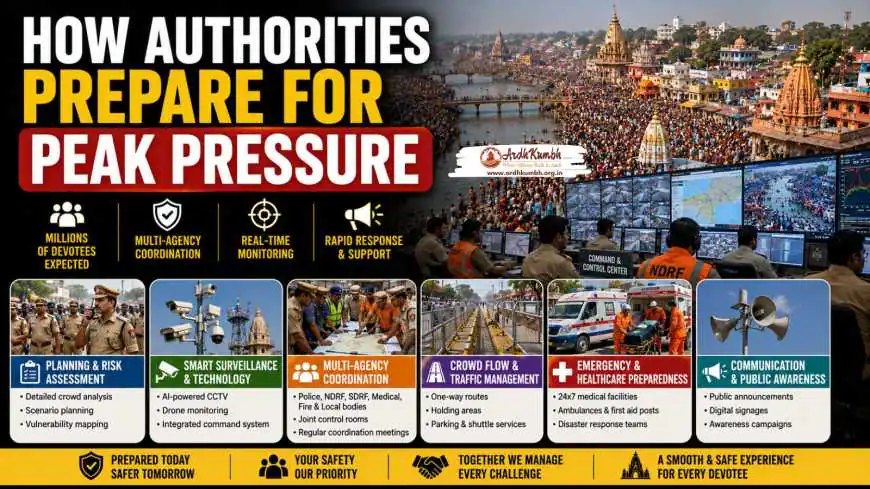
This blueprint is a living document of staggering complexity. It maps out the entire temporary city, designating specific zones for residential camps, akhara encampments, commercial areas, and, most critically, the vast, open "holding areas" that act as buffers to absorb the immense crowd pressure on the main bathing days. It calculates the exact width and capacity of every road, the precise number and location of pontoon bridges, the positioning of every police check-post, and the placement of every medical camp and fire station. This is not just urban planning; it is a form of sacred geometry, designed to create a circulatory system for a human ocean. The blueprint is then translated into a series of tenders, contracts, and memorandums of understanding, ensuring that every single piece of the puzzle—from the construction of temporary toilets to the deployment of AI-powered surveillance drones—is in place well before the first pilgrims arrive.
The Digital Eye and the Central Nervous System: AI, CCTV, and the Command Centre 🛰️
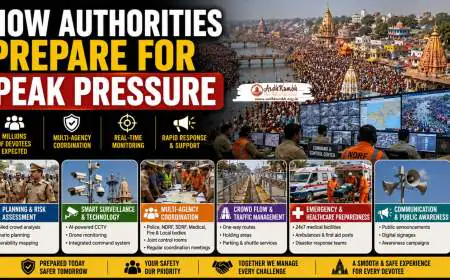
In the modern era, the Integrated Command and Control Centre (ICCC) is the pulsing, digital brain of the Kumbh Mela's peak pressure preparations. Months in advance, the administration installs a sprawling, high-tech network of thousands of high-definition CCTV cameras across the entire Mela grounds. These are mounted on poles, on temporary towers, and on tethered balloons and drones, providing a live, 360-degree, bird's-eye view of every street, every ghat, and every critical junction. This immense video feed is streamed back to the ICCC, a darkened room filled with massive screens where police, disaster management, and civic officials sit side-by-side, watching the pulse of the temporary city like surgeons monitoring a patient's vital signs.
But the true revolution is the integration of Artificial Intelligence. The CCTV feeds are not just passively watched. AI algorithms analyze the footage in real-time, measuring crowd density with incredible accuracy, calculating the speed and direction of human flows, and instantly detecting dangerous anomalies. If the AI detects a sudden surge, a bottleneck forming where two flows meet, a person falling, or a crowd moving in the wrong direction against a designated one-way flow, it triggers an instant, silent alarm. The ICCC can then zoom in, assess the threat, and dispatch a response team or issue an automated, localized audio warning through strategically placed public address systems within seconds. This is predictive crowd management. The command centre also coordinates with railway and state transport authorities in real-time, adjusting the frequency and routing of special shuttle trains and buses based on the ebb and flow of arriving pilgrims, ensuring that the transport system does not become a source of additional pressure.
Trending Guides Now
Ardh Kumbh Crowd Management & Facilities Guide
Read Guide →
How Crowd Discipline Is Planned for Ardh Kumbh 2027
Read Guide →
How Crowd Flow Will Be Managed in Peak 2027 Days
Read Guide →
How Movement Will Be Regulated on Peak Days
Read Guide →
Best Routes to Reach Haridwar for Ardh Kumbh Mela
Read Guide →
Ardh Kumbh 2027 Dates (Official) - Haridwar Snan Schedule
Read Guide →
How Ardh Kumbh Sustained Leadership Traditions
Read Guide →
Can Ardh Kumbh Be Experienced Digitally
Read Guide →The Human Safety Net: The Deployment of a Temporary Army 👮🤝
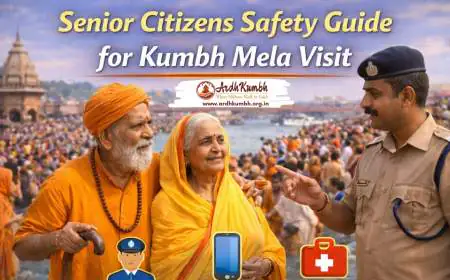
Technology is only as effective as the human beings who operate it. The most visible and crucial layer of peak pressure preparation is the massive, coordinated deployment of a temporary security force. This is not a handful of local police. It is a vast, multi-layered human safety net comprising the state police, the Provincial Armed Constabulary (PAC), paramilitary forces, and, most importantly, an army of trained volunteers, the sevadars. Months in advance, police personnel undergo special training in crowd psychology, disaster response, and the specific, non-confrontational communication techniques required to manage a deeply devotional, often emotionally charged, and highly dense crowd. They are taught to be shepherds, not soldiers.
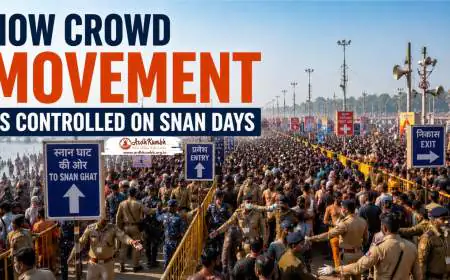
On the peak days, the deployment map reads like a military campaign. Every chowk, every bridge approach, every ghat entrance, and every holding area is assigned a specific number of personnel, with clear chains of command and dedicated, encrypted communication channels. "Quick Reaction Teams" (QRTs) are stationed at strategic points, ready to respond to any medical emergency, lost-person report, or security threat within minutes. The sevadars, many of whom are pilgrims themselves, serve as the crucial, gentle interface between the uniformed forces and the masses. They are trained to guide, to reassure, and to serve, offering water, assistance, and a calm, smiling presence in the midst of the intense pressure. The administration also conducts multiple full-scale mock drills in the months leading up to the event, simulating a variety of worst-case scenarios—a bridge panic, a building fire, a medical epidemic—to ensure every single person in the chain of command knows their exact role when the pressure is at its absolute zenith.
The Temporary City's Lifelines: Infrastructure That Cannot Fail 🏕️
A city of millions cannot survive for even a single day without robust, fail-proof infrastructure. Preparing for the peak pressure of the Kumbh means building and testing an entire city's worth of utilities in a matter of weeks, on a floodplain, with the knowledge that it will all be dismantled shortly after. The engineering challenge is immense. The pontoon bridges, built by the Indian Army's Corps of Engineers, are the most critical arteries of this temporary city. Their number, their exact placement, and their capacity are calculated based on sophisticated flow-rate models. Each bridge is designated for a single direction of traffic, and their entry points are designed with "gating" mechanisms to control the density on the bridge. The power grid, with its backup generators, is laid out to ensure that the ICCC, the medical camps, and the public lighting never fail. The water supply, a network of pipes and purification plants, is tested relentlessly for quality and pressure.
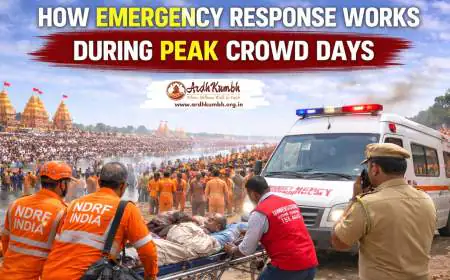
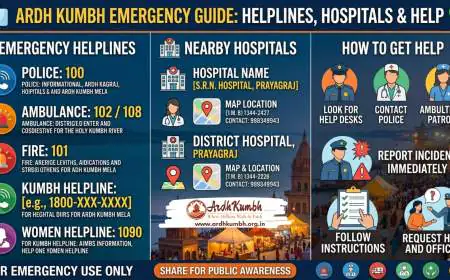
Perhaps the most underappreciated feat of engineering is the sanitation system. The administration deploys tens of thousands of temporary toilets, connected to a complex network of underground tanks and treatment facilities. An army of sanitation workers, working in coordinated shifts, ensures that the city remains remarkably clean, preventing the outbreak of disease that could so easily devastate a dense, temporary gathering. The medical infrastructure is equally comprehensive. Dozens of temporary hospitals, equipped with ICU beds and emergency operation theatres, are built at strategic points, supported by a network of smaller first-aid posts located every few hundred meters. A fleet of ambulances, with dedicated emergency lanes that are kept strictly clear of pedestrian traffic, stands ready. The entire infrastructure is a testament to the fact that the spiritual experience of the Kumbh is supported by a profound, secular, and deeply practical form of love and care.
The Sacred Choreography: Coordinating With the Akharas 🔱
A unique layer of peak pressure preparation that has no parallel in any other mass gathering is the delicate, diplomatic coordination with the great monastic orders, the akharas. Their grand, ecstatic, and densely populated Shahi Snan processions are the spiritual heart of the Kumbh and the single greatest trigger for crowd pressure. The administration does not impose a schedule upon them. Instead, months in advance, senior officials engage in a series of respectful, detailed negotiations with the Mahants and leaders of each akhara. The exact timing, the precise route, the duration of the ritual bath, and the designated ghat for each procession are all agreed upon and formalized in a mutually binding schedule. This is a masterclass in cultural sensitivity and practical diplomacy.
This negotiated, pre-agreed schedule is the foundation of the entire crowd management plan for the day. The administration then creates a "rolling wave" system of security. The route is cleared, and one akhara is allowed its protected, spectacular journey to the river at a time. The rest of the immense crowd is held safely behind pre-designated barricades, their anticipation managed, their movement completely controlled. The akharas themselves provide internal marshals who help manage their own ranks. This seamless fusion of ancient ritual hierarchy and modern crowd science is one of the most brilliant and essential aspects of the Kumbh's success. It ensures that the spiritual rights of the akharas are honored to the fullest, while the physical safety of the millions who have come to witness them is absolutely guaranteed.
The Predictive Science: Data, Modeling, and the Art of Anticipation 📊
The preparation for peak pressure at the Kumbh has become an increasingly sophisticated science of prediction. The administration now relies on complex crowd flow modeling software, feeding it historical data from previous Melas, satellite imagery of the terrain, and real-time inputs from railway bookings, bus arrivals, and digital ticketing platforms. These models can simulate crowd behavior under different scenarios, allowing planners to identify potential "choke points" and optimize the flow of people before a single pilgrim arrives. The models are validated and refined during the smaller, less intense bathing days leading up to the main event, creating a continuous feedback loop.
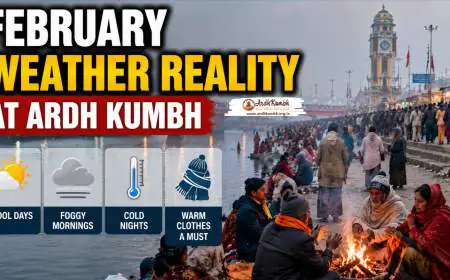
This predictive science extends to resource allocation. Based on the projected crowd numbers for a specific peak day, the exact number of additional buses, the precise quantity of food supplies for the bhandaras, and the specific levels of medical supplies at each camp are all calculated. The meteorological department sets up a temporary weather station on the Mela grounds, providing hyper-local, real-time forecasts that are crucial for managing the challenges of sudden rain, dense fog, or extreme cold. This data-driven, analytical approach does not remove the human element; it liberates it. By automating the calculations and predictions, the science of crowd management frees up the human experts to do what they do best: make the nuanced, compassionate, and often instantaneous decisions that no algorithm can replicate.
The Pilgrim's Role: How Public Awareness Completes the Safety Net ✅
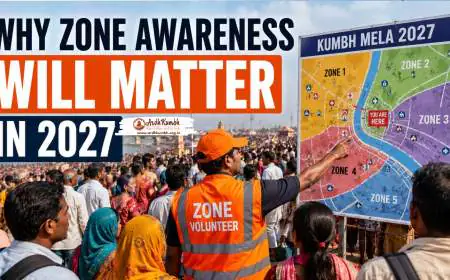
The most sophisticated management system in the world is rendered fragile if the crowd itself is not a willing, informed participant. A crucial, often overlooked, element of peak pressure preparation is the massive public awareness campaign that the administration launches in the weeks leading up to the Mela. This is a multi-platform, multi-lingual blitz of information, disseminated through newspapers, radio, television, social media, and a dedicated official app. The campaign's goal is simple: to educate the pilgrim before they even leave home. Maps of the zone system are published. The color-coded entry and exit routes are explained. The strict, non-negotiable rules of the one-way system on the pontoon bridges are communicated with diagrams and simple language. Pilgrims are taught the importance of the "holding areas," not as a frustration, but as a vital safety buffer. They are urged, in the most respectful and devotional language, to be patient, to travel light, to keep moving on the bridges, and to immediately follow the instructions of the police and volunteers.
This campaign is not just about information; it is about creating a culture of shared responsibility. It turns the pilgrim from a passive, potentially endangered individual into an active, conscious agent of collective safety. The pilgrim who has studied the zone map at home, who knows the color of their entry gate, who carries a photocopy of their ID and their camp's sector number, and who understands the profound spiritual value of patience, is not just protecting themselves. They are contributing to the peaceful, flowing, and safe river of humanity that is the ultimate, shared success of the Kumbh Mela.
The Quiet Vigil: The Calm After the Storm That Is Already Planned
The final act of peak pressure preparation is planning for the dispersal. As the last Shahi Snan concludes and the millions begin their journey home, the entire security and logistical apparatus pivots smoothly into reverse. The same one-way bridges, the same phased openings, the same watchful AI eyes, and the same volunteer and police force that guided the tide inward now gently shepherd it outward. The transport system, which was on high alert for arrivals, now focuses entirely on departures, with trains and buses marshaled at a frantic but organized pace. The medical camps remain on high alert for the exhausted and the injured. The sanitation system works through the night to restore the city. The success of the Kumbh is not just in how it handles the peak, but in how gracefully it returns to stillness, leaving behind a clean riverbank and a deep, quiet sense of a sacred duty, flawlessly fulfilled. The immense pressure has been met not with chaos, but with a compassionate, intelligent, and profoundly human order.
Frequently Asked Questions