












































































How Kumbh Survived Without Central Authority
Discover how Kumbh survived without central authority for millennia through a decentralized akhara network, an unchangeable cosmic calendar, oral traditions, and the grassroots faith of millions of pilgrims.

The Akhara Network: A Distributed Monastic Federation 🔱
The closest thing the Kumbh has to an institutional backbone is the akhara system, but even this is a masterpiece of decentralization. The akharas are not a single, unified church. They are a fiercely independent federation of monastic warrior orders—the Juna, Niranjani, Mahanirvani, and others—each with its own leadership, its own internal governance, its own economic resources, and its own unbroken spiritual lineage. There is no supreme akhara that commands the others. Their relationship is governed by centuries of negotiated tradition, mutual respect, and a shared commitment to the dharma of the pilgrimage. This distributed structure is the key to their resilience. If one akhara were to be weakened, corrupted, or suppressed by a hostile political power, the others would remain intact, and the Kumbh would continue. The akharas also operate as a mobile institutional memory. They do not rely on permanent structures at the Kumbh sites. Their camps are temporary, but the knowledge of how to set them up, where to place them, and how to manage the sacred processions is carried in the minds of their senior sadhus and passed down through the guru-shishya parampara.
When the time for the Kumbh arrives, the akharas converge, bringing their ancient ritual technologies, their sacred dhuni fires, and their organizational expertise. They coordinate the most critical event—the shahi snan—through a pre-agreed, hierarchical order that is the result of centuries of diplomacy. This is a brilliant model of a distributed, non-centralized institution, a spiritual federation where power is shared, autonomy is respected, and the whole is infinitely more resilient than any single part. The akhara network is a living proof that a vast, complex, and long-lasting tradition can be organized not through top-down control but through a shared purpose and autonomous, cooperating nodes.
The Cosmic Clock That No Human Hand Controls ⏳
If the akharas provide the human organizational structure, the astrological calendar provides the divine, non-negotiable authority. The timing of the Kumbh is not set by a committee of priests. It is determined by the transit of Jupiter and the Sun into specific zodiac signs—a cosmic event that occurs regardless of human politics. This is one of the most profound reasons the Kumbh survived without central authority. You cannot bribe a planet. You cannot assassinate a star. You cannot pass a law to repeal a planetary alignment. When the auspicious moment arrives, it is a summons that every sampradaya, every akhara, and every pilgrim acknowledges. This celestial clock is the ultimate decentralized authority, one that is visible to all and controlled by none. This cosmic mandate freed the Kumbh from the need for a central human authority to issue a call. The call came from the sky. The complex astronomical knowledge required to calculate the exact moment was itself preserved in a decentralized manner, held by multiple independent lineages of pandits and astrologers across the subcontinent. There was no single observatory that could be destroyed. The Panchang (almanac) was a distributed network of knowledge. Every six or twelve years, when the stars aligned, the pilgrim caravans would begin to move, not because a king had commanded it, but because the universe itself had opened a sacred window.
This cosmic independence is what allowed the Kumbh to survive the rise and fall of countless dynasties. Tyrants came and went, but Jupiter continued its steady, twelve-year orbit, and the call to the Sangam was renewed, fresh and irrefutable, with every cycle. The Kumbh survived without central authority because its primary directive was written in the sky, not on a human decree.
Trending Guides Now

History of Ardh Kumbh Mela From Samudra Manthan to Modern Times
Read Guide →
How Saints and Sadhus Define the Ardh Kumbh Tradition
Read Guide →
Why Saints Are Called Living Archives of Kumbh
Read Guide →
Kumbh vs Ardh Kumbh: The Difference Explained
Read Guide →
Ardh Kumbh 2027 Dates (Official) - Haridwar Snan Schedule
Read Guide →
Dharamshala Stay During Ardh Kumbh: Free & Budget Guide
Read Guide →
Official Progress Report of Haridwar Ardh Kumbh 2027 Infrastructure Projects
Read Guide →
Where to Find 24-Hour Pharmacies in Haridwar During Ardh Kumbh 2027 Emergencies
Read Guide →The Oral River: Knowledge That Flows Without a Library 🗣️
A centralized institution relies on written charters, libraries, and archives. The Kumbh's wisdom relied on something far more durable: the oral tradition. The precise mantras for the sacred bath, the correct procedures for the yagya, the intricate choreography of the aarti, the philosophical debates of Vedanta—all of this knowledge was preserved not in books but in the living memory of countless gurus, sadhus, and pandits. This was a deliberate, spiritual technology. A text can be burned. A recitation, living in the breath of thousands of practitioners across the subcontinent, is essentially immortal. The Kumbh maintained continuity without institutions by storing its sacred operating system in the most resilient hardware ever devised: the devoted human mind. The Kumbh itself was the grand syncing event. Scholars from different regions would gather, chant together, and cross-verify their knowledge. This was a massive, decentralized, real-time peer-review system that ensured not a single syllable of the Vedas was corrupted over millennia. The Vedic memorization techniques, with their complex, interlocking recitation patterns, acted as an internal error-correction code.
This oral network meant that the Kumbh's spiritual and ritual knowledge was never located in a single, vulnerable place. It existed in a distributed cloud of human consciousness, making the tradition incredibly resilient to the destruction of physical institutions like the great universities of Nalanda and Vikramashila. The knowledge was wherever a trained voice was chanting. The Kumbh survived without central authority by making every initiated sadhu and pandit a living, breathing library, a node in an indestructible network of sacred sound.
The Pandas and Vahis: A Distributed Social Database 📜
No central administration tracks the millions of pilgrims who attend the Kumbh. That impossible task is handled by a brilliant, decentralized human network: the pandas, the hereditary pilgrim priests, and their vahis (genealogical record books). Each panda family maintains a unique, personal relationship with specific pilgrim families, often across ten or fifteen generations. When a pilgrim arrives, they seek out their family's panda, not an impersonal registration desk. The panda opens a handwritten ledger and finds the names of their ancestors, creating a direct, tangible link between the present pilgrimage and a chain of devotion stretching back centuries. This panda-vahi system is a distributed social database of extraordinary resilience. There is no master server to crash, no central archive to burn. The records are held in thousands of independent, private volumes, each maintained by a family with a vested, hereditary interest in its preservation. This system provided social continuity without a central institution. It bound families to the sacred river in a multi-generational covenant that no political upheaval could break.
The pandas also functioned as a communication network, knowing which routes were safe, which regions were sending pilgrims, and how to navigate the changing political landscapes. Their decentralized, personalized service is one of the silent, structural marvels that kept the Kumbh alive through centuries when formal institutions were crumbling. The Kumbh survived without central authority by distributing the vital task of social memory among thousands of independent, dedicated families, creating a network that was as human as it was indestructible.
The Sacred Geography That No Empire Could Conquer 🌊
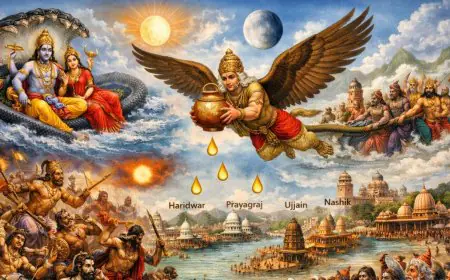
An institution can be destroyed, but a river flows forever. The sacred geography of the Kumbh is its ultimate institutional independence. The Sangam at Prayagraj, the Har Ki Pauri at Haridwar, the Shipra at Ujjain, the Godavari at Nashik—these are not man-made structures. They are living, divine presences. The core ritual of the Kumbh, the snan, requires only the pilgrim and the water. It needs no temple, no cathedral, no centralized authority. This made the Kumbh impossible to suppress. A hostile ruler could tax pilgrims or block roads, but he could not remove the river, and he could not prevent a determined soul from reaching its banks. The four-site rotation was itself a stroke of geo-spiritual genius. By dispersing the Kumbh across the subcontinent—north, center, west, and south—the tradition ensured that the suppression of one site would not end the pilgrimage. The sacred geography itself is a decentralized network. The rivers are the ultimate non-institutional authority, their sanctity flowing from the Himalayas and the heart of the land, recognized by all and owned by none.
The Kumbh's continuity is anchored not in a building but in the very hydrology of the subcontinent, a sacred map that political borders can never erase. The Kumbh survived without central authority because its central shrine was not a man-made monument that could be captured, but a living goddess, the eternal and unconquerable Ganga.
The Grassroots Faith: The Leaderless Movement of Millions 🙏
The most powerful force ensuring the Kumbh's survival without a central authority is the simplest: the unshakeable, leaderless faith of ordinary people. For over two thousand years, millions of farmers, weavers, merchants, widows, and laborers have walked incredible distances, often at great risk, to bathe in the sacred rivers. No one commanded them. No institution coordinated them. They came because their parents had come, because their village had always come, because the stories of the Kumbh's power were woven into their lullabies. This is a grassroots spiritual movement of staggering scale and durability. This faith is a distributed, self-replicating phenomenon. It is passed down in families, in villages, in the oral traditions of local communities. It cannot be decreed from above, and it cannot be extinguished by force. The pilgrim who walks a hundred miles to the Sangam is both a participant and an organizer. The collective movement of millions, all guided by the same ancient calendar and the same inner pull, creates an emergent, self-organizing order.
The Kumbh is not a top-down event. It is a spontaneous, sacred convergence, a living proof that a community can organize itself around a shared, transcendent purpose without needing a central command structure. This is the profound, democratic genius at the heart of the world's largest pilgrimage. The Kumbh survived without central authority because it was never an institution to begin with. It is a living, breathing, self-organizing organism, a sacred ecosystem that has evolved over millennia to be perfectly resilient to the one constant of human history: change. The empires of the world are built and then crumble. The Kumbh flows on, as eternal and as uncommandable as the river herself.
Frequently Asked Questions