

































































How Ardh Kumbh Stayed Relevant Over Centuries
Discover how Ardh Kumbh stayed relevant over centuries through its unbreakable cosmic calendar, decentralized akhara network, grassroots faith, and remarkable ability to adapt while preserving its sacred core.

The Unbreakable Cosmic Clock: Why the Stars Kept the Pilgrimage Alive ⏳
The single most powerful force ensuring the Ardh Kumbh's relevance across centuries is its unchangeable, celestial authority. The Kumbh is not summoned by a king, a pope, or a committee. It is summoned by the movement of Jupiter and the Sun into specific, mathematically precise zodiacal positions. This astrological clock, calculated and preserved by generations of astronomer-priests, is entirely immune to human politics. A Mughal emperor could not decree that Jupiter should not enter Aquarius. A British viceroy could not delay the Sun's ingress into Aries. When the auspicious moment arrived, it was a call that echoed across the subcontinent, a call that no earthly power could silence. The Ardh Kumbh at the six-year mark, with its own distinct and potent planetary configuration, provided a regular, recurring spiritual heartbeat that kept the tradition pulsing even between the grand twelve-year Poorna Kumbhs.
This cosmic independence gave the pilgrimage an unassailable legitimacy. The faithful knew, with absolute certainty, that the sacred moment was not a human invention. It was a cosmic gift. The Kumbh's calendar, enshrined in the decentralized Panchang (almanac) tradition, could not be destroyed by burning a single library or exiling a single priest. It existed in the minds of countless pandits, in the rhythms of village life, and in the very skies above. This is the first and most fundamental secret of the Kumbh's enduring relevance: it is aligned with a reality larger than any empire. As long as the planets move, the Kumbh will have a reason to exist, a sacred appointment that the cosmos itself insists upon. This celestial mandate has allowed the gathering to remain not just a tradition but a living, dynamic event, eternally renewed by the heavens.
The Decentralized Body: How the Akharas Ensured No King Could Kill It 🔱
If the cosmic clock provided the soul, the akhara system provided the indestructible body. The Kumbh Mela did not rely on a single, centralized institution that could be targeted and destroyed. Instead, its organizational backbone was a federation of fiercely independent monastic warrior orders—the Juna, Niranjani, Mahanirvani, and others—each with its own leadership, its own economic resources, and its own unbroken spiritual lineage. This decentralized architecture was a masterstroke of survival. A hostile ruler could suppress one akhara, but the others would continue. A single corrupt mahant could be isolated. The knowledge of how to organize the Mela—how to lay out the camps, manage the sacred processions, and resolve disputes—was not stored in a single vulnerable archive. It was distributed across thousands of human minds, passed down through the guru-shishya parampara within each order. The Ardh Kumbh stayed relevant because its institutional body was more like a resilient organism than a brittle machine. It could lose a limb and still thrive.
The akharas also provided a martial and diplomatic shield. During periods of intense persecution, the warrior naga sadhus physically defended the pilgrimage. In times of political negotiation, the akhara mahants engaged with rulers as the legitimate representatives of an immense spiritual constituency. This ensured the Kumbh was never simply a passive, helpless gathering of commoners. It had its own defenders, its own diplomats, and its own internal governance. This self-sufficiency made the pilgrimage a power that even the mightiest emperors had to reckon with, not dismiss. The Ardh Kumbh has continued to be relevant because its power is not lent by any external state. It is generated from within, by the collective spiritual and organizational strength of the akharas, a model of decentralized authority that has proven more durable than any empire.
Trending Guides Now
What Is the Story Behind the Ardh Kumbh Mela?
Read Guide →
History of Ardh Kumbh Mela From Samudra Manthan to Modern Times
Read Guide →
How Ardh Kumbh Preserved India’s Oral Traditions
Read Guide →
Why Saints Are Called Living Archives of Kumbh
Read Guide →
Best Routes to Reach Haridwar for Ardh Kumbh Mela
Read Guide →
Ardh Kumbh 2027 Dates (Official) - Haridwar Snan Schedule
Read Guide →
How Kumbh Became a Platform for Social Reform
Read Guide →
How Kumbh Maintained Continuity Without Institutions
Read Guide →The Grassroots Fire: Why Ordinary Pilgrims Never Stopped Coming 🙏
No institution, however brilliant, can survive without the living faith of ordinary people. The deepest reason the Ardh Kumbh stayed relevant over centuries is the simplest: millions of farmers, weavers, merchants, and widows kept walking. They walked through war zones, through famine, through the heavy, discouraging taxes imposed by hostile rulers. They came because their parents had come, and their grandparents before them. The Kumbh was woven into the fabric of family memory, a sacred duty passed down as naturally as a name. This grassroots devotion was a force that no political decree could extinguish. A ruler might behead a saint, but he could not stop a million grandmothers from whispering the old stories to their grandchildren, stories of the Ganga's grace and the power of the snan on the sacred day. The faith was a quiet, subterranean river, flowing beneath the visible landscape of politics and war, and it would resurface, as powerful as ever, whenever the cosmic moment arrived.
The pandas, the hereditary pilgrim priests, were the custodians of this grassroots fire. Their genealogical vahis (record books) created a multi-generational contract between specific families and the sacred river. When a pilgrim saw their great-great-grandfather's name recorded in a book that had been kept at the Sangam for two hundred years, the Kumbh ceased to be an optional religious event. It became an unbreakable family obligation. This profound, personal, and emotional connection ensured a steady stream of pilgrims across every century, regardless of the political climate. The Ardh Kumbh remained relevant because it was not merely an event; it was an inheritance, a living relationship between millions of families and the sacred geography of India.
The Fluidity of Form: Adapting to Change Without Losing the Soul 🔄
The Ardh Kumbh has never been a static relic. Its genius lies in its ability to absorb profound changes in technology, society, and communication without ever compromising the essential, transformative ritual of the sacred snan. When the printing press arrived, the Kumbh used it to disseminate maps and schedules. When the railway came, it brought millions who could never have made the long journey on foot, democratizing the pilgrimage on an unprecedented scale. The colonial era, which brought administrative anxiety and a scientific gaze, was met not with futile resistance but with a pragmatic integration of new systems of crowd management, sanitation, and record-keeping. The British, for all their suspicion, ultimately became facilitators of a tradition they could not suppress.
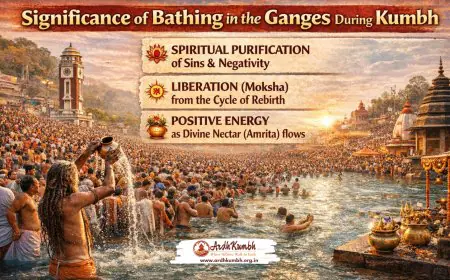
In the modern era, the Kumbh has seamlessly integrated digital technology. Official apps provide real-time maps and snan schedules. AI-powered cameras and drones now monitor crowd density to prevent stampedes. Satellite imagery helps plan the layout of the temporary city. Yet, at 4 AM, the pilgrim still walks through the cold mist, enters the freezing water, and chants the same mantras their ancestors chanted a thousand years ago. The Ardh Kumbh stays relevant because it understands a profound truth: the external form is a servant to the internal essence. The technology changes. The core ritual—the direct, unmediated, and transformative encounter between the soul and the sacred river—remains eternal. This willingness to evolve while remaining anchored in the timeless has allowed the Kumbh to speak to every new generation in a language it can understand.
The Inclusive Embrace: Remaining Relevant by Welcoming All 🤲
A tradition can become obsolete when it becomes exclusive, rigid, and bound to a single social class or caste. The Ardh Kumbh has remained powerfully relevant for centuries precisely because it has always been a radically inclusive space. At the Sangam, the freezing water that closes over the head of a Brahmin is the same water that closes over the head of a Dalit. In the long, unbroken rows of the bhandara, the free community kitchen, a princess and a sweeper sit on the same cold earth and eat the same simple dal and roti. This was, and remains, a profound and recurring challenge to the rigid hierarchies of the outside world. The Kumbh created a temporary, sacred world where the soul, not the social label, was the only currency that mattered. This radical, lived experience of equality has been a magnetic force for the marginalized and the oppressed for centuries.
The Kumbh has also been a platform for the voices of spiritual protest and reform. The Bhakti saints—Kabir, Ravidas, Mirabai, and countless others—whose poetry condemned caste and empty ritualism, found the Kumbh to be their greatest amplifier. Their message of a direct, personal, and egalitarian devotion to the divine resonated with the masses and is still sung at the Mela today. The Kumbh also provided a rare space of spiritual agency for women, who could make the pilgrimage and offer their prayers directly to the river, the divine Mother, without the mediation of a male priest. By embracing the lowly, the outcaste, the women, and the seeker from every background, the Ardh Kumbh has ensured that it is not just a gathering of the elite but a genuine festival of the entire human family. This profound inclusivity is one of the key reasons for its undying relevance.
The Living Library: Preserving the Wisdom Each Generation Needs 📜
The Ardh Kumbh stayed relevant over centuries because it was never just a ritual; it was a living university, a vast, decentralized library of sacred knowledge that could not be burned. The oral traditions—the precise chanting of the Vedas, the storytelling of the Puranas, the guru's whispered transmission of a yogic technique—ensured that the wisdom of the civilization was not stored in fragile manuscripts but in the indestructible medium of the human voice and memory. The Kumbh was the grand syncing event, where pandits from different regions would chant together, cross-verifying their knowledge in a massive, public, error-correcting system. A young sadhu could learn a rare astrological calculation from a master at the Kumbh, knowledge that had been lost in his own region. The Kumbh was the backup drive of a civilization, the place where the spiritual operating system was preserved, updated, and passed on.
This preservation of knowledge made the Kumbh eternally relevant. Every generation faces its own forms of ignorance and suffering. The Kumbh offered, and continues to offer, access to a tested, profound body of wisdom about the nature of the mind, the path to inner peace, and the art of living a meaningful life. The sadhus, the philosophers, and the storytellers provide a wisdom that is not abstract but practical, a spiritual technology that is as applicable to the stresses of modern urban life as it was to the challenges of a medieval village. The Kumbh remains relevant because it answers the deepest and most timeless questions of the human heart: Who am I? Why am I here? How can I be free?
The Enduring Pull: Why the Six-Year Cycle Captures the Human Soul 🔄
The specific rhythm of the Ardh Kumbh—the six-year cycle—is perfectly calibrated to the human lifespan and the human psyche. Twelve years is a long, almost abstract stretch of time. Six years is an intimate, personal cycle. A child who is brought to the Ardh Kumbh at the age of six will return as a young adolescent of twelve, and again as a young adult of eighteen. The pilgrimage becomes a rhythm that marks the passages of their life. For the householder, the six-year interval is a regular, achievable spiritual renewal, a sacred pit stop on the long journey of a busy life. It is frequent enough to be an active part of one's lived experience, yet rare enough to be a profound and anticipated event. This psychological resonance of the six-year cycle is a key to its enduring relevance. It fits the human life. It is a spiritual beat that the soul can dance to.
The Ardh Kumbh also offers a unique spiritual gift that is distinct from the grander Poorna Kumbh. Its slightly smaller, more intimate scale provides a setting for quiet, personal transformation, for the healing of deep inner wounds, and for a direct, contemplative encounter with the sacred. In a world that is increasingly noisy, frantic, and overwhelming, the Ardh Kumbh's atmosphere of accessible peace and profound presence is more relevant than ever. It offers a temporary sanctuary, a place to detox from the digital noise and reconnect with the simple, eternal rhythms of the river, the sun, and the soul.
The River That Calls Across Centuries 🌊
The tents of the Ardh Kumbh will be folded, as they are after every cycle. The pontoon bridges will be dismantled. The millions of pilgrims will return to their homes. But the pilgrimage does not end. It flows into the daily life of the civilization, carrying the seeds of faith, equality, wisdom, and peace that were planted on the banks of the sacred river. The Kumbh has remained relevant for over a thousand years because it is not an escape from life; it is a training ground for life. It sends its pilgrims back into the world stronger, kinder, and quieter, carrying a peace that is not of this world.
The river continues to flow, indifferent to the passage of centuries. The stars continue their eternal dance. And the call of the Kumbh, a call that is older than memory and as fresh as the coming dawn, will sound again, as it always has. The Ardh Kumbh will remain relevant because the human need for purification, for community, for meaning, and for a direct experience of the sacred is not a medieval relic. It is a permanent, unquenchable fire in the human heart, and the Kumbh is the place where that fire is tended, renewed, and passed on, generation after generation, into an eternal future.
Frequently Asked Questions