The Physical Training: Building the Will Through the Body 💪
The spiritual training of the Ardh Kumbh begins with the most fundamental instrument of all: the body. The pilgrimage is a sustained, multi-day physical challenge. You will walk ten to fifteen kilometers a day on uneven ground. You will wake at 3 AM in the biting cold and force yourself out of whatever warmth you have found. You will immerse yourself in freezing water that steals your breath and shocks every nerve. You will carry your own belongings, navigate endless queues, and sleep on a thin mattress in a cold tent. This is not incidental hardship. It is the first, foundational lesson in spiritual discipline. The body, which in modern life is often pampered and insulated from any real discomfort, is taught to obey the will rather than dictate to it. When the body complains, and it will, the pilgrim learns a profound truth: you are not your body. You are the awareness that can witness the pain, the fatigue, and the cold, and still take the next step.
This physical training is a form of tapas, the sacred fire that burns away laziness and attachment to comfort. Every shivering step in the pre-dawn darkness is a rep fired in the gym of the soul. The cold water of the snan is not just a bath; it is a daily baptism, a voluntary confrontation with intense sensation that teaches you to breathe through difficulty, to remain calm in the face of shock, and to emerge on the other side feeling vibrantly, intensely alive. This direct, embodied training rewires the nervous system. The pilgrim who has willingly endured the cold of the Sangam discovers a new baseline for what counts as "difficult." The ordinary stresses of life—a traffic jam, a difficult boss, a cold office—lose their power. The body has been trained to be an ally on the spiritual path, not an obstacle, and this training is one of the most practical and lasting gifts of the Kumbh.
The Sensory Training: Finding the Still Point in Chaos 🌫️
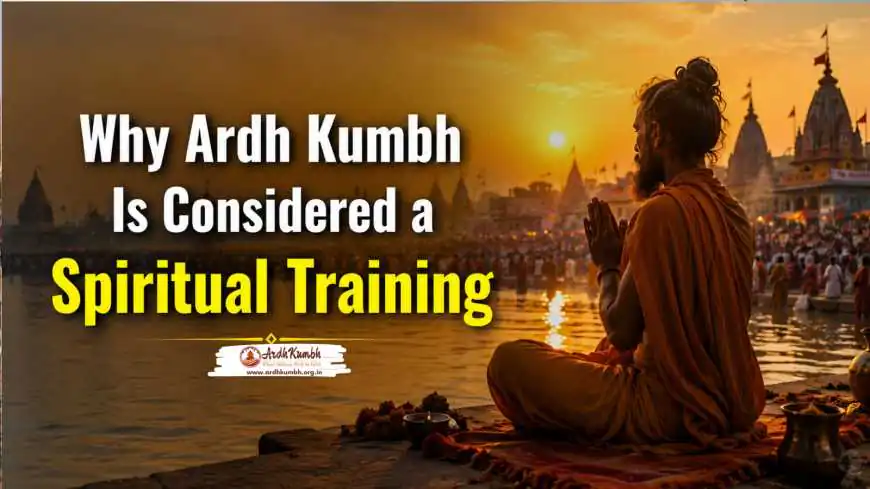
If the body is trained through physical hardship, the mind is trained through a deliberate, intense assault on the senses. The Ardh Kumbh is the most sensorily overwhelming environment on the planet. The noise is relentless: temple bells, blaring loudspeakers, chanting, shouting, crying, laughing. The air is thick with the smells of incense, woodsmoke, sweat, and flowers. The visual field is a dizzying, chaotic kaleidoscope of colors, moving processions, and endless faces. The modern mind, accustomed to quiet, curated, and controllable environments, is completely unequipped for this. The spiritual training here is to find a still point of inner silence within the raging storm. This is the yogic art of pratyahara, the withdrawal of the senses, practiced not in a Himalayan cave but in the heart of the busiest marketplace on earth.
The constant temptation is to be swept away by the chaos, to become mentally exhausted, irritated, and reactive. The training is to observe the noise without becoming it. The pilgrim learns to walk through the crowded lanes with their mind anchored in a mantra, their gaze soft, their heart calm. They learn to hear the sacred syllable "Om" hidden beneath the cacophony of the loudspeaker. They learn to see the divine play, the lila, in the apparent disorder. This is an advanced spiritual skill, one that takes years to develop in a quiet monastery. The Kumbh offers a crash course. It forces you to find your center not by escaping the world but by standing firmly in the middle of its most intense manifestation. The pilgrim who learns this skill in the chaos of the Mela has acquired a spiritual tool that will serve them for a lifetime, enabling them to carry a portable sanctuary of peace into any stressful situation.
The Ego Training: Annihilation in Anonymity 🤲
Modern culture is an obsessive, lifelong project of ego-construction. We build identities, curate social media profiles, and chase achievements to prove our specialness. The Ardh Kumbh is a demolition crew for this elaborate, exhausting structure. In the vast, anonymous crowd of millions, your social identity dissolves completely. Your job title, your bank balance, your educational pedigree, your carefully crafted image—none of it is visible, and none of it matters. You are just one dark, shivering shape among millions, moving toward the water. This is the ego training of the Kumbh, and it is one of the most profound and terrifying spiritual exercises a human being can undertake. The ego, which thrives on differentiation and recognition, suddenly finds itself out of a job. It screams in panic. It tries to reassert itself through comparison, judgment, or a desperate, internal clinging to its own story.
The training is to let this happen. To allow the ego to be starved of its fuel and to discover, in that starvation, a strange and liberating peace. For a few sacred days, you can exist not as the main character in your personal drama but as an anonymous soul among souls. The peace of being nobody in particular is a revelation. The intense spiritual training of the Kumbh is to surrender the need to be someone important and to rest in the simple, radiant fact of your own being. This is not a lesson you can learn from a book. It must be experienced, and the Kumbh provides the perfect, humbling, and ultimately liberating arena for this experience. The pilgrim who has been trained in this ego-annihilation returns home less reactive, less defensive, and less driven by the exhausting need for external validation. They have tasted the freedom of a quieter self.
The Emotional Training: The Purge and the Release 😭
The combination of physical exhaustion, sensory overload, and ego-dissolution creates the perfect conditions for a deep, often unexpected, emotional purge. The Ardh Kumbh is not just a training in stillness; it is also a training in feeling. Stripped of your usual coping mechanisms—work, entertainment, social media, comfort food—the buried grief, anger, and fear you have been carrying for years begin to surface. A pilgrim might find themselves weeping uncontrollably during the evening aarti, not from sadness but from a sudden, inexplicable sense of release. An old, forgotten wound may surface with vivid intensity. Irrational irritation or profound anxiety may grip you in the middle of a crowd.
This is the emotional training of the pilgrimage. It is the yogic process of samskara shuddhi, the purification of deep, subconscious impressions. The training is not to suppress these feelings, not to judge them, and not to weave them into a dramatic story. The training is to simply allow the storm to pass through you, as the river allows a flood. To feel what is there, without running from it, without numbing it. The Kumbh provides a vast, compassionate, and non-judgmental container for this release. The river will carry your tears. The collective devotional energy will hold the space for your healing. The pilgrim who can sit with their own pain, without flinching, is doing some of the most advanced and difficult spiritual work a human being can do. The Kumbh trains you to be strong enough to be vulnerable, resilient enough to feel deeply, and wise enough to let it all go.
The Patience Training: The Discipline of the Long Wait ⏳
The Ardh Kumbh is a relentless, unavoidable school of patience. You will wait for the snan. You will wait for food at the bhandara. You will wait for the crowd to move. You will wait for the fog to lift. You will wait in lines that seem to stretch to eternity. There is no fast-pass at the Kumbh. There is no VIP lane to enlightenment. This forced, grinding training in patience is one of the most countercultural and valuable gifts of the pilgrimage. We live in a world of instant gratification, where frustration arises the moment a webpage takes three seconds to load. The Kumbh systematically breaks this addiction to speed. You learn that you cannot hurry the crowd, you cannot rush the ritual, you cannot force the sun to rise faster. You can only wait, and learn to wait well.
The training is to transform the experience of waiting from a frustrating delay into a sacred pause. A wait in line becomes an opportunity for silent mantra repetition. A slow, shuffling walk in the crowd becomes a moving meditation. The pilgrim learns that the space between events is not empty, wasted time. It is fertile ground for presence and reflection. This patience, once forged in the crucible of the Kumbh, becomes a permanent part of the pilgrim's character. The long lines of the Mela make the queues of ordinary life feel trivial. The deeper training is the realization that spiritual growth itself is a slow, patient unfolding, not a quick fix. The Kumbh teaches you to trust the process, to accept the slow rhythm of real transformation, and to find peace in the waiting, knowing that the sacred bath will come when it comes, and the grace will be all the sweeter for the wait.
The Detachment Training: Living With Less, Feeling Richer 🏕️
The Ardh Kumbh trains you in vairagya, the sacred art of detachment, not by lecturing you about the evils of materialism but by immersing you in a world where you simply have less, and discover you are happier for it. For the duration of the pilgrimage, your life is stripped down to the essentials. You live out of a single, small bag. You wear the same set of warm clothes day after day. You eat simple, sattvic food from a leaf plate. You have no control over the menu, the weather, or the noise level. You are detached from your car, your wardrobe, your entertainment, and your carefully curated personal space. This is not a deprivation. It is a profound, experiential training in simplicity.
The revelation that comes from this training is life-altering: you discover that your baseline happiness does not depend on your possessions or your comfort. The joy you feel sipping a hot chai from a clay cup after a freezing bath is more intense than any pleasure you have purchased. The deep, restful sleep in a simple tent, after a day of walking, is more satisfying than any night on a luxury mattress. The Kumbh trains you to see the difference between genuine need and manufactured desire. It shows you, in the most concrete terms, that you can live with far less and feel infinitely richer. This training in detachment does not require you to renounce your life when you return home. It simply equips you with the wisdom to hold your possessions more lightly, to crave less, and to appreciate the profound abundance of a simple, uncluttered life.
The Faith Training: Persisting When the Feeling Fades 😔
The most advanced spiritual training the Ardh Kumbh offers is in the nature of faith itself. At some point during the pilgrimage, for almost every pilgrim, the initial wave of inspiration and devotion will recede. The body will be exhausted. The mind will be overwhelmed. A sense of spiritual dryness, doubt, or even emptiness may descend. The rituals that seemed so powerful on the first day may feel hollow. This is the "dark night of the soul" of the pilgrimage, and it is not a sign of failure. It is the final, most rigorous training of the spirit. The test is to persist when all the pleasant feelings of devotion have vanished. To continue walking to the ghat, to continue offering your prayers, to continue sitting in silence, not because you feel like it, but because you have made a sacred commitment.
This is faith stripped of all sentimentality, reduced to its bare, essential core: the simple, stubborn, sacred act of showing up. The training is to learn that true faith is not a warm, fuzzy emotion. It is a quiet, unshakeable decision. The pilgrim who passes through this desert and continues to the water's edge emerges with a faith that is not dependent on good feelings. It is a grounded, tested, and enduring trust, tempered in the fire of doubt. This is the faith that can survive the darkest tragedies and the driest spiritual winters of life. The Kumbh trains you not just to taste the sweetness of devotion, but to develop the unshakeable, disciplined strength of a faith that has chosen the divine, with full consciousness, even when the divine feels utterly absent.
Practical Tips for Maximizing Your Spiritual Training ✅
To gain the full benefit of this spiritual training, approach the Kumbh not as a passive pilgrim but as an active trainee. First, set a clear, simple sankalpa (sacred intention) before you arrive. This is your training goal. Write it down. Return to it every morning. It will be your anchor when the chaos tries to sweep you away. Second, treat every challenge as a deliberate exercise. The long walk is a session of moving meditation. The crowded queue is a patience drill. The cold water is a willpower workout. Reframing hardship as training transforms it from a source of complaint into a source of strength. Third, build in deliberate periods of silence each day, even if just for fifteen minutes. Use this time to sit by the river, journal your experiences, and simply observe your own mind. This is your recovery period, essential for integrating the intense training.
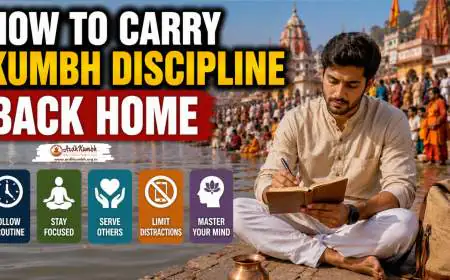
Fourth, treat your interactions with fellow pilgrims as seva (selfless service) training. Help the elderly, share your food, offer a kind word to the lost. This shifts your focus from your own struggle to the needs of others, which is one of the fastest paths to dissolving the ego. Finally, keep a small journal. Every evening, write down three things: a challenge you faced, how you responded, and what you learned. This simple practice will solidify the training and make the lessons conscious and retrievable long after the Mela is over. The Kumbh is a world-class spiritual gym, but like any gym, what you get out of it depends on the intention and effort you put in.
The Training That Never Ends
The tents will be folded, and the great, temporary city of the Ardh Kumbh will be dismantled, returning the riverbanks to their quiet, ordinary state. But the spiritual training you have received does not end. The calluses built on your soul through the long walks and the cold baths remain. The patience forged in the endless queues, the detachment learned in the simplicity of your tent, the faith tested in moments of doubt, and the inner silence discovered in the heart of chaos—these are now permanent parts of your being. The Kumbh is considered a spiritual training because it does not just give you a peak experience; it gives you a new operating system.
You return to your life, to your job, your family, and your responsibilities, but you are not the same person who left. You have been forged. The ordinary stresses of the world meet a mind that has been trained to remain still in a roaring crowd. The temptations of consumerism meet a heart that has tasted the profound joy of simplicity. The challenges of relationships meet a soul that has been trained in patience and compassion. This is the ultimate, lifelong gift of the Ardh Kumbh. It is not an escape from life. It is an intense, immersive training for life, a sacred boot camp that equips you with the inner resources to live with greater purpose, resilience, and an unshakeable, radiant peace. The pilgrimage to the river is over, but the pilgrimage of your life has just begun, and you are now truly ready to walk it.