






































































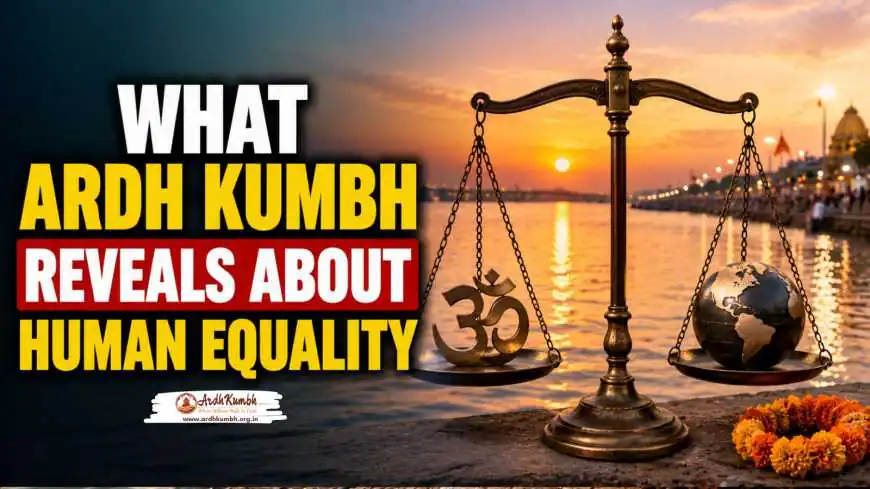
What Ardh Kumbh Reveals About Human Equality
Discover what Ardh Kumbh reveals about human equality. From the leveling waters of the Sangam to the shared meals of the bhandara, explore how the pilgrimage dissolves social hierarchies and unites all souls.
The Sangam: Where All Differences Dissolve in Cold Water 🌊
The first and most powerful revelation of human equality at the Ardh Kumbh occurs at the water's edge. The moment of the sacred snan is the great leveler. When a millionaire industrialist and a landless laborer step into the freezing river at the same astrologically charged moment, they are equals in every way that matters. The cold does not privilege the rich. The current does not respect caste. The water that closes over the head of a Brahmin is the same water that closes over the head of a Dalit. In that instant of total, shocking, physical vulnerability, every single person is reduced—or rather, elevated—to the same fundamental human state: a soul in a body, seeking purification and grace.
This is not a modern, reformist interpretation imposed on the pilgrimage. It is the very theology of the sacred rivers. Ganga Ma is a mother, and a true mother does not love one child more than another. The scriptures themselves declare that the river's purifying power is unconditional. It does not check credentials. It does not ask about sins or virtues, much less about social standing. The snan is the great spiritual reset, a temporary return to an Edenic state before the fall into social division. When you emerge from that water, gasping and reborn, you do not emerge as a Brahmin or a Shudra, a merchant or a sweeper. You emerge as a human being, washed clean of both karma and the artificial identities that cling to it.
This direct, embodied experience of equality leaves a lasting imprint on the soul. A pilgrim who has stood naked and shivering next to a stranger from a completely different walk of life, both of them united in a single, desperate, joyful act of faith, can never quite see that "other" as entirely separate again. The Sangam dissolves the illusion of hierarchy not by arguing against it, but by making it physically, experientially irrelevant. For those precious moments in the water, the only currency is faith, and the only identity is pilgrim.
The Bhandara: A Radical Experiment in Shared Nourishment 🍚
If the snan is the ritual of equality, the bhandara—the free, community kitchen—is its daily, practical sustenance. The bhandaras of the Ardh Kumbh are arguably the largest and most effective experiments in an egalitarian, classless society ever conducted. Every day, hundreds of thousands of meals are served, free of charge, to anyone who sits in the row. There is no VIP section. There is no premium menu for those who can pay. There is no means-testing, no qualification, and no questions asked. The wealthy philanthropist, the wandering sadhu, the impoverished widow, and the curious foreign traveler all receive the same simple, nourishing, sattvic food, ladled onto the same type of leaf plate by volunteers who serve everyone with the same respectful gesture.
Trending Guides Now

Is Ardh Kumbh a Once-in-a-Lifetime Experience?
Read Guide →
Can Ardh Kumbh Be Understood Without Scriptures?
Read Guide →
Is Ardh Kumbh a Gateway to Spiritual Life? Or Just a Dip in Cold Water?
Read Guide →
Can Ardh Kumbh Reshape Daily Living
Read Guide →
Ardh Kumbh 2027 Dates (Official) - Haridwar Snan Schedule
Read Guide →
Dharamshala Stay During Ardh Kumbh: Free & Budget Guide
Read Guide →
Official Progress Report of Haridwar Ardh Kumbh 2027 Infrastructure Projects
Read Guide →
Where to Find 24-Hour Pharmacies in Haridwar During Ardh Kumbh 2027 Emergencies
Read Guide →This is a radical dismantling of social hierarchy. In the ordinary world, food is one of the most potent markers of status—what you eat, where you eat it, and with whom. At the Kumbh, this entire edifice collapses. The act of sharing a meal, which in every culture is a sign of kinship and equality, is performed on a mass scale. You sit cross-legged on the ground, your shoulder touching the shoulder of a person you might never have been permitted to dine with in the stratified world outside. You eat the same dal, mop it up with the same roti, and drink the same water. The bhandara is the practical, edible expression of the Upanishadic truth that the same divine self resides in all beings. When you feed a stranger as an act of worship, the distinction between giver and receiver, high and low, dissolves. The bhandara reveals that at the most fundamental level of human need—hunger—we are all absolutely equal, and that the act of meeting that need can create a fleeting but profound community that prefigures a more just and compassionate world.
The Akhara Camps: Where Renunciation Levels All Ranks 🔱
The akhara camps at the Ardh Kumbh offer yet another startling revelation about human equality. These are the headquarters of the great monastic orders, the warrior-ascetic lineages that are the institutional backbone of the Kumbh. Within an akhara, the hierarchies of the outside world are not just ignored; they are deliberately, systematically inverted. A young man who joins an akhara and takes initiation as a naga sadhu or a sannyasi undergoes a ritual death. His former caste, his family name, his wealth, and his social status are all consigned to the funeral pyre. He emerges with nothing: a new spiritual name, a single set of gerua robes or, in the case of the nagas, nothing but ash, and a total dependence on alms.
Inside the akhara, a former prince and a former sweeper are brothers. They eat the same food, perform the same rigorous austerities, and obey the same guru. The only hierarchy that exists is based on spiritual attainment and seniority of initiation, not on birth. This living demonstration of a society organized around inner worth rather than external circumstance is profoundly challenging to the caste-based and class-based hierarchies of mainstream Indian society. The akharas are not perfect utopias; they have their own internal politics and power struggles. But their foundational principle is a radical spiritual egalitarianism. Anyone, from any background, can rise to the highest levels of spiritual authority if they demonstrate the requisite detachment, discipline, and wisdom. The akhara is a living laboratory for a meritocracy of the spirit, and its presence at the heart of the Kumbh is a continuous, centuries-old sermon on the fundamental equality of all souls before the divine.
The Crowd: Anonymity as the Great Liberator 🚶
There is a particular kind of liberation that comes from being anonymous in a vast crowd. At the Ardh Kumbh, your carefully constructed identity—your job title, your social standing, your online persona, your family name—becomes completely invisible. No one knows you are a respected surgeon or a struggling artist, a mother of four or a lonely bachelor, a person burdened by debt or a person of considerable means. You are simply one dark shape among millions, moving through the fog toward the river. This enforced anonymity is a profound revelation of human equality. It shows you that the self you spend so much energy maintaining is not your essence. It is a costume, and the Kumbh strips it away.
In this anonymity, a strange and wonderful freedom blossoms. You are free from the pressure to perform, to impress, to maintain a status. You are free to be kind without it being a transaction. You are free to weep without explaining yourself. You are free to sit in silence and simply be. The crowd, which you may have feared as a crushing, dehumanizing force, becomes instead a sanctuary of equality. Every face you see is a mirror, reflecting back your own fundamental humanity. The old woman struggling to walk, the young child laughing at a balloon, the sadhu lost in meditation—you feel a connection to all of them that is not based on any social similarity but on the simple, profound, shared fact of being alive, on pilgrimage, in this sacred place. The Ardh Kumbh reveals that the ego's desperate need to be special is a burden, and that the peace of being just one soul among millions is one of the most liberating experiences a human being can have.
The Sadhus: Living Symbols of a Life Beyond Status 🕉️
The sadhus who gather at the Ardh Kumbh are the most visible and radical embodiments of its revelation about human equality. These renunciates, particularly the ash-smeared, naked naga babas, have voluntarily placed themselves at the absolute bottom of the social hierarchy in order to attain the highest spiritual freedom. They own nothing. They depend entirely on the charity of others. According to the metrics of the material world, they are the poorest of the poor. Yet, in the sacred economy of the Kumbh, they are treated as the highest royalty. Kings and prime ministers seek their blessings. The most privileged pilgrims bow at their feet. This is a complete inversion of worldly values, and it delivers a powerful, silent teaching.
The sadhus demonstrate that true human worth has nothing to do with wealth, power, or social standing. Their very presence is a critique of a society obsessed with accumulation and status. They show that a human being can be deeply content, radiantly peaceful, and immensely respected while possessing absolutely nothing. Their equality is a radical freedom from the endless cycle of wanting, acquiring, and defending. By witnessing them, by sitting near them, by receiving their often wordless blessings, the pilgrim absorbs a profound lesson: you are not your possessions. You are not your resume. You are an eternal soul, and in that essential identity, you are equal to every other soul, from the billionaire to the beggar, from the saint to the sinner. The sadhus are the living proof that a life of radical simplicity is not a life of deprivation but a life of immense, liberating abundance.
Women and Equality: The Divine Feminine at the Center 🌸
The question of human equality at the Ardh Kumbh cannot be fully addressed without looking at the role of women. While the traditional monastic orders are predominantly male, and some specific Rituals have historically been gendered, the spiritual heart of the Kumbh is powerfully feminine. The sacred river, the very reason for the pilgrimage, is Ganga Ma, the divine Mother. The central myth of the Kumbh, the churning of the cosmic ocean, involves the goddess Lakshmi and the pot of amrit, a symbol of the creative, life-giving womb. The divine feminine is not peripheral; it is the very ground of the gathering.
In the practical, lived experience of the pilgrimage, women are not passive attendees but active, powerful spiritual agents. You see them everywhere—leading family groups, singing bhajans with fierce devotion, performing their own pujas with quiet authority, and walking miles to the Sangam with a determination that belies their age or physical frailty. For many women, especially widows who have been marginalized in village society, the Kumbh is a rare space of spiritual autonomy and equality. They can come to the river directly, without a male intermediary, and offer their prayers. The water that purifies them does not ask for a husband's permission. In this sense, the Ardh Kumbh reveals a deep, underlying spiritual equality that transcends the often-patriarchal structures of formal religious institutions. The Mother welcomes her daughters with the same unconditional love as her sons.
The Temporary City: A Model of a Casteless Society 🏕️
For a few sacred weeks, the Ardh Kumbh creates a functioning city of millions that operates largely without the rigid caste and class divisions of ordinary Indian society. This temporary metropolis, with its massive infrastructure, its hospitals, its markets, and its sanitation systems, is a proof-of-concept for a different kind of human community. The lines for the bhandara, the paths to the ghats, and the rows of tents are all spaces of unavoidable, peaceful mixing. A high-caste pilgrim may find herself being served food by a volunteer from a marginalized community. A wealthy merchant may have his life saved by a doctor who, in the world outside, he would never have deigned to share a meal with.
This temporary suspension of social norms is not a chaotic breakdown of order. It is a highly functional, deeply organized alternative order, governed by a shared spiritual purpose. The Kumbh reveals that the divisions we believe are necessary for a stable society are, in fact, not. A city of millions can function beautifully when its primary organizing principle is not profit or power, but service and devotion. The Ardh Kumbh reveals that a compassionate, egalitarian community is not a utopian dream. It is a practical reality that has been successfully manifested, cycle after cycle, for centuries. The city is dismantled after each Mela, but the memory of what it was like to live in it—even for a few days—lingers in the hearts of pilgrims, a quiet challenge to the inequalities of the world they must return to.
What the Kumbh Teaches a World Divided by Inequality 🌏
The revelations of the Ardh Kumbh about human equality are not just relics of an ancient tradition. They are urgently, prophetically relevant to a modern world fractured by staggering economic inequality, resurgent casteism, racial division, and a global refugee crisis. The Kumbh does not offer a political manifesto or an economic theory. It offers something far more powerful: a lived, embodied experience of our shared humanity. It demonstrates that the walls we build between ourselves—of nation, race, class, and religion—are ultimately fictions, and that these fictions dissolve when we stand together, vulnerable and equal, before something infinitely larger than our individual selves.
The lesson the Kumbh offers is radical in its simplicity. When you feed a stranger as an act of worship, inequality cannot survive. When you bathe in the same water as millions of others, with no VIP ghat and no premium access, hierarchy begins to crumble. When you sit in silence with a naked sadhu and feel a peace that has nothing to do with his or your bank balance, you understand what true wealth is. The Ardh Kumbh is a school for the soul, and its core curriculum is the fundamental, unassailable, and sacred equality of all human beings. It is a vision of the world not as a pyramid with a few at the top and many at the bottom, but as a vast, level circle, gathered around the sacred fire, all of us pilgrims on the same ancient path, all of us equally beloved children of the same divine Mother.
The River That Remembers Your True Name
The Ganga does not know the name your parents gave you, the caste you were born into, the size of your bank account, or the titles that precede or follow your name in the world of mortals. She knows only the name of your soul, and that name is the same for everyone. It is "child." It is "pilgrim." It is "beloved." The Ardh Kumbh is the great homecoming where we remember this name. It is the place where the illusions of hierarchy are washed away by the cold, gray, eternally flowing water, and we stand revealed to ourselves and to each other as what we have always been: equal, luminous, and infinitely precious sparks of the one divine fire. This is the vision of human equality that the Kumbh offers the world, not as a theory to be debated, but as a reality to be lived, one sacred bath and one shared meal at a time.
Frequently Asked Questions