

















































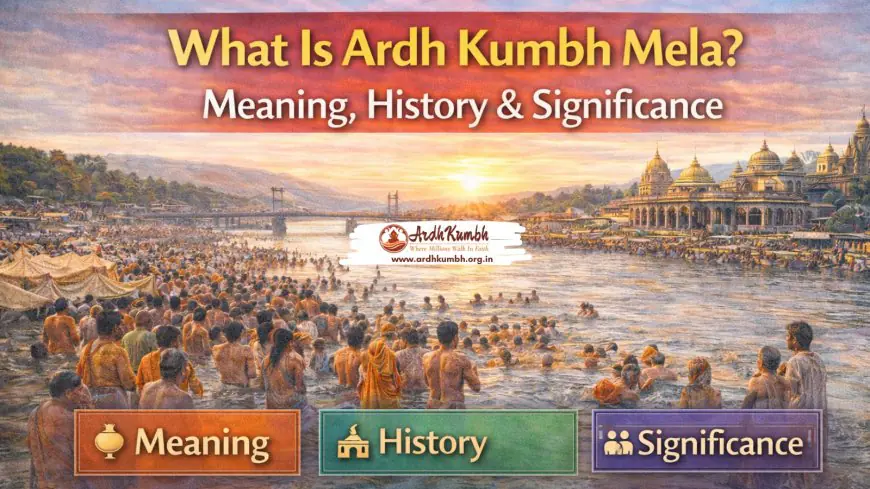
What Is Ardh Kumbh Mela? Meaning, History & Significance
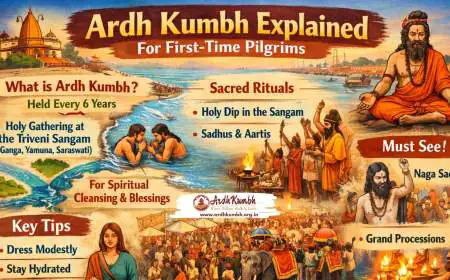
Ardh Kumbh Mela is a sacred Hindu pilgrimage held midway between Kumbh Melas, symbolising spiritual purification, faith, and renewal of dharma.
Understanding Ardh Kumbh Mela in Simple Words
The Ardh Kumbh Mela is one of the most important spiritual gatherings in Hindu tradition, but for many people, the meaning is not clearly understood. Most pilgrims hear the word “Kumbh” often, yet they are unsure what makes Ardh Kumbh different or why it exists at all.
In simple words, Ardh Kumbh Mela is a sacred gathering that happens as part of a larger spiritual cycle. It is not a random festival, a tourist event, or a cultural fair. It exists because Hindu tradition believes that certain periods of time are spiritually powerful, and during those times, gathering together for prayer, bathing, and reflection brings deep inner benefit.
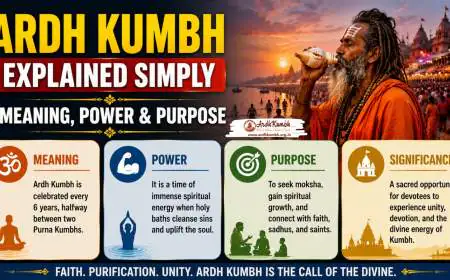
The word “Ardh” means half. This does not mean half importance or half value. It means halfway in a spiritual cycle. Just like people pause midway in life to reflect, renew discipline, and correct direction, Ardh Kumbh exists as a midpoint spiritual pause.
The word “Kumbh” refers to a sacred pot, but in spiritual understanding, it represents Amrit, which means divine nectar or spiritual energy. This nectar is not something you can see or hold. It represents purity, wisdom, and liberation from suffering.
Trending Guides Now

What Makes Ardh Kumbh Spiritually So Powerful?
Read Guide →
Is Ardh Kumbh a Once-in-a-Lifetime Experience?
Read Guide →
Can Ardh Kumbh Shape Your Daily Discipline? A Journey That Lasts Longer Than the Dip
Read Guide →
Is Ardh Kumbh Truly Meant for Everyone?
Read Guide →
Best Routes to Reach Haridwar for Ardh Kumbh Mela
Read Guide →
Ardh Kumbh 2027 Dates (Official) - Haridwar Snan Schedule
Read Guide →
How Kumbh Keeps India’s Civilizational Memory Alive
Read Guide →
February Weather Reality at Ardh Kumbh
Read Guide →So when we say Ardh Kumbh Mela, we are talking about a mid-cycle spiritual gathering focused on purification, discipline, and renewal.
Attending the next Ardh Kumbh?
Get official dates, snan rules, Akharas, and planning guidance in our complete event guide.
→ Ardh Kumbh Mela 2027 Complete Guide
Ardh Kumbh Is Not a Regular Festival
Many first-time readers think Ardh Kumbh is like a large religious fair. This is not correct.
A fair is organised for enjoyment or celebration. Ardh Kumbh Mela is organised for spiritual discipline. People do not attend just to watch or pass time. They attend to participate in a system that has been followed for thousands of years.
Everything at Ardh Kumbh follows rules:
-
When people bathe
-
Who bathes first
-
How rituals are performed
-
How discipline is maintained
These rules exist to protect the spiritual purpose of the gathering.
To truly experience the spiritual power of Ardh Kumbh, every devotee should explore Shahi Snan rituals and Akhara traditions, which explain the sacred bathing process, monastic discipline, and ancient customs that shape this holy gathering. This guide helps pilgrims connect deeply with the true essence of the Mela.
Why People Gather at Ardh Kumbh
People come to Ardh Kumbh for different reasons, but the core purpose is the same.
Some come to seek inner peace.
Some come to cleanse their mind and actions.
Some come to continue family traditions.
Some come to observe saints and spiritual teachers.
In simple terms, Ardh Kumbh is about stopping, reflecting, and resetting life’s direction.
In daily life, people are busy with work, money, family pressure, and stress. Ardh Kumbh creates a space where life slows down and focus turns inward.
Why Bathing Is Important
One of the most visible parts of Ardh Kumbh is ritual bathing.
In Hindu thought, water represents purity and flow. Bathing during Ardh Kumbh is not about cleaning the body. It is about symbolic cleansing of thoughts, habits, and past actions.
People believe that when they bathe with faith and discipline during Ardh Kumbh, they let go of negativity and start fresh.
Even those who do not fully understand philosophy still participate because the act itself carries meaning through tradition.
Who Ardh Kumbh Is For
A common misunderstanding is that Ardh Kumbh is only for saints or religious experts.
This is not true.
Ardh Kumbh is for:
-
Ordinary families
-
Elderly people
-
Young adults
-
First-time pilgrims
-
Spiritual seekers
Saints and ascetics play a guiding role, but the gathering exists for society as a whole.
Why Discipline Matters at Ardh Kumbh
People often notice that Ardh Kumbh has strict rules. Movement is controlled. Waiting is common. Instructions must be followed.
This discipline is not meant to trouble pilgrims. It teaches patience, humility, and order. In spiritual traditions, discipline itself is considered a form of worship.
Ardh Kumbh shows that faith is not only emotion. It is also practice and restraint.
Ardh Kumbh as a Living Tradition
Ardh Kumbh is not something recreated from history books. It is a living tradition that continues because people believe in it.
No one is forced to attend. People come voluntarily, generation after generation. This continuity is what makes Ardh Kumbh special.
It is not remembered.
It is not reenacted.
It is lived.
Why Understanding Comes Before Attending
Many people attend Ardh Kumbh without understanding it. They still gain something. But those who understand its meaning experience it more deeply.
When you know why Ardh Kumbh exists,
when you know what it represents,
and when you know how to approach it,
the experience becomes calmer, clearer, and more meaningful.
That is why learning about Ardh Kumbh in simple words is the first and most important step.
Meaning of Ardh and Kumbh Explained Simply
To understand Ardh Kumbh Mela, it is important to clearly understand the two words that form its name: Ardh and Kumbh. Many misunderstandings about Ardh Kumbh happen because these words are taken in a literal or incomplete way.
This section explains both words in the simplest possible manner.
Meaning of “Ardh” in Simple Words
The word Ardh comes from Sanskrit and means half.
But in Hindu tradition, Ardh does not mean half value or half importance. It means halfway in a cycle.
In Indian philosophy, life and time are seen as cycles, not straight lines. Just like:
-
A year has seasons
-
Life has stages
-
Spiritual practice has phases
there are moments meant for review, correction, and renewal.
Ardh represents that midpoint.
So when Ardh is used in Ardh Kumbh, it means:
-
Halfway point between two major spiritual cycles
-
A time to renew discipline
-
A moment to reconnect with spiritual purpose
It does not mean something smaller, weaker, or less sacred.
Why “Ardh” Is Spiritually Important
In daily life, people pause midway to check direction. Farmers check crops mid-season. Students revise before exams. Families reassess priorities at different stages.
In the same way, Ardh Kumbh exists as a spiritual pause.
It allows:
-
Saints to renew vows
-
Families to reconnect with faith
-
Society to realign values
That is why Ardh is considered necessary, not optional.
Meaning of “Kumbh” in Simple Words
The word Kumbh means pot or vessel.
But in spiritual understanding, Kumbh does not refer to an ordinary pot used at home. It represents a container of sacred energy.
In Hindu philosophy:
-
A pot holds water
-
Water represents life
-
Sacred water represents purity and wisdom
So Kumbh symbolically means a container of Amrit, or divine essence.
Amrit does not mean a physical liquid. It represents:
-
Truth
-
Purity
-
Liberation from suffering
-
Inner clarity
So when people speak of Kumbh, they are referring to a spiritual opportunity, not an object.
Why Kumbh Is Linked to Human Life
The human body itself is often compared to a Kumbh.
Just like a pot:
-
The body holds life
-
The mind holds thoughts
-
The heart holds intention
Ardh Kumbh reminds people to clean the container, meaning:
-
Clean thoughts
-
Disciplined actions
-
Pure intention
This is why Kumbh is deeply connected to self-reflection, not external celebration.
Combined Meaning of Ardh Kumbh
When we combine both words, Ardh Kumbh means:
A mid-cycle spiritual gathering meant for purification, renewal, and discipline, based on ancient tradition.
It is not:
-
A fair
-
A holiday
-
A tourist event
It is a structured spiritual pause in a long-running cycle of faith.
Why the Name Matters
Names in Hindu tradition are not random. They explain purpose.
The name Ardh Kumbh itself tells us:
-
When it happens in the cycle
-
Why it happens
-
What it is meant to achieve
Understanding the name helps people approach the event with the right mindset, not confusion or unrealistic expectations.
Simple Way to Remember the Meaning
You can remember Ardh Kumbh like this:
Ardh means halfway
Kumbh means sacred container
Ardh Kumbh means halfway spiritual renewal
This simple understanding is enough to grasp the foundation of Ardh Kumbh Mela.
Why This Understanding Is Important
When people misunderstand Ardh and Kumbh, they:
-
Compare events incorrectly
-
Expect comfort over discipline
-
Miss the spiritual purpose
When people understand the meaning, they:
-
Respect the tradition
-
Participate patiently
-
Gain deeper value
That is why meaning comes before attendance.
What Is Ardh Kumbh Mela in Hindu Tradition
In Hindu tradition, Ardh Kumbh Mela is not seen as a festival created by people. It is seen as a spiritual practice that follows the natural order of time. It exists because Hindu thought believes that certain moments are meant for reflection, cleansing, and renewal, not because anyone decided to organise a large gathering.
Ardh Kumbh is part of Sanatan Dharma, which means a way of life that flows continuously without beginning or end. In this tradition, faith is not only personal. It is also collective, practiced together at specific moments that hold spiritual importance.
Ardh Kumbh as a Dharmic Gathering
In Hindu understanding, Dharma means living in balance with truth, duty, and discipline. Ardh Kumbh Mela functions as a dharmic gathering where people step away from daily routines and reconnect with these values.
It is not about entertainment or celebration. It is about:
-
Self-discipline
-
Humility
-
Reflection
-
Renewal of faith
People attend not to escape life, but to realign life.
Role of Time in Hindu Tradition
Hindu tradition treats time as cyclical, not linear. This means events return again and again in a rhythm.
Ardh Kumbh exists because:
-
Certain points in time are considered spiritually powerful
-
Midpoints are important for correction and balance
-
Spiritual effort is meant to be renewed, not postponed
Ardh Kumbh is that midpoint where individuals and society pause together.
Collective Practice, Not Individual Ritual
Many Hindu practices are done individually, like daily prayer or fasting. Ardh Kumbh Mela is different because it is collective.
When millions gather with the same intention:
-
Faith becomes visible
-
Discipline becomes shared
-
Spiritual focus becomes stronger
Hindu tradition believes that collective practice multiplies spiritual effect.
Why Ardh Kumbh Is Not Optional in Tradition
In Hindu belief, Ardh Kumbh is not something that can be skipped without reason. Saints, ascetics, and spiritual teachers treat it as a duty, not a choice.
This does not mean every person must attend physically. It means the tradition itself must be observed so that spiritual continuity remains unbroken.
Importance of Saints and Ascetics
Saints and ascetics play a central role in Ardh Kumbh, not as leaders of people, but as guardians of tradition.
They:
-
Preserve ancient practices
-
Maintain discipline
-
Ensure rituals are performed correctly
Their presence reminds society that Ardh Kumbh is rooted in renunciation, not comfort.
Ardh Kumbh and Household Life
Ardh Kumbh is not meant only for monks. Hindu tradition balances two paths:
-
Renunciation
-
Household responsibility
Ardh Kumbh brings both together. Families, elders, and young people participate alongside ascetics, each according to their role.
This balance is central to Hindu philosophy.
Why Rules Matter in Ardh Kumbh
People often wonder why there are many rules during Ardh Kumbh.
In Hindu tradition, rules are not restrictions. They are protective boundaries.
Rules ensure:
-
Safety
-
Fairness
-
Order
-
Spiritual focus
Without rules, the gathering would lose its meaning.
Ardh Kumbh as Preservation of Tradition
Ardh Kumbh has continued for centuries because it is practiced, not explained away. Each generation participates, learns, and passes it forward.
Hindu tradition values such living practices more than written instruction alone.
Why Ardh Kumbh Still Holds Meaning
Even today, Ardh Kumbh remains relevant because it addresses universal needs:
-
Inner peace
-
Moral reset
-
Community connection
-
Respect for discipline
These needs do not change with time.
Simple Way to Understand Ardh Kumbh in Hindu Tradition
In the simplest words:
Ardh Kumbh is a collective spiritual pause
It is rooted in Hindu understanding of time and duty
It exists to renew faith, discipline, and balance
Understanding this helps people participate with respect rather than confusion.
Scriptural Origin of Ardh Kumbh Mela
The origin of Ardh Kumbh Mela is deeply rooted in Hindu scriptures, where time, space, and human life are viewed as part of a larger cosmic order. In these texts, important spiritual practices are not decided by human convenience. They arise naturally when certain conditions of time and place come together. Ardh Kumbh belongs to this category of practices that are scripturally supported, symbolically rich, and continuously followed.
To understand the scriptural foundation of Ardh Kumbh, one must first understand how Hindu texts explain the ideas of Amrit, sacred rivers, and cyclical spiritual gatherings.
Samudra Manthan and the Concept of Amrit
The philosophical root of all Kumbh traditions comes from the story of Samudra Manthan, described in ancient Hindu texts such as the Bhagavata Purana, Vishnu Purana, and Padma Purana.
In simple words, Samudra Manthan describes the churning of the cosmic ocean by divine and opposing forces. The purpose of this churning was not material gain, but the emergence of Amrit, which represents freedom from decay, suffering, and ignorance.
This story is symbolic, not literal. The ocean represents the human mind and the universe. The churning represents effort, discipline, and struggle. The many objects that emerge represent experiences of life. Among all of them, Amrit represents ultimate clarity and liberation.
Amrit in scriptures is not described as a drink that makes the body immortal. It is described as a state of spiritual awakening. This is why Amrit cannot be owned, stored, or consumed like an object. It can only be experienced.
Why Amrit Is Linked to Sacred Bathing
Hindu scriptures often use water as a symbol of purity, flow, and transformation. When Amrit is associated with water, it does not mean that water physically turns into nectar. It means that certain moments and places make inner purification easier.
Sacred bathing emerges from this idea. Bathing becomes a symbolic act where a person:
-
Lets go of mental burden
-
Acknowledges past actions
-
Commits to inner discipline
In this understanding, sacred bathing is not about washing the body, but about resetting intention. The act becomes meaningful only when combined with faith and discipline.
This is the philosophical base from which Kumbh and Ardh Kumbh practices arise.
Why Certain Places Became Kumbh Sites
Hindu scriptures describe certain locations as Tirthas, which means crossing points between the ordinary and the sacred. These are places where spiritual awareness is believed to be naturally heightened.
Such places are often connected to rivers, because rivers represent continuity, life, and movement. Rivers flow across regions without discrimination, symbolising equality and collective existence.
Scriptures describe sacred rivers as carriers of spiritual memory. This does not mean memory in a scientific sense, but in a symbolic and cultural sense, where repeated faith over generations strengthens meaning.
This is why Kumbh-related gatherings are location-specific. They cannot be moved or replicated elsewhere, because the spiritual meaning is tied to the place itself, not convenience.
Why Ardh Kumbh Is Location-Specific
Ardh Kumbh exists only at specific Kumbh locations because Hindu tradition treats place as sacred, not interchangeable.
Each Kumbh site has its own scriptural identity based on:
-
River significance
-
Mythological association
-
Long-standing ascetic presence
Ardh Kumbh is observed only where scriptures allow a mid-cycle gathering. This ensures that the practice remains aligned with tradition, not expanded arbitrarily.
How Ardh Kumbh Emerged as a Separate Observance
Hindu scriptures and commentaries recognise that spiritual effort should not be postponed for long intervals. Waiting too long weakens discipline and continuity.
This is why mid-cycle observances are supported. Ardh Kumbh emerges from this logic. It exists to:
-
Renew vows of ascetics
-
Re-establish ritual discipline
-
Allow society to reconnect with tradition
Ardh Kumbh is not an innovation. It is a scripturally justified midpoint gathering that preserves momentum between larger cycles.
Difference Between Annual Baths and Kumbh Baths
Hindu tradition allows regular sacred bathing at rivers throughout the year. These baths are personal and routine.
Kumbh and Ardh Kumbh baths are different because they are:
-
Time-bound
-
Collective
-
Governed by strict discipline
Annual baths focus on individual devotion. Kumbh baths focus on collective spiritual alignment. This distinction is clearly maintained in scriptural thought.
How Ardh Kumbh Was Preserved Over Centuries
Ardh Kumbh survived not because it was enforced, but because it was respected.
Saints preserved it by practicing it.
Communities preserved it by participating in it.
Tradition preserved it by passing it forward.
Even when political systems changed, the scriptural framework remained unchanged. This continuity confirms that Ardh Kumbh is not a social habit, but a deeply rooted spiritual institution.
Why Scripture Still Matters Today
Understanding the scriptural origin of Ardh Kumbh helps modern readers see it clearly. It is not superstition. It is not blind belief. It is a symbolic system designed to guide human behaviour toward balance and reflection.
When scripture, place, and practice align, Ardh Kumbh naturally takes form.
That is why Ardh Kumbh is not recreated by planning.
It emerges when conditions are fulfilled.
Historical Evolution of Ardh Kumbh Mela
The historical evolution of Ardh Kumbh Mela explains how this tradition has continued across centuries without interruption. Unlike festivals started by rulers or institutions, Ardh Kumbh developed through belief, practice, and continuity. Its history is not tied to one moment but unfolds gradually through human participation guided by faith.
Ardh Kumbh in the Ancient Period
In the ancient period, spiritual life in India revolved around sages, rishis, and wandering ascetics. These seekers lived close to nature, especially near sacred rivers, which were considered ideal places for meditation and self-discipline.
During this time, early sages and ascetics gathered naturally at spiritually important locations. There were no announcements, schedules, or organisers. People came because tradition taught them that certain moments were meant for collective spiritual effort.
Oral Tradition and Community Memory
Knowledge about Ardh Kumbh practices was passed down through oral tradition and community memory. Elders shared stories, rituals, and lived experiences with younger generations.
Written records were not the primary method because spiritual knowledge was believed to be lived and experienced, not documented. Faith survived through repetition, memory, and participation, not written instruction.
Why Written Records Were Limited
In early Hindu tradition, writing was not considered the strongest way to preserve spiritual truth. The focus was on discipline, practice, and direct experience.
This is why Ardh Kumbh traditions survived even without detailed written documentation. The tradition lived in people, not books.
Growth of Organized Ascetic Groups
As society evolved, the medieval period brought larger gatherings and more participants. This growth led to the formation of organized ascetic groups, later known as akharas.
Akharas were created to:
-
Preserve teachings
-
Maintain discipline
-
Protect spiritual traditions
They were not political groups. They were spiritual institutions meant to safeguard order.
Development of Akharas and Discipline
With increasing numbers, discipline became essential. Akharas introduced rules for rituals, conduct, and training of ascetics. This helped prevent conflict and ensured the spiritual purpose of Ardh Kumbh remained intact.
This period marked an important shift where structure strengthened tradition, rather than weakening it.
Recognition by Kingdoms and Local Administrations
In the pre-modern and early modern period, rulers and local administrations began recognising Ardh Kumbh Mela as an important spiritual gathering.
Support was practical, not controlling. Authorities helped with:
-
Safety
-
Basic facilities
-
Protection of pilgrims
Crucially, ritual authority remained untouched.
Why Ardh Kumbh Was Never Stopped
Despite changes in rulers, borders, and systems, Ardh Kumbh was never stopped. The reason is simple.
It did not depend on political power.
It depended on belief and participation.
When a tradition lives in people’s faith, it survives every external change.
Ardh Kumbh in Modern India
In modern India, the state plays a supportive role. Governments manage logistics, infrastructure, and safety, while spiritual authority remains with traditional custodians.
This separation ensures that Ardh Kumbh remains authentic, even at a very large scale.
How Tradition Remained Unchanged
Technology, planning tools, and modern systems help manage crowds, but they do not change:
-
Ritual discipline
-
Spiritual purpose
-
Traditional hierarchy
This balance allows Ardh Kumbh Mela to remain true to its roots while adapting externally.
Why Ardh Kumbh Is Still Relevant Today
Even in modern life, people feel the need to pause, reflect, and reconnect. Ardh Kumbh provides that pause.
It offers:
-
Inner renewal
-
Moral reflection
-
Collective discipline
These needs do not disappear with time.
Ardh Kumbh as a Living Tradition
The history of Ardh Kumbh Mela shows that it is not a tradition frozen in the past. It is living and active, carried forward by people who believe in it.
Those who attend today are not observing history.
They are continuing history.
This uninterrupted continuity is what makes Ardh Kumbh Mela one of the most enduring spiritual traditions in the world.
Spiritual Significance of Ardh Kumbh Mela Explained Simply
The spiritual significance of Ardh Kumbh Mela lies in its purpose, not its size. In Hindu tradition, Ardh Kumbh is not important because millions gather. It is important because it creates a collective moment for inner cleansing, discipline, and spiritual renewal.
Ardh Kumbh exists to remind people that life is not only about earning, surviving, or achieving goals. It is also about pausing, reflecting, and correcting direction.
Ardh Kumbh as a Time for Inner Cleansing
In Hindu thought, cleansing is not limited to the body. The mind and actions also collect impurities such as anger, greed, fear, and ego. The Ardh Kumbh Mela is seen as a time when people consciously try to release these burdens.
The spiritual idea is simple:
-
The body enters water
-
The mind enters reflection
-
The heart enters humility
This combination is what gives Ardh Kumbh spiritual meaning.
Why Bathing Holds Spiritual Meaning
The most visible act at Ardh Kumbh is ritual bathing, also known as snan. Many misunderstand this as superstition or habit.
In reality, snan during Ardh Kumbh is symbolic. Water represents flow and renewal. When people bathe with faith and discipline, they symbolically:
-
Let go of past mistakes
-
Accept responsibility for actions
-
Commit to better living
The bath is not powerful by itself. Its power comes from intention, timing, and belief.
Karma and Spiritual Reset
Hindu philosophy teaches that every action leaves an impression, known as karma. Over time, these impressions affect thoughts, behaviour, and peace of mind.
The spiritual significance of Ardh Kumbh is that it provides a moment to pause karmic momentum. People reflect on how they have lived and decide how they want to live next.
This is why Ardh Kumbh is often described as a spiritual reset, not a reward.
Why Ardh Kumbh Is Important for Ordinary People
A common misunderstanding is that Ardh Kumbh is mainly for saints or highly religious people. This is not true.
Ardh Kumbh is especially meaningful for:
-
Families under stress
-
Elderly people seeking peace
-
Young people searching for direction
-
Individuals feeling disconnected
The gathering allows ordinary people to step out of daily pressure and reconnect with values, discipline, and simplicity.
Role of Discipline in Spiritual Growth
Many people notice strict rules at Ardh Kumbh and feel confused. From a spiritual point of view, discipline is central.
Waiting patiently, following instructions, and accepting discomfort are part of the practice. Hindu tradition teaches that self-control strengthens the mind.
In this way, Ardh Kumbh becomes a training ground for:
-
Patience
-
Humility
-
Respect for order
These qualities are considered spiritual achievements.
Collective Faith and Its Power
One unique spiritual aspect of Ardh Kumbh Mela is collective participation. When millions focus on purification and reflection at the same time, it creates a powerful shared atmosphere.
Hindu tradition believes that collective faith amplifies individual effort. Even people with weak personal discipline benefit from being part of a disciplined group.
This is why Ardh Kumbh is organised as a mass gathering rather than a private ritual.
Ardh Kumbh and Renunciation
Saints and ascetics play a visible role at Ardh Kumbh, not to display power, but to represent renunciation.
Renunciation does not mean leaving society forever. It means reducing attachment to ego, comfort, and excess.
Seeing ascetics reminds ordinary people that:
-
Happiness does not depend on possessions
-
Simplicity brings clarity
-
Discipline brings freedom
This silent teaching is a major part of Ardh Kumbh’s spiritual impact.
Spiritual Meaning Beyond Religion
Even for those who are not deeply religious, the spiritual significance of Ardh Kumbh can be understood at a human level.
It offers:
-
Mental pause in a fast life
-
Emotional release
-
Sense of belonging
-
Respect for tradition
These benefits are universal, not limited to belief systems.
Why Ardh Kumbh Is Still Spiritually Relevant
Modern life is filled with stress, competition, and distraction. Ardh Kumbh remains relevant because it addresses these problems at their root.
It encourages people to:
-
Slow down
-
Reflect honestly
-
Reconnect with values
As long as people seek peace and balance, Ardh Kumbh Mela will remain spiritually meaningful.
Simple Way to Understand the Spiritual Significance
In the simplest words:
Ardh Kumbh is a pause for the soul
It is a reset for the mind
It is a discipline for the heart
Understanding this helps people experience Ardh Kumbh not as a crowd, but as a personal spiritual journey within a collective space.
Role of Akharas in Preserving Ardh Kumbh Tradition
The role of Akharas in preserving Ardh Kumbh tradition is central and irreplaceable. Without Akharas, Ardh Kumbh would lose its structure, discipline, and spiritual authority. In Hindu tradition, Akharas are not event organisers or social groups. They are custodians of spiritual discipline who ensure that ancient practices continue exactly as intended.
Ardh Kumbh survives because Akharas protect its rules, values, and purpose, generation after generation.
What Are Akharas in Simple Words
Akharas are organised spiritual orders made up of saints, ascetics, and renunciates. They exist to preserve teachings, train disciples, and maintain strict discipline. Each Akhara follows a well-defined path of practice, behaviour, and responsibility.
In simple terms, Akharas are guardians of tradition, not institutions of power.
Why Akharas Exist
As spiritual gatherings grew larger, discipline became necessary. Without discipline, confusion, conflict, and loss of purpose could occur. Akharas were formed to bring order without weakening faith.
They exist to:
-
Protect spiritual practices
-
Maintain ethical conduct
-
Ensure rituals are performed correctly
-
Train future generations of ascetics
This is why Ardh Kumbh Mela depends on Akharas to remain authentic.
Akharas as Spiritual Authorities
In Ardh Kumbh, Akharas hold spiritual authority, not administrative power. Their authority comes from renunciation, discipline, and lineage, not from force or position.
People respect Akharas because their members live lives of restraint and service. This moral authority allows them to guide massive gatherings without domination.
Preserving Ritual Discipline
One of the most important roles of Akharas is preserving ritual discipline.
They ensure that:
-
Sacred practices are not altered
-
Ritual order is respected
-
Spiritual hierarchy is maintained
This discipline prevents Ardh Kumbh from turning into an unstructured crowd event. Order protects meaning.
Transmission of Knowledge Across Generations
Akharas function like living schools. Knowledge is passed from teacher to disciple through training, observation, and practice, not only through books.
This system ensures that:
-
Teachings remain practical
-
Values are lived, not only spoken
-
Tradition stays consistent
Because of this, Ardh Kumbh tradition survives even without written instruction.
Why Akharas Are Independent of Political Power
A key reason Ardh Kumbh survived historical changes is that Akharas remain independent of political systems. They do not depend on rulers or governments for legitimacy.
Support may be accepted for safety or logistics, but spiritual control always remains with Akharas. This independence protects the tradition from manipulation or dilution.
Coordination and Collective Decision-Making
Akharas do not act randomly. They follow collective decision-making through traditional councils and consensus. The Akhara Parishad functions as a coordinating body that helps maintain unity and resolve disputes.
This collective approach prevents fragmentation and ensures that Ardh Kumbh remains one unified spiritual tradition.
Teaching Through Example
Perhaps the most powerful role of Akharas is teaching through example. Ascetics live with minimal possessions, strict discipline, and constant practice.
For ordinary people, this offers a silent lesson:
-
Simplicity brings clarity
-
Discipline builds strength
-
Detachment reduces suffering
This influence cannot be replaced by instruction alone.
Why Ardh Kumbh Cannot Exist Without Akharas
Ardh Kumbh is not defined by crowds or rituals alone. It is defined by discipline, order, and spiritual continuity.
Without Akharas:
-
Rituals would lose structure
-
Authority would weaken
-
Tradition would fragment
That is why Akharas are the backbone of Ardh Kumbh tradition.
Akharas as Keepers of Continuity
Over centuries, generations changed, societies transformed, and systems evolved. Akharas remained constant.
They carried Ardh Kumbh forward not by adapting its meaning, but by protecting its core.
This continuity is the reason Ardh Kumbh is still recognised today as an authentic spiritual gathering.
Simple Way to Understand the Role of Akharas
In simple words:
Akharas protect discipline
Akharas preserve tradition
Akharas ensure continuity
Without them, Ardh Kumbh would not survive as a spiritual institution.
Why Ardh Kumbh Is Different From Other Pilgrimages
Many people think that Ardh Kumbh Mela is just another large pilgrimage like visiting a temple or a holy town. This understanding is incomplete. Ardh Kumbh is fundamentally different from other pilgrimages in purpose, structure, discipline, and spiritual depth.
To understand this difference, it is important to look beyond crowds and rituals and focus on how Ardh Kumbh functions in Hindu tradition.
Ardh Kumbh Is Time-Based, Not Place-Based Alone
Most pilgrimages are connected mainly to a place. People can visit temples or sacred rivers at any time of the year. The spiritual value comes from the location itself.
Ardh Kumbh Mela is different because it is tied to sacred time as much as sacred place. It exists only when certain spiritual conditions are fulfilled. This makes Ardh Kumbh a time-bound spiritual gathering, not an anytime pilgrimage.
Because of this, Ardh Kumbh cannot be visited casually or repeatedly at will.
Ardh Kumbh Is Collective, Not Individual
Most pilgrimages are individual or family-based. People go according to personal convenience, pray, and return.
Ardh Kumbh Mela is collective by design. Millions participate together, following the same discipline and purpose. The experience is shared, not private.
Hindu tradition believes that collective spiritual effort creates stronger impact than individual practice. This collective nature sets Ardh Kumbh apart.
Strict Discipline Is Central to Ardh Kumbh
In many pilgrimages, people move freely and follow personal routines. Rules are minimal.
At Ardh Kumbh, discipline is essential. Movement, rituals, and behaviour follow strict order. Waiting, patience, and obedience are part of the experience.
This discipline teaches:
-
Humility
-
Self-control
-
Respect for tradition
In Hindu philosophy, discipline itself is a spiritual practice, not a limitation.
Presence of Ascetics Makes Ardh Kumbh Unique
While saints may visit temples or pilgrimages, Ardh Kumbh is centred around ascetics and renunciates. Their presence is not decorative or optional.
Ascetics represent:
-
Renunciation
-
Detachment
-
Lifelong spiritual commitment
Their central role makes Ardh Kumbh a spiritual institution, not just a devotional journey.
Ritual Order Matters More Than Personal Preference
In most pilgrimages, people choose when and how they worship.
At Ardh Kumbh Mela, ritual order is fixed and respected. Who performs rituals first, how bathing happens, and when public participation begins are all decided by tradition.
This order ensures:
-
Fairness
-
Spiritual integrity
-
Continuity
Personal convenience is secondary to collective discipline.
Ardh Kumbh Is a Renewal, Not a Request
Many pilgrimages focus on asking for blessings, solving problems, or fulfilling wishes.
Ardh Kumbh is about renewal, not requests. People come to:
-
Reflect on life
-
Correct behaviour
-
Strengthen discipline
It is less about asking and more about becoming better.
The Experience Is Demanding by Design
Other pilgrimages often aim for comfort and ease.
Ardh Kumbh Mela is physically and mentally demanding, and this is intentional. Walking long distances, waiting patiently, and adjusting to discomfort are part of the spiritual training.
Hindu tradition teaches that growth comes through effort, not ease.
Ardh Kumbh Is a Living System, Not an Event
Most pilgrimages are events people attend.
Ardh Kumbh is a living system maintained by tradition, discipline, and continuity. It exists whether or not individuals attend.
People do not create Ardh Kumbh.
They join it.
Why Understanding This Difference Matters
When people treat Ardh Kumbh like an ordinary pilgrimage, they often feel confused or frustrated. When they understand its uniqueness, they experience calm and meaning.
Understanding the difference helps pilgrims:
-
Prepare mentally
-
Respect discipline
-
Gain deeper value
Simple Way to Understand the Difference
In simple words:
Other pilgrimages focus on place
Ardh Kumbh focuses on time and discipline
Other pilgrimages are personal
Ardh Kumbh is collective
Other pilgrimages are comfortable
Ardh Kumbh is transformational
Why This Difference Preserves the Tradition
If Ardh Kumbh became like other pilgrimages, it would lose its identity. Its strictness is what protects its meaning.
That is why Ardh Kumbh remains different, and that difference is its strength.
Cultural and Social Importance of Ardh Kumbh Mela
The cultural and social importance of Ardh Kumbh Mela goes far beyond religion. While its foundation is spiritual, its impact touches community life, shared values, social harmony, and cultural continuity. Ardh Kumbh is not only about individual faith; it is about how society comes together to remember who it is and what it stands for.
A Living Expression of Indian Culture
The Ardh Kumbh Mela is one of the clearest living expressions of Indian culture. It brings together traditions that are thousands of years old and presents them in a form that people can still experience today.
Languages, customs, food habits, clothing styles, and regional practices all appear side by side. People from different parts of the country meet without barriers. This shared space creates a sense of cultural unity without uniformity.
Unity Beyond Social Differences
One of the most powerful social aspects of Ardh Kumbh is equality. At the gathering, people from all backgrounds stand together.
There is no importance given to:
-
Wealth
-
Status
-
Occupation
-
Region
What matters is participation, discipline, and respect for tradition. This experience reminds society that shared values are stronger than social divisions.
Role of Seva and Voluntary Service
Service, known as seva, is central to the social spirit of Ardh Kumbh Mela. Thousands of volunteers serve food, water, medical help, and guidance without expecting anything in return.
This culture of service teaches:
-
Compassion
-
Responsibility
-
Community support
For many people, performing seva is as meaningful as ritual practice. It reinforces the idea that spirituality includes caring for others.
Transmission of Values Across Generations
Families often attend Ardh Kumbh together. Elders explain customs to children. Young people observe discipline in action. This creates inter-generational learning that books alone cannot provide.
Values such as:
-
Patience
-
Respect
-
Simplicity
-
Self-control
are learned naturally through observation and participation. This makes Ardh Kumbh an informal cultural classroom.
Preserving Oral Traditions and Folk Knowledge
Alongside rituals, stories, teachings, songs, and traditional explanations are shared. Saints speak, elders narrate experiences, and discussions happen naturally.
This keeps oral tradition alive, which is an important part of Indian culture. Knowledge is not limited to written texts; it flows through conversation and shared experience.
Strengthening Community Bonds
People who attend Ardh Kumbh often return with a stronger sense of connection to society. Sharing hardship, waiting together, and helping strangers create bonds that last beyond the event.
This shared experience builds:
-
Trust
-
Mutual respect
-
Collective identity
Such bonds are rare in modern life and are a key social benefit of Ardh Kumbh Mela.
Cultural Continuity in a Changing World
Modern life changes rapidly, but Ardh Kumbh provides continuity. It reassures people that some values remain constant even as lifestyles evolve.
The gathering shows that tradition does not block progress. It grounds progress by reminding society of its roots.
Encouraging Simplicity and Balance
Ardh Kumbh temporarily removes people from comfort and routine. This experience encourages simplicity and reflection.
Many participants return with:
-
Reduced attachment to excess
-
Greater appreciation for basics
-
Better emotional balance
This shift benefits not just individuals but families and communities as well.
Why Cultural and Social Importance Matters
Understanding the cultural and social importance of Ardh Kumbh Mela helps people see it clearly. It is not only about rituals or belief. It is about how a society renews itself.
It strengthens culture, builds unity, teaches values, and keeps tradition alive through participation rather than instruction.
Simple Way to Understand Its Importance
In simple words:
Ardh Kumbh connects people
Ardh Kumbh preserves culture
Ardh Kumbh strengthens society
That is why its value goes beyond religion.
Why Ardh Kumbh Still Matters in Modern Life
In today’s fast-moving world, many people question the relevance of ancient traditions. Yet the importance of Ardh Kumbh in modern life remains strong because it addresses problems that modern systems often fail to solve. Stress, isolation, imbalance, and loss of meaning are common today, and Ardh Kumbh Mela responds to these issues at a human level.
Ardh Kumbh matters not because it is old, but because it is useful.
A Pause in a Constantly Busy Life
Modern life rarely allows people to pause. Work pressure, digital screens, financial stress, and social competition keep the mind constantly active.
The spiritual value of Ardh Kumbh lies in its ability to create a forced pause. People step away from routine and enter a space where slowing down is normal. This pause allows the mind to settle and the heart to reflect.
In a world that rewards speed, Ardh Kumbh teaches the value of stillness.
Mental Health Through Simplicity
Many modern mental health issues arise from overload and comparison. Ardh Kumbh promotes simplicity through basic living, limited possessions, and disciplined routines.
When people experience simple food, shared space, and limited comfort, they often realise how little is actually needed for peace. This simplicity creates mental clarity and emotional balance.
The relevance of Ardh Kumbh today lies in reminding people that peace does not require excess.
Restoring Human Connection
Modern communication is fast but often shallow. People are connected digitally but disconnected emotionally.
Ardh Kumbh Mela restores real human connection. People walk together, wait together, help strangers, and share experiences. This physical presence builds trust and empathy.
Such connection is rare today, making Ardh Kumbh socially meaningful even beyond religion.
Discipline as a Modern Need
Discipline is often misunderstood as restriction. In reality, discipline creates freedom.
At Ardh Kumbh, discipline is practiced collectively. Following instructions, waiting patiently, and respecting order strengthen self-control. These habits directly benefit modern life, where lack of discipline leads to stress and chaos.
The discipline of Ardh Kumbh trains the mind to stay calm under pressure.
Values Over Material Success
Modern success is often measured by wealth, status, and achievement. Ardh Kumbh shifts focus to values such as humility, service, patience, and restraint.
Witnessing ascetics and volunteers reminds people that respect comes from character, not possessions. This value shift helps individuals rethink priorities.
In this way, Ardh Kumbh remains morally relevant.
A Sense of Belonging in a Fragmented World
Many people today feel disconnected from community and tradition. Ardh Kumbh offers belonging without conditions.
People are accepted without introduction, qualification, or identity labels. Participation alone creates inclusion. This sense of belonging is deeply healing in modern society.
Spirituality Without Complexity
Modern people often avoid spirituality because it feels complicated or rigid. Ardh Kumbh offers simple spirituality.
No advanced knowledge is required. Participation, sincerity, and respect are enough. This accessibility makes Ardh Kumbh meaningful even for those who are not deeply religious.
Why Younger Generations Still Find Meaning
Young people face uncertainty, pressure, and identity confusion. Ardh Kumbh offers grounding.
Seeing a tradition that survived centuries gives perspective. It shows that life is larger than individual struggle and that discipline and patience have long-term value.
This is why Ardh Kumbh continues to attract younger generations, even in modern times.
Tradition as Stability, Not Resistance
Some see tradition as resistance to change. Ardh Kumbh proves the opposite.
It adapts externally while remaining stable internally. This balance shows how tradition can support progress rather than block it.
Simple Way to Understand Its Modern Relevance
In simple words:
Modern life creates pressure
Ardh Kumbh creates balance
Modern life isolates
Ardh Kumbh connects
Modern life rushes
Ardh Kumbh pauses
That is why Ardh Kumbh still matters today.
A Living Answer to Modern Problems
Ardh Kumbh is not a solution written in a book. It is a practice lived by millions.
As long as people seek peace, meaning, and connection, Ardh Kumbh Mela will remain relevant in modern life.
Common Misunderstandings About Ardh Kumbh Mela
Despite its long history and deep meaning, the Ardh Kumbh Mela is often misunderstood. Many of these misunderstandings come from comparing it with regular pilgrimages, festivals, or modern events. Clearing these doubts helps people approach Ardh Kumbh with the right mindset and expectations.
Misunderstanding: Ardh Kumbh Is Less Important Than Kumbh or Maha Kumbh
One of the most common misunderstandings is that Ardh Kumbh is smaller or less sacred than other Kumbh gatherings.
In reality, Ardh Kumbh Mela has full spiritual legitimacy. The word “Ardh” does not mean half importance. It means halfway in a spiritual cycle. The ritual value and spiritual discipline of Ardh Kumbh remain complete.
People who attend Ardh Kumbh with sincerity receive the same spiritual benefit as any major Kumbh gathering.
Misunderstanding: Ardh Kumbh Is Only for Saints and Sadhus
Many believe that Ardh Kumbh Mela is meant only for saints, ascetics, or highly religious people.
This is incorrect. While saints play an important guiding role, Ardh Kumbh is meant for ordinary people as well. Families, elders, youth, and first-time pilgrims are all part of the tradition.
Saints preserve discipline, but the gathering exists for society as a whole.
Misunderstanding: Bathing Alone Gives Spiritual Benefit
Some people think that simply bathing during Ardh Kumbh automatically removes all problems or sins.
Hindu tradition teaches that intention matters more than action. Bathing is symbolic. Its value depends on:
-
Faith
-
Discipline
-
Inner reflection
Without these, bathing becomes a routine act. Ardh Kumbh teaches inner change, not instant reward.
Misunderstanding: Crowds Reduce Spiritual Value
Large crowds often make people think spirituality is lost.
In Hindu belief, collective participation increases spiritual energy. When many people gather with a shared intention, the experience becomes stronger, not weaker.
Crowds at Ardh Kumbh Mela are part of its spiritual identity, not a flaw.
Misunderstanding: Ardh Kumbh Is Just a Cultural Festival
Some see Ardh Kumbh as a cultural event with rituals, colours, and gatherings.
While culture is visible, Ardh Kumbh is primarily a spiritual discipline, not entertainment. Cultural expressions exist to support faith, not replace it.
Treating Ardh Kumbh as a festival leads to disappointment and confusion.
Misunderstanding: Rules and Waiting Mean Poor Management
First-time visitors often feel frustrated by waiting, restrictions, or movement control.
These are not signs of poor management. They are part of ritual discipline and safety. Waiting teaches patience, humility, and respect for order.
In Ardh Kumbh, waiting itself is part of the spiritual practice.
Misunderstanding: Only One Visit Is Enough
Some people believe that attending Ardh Kumbh once completes a spiritual duty.
In tradition, Ardh Kumbh is not about completion. It is about renewal. People return when possible to refresh discipline and intention.
Spiritual growth is ongoing, not a one-time achievement.
Misunderstanding: Ardh Kumbh Is Outdated in Modern Times
Modern thinking often labels ancient traditions as irrelevant.
Ardh Kumbh remains relevant because it addresses timeless human needs such as peace, reflection, and belonging. Modern stress has increased, making such traditions more important, not less.
Misunderstanding: Understanding Is Not Necessary
Many believe they can attend without understanding and still gain full value.
While participation is meaningful, understanding deepens the experience. Knowing why Ardh Kumbh exists helps people respect discipline and avoid frustration.
Understanding transforms attendance into true participation.
Why Clearing These Misunderstandings Matters
When misunderstandings remain:
-
Expectations become unrealistic
-
Discipline feels like restriction
-
Spiritual value feels hidden
When misunderstandings are cleared:
-
Experience becomes calm
-
Faith becomes meaningful
-
Participation becomes fulfilling
Simple Way to Avoid Misunderstanding Ardh Kumbh
In simple words:
Ardh Kumbh is not about comfort
It is about discipline
It is not about reward
It is about renewal
It is not about crowds
It is about collective faith
Understanding this removes confusion and builds respect.
Understanding Ardh Kumbh Before Attending
The Ardh Kumbh Mela is not an experience meant to be understood only after attending. Its true value begins before the journey starts, with understanding. When people know what Ardh Kumbh represents, they approach it with clarity instead of confusion, respect instead of expectation, and patience instead of urgency.
Ardh Kumbh is not about sightseeing, comfort, or quick results. It is about inner renewal, discipline, and collective faith. Without this understanding, even sincere participation can feel tiring or overwhelming. With understanding, the same experience becomes calm, meaningful, and transformative.
Why Understanding Comes Before Participation
Many difficulties faced by pilgrims arise not from crowds or rules, but from wrong assumptions. When people expect Ardh Kumbh to behave like a normal pilgrimage, frustration follows. When they understand that it is a time-bound spiritual discipline, acceptance follows.
Understanding helps people:
-
Respect traditions
-
Accept waiting and discipline
-
Participate without stress
-
Gain deeper meaning
This mental readiness is as important as physical preparation.
Ardh Kumbh Is a Mindset, Not Just a Journey
Attending Ardh Kumbh Mela is not only about reaching a place. It is about entering a mindset of humility, patience, and reflection.
Those who carry this mindset:
-
Observe more than they demand
-
Learn more than they question
-
Feel more than they expect
In this way, Ardh Kumbh becomes a personal inner journey within a collective space.
Respecting Tradition Through Awareness
Traditions survive not because they are old, but because they are understood and respected. Ardh Kumbh survives because people continue to value its meaning, not just its scale.
Understanding the meaning of Ardh, the symbolism of Kumbh, the role of discipline, and the importance of collective practice allows people to honour the tradition rather than unintentionally dilute it.
What Ardh Kumbh Ultimately Teaches
At its core, Ardh Kumbh Mela teaches simple but powerful lessons:
-
Life needs pauses
-
Discipline brings clarity
-
Simplicity creates peace
-
Collective effort strengthens individuals
These lessons are relevant to everyone, whether deeply religious or not.
Understanding Creates the Right Experience
People often ask whether Ardh Kumbh is worth attending. The better question is whether one is ready to understand it.
When understanding comes first:
-
Discomfort feels manageable
-
Waiting feels meaningful
-
Participation feels complete
Without understanding, even the most sacred experience can feel confusing.
A Final Simple Thought
In simple words:
Ardh Kumbh is not something you attend
It is something you align with
When alignment happens, the experience unfolds naturally.
Understanding Ardh Kumbh Mela before attending is not about learning facts. It is about preparing the mind and heart. Those who do this do not just return with memories. They return with clarity, balance, and renewed direction.
That is the true purpose of Ardh Kumbh.
Frequently Asked Questions