






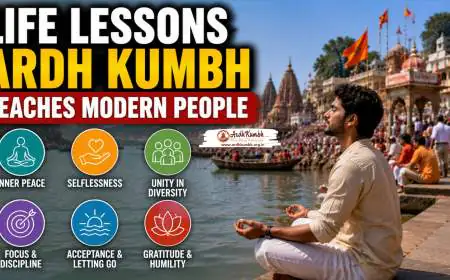
















































Life Lessons Ardh Kumbh Teaches Modern People
Discover the profound life lessons Ardh Kumbh teaches modern people. From patience and impermanence to faith and community, explore how this ancient pilgrimage transforms daily living.
The Cold Water That Teaches Presence 🌊
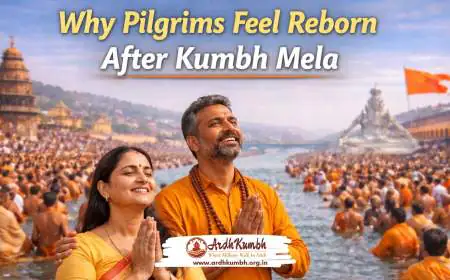
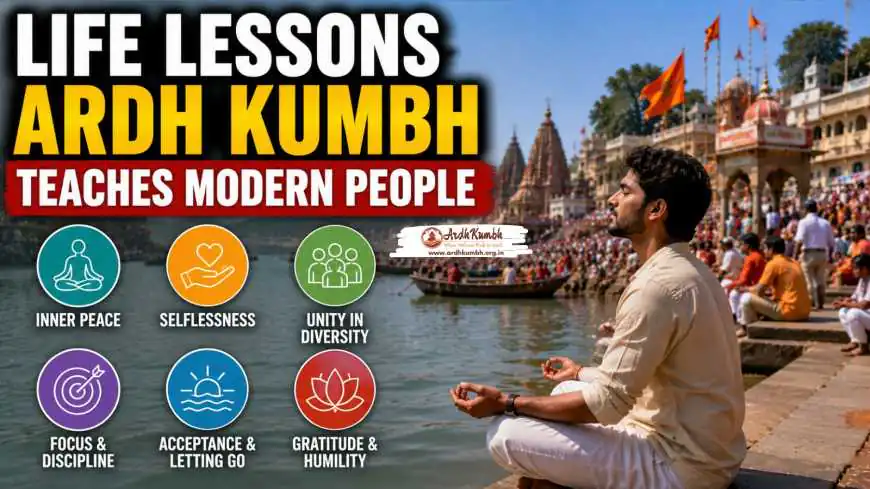
The first and most immediate lesson Ardh Kumbh teaches arrives the moment you step into the sacred water before dawn. The cold is not a concept. It is a physical reality that eliminates every thought except the experience of being exactly where you are.
Modern life specializes in pulling attention away from the present moment. Notifications demand responses. Calendars dictate movement. The mind lives perpetually in the next task, the next meeting, the next deadline. The present is treated as a brief inconvenience to be endured on the way to the future. Then you stand at the Sangam in the pre-dawn darkness, the cold water swirling around your body, and the future simply ceases to exist. There is only the water. There is only this breath. There is only now.
This is not a lesson that can be learned from a meditation app. The sacred bath at Ardh Kumbh teaches presence by making presence unavoidable. The body's shock response to cold water triggers what physiologists recognize as a forced activation of the parasympathetic nervous system. Heart rate steadies. Breathing deepens. The mental chatter that accompanied you to the water's edge falls silent. For those few moments of immersion, you are not thinking about the past or worrying about the future. You are completely, undeniably, and irreversibly present.
The lesson of presence persists long after you have dried yourself and changed into warm clothes. Having experienced what it feels like to be fully present—not as a concept but as a lived physical and mental state—you carry a reference point back into ordinary life. The next time stress pulls your attention into anxious futures, you can recall the cold water at Prayagraj. You can remember what presence actually feels like. This is the first and most enduring gift of the sacred bath.
Trending Guides Now

Live Like a Sadhu for One Day at Kumbh Mela
Read Guide →
Why Sadhus Call Ardh Kumbh a Living Scripture
Read Guide →
Why People Feel Changed After Ardh Kumbh Mela
Read Guide →
Why Millions Return to Ardh Kumbh Mela Again and Again
Read Guide →
Best Routes to Reach Haridwar for Ardh Kumbh Mela
Read Guide →
Essential Rules Every Ardh Kumbh 2027 Pilgrim Must Follow
Read Guide →
Who Are Naga Sadhus and Why They Lead Kumbh
Read Guide →
Biggest Crowds Ever Recorded at Ardh Kumbh
Read Guide →Walking Miles in the Dark and Rediscovering Patience 🚶
The Ardh Kumbh teaches patience not through sermons but through the simple, unavoidable reality of walking. The Mela grounds are vast. The crowds on peak days are dense beyond anything most people have experienced. You will walk. You will wait. You will find yourself moving at a pace determined not by your own urgency but by the collective rhythm of millions of fellow pilgrims.
Modern people are not accustomed to this kind of patience. We have trained ourselves and been trained by our technology to expect instantaneity. Messages receive immediate responses. Food arrives at our doors within minutes. Information is available at the tap of a finger. The capacity to wait—to simply be in a state of movement or stillness without demanding that it accelerate—has atrophied in the modern psyche.
The walking at Kumbh rebuilds this capacity. You cannot speed up the crowd. You cannot find a shortcut that bypasses the shared journey. You can only walk, step by step, toward the sacred water that awaits. And somewhere in the walking, the resistance to slowness begins to dissolve. You notice the faces around you. You hear the chanting that rises and falls from different directions. You feel the gradual approach of dawn, the slow lightening of the sky, the changing temperature of the air. These experiences are available only to those who are moving slowly enough to receive them.
The patience learned at Kumbh is not passive resignation. It is active presence within slowness. It is the recognition that some experiences cannot be accelerated without being destroyed. The walk to the Sangam is not an obstacle to be overcome on the way to the bath. It is part of the bath. The waiting is part of the worship. The slowness is part of the sacred experience, not an interruption of it.
The Temporary City That Teaches Impermanence 🏕️
The Ardh Kumbh Mela is a city of millions that exists for a few weeks and then vanishes. The roads are dismantled. The tents are packed. The pontoon bridges are removed. The fields that hosted the largest gathering of human beings on earth return to their ordinary agricultural existence. This is impermanence made visible on the grandest possible scale.
Modern life is built on the illusion of permanence. We accumulate possessions as though they will last forever. We construct identities as though they are fixed rather than fluid. We live as though the current arrangement of our lives—our relationships, our careers, our homes—is stable and enduring. Then we visit a place like Kumbh, where an entire city is built knowing it will be destroyed, where millions gather knowing they will disperse, and something shifts in our understanding.
The lesson of impermanence at Kumbh is not depressing. It is liberating. Watching the temporary city function so beautifully—the bhandaras feeding hundreds of thousands, the akhara camps maintaining their disciplines, the pilgrims finding their way to the water—reveals that impermanence does not diminish meaning. If anything, it intensifies it. The relationships formed at Kumbh, brief though they may be, carry a particular sweetness because both parties know they are temporary. The rituals performed have special power because they exist in a bounded sacred time rather than the indefinite extension of ordinary life.
The sadhus at Kumbh embody this lesson most radically. Their ash-smeared bodies, their minimal possessions, their wandering existence—all of this declares that permanence is an illusion and that freedom lies in accepting rather than resisting this truth. They do not preach impermanence. They live it. And their presence at Kumbh invites pilgrims to consider what might shift in their own lives if they held their possessions, their identities, and their circumstances a little more lightly.
Faith Without Guarantees: The Lesson of Collective Trust 🙏
The faith on display at Ardh Kumbh is not the comfortable faith of those who have never been tested. It is the faith of pilgrims who have traveled vast distances, often at significant financial cost and physical hardship, without any guarantee of what they will receive in return.
Modern rationality struggles with this kind of faith. The dominant worldview of contemporary society insists on measurable returns, predictable outcomes, and contractual certainty. You invest X and you receive Y. You perform action A and you get result B. Faith that operates outside this logic appears irrational, even foolish. Yet at Kumbh, millions of people demonstrate a different way of being—one that does not demand guarantees before committing, that does not require proof before trusting, that finds meaning in the act of devotion itself rather than in its measurable outcomes.
This is not blind faith in the sense of unthinking obedience. It is faith as a mode of being—a willingness to orient one's life toward something larger than the individual self, to participate in rituals whose full significance may not be intellectually understood, to trust that the effort of the pilgrimage carries value regardless of whether the pilgrim can articulate exactly what that value is.
The lesson for modern people is not necessarily to adopt the specific religious beliefs that animate Kumbh pilgrims. It is to recognize that the demand for certainty, for measurable return on every investment of time and energy, may itself be a limitation. There are dimensions of human experience that cannot be accessed through calculation. There are transformations that cannot be predicted or guaranteed in advance. The pilgrim who steps into the sacred water with faith is not irrational. They are accessing a mode of knowing that operates differently from rational calculation—not opposed to it, but complementary to it.
Simplicity in the Midst of Scale: The Lesson of Enough ✅
The Ardh Kumbh teaches simplicity not as an aesthetic choice but as a practical necessity. You cannot carry excess luggage when you must walk kilometers through crowds. You cannot maintain elaborate routines when you wake at 3 AM for the sacred bath. You cannot cling to the comforts of ordinary life when you are sleeping in a basic tent and eating simple food from a community kitchen.
Modern life has made complexity the default. We manage multiple devices, multiple accounts, multiple commitments. We accumulate possessions we do not need. We fill our schedules with activities whose purpose we cannot clearly articulate. Simplicity is something we must consciously choose, and it requires constant effort to maintain against the pressure of a culture that equates more with better.
Kumbh simplifies by necessity. The pilgrim discovers, often with surprise, that happiness does not require the elaborate infrastructure of modern comfort. The simple dal and rice served at a bhandara tastes extraordinary after a morning of walking and bathing. The warmth of a basic blanket in a simple tent feels like luxury after the cold pre-dawn hours. The conversation with a stranger on the ghat steps provides more genuine human connection than hours of social media scrolling.
The lesson of enough is one of the most countercultural teachings Kumbh offers. The gathering demonstrates, through the lived experience of millions, that the essentials of human flourishing are remarkably few. Food, shelter, companionship, purpose—these are available in forms far simpler than modern consumer culture suggests. The pilgrim who internalizes this lesson returns home with a recalibrated sense of what is necessary and what is merely accumulated.
The Ego Dissolution That Happens in a Sea of Humanity
Standing in a crowd of millions, the individual self becomes difficult to sustain. The Ardh Kumbh teaches humility not by instructing you to be humble but by placing you in circumstances where ego-maintenance becomes practically impossible.
Modern life, particularly in its urban and digital forms, constantly reinforces the centrality of the individual self. Algorithms personalize content to your preferences. Advertising addresses you as a unique consumer. Social media platforms encourage you to curate and display your identity. The architecture of contemporary experience is designed to make you feel like the protagonist of your own story.
Kumbh dismantles this architecture. In the crowd moving toward the Sangam, your individual preferences are irrelevant. The mass moves according to its own logic, and you are carried within it. Your social status, your professional achievements, your carefully constructed identity—none of these are visible or relevant in the pre-dawn darkness at the ghats. You are simply one pilgrim among millions, indistinguishable in the collective movement toward the sacred water.
This dissolution of ego is initially uncomfortable. The self resists its own diminishment. But as the days pass, many pilgrims discover a strange relief in anonymity. The burden of being a separate self, with all its demands for recognition and validation, is temporarily lifted. You are part of something larger than yourself, and that belonging requires no performance, no achievement, no proof of worth.
The lesson of ego dissolution is not that individuality should be permanently abandoned. It is that the self is more fluid than we ordinarily assume. We can step out of our individual identities and into collective experiences without losing what is essential about us. We can be part of a crowd without being lost in it. The balance between individual and collective that Kumbh teaches is a wisdom that modern life, with its relentless individualization, sorely needs.
Community Without Contracts: The Gift of Unconditional Sharing 🤝
The bhandaras at Kumbh feed hundreds of thousands of pilgrims daily without asking for payment, without checking credentials, without distinguishing between the wealthy and the poor. This is community at Kumbh in its purest form—giving without expectation of return, receiving without incurring debt, belonging without signing a contract.
Modern social relations are increasingly contractual. We sign terms of service for digital platforms. We enter legally binding agreements for housing and employment. Even our personal relationships are often governed by unstated expectations of reciprocity—I give you this, you give me that. The idea of unconditional sharing, of giving to strangers who can never repay you, of receiving from anonymous donors you will never meet, has become foreign to the modern sensibility.
Kumbh restores this possibility. The food served at the bhandara is given freely, without condition. The pilgrim who eats does not know who funded the meal. The donor who funded it does not know who will eat. The transaction is depersonalized in the best possible way—it becomes a pure expression of generosity rather than a relationship of obligation between specific individuals.
The spiritual principle underlying this practice is that the true giver is the divine, and both donor and recipient are participants in a flow of grace that precedes and exceeds them both. But the practical effect is a community organized around giving rather than exchanging. Pilgrims who experience this report that it changes their understanding of what human relationships can be. Not every interaction needs to be transactional. Not every gift needs to create an obligation. Some things can simply be given and received, and the giving and receiving themselves are the whole point.
Silence That Speaks Louder Than Noise
The Ardh Kumbh is not a silent place. The chanting, the temple bells, the announcements over loudspeakers, the continuous murmur of millions of voices—all of this creates a soundscape that is anything but quiet. Yet within this ocean of sound, pilgrims often discover an inner silence that modern life, despite its superficial quiet, rarely provides.
Modern life is filled with noise but starved of silence. Not auditory silence necessarily—though that too is increasingly rare—but the inner silence that comes when the mind is not being constantly stimulated by external input. The notifications, the headlines, the advertisements, the endless stream of content—all of this keeps the mind in a state of continuous low-grade agitation. Even when the external environment is quiet, the internal environment remains noisy.
The paradox of Kumbh is that the external noise can facilitate inner silence. The chanting, the mantras, the rhythmic sounds of the aarti—these are not distractions from inner stillness but gateways to it. They occupy the surface mind, giving it something to focus on, while the deeper layers of consciousness settle into quiet. Many pilgrims describe moments of profound stillness in the midst of what appears, from the outside, to be chaos.
The lesson for modern life is that silence is not simply the absence of noise. It is a quality of attention that can be cultivated even in noisy environments. The pilgrim who has found inner stillness at the crowded Sangam during Kumbh returns home knowing that peace is portable. It does not require a silent retreat center or perfect external conditions. It can be accessed in the midst of activity, in the heart of the city, in the middle of whatever life is currently offering.
The River That Does Not Stop Flowing: A Teaching on Resilience 🌊
The Ganga at Prayagraj flows continuously. Empires have risen and fallen along her banks. Languages have transformed. The specific rituals performed in her waters have evolved. But the river herself has continued flowing, carrying with her the accumulated faith of countless generations. This continuity is itself a life lesson Ardh Kumbh teaches—one about resilience, persistence, and the power of simply continuing.
Modern life often fetishizes disruption. We are encouraged to pivot, to reinvent, to disrupt ourselves and our industries. There is value in adaptation, but the relentless emphasis on change can obscure the equal value of continuity. Some things are valuable precisely because they have persisted. Some wisdom is trustworthy precisely because it has survived. Some commitments are meaningful precisely because they are kept across decades rather than abandoned when they become difficult.
The akhara sadhus at Kumbh embody this continuity. Their lineages stretch back centuries. Their practices have been transmitted from guru to disciple across generations. They have survived political upheavals, religious persecutions, and the pressure of a modern world that finds their way of life incomprehensible. They persist not because they are stubborn but because what they preserve is worth preserving.
The teaching of the river is that resilience is not about rigidity. The river adapts to every obstacle—flowing around rocks, accepting tributaries, changing course when the terrain demands it—while remaining fundamentally the same river. This is the resilience that Kumbh models: not the brittle resistance to all change, but the flexible persistence that adapts in form while remaining continuous in essence.
Returning Home: How the Lessons Integrate Into Daily Life
The most significant lesson Ardh Kumbh teaches may be the one that emerges after the pilgrimage ends. The gathering is temporary. The pilgrim returns home. And the question becomes: how do the insights gained at the Sangam survive the transition back into ordinary life?
The integration of pilgrimage experience is itself a spiritual practice. The weeks and months after Kumbh are when the real test of transformation occurs. Can the patience learned in the crowded lanes of the Mela survive a traffic jam in the city? Can the simplicity embraced in a basic tent survive the return to a home filled with possessions? Can the presence discovered in the cold water of the Sangam survive the distractions of ordinary routine?
The Ardh Kumbh provides not just experiences but reference points. The pilgrim who has been truly present in the sacred water knows what presence feels like and can recognize its absence. The pilgrim who has eaten with gratitude at a bhandara knows what enough feels like and can recognize the difference between genuine need and manufactured desire. The pilgrim who has felt ego dissolve in the crowd knows that the self is more fluid than it ordinarily appears and can access that fluidity even in more individualistic contexts.
The return from pilgrimage is not a return to who you were before. It is a return with new capacities, new perspectives, and new possibilities. The life lessons of Ardh Kumbh are not dependent on remaining at the Sangam. They are portable. They travel with you. They wait beneath the surface of ordinary consciousness, ready to be recalled when the cold water of memory triggers the presence, the patience, and the peace that the sacred gathering awakened.
Frequently Asked Questions