




























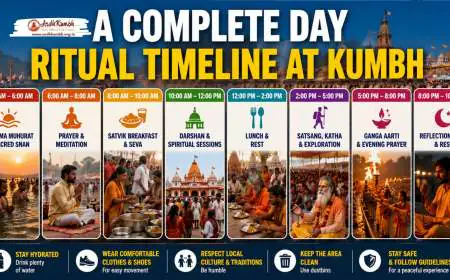































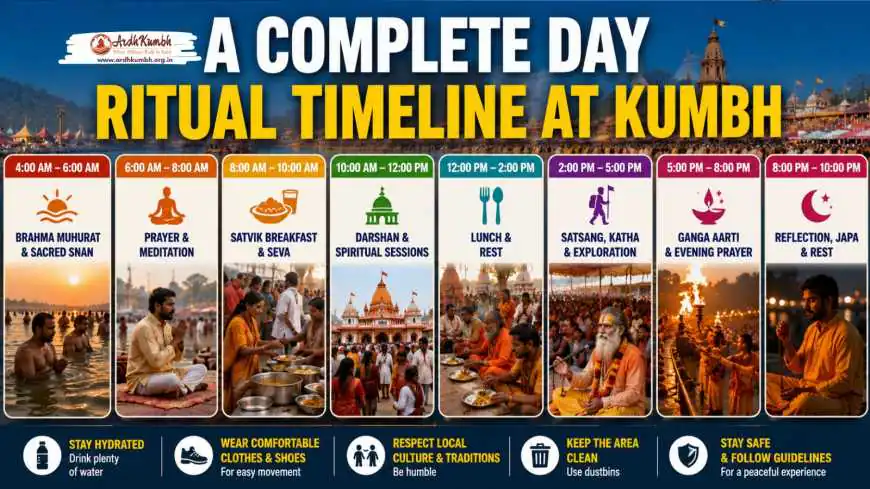
A Complete Day Ritual Timeline at Kumbh
Experience a complete day ritual timeline at Kumbh Mela from pre-dawn snan to midnight aarti. Learn the hour-by-hour schedule of sacred baths, akhara processions, temple visits, and evening rituals that define a pilgrim's day.
Brahma Muhurta: The Pre-Dawn Hours That Set the Sacred Tone 🌅
The Kumbh day begins in what the ancient texts call Brahma Muhurta—the period roughly ninety minutes before sunrise when the world is still wrapped in darkness and the mind is naturally inclined toward stillness. This is not merely a convenient time to wake up. It is considered the most spiritually receptive period of the entire day, when the veil between the material and the subtle is believed to be thinnest.
At Kumbh, Brahma Muhurta arrives differently depending on the season of the Mela. During the winter Kumbh, the pre-dawn hours carry a biting cold that shocks the body into full alertness the moment you step out of your blanket. The camps are quiet except for the soft murmurs of sadhus beginning their personal practices. Small fires flicker outside tents where chai is being prepared. The loudspeakers have not yet begun their daytime announcements. This is the hour of individual devotion before the collective rituals begin.
Pilgrims who understand the daily ritual rhythm use this time for personal meditation, japa, or silent sitting by the river. The ghats at this hour are nearly empty. The water reflects the last stars. The silence is not the silence of an empty room but the silence of a vast gathering that has not yet fully awakened. For those seeking a deeply personal connection to the sacred river before the crowds arrive, this is the irreplaceable window.
The akharas stir to life during Brahma Muhurta in ways most visitors never see. Inside the camps, senior sadhus perform their personal rituals—the lighting of the dhuni or sacred fire, the application of bhasma or sacred ash, the first mantras of the day spoken in low voices that carry across the compound. These are not public performances. They are the private spiritual technology of lineages that have maintained these practices for centuries. If you are staying near an akhara camp, simply sitting quietly and listening to these sounds drift across the pre-dawn air is itself a profound experience.
Trending Guides Now

Har Ki Pauri Ganga Aarti Time Today in Haridwar
Read Guide →
Ardh Kumbh Mela Rituals Explained Shahi Snan & Akhara Traditions
Read Guide →
Why Order and Cleanliness Are Strictly Enforced
Read Guide →
Daily Spiritual Practices Only Seen at Ardh Kumbh
Read Guide →
Best Routes to Reach Haridwar for Ardh Kumbh Mela
Read Guide →
Essential Rules Every Ardh Kumbh 2027 Pilgrim Must Follow
Read Guide →
Who Are Naga Sadhus and Why They Lead Kumbh
Read Guide →
Biggest Crowds Ever Recorded at Ardh Kumbh
Read Guide →The First Sacred Snan: Why Early Morning Bath Holds Supreme Importance 🛕
As the first hint of grey light appears on the eastern horizon, the ghats begin their transformation. The morning snan at Kumbh is not just another activity on the daily schedule. It is the central ritual around which the entire day is organized. Everything before leads to it. Everything after flows from it.
The pre-dawn bathers are typically the most experienced pilgrims and the sadhus who maintain strict personal disciplines. They enter the water before the crowds arrive, when the river still carries the stillness of night. The cold water at this hour requires genuine commitment. There is no casual dipping. Every step into the river is a conscious choice, a small act of courage that sets the tone for the spiritual work of the day ahead.
The snan ritual itself follows a sequence that has been preserved across generations. The pilgrim stands at the water's edge, makes the sankalpa or sacred intention, and then enters the water fully—not tentatively, not partially, but with complete immersion. Three dips are traditional, though some traditions specify five or seven. Each dip is accompanied by specific mantras or, for those who do not know the Sanskrit, by simple heartfelt prayer in whatever language the heart speaks.
The water temperature varies significantly depending on the Kumbh location and season. The winter Kumbh at Prayagraj demands a particular kind of determination. The cold is not gentle. It takes the breath away. But this physical shock serves a spiritual purpose. It breaks the ordinary flow of thought. For those few moments in the water, you are not thinking about your train ticket, your hotel booking, or your office responsibilities. You are completely present, completely alive, completely in the experience. This is precisely the state the ritual is designed to induce.
After the dips, the post-snan rituals begin immediately. Surya Arghya—the offering of water to the rising sun—is performed while still standing at the water's edge in wet clothes. This offering of gratitude establishes the reciprocity that defines the entire Kumbh experience. You have received the river's purification. You immediately offer something back. The cycle of giving and receiving that will continue throughout the day begins here with cupped hands full of sacred water catching the first direct sunlight.
Temple Darshan: The Morning Window When Sanctuaries Come Alive 🔱
Once the snan is complete and the sun has fully risen, the morning temple visits begin. The temples within the Kumbh grounds and in the surrounding areas open their sanctums for the morning darshan, and this is considered the most auspicious time for receiving the deity's blessing after your own purification in the river.
The logic is straightforward. You have just cleansed your body and, through intention, your subtle being. You now approach the divine presence in a state of ritual purity that amplifies the effectiveness of the darshan. Walking directly from the ghat to the temple while still carrying the coolness of the river on your skin is itself part of the ritual sequence. The tradition of aadra vasthra darshan—temple visitation in damp clothes—is practiced widely at Kumbh and is considered proper rather than improper.
The main temples near the Kumbh grounds each have their own morning rhythm. The bells ring continuously as pilgrims pour in from the ghats. The priests move through their morning puja sequences with the practiced efficiency of those who have performed these rituals thousands of times. The smell of incense, fresh flowers, and burning camphor fills the enclosed spaces. For many pilgrims, this combination of sensory experiences—the cold river water still on their skin, the temple incense in their breath, the sound of bells and mantras in their ears—creates a holistic immersion that no single ritual element could achieve alone.
Offerings at the temple after morning snan typically include fresh flowers, preferably marigold garlands purchased near the ghats, and bel patra if visiting a Shiva shrine. Many pilgrims also offer coconuts, breaking them at the temple threshold as a symbolic offering of the ego that the morning purification has softened. The temple priests apply chandan and kumkum tilak to the foreheads of pilgrims, sealing the morning's spiritual work with these cooling and activating substances respectively.
Mid-Morning: The Akhara Processions and Camp Activities
By mid-morning, the Kumbh grounds have fully awakened. This is the period when the akhara camps become the focal point of activity, particularly on non-shahi snan days when the major processions are not scheduled. Understanding what happens during these hours helps pilgrims plan their day to witness the traditions that make Kumbh unique.
The akhara camps are not static exhibitions. They are living communities with their own daily rhythms. Mid-morning is typically when the sadhus are most accessible to visitors. The morning personal rituals are complete. The afternoon rest period has not yet begun. This is the window for darshan of senior mahants, for sitting at the dhuni and absorbing the atmosphere, and for conversations with sadhus who are willing to share their knowledge with sincere seekers.
Many akharas conduct public discourses during this time. A senior sadhu sits under a canopy, often surrounded by disciples and visitors, and expounds on scripture or answers questions from those gathered. These sessions are typically conducted in Hindi or Sanskrit, though some sadhus speak other languages and can engage with international pilgrims. Even without full linguistic understanding, simply sitting in the presence of a realized teacher during these discourses is considered spiritually beneficial.
The akhara wrestling pits are also active during mid-morning. Traditional Indian wrestling or kushti remains an integral part of akhara training, and watching the young sadhus practice in the clay pits is to witness a tradition that predates the Kumbh itself. The physical discipline, the respect shown to the guru overseeing the practice, and the integration of body and spirit on display offer a different perspective on renunciate life than the popular image of passive meditation.
For pilgrims not visiting akharas, mid-morning is an excellent time for exploring the Mela grounds. The crowds are manageable compared to the afternoon peak. The various camps, exhibitions, and cultural programs are in full operation. This is also a good time for visiting the information centers, confirming schedules for upcoming events, and orienting yourself to the layout of this temporary city.
The Midday Bhandara: Sacred Food That Nourishes Body and Soul 🍚
As the sun climbs higher and the morning's spiritual exertions begin to take their toll, the Kumbh bhandaras come into focus. These community kitchens, operated by various religious organizations, akharas, and charitable trusts, serve free food to pilgrims throughout the day. The midday meal at a bhandara is not merely a practical necessity. It is a ritual in its own right, carrying the spiritual significance of annadanam—the sacred offering of food.
The bhandara experience at Kumbh varies enormously. Some are simple operations serving basic but nourishing food to thousands of pilgrims each day. Others are elaborate affairs with multiple dishes prepared according to strict sattvic principles. What they share is the underlying philosophy that feeding a pilgrim is feeding the divine, that the food served at Kumbh carries a subtle blessing beyond its nutritional value.
Eating at a community bhandara rather than in private accommodation connects you to the communal dimension of Kumbh. You sit in long rows with strangers who are, in the spiritual understanding, not strangers at all but fellow travelers on the same path. The food is simple—typically dal, rice, roti, sabzi, and sometimes a sweet—but it tastes different when eaten in this context. The cold river water, the morning rituals, the walking, and the spiritual atmosphere combine to make the simplest meal feel like a feast.
Many pilgrims choose to make a small donation at the bhandara even though the food is free. This is not payment. It is participation, a gesture that acknowledges the generosity being received and contributes to its continuation for the next pilgrim who will sit in that same spot tomorrow.
The midday hours between the bhandara and the afternoon are also when many pilgrims take rest. The Kumbh day begins early, the winter sun can be deceptively draining, and the evening rituals will require fresh energy. A short rest during these hours is not laziness. It is practical wisdom that allows full participation in what is still to come.
Afternoon: Spiritual Discourses, Personal Practice, and River Reflections
The afternoon period at Kumbh is often the most unstructured part of the day, and this lack of fixed programming is itself meaningful. The morning demanded active participation—the snan, the temple visits, the akhara darshan. The evening will demand the same. The afternoon offers a spaciousness that allows the morning's experiences to integrate.
Many pilgrims use this time for personal spiritual practice that does not require a specific location. Sitting by the river and watching its flow. Finding a quiet corner for meditation or japa. Reading scripture or simply reflecting on the experiences of the morning. The Kumbh grounds, despite their vastness and crowds, contain countless small spaces where a single person can sit undisturbed. Finding such a space and simply being still for an hour is one of the most underrated Kumbh practices.
The spiritual discourses that began in the morning often continue into the afternoon, with different teachers taking the stage at different camps. Some of the most profound sessions occur during these hours when the crowds are thinner and the atmosphere is more intimate. A small gathering of thirty people listening to a sadhu speak about the nature of consciousness can be more transformative than a grand ceremony witnessed from a distance.
The afternoon river has its own character. The morning mist is long gone. The water sparkles under the direct sun. The ghats are less crowded than at dawn. Some pilgrims choose this time for a second, more leisurely snan—not the formal ritual of the morning but a quieter immersion that feels more like communion than ceremony. The water temperature is warmer. There is no rush. You can float for a few minutes, look at the sky, and feel the river holding you as it has held countless others before you.
Sandhya Kaal: The Evening Transition When Light Becomes Sacred 🌅
As the sun begins its descent toward the western horizon, the Kumbh enters its most visually and spiritually spectacular phase. Sandhya kaal—the transitional period between day and night—is considered as spiritually potent as Brahma Muhurta, and the rituals that unfold during this time are among the most memorable experiences Kumbh offers.
The evening Ganga Aarti or river worship ceremony is the centerpiece of the sandhya period. At the main ghats, priests prepare elaborate platforms with multiple lamps, conch shells, incense, and flowers. As the designated time approaches, pilgrims gather in increasing numbers, finding places on the steps, on boats, or standing along the riverbank. The atmosphere is expectant but not tense—a collective anticipation that something beautiful is about to happen.
When the aarti begins, the effect is overwhelming in the best possible way. The priests move in synchronized gestures, circling large oil lamps that send sparks into the darkening sky. The chanting of Vedic mantras fills the air through powerful sound systems while pilgrims join in with whatever words they know. The river reflects the flames, creating the illusion that the water itself is on fire with devotion. This evening ritual at Kumbh is not a performance. It is a participatory act of collective worship that has been conducted on these riverbanks for centuries.
The individual evening rituals at the ghats are equally meaningful. Many pilgrims float small diya lamps on the river—clay bowls filled with oil and a cotton wick, lit and set adrift with a prayer. Watching hundreds of these small flames drift downstream, each carrying someone's hope or gratitude or plea, is an experience that stays with you long after you leave Kumbh.
The temple bells ring with particular intensity during sandhya as the evening puja is performed in shrines throughout the Mela grounds. The combination of river aarti, temple bells, floating lamps, and the deepening twilight creates an atmosphere that words struggle to capture. This is the time when even the most skeptical visitors often find themselves moved in unexpected ways.
Night at Kumbh: Bhajans, Kirtan, and the Subtle Shift Into Contemplation 🎶
When full darkness settles over the Kumbh grounds, the character of the Mela shifts again. The daytime energy of activity and movement gives way to the nighttime energy of song, story, and intimate gathering. The night rituals at Kumbh are less formal than the morning and evening ceremonies but no less significant in the spiritual journey of the pilgrim.
Bhajans and kirtan fill the night air from multiple directions. Different camps host different styles—traditional devotional singing with harmonium and tabla, ecstatic kirtan with call-and-response chanting, and quieter gatherings where a single voice carries a bhajan that has been sung for centuries. You can wander from camp to camp, sampling the different musical offerings, or you can settle into one gathering and let the repetition of the divine names carry you into a meditative state.
The akharas at night take on a different quality. The dhuni fires burn brighter in the darkness. The sadhus who were occupied with visitors during the day often become more accessible for personal interaction. Some akharas hold night-long chanting sessions or philosophical discussions that continue until the early hours. The nighttime akhara experience is less about spectacle and more about substance—the real spiritual work that happens when the crowds have thinned and only the serious remain.
For many pilgrims, the night hours are when Kumbh reveals its deepest self. Sitting by the river in darkness, watching the reflection of camp lights on the water, hearing distant bhajans carried on the cold night air, you understand something about this gathering that cannot be understood during the busy daylight hours. Kumbh is not ultimately about the rituals, the processions, or even the sacred bath. It is about this—the sustained collective presence of millions of people oriented toward something beyond the material, creating a field of consciousness that each individual can access according to their capacity.
The night meal is typically lighter than the midday bhandara. Many pilgrims eat simply and early, preferring to keep the body light for the evening practices. The camps begin to quiet down by midnight, though some activities continue through the night, particularly on days leading up to the major bathing dates.
Special Days: How the Shahi Snan Transforms the Daily Timeline ⚠️
The daily ritual timeline described above applies to the ordinary days of Kumbh Mela. The shahi snan days—the royal bathing days when the akharas process to the river in their full ceremonial glory—follow a dramatically different schedule that every pilgrim should understand.
On shahi snan days, the entire Kumbh awakens much earlier. The akhara processions begin in the pre-dawn darkness, sometimes as early as 2 or 3 AM. The roads to the ghats are secured hours in advance. Pilgrims who wish to witness the processions or bathe at the most auspicious moments must plan to be in position well before the official timings.
The shahi snan schedule is announced by the Mela administration in advance, but experienced pilgrims know that the actual timings are fluid. Processions can be delayed. Crowd movements can slow everything down. The wise approach is to choose one or two key things you want to witness rather than trying to see everything. The shahi snan is not a day for a relaxed pace. It is a day of intensity, of compressed crowds, and of heightened spiritual energy.
The post-shahi snan period on these special days is often more relaxed. The major akharas have completed their bathing. The ritual precedence has been observed. The afternoon and evening tend to follow the more usual pattern, though with larger crowds and a palpable sense that something significant has been accomplished.
Practical Wisdom for Following the Kumbh Daily Rhythm ✅
Knowing the daily ritual timeline is valuable, but knowing how to actually live it—how to adapt it to your physical capacity, your spiritual inclination, and your practical circumstances—is what transforms information into experience.
Listen to your body. The full Kumbh day from Brahma Muhurta to late-night bhajans is demanding. Not every pilgrim needs to participate in every phase. Some will prioritize the morning snan and evening aarti, resting during the afternoon. Others will attend the late-night sessions and sleep later in the morning. There is no single correct way. The Kumbh accommodates all sincere approaches.
Stay warm during winter Kumbh. The pre-dawn and post-sunset hours can be genuinely cold. Layers of woolen clothing, a good blanket for your accommodation, and hot drinks available from countless chai stalls are not luxuries. They are necessities that allow you to participate fully rather than spending your pilgrimage shivering and counting the hours until you can retreat indoors.
Carry essentials but not excess. A small bag with water, some fruits or snacks, a torch for dark pathways, and any personal items you need is practical. But do not burden yourself with possessions that become distractions. The Kumbh day involves significant walking. Travel light.
Be flexible. Timings shift. Events get rescheduled. The crowd flow takes you in unexpected directions. The pilgrim who clings rigidly to a predetermined schedule often misses the spontaneous blessings that Kumbh offers. Hold your plan lightly. Leave room for the unexpected conversation with a sadhu, the unplanned detour into a camp where something beautiful is happening, the sudden impulse to simply sit by the river and watch it flow.
The River Does Not Rush
As the final lamp is lit and the last bhajan fades into the night, the Kumbh settles into a brief stillness before the cycle begins again. Tomorrow, Brahma Muhurta will arrive exactly as it did today. The sadhus will light their fires. The pilgrims will walk toward the water. The bells will ring. The lamps will be offered. The same ancient rhythm will pulse through another day of this temporary city that has been arising and dissolving on these riverbanks for longer than recorded history can trace.
The complete day ritual timeline at Kumbh is not ultimately about clock time. It is about aligning your personal rhythm with a cosmic rhythm that the sages recognized and encoded into these practices. The early morning bath connects you to the energy of new beginnings. The midday bhandara reminds you that spiritual life is sustained by community. The evening aarti teaches you that light is most beautiful when shared. And the night silence whispers that beneath all the rituals, all the chanting, all the movement, there is a stillness that has been here all along, waiting for you to notice it.
When you walk back to your camp through the quieting lanes of the Mela, the river still flowing beside you in the darkness, you carry with you not just the memory of a day well spent but the lived understanding that this day could not have been lived this way anywhere else on earth. The Kumbh gave you its rhythm. You gave it your presence. And in that exchange, something subtle but real has changed—as it has for every pilgrim who has walked these ghats since the first Kumbh was convened in a time so distant that history and legend have merged into a single sacred stream.
Frequently Asked Questions