















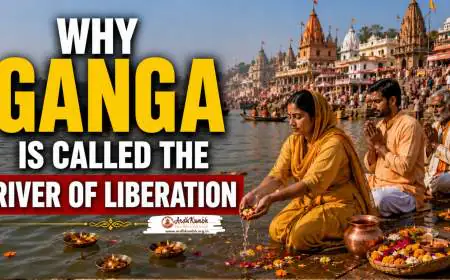
























Why Ganga Is Called the River of Liberation
Discover why Ganga is called the river of liberation in Hindu tradition. Explore the spiritual significance, ancient texts, and timeless belief that her waters free the soul from the cycle of birth and death.
The Scriptural Foundation: What the Ancient Texts Actually Say About Ganga and Liberation
The designation of Ganga as the River of Liberation is not based on vague sentiment or poetic exaggeration. It rests on specific textual declarations found across the entire spectrum of Hindu sacred literature. The Puranas, the Mahabharata, and the Dharmashastras all speak with remarkable consistency about the liberating power of Ganga's waters.
The Skanda Purana, in its extensive section called the Kashi Khanda, makes the most direct and frequently cited declaration. It states that anyone who bathes in Ganga with faith and proper intention is freed from all sins accumulated across lifetimes. More significantly, it declares that even those who cannot make the pilgrimage themselves benefit from the Ganga's grace if their ashes or bones are immersed in her waters after death. The text is explicit: Ganga does not merely purify. She liberates.
The Bhagavata Purana reinforces this understanding through the story of King Bhagiratha, whose ancestors had been reduced to ashes by the angry gaze of Sage Kapila. These ancestors wandered as restless spirits, unable to attain liberation because their funeral rites remained incomplete. Bhagiratha's penance brought Ganga from the celestial realm to the earth specifically for the purpose of liberating these trapped souls. The moment her waters touched their ashes, they attained moksha. This founding narrative establishes Ganga's identity as Moksha Dayini at the very origin of her earthly presence.
The Mahabharata contains numerous passages that affirm Ganga's liberating power. In the Anushasana Parva, Bhishma—himself the son of Ganga—delivers an extended discourse on the sacred rivers, placing Ganga at the apex. He declares that the mere sight of Ganga, the mere touch of her water, the mere utterance of her name, is sufficient to cleanse sins and open the path to liberation. The text emphasizes that Ganga's power extends beyond the physical act of bathing. Even remembrance of her from a distance carries spiritual efficacy.
Trending Guides Now
Strict Rules Pilgrims Follow at Ardh Kumbh
Read Guide →
What Self-Restraint Really Means at Kumbh
Read Guide →
Why Listening Is Valued More Than Speaking at Kumbh
Read Guide →
How to Spiritually Prepare for Ardh Kumbh Visit
Read Guide →
Best Routes to Reach Haridwar for Ardh Kumbh Mela
Read Guide →
Essential Rules Every Ardh Kumbh 2027 Pilgrim Must Follow
Read Guide →
Who Are Naga Sadhus and Why They Lead Kumbh
Read Guide →
Biggest Crowds Ever Recorded at Ardh Kumbh
Read Guide →The Garuda Purana, the text most closely associated with death rituals and afterlife journeys, devotes considerable attention to Ganga's role in post-mortem liberation. It describes in detail the ritual procedures for immersing ashes in Ganga and the spiritual mechanism by which this act severs the deceased soul's attachment to its former body and its karmic residues. The text presents Ganga as the bridge between the world of the living and the realm of the liberated.
The Descent of Ganga: A Liberation Story at the Origin 🔱
The story of Ganga's descent from heaven to earth, known as Gangavataran, is not merely a colorful myth. It is the theological foundation upon which her identity as the River of Liberation rests. Understanding this narrative in its fullness reveals why Ganga is considered uniquely capable of granting moksha.
The story begins with the sixty thousand sons of King Sagara, who were reduced to ashes by Sage Kapila's curse. These princes had insulted the sage, and their instantaneous incineration left them as trapped spirits, unable to move forward on their soul's journey because the proper funeral rites had not been performed. Their restless presence haunted the kingdom, and successive generations of Sagara's descendants attempted to resolve their condition.
The task fell to Bhagiratha, a descendant of Sagara who was both a king and a yogi of extraordinary determination. He understood that only the waters of the celestial Ganga—then flowing exclusively in the heavenly realms—could liberate his ancestors. He left his kingdom, retreated to the Himalayas, and performed austerities so intense that the gods themselves grew concerned about the power he was accumulating.
His penance succeeded. Brahma agreed to allow Ganga to descend, but with a warning: the force of her fall from heaven to earth would shatter the planet unless someone capable of bearing her impact received her first. Bhagiratha then directed his penance toward Shiva, who agreed to receive Ganga in his matted locks. When Ganga descended, Shiva caught her in his hair and released her in controlled streams, taming her destructive power into a manageable flow.
Ganga followed Bhagiratha across the plains of northern India until she reached the ashes of his ancestors. The moment her waters touched those ashes, the sixty thousand sons of Sagara were liberated. They attained moksha, freed from the cycle of rebirth, because Ganga had touched what remained of their earthly existence.
This narrative establishes several crucial aspects of Ganga's liberating identity. First, Ganga's very presence on earth is the result of a compassionate act aimed at liberation. She did not fall accidentally. She descended specifically to free souls trapped in karmic bondage. Second, Ganga's liberating power requires mediation—Bhagiratha's penance, Shiva's consent, the controlled release—suggesting that liberation through Ganga involves a relationship between divine grace and human effort. Third, the liberation happens through contact with physical remains, establishing the connection between Ganga's water and post-mortem ritual that continues to this day.
The Metaphysics of Water: How Ganga's Physical Substance Carries Spiritual Power
The claim that a river's water can liberate the soul from the cycle of rebirth raises obvious questions for the modern mind. How can a physical substance affect a non-physical soul? The metaphysical framework within which Ganga is understood as the River of Liberation addresses this question with considerable sophistication.
In the Samkhya and Vedanta philosophical systems that underlie much of Hindu thought, matter and spirit are not absolutely separate realities. They are different manifestations of the same ultimate reality, distinguished by the density of their vibration rather than by essential difference. The physical world, including water, is a gross expression of subtle principles. Under certain conditions, physical substances can carry spiritual potency.
Ganga's water is understood to have been sanctified at its origin. Because Ganga descended from the celestial realm—from Brahmaloka or even from Vaikuntha, depending on the specific tradition—her water carries the vibrational signature of those higher realms. Contact with Ganga water is contact with a substance that has not been entirely separated from its divine source. The water molecules themselves are believed to retain a subtle quality that purifies the subtle body or sukshma sharira of the pilgrim.
The concept of tirtha is crucial here. A tirtha is conventionally translated as a pilgrimage place, but its literal meaning is a crossing place or a ford. A tirtha is a location where the boundary between the material and spiritual worlds is thinner, where crossing from one to the other is easier. Ganga is the ultimate tirtha because she is not a fixed location but a flowing presence. She brings the crossing place to you.
The role of faith or shraddha in activating Ganga's liberating power is emphasized across texts. The water does not work mechanically or magically. It works through the medium of the pilgrim's faith and the ritual's proper performance. This is why the texts can simultaneously claim that Ganga liberates all who contact her and that the bath must be taken with proper intention. The water is the vehicle. Faith is the engine. Liberation is the destination.
Death and Ganga: The Rituals That Connect the River to Final Liberation 🕉️
The connection between Ganga and death rituals is perhaps the most visible expression of her identity as the River of Liberation. The practices surrounding death, cremation, and the immersion of ashes in Ganga constitute a complete ritual technology aimed at securing moksha for the deceased.
The ideal death in Hindu tradition has always been understood as a death on the banks of Ganga. The Kashi Labh or the attainment of death in Varanasi is considered a supreme blessing because the dying person can hear Ganga flowing, can receive her water on their lips, and can have their final moments shaped by her presence. The belief holds that Yama, the god of death, cannot claim a soul that departs within the sacred precincts of Kashi, because Shiva himself whispers the taraka mantra—the mantra of crossing over—into the ear of the dying.
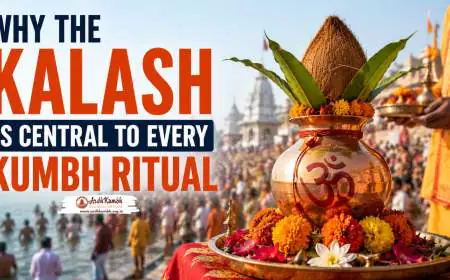
When death occurs elsewhere, the ritual sequence still centers on Ganga. The body is cremated according to prescribed rites. The ashes and remaining bone fragments are collected, often kept in a sacred vessel, and then transported to a Ganga tirtha for immersion. Haridwar, Varanasi, Prayagraj, and other sacred sites along the river are preferred locations for this asthi visarjan or bone immersion.
The ritual of immersion is performed with specific mantras and offerings. The priest or family member pours the ashes into the flowing water while reciting prayers that request Ganga to receive the departed soul, to wash away its remaining karmas, and to guide it toward liberation. The flowing nature of the water is ritually significant. The ashes are not simply deposited. They are entrusted to a current that will carry them forward, symbolizing the soul's continuing journey toward freedom.
The Garuda Purana provides the theological rationale for these rituals. It explains that the soul after death retains subtle attachments to its former body and its former life. These attachments can bind the soul to the earthly realm, preventing its natural movement toward liberation. The immersion of ashes in Ganga severs these attachments. The physical remnants of the life are given to the sacred river, and the soul is released to continue its journey unburdened.
Living Liberation: How Bathing in Ganga Transforms the Living Pilgrim
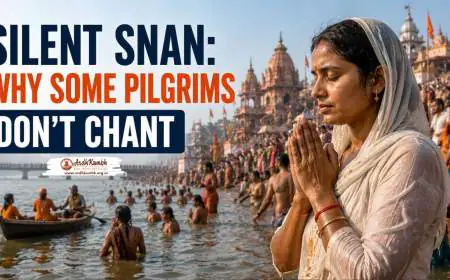
While Ganga's association with death rituals is well known, her identity as the River of Liberation extends equally to the living. The Ganga snan or sacred bath is not merely a purification ritual. It is understood as a participation in the same liberating power that frees the dead, applied to the living soul still navigating its earthly journey.
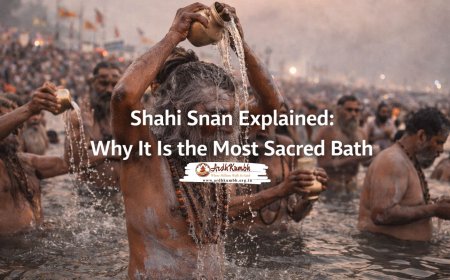
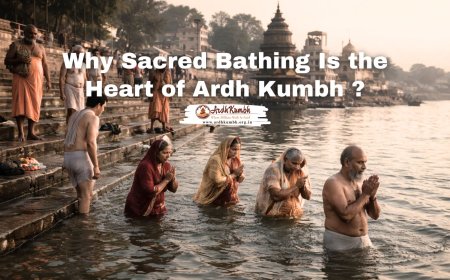
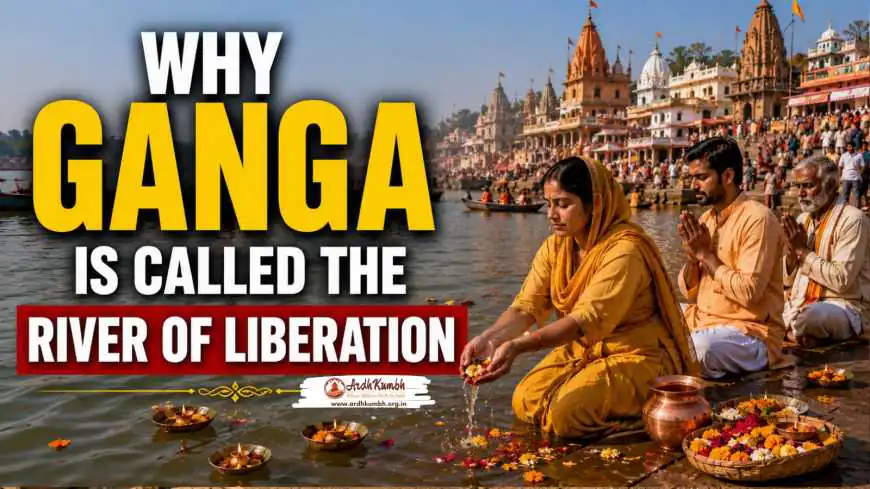
The experience of bathing in Ganga at dawn, particularly at a sacred ghat during an auspicious period, is described by countless pilgrims in remarkably consistent terms. The shock of the cold water. The momentary loss of ordinary consciousness. The emergence into a state of heightened clarity. This is not simply a refreshing swim. It is a temporary death and rebirth—a mini-liberation that prefigures the final liberation to come.
The mantras recited during the snan explicitly invoke liberation. The pilgrim does not pray for wealth, for health, for success in worldly endeavors. The traditional sankalpa or intention formulated before entering the water requests moksha—freedom from the cycle of birth and death, union with the divine, the dissolution of the individual self into the universal consciousness. Every sacred bath in Ganga is a rehearsal for the final liberation.
The post-snan rituals—the Surya Arghya, the temple darshan, the offerings, the charitable giving—extend this liberating intention into action. The bath opens the door. The subsequent rituals walk through it. The pilgrim who has bathed in Ganga with full faith and proper intention is considered to have been granted a taste of the liberation that awaits, a preview that strengthens faith and clarifies the path forward.
The akhara sadhus and sannyasis who spend their lives on Ganga's banks represent the living embodiment of this principle. They have renounced worldly life, committed themselves to spiritual practice, and chosen to remain in Ganga's presence until their final breath. Their ash-smeared bodies, their matted hair, their constant chanting—all of this is the lifestyle of those who have already begun the liberation process that Ganga's water initiates. They are living proof, in the eyes of devotees, that Ganga's liberating promise is real and effective.
The Scientific Mystery That Complements the Spiritual Claim ⚗️
The bacteriophage properties of Ganga water constitute one of those rare instances where scientific investigation appears to support rather than contradict traditional belief. This is not to suggest that science has proven Ganga's spiritual power. But the scientifically documented unusual properties of her water add an intriguing material dimension to the spiritual claims.
The British bacteriologist Ernest Hanbury Hankin published a paper in 1896 documenting that Ganga water killed cholera bacteria within hours while other water sources allowed the bacteria to flourish. He observed this phenomenon but could not fully explain it. Subsequent research identified bacteriophages—viruses that attack and destroy specific bacteria—as present in Ganga water at unusually high concentrations.
More recent studies have confirmed that Ganga water possesses higher levels of dissolved oxygen and a unique microbial ecosystem that contributes to its self-purifying capacity. The water's ability to remain fresh longer than water from other rivers, even when stored for extended periods, has been documented by multiple researchers.
From the perspective of traditional belief, these scientific findings are interesting but ultimately incidental. Ganga's liberating power does not depend on her bacteriological properties. Yet the convergence between ancient reverence and modern investigation creates a compelling narrative. The river that sages have claimed for millennia possesses extraordinary purifying properties turns out to possess measurable physical properties that set her apart from other water sources.
The Himalayan origin of Ganga also contributes to her unique character. The water that emerges at Gaumukh and Gangotri has filtered through glacial ice and mineral-rich rock formations, acquiring a mineral composition and energetic signature that cannot be replicated elsewhere. The cold, the clarity, and the particular quality of Himalayan glacial melt all contribute to an experience of bathing that is physically distinct from bathing in other rivers.
Bhakti and Ganga: The Devotional Relationship That Activates Liberation 🙏
The concept of bhakti—devotional love directed toward the divine—provides the key to understanding how Ganga's liberating power becomes personally accessible. The texts are clear that Ganga does not liberate mechanically. She liberates through relationship. The pilgrim who approaches Ganga with love, with faith, with the emotional openness that characterizes bhakti, receives what the pilgrim who approaches with mere curiosity or obligation does not.
Ganga is addressed as mother. This is not a casual metaphor. In the Hindu understanding, the maternal relationship is the most unconditional form of human love. A mother does not judge. A mother does not reject. A mother receives her child regardless of what that child has done. When devotees call Ganga Ma, they are invoking this quality of unconditional acceptance. The river that liberates is the mother who takes back her children regardless of their karmic condition.
The bhajans and stotras composed in praise of Ganga across centuries express this devotional relationship with remarkable emotional depth. The Ganga Stotram attributed to Adi Shankaracharya, the Ganga Lahari of Jagannatha Pandita, and countless folk songs and regional compositions all address Ganga in the language of intimate love. They praise her beauty, her compassion, and her power to save. They express the devotee's longing for her grace. They describe the peace that descends when her water touches the skin.
This bhakti dimension explains why pilgrims travel vast distances, endure significant hardships, and spend their life savings to reach Ganga. They are not coming to collect a substance with unusual properties. They are coming to meet their mother, to receive her darshan, to be held in her flowing embrace. The liberation they seek is not an abstract metaphysical condition. It is the tangible experience of being loved unconditionally by the divine presence that flows through this specific river.
The River That Does Not Discriminate
The most radical aspect of Ganga's liberating identity may be its universality. The texts explicitly state that Ganga does not discriminate. She does not ask about caste, about gender, about nationality, about the specific nature of the sins that weigh on the pilgrim's conscience. She receives all. She purifies all. She liberates all who come to her with faith.
This universality of Ganga's grace stands in contrast to some other forms of ritual purification that are restricted to specific groups or require specific qualifications. The Ganga is open. The beggar and the king enter the same water. The saint and the sinner receive the same embrace. The Brahmin and the outcaste are equally her children.
The Kumbh Mela embodies this universality on the grandest possible scale. Millions gather. Every conceivable type of human being is present. And all of them, without exception, are welcomed by the river. The akhara sadhu who has renounced everything and the householder who has brought his entire family, the illiterate farmer and the university professor, the Indian pilgrim whose ancestors have come to this river for centuries and the foreign visitor who has only recently heard her name—all step into the same water, and all receive what Ganga gives.
This is why Ganga is called the River of Liberation in a sense that transcends even the specific theological claims made about her. She liberates not only from karmic bondage but from the psychological bondage of unworthiness, from the social bondage of hierarchy, from the spiritual bondage of believing that liberation is only for the specially qualified. Her flowing water does not ask who you are. It asks only that you enter.
The Flow That Never Ceases
At the end of all inquiry, the Ganga flows. This is the simple, irreducible fact at the heart of her liberating identity. Empires have risen and dissolved along her banks. The languages spoken by her shores have transformed beyond recognition. The specific rituals performed in her waters have evolved. But the river herself has continued flowing from Gaumukh to the Bay of Bengal without interruption, carrying with her the accumulated faith of countless generations.
The continuity of Ganga's flow is itself a teaching about liberation. She flows without attachment. She nourishes without possessing. She receives the ashes of the dead and the offerings of the living with equal equanimity. She does not accumulate. She does not hold back. She simply gives herself, continuously, to whatever and whomever she touches.
This is the essence of liberation as the Hindu traditions understand it. Liberation is not the acquisition of something new. It is the removal of what obstructs the natural flow of being. The soul in its essential nature is already free, already pure, already divine. But this nature is obscured by ignorance, by attachment, by the accumulated residues of countless actions performed with selfish intention. Ganga's water washes away these residues. Her flow reminds the soul of its own essential nature as flowing consciousness rather than fixed entity.
When a pilgrim stands in Ganga at dawn, cold water swirling around their body, first light catching the surface of the river, the mantras of countless previous pilgrims echoing in the air, something shifts. The boundaries that ordinarily separate the individual self from the universal self become temporarily porous. The river that is flowing outside and the consciousness that is flowing within are recognized as expressions of the same underlying reality. This recognition, even if it lasts only a moment, is the liberation that Ganga offers. She is called the River of Liberation because she has facilitated this recognition for countless souls across countless lifetimes, and she will continue to do so as long as the Himalayas send their meltwater down to the waiting plains.
Frequently Asked Questions