


























































Kumbh vs Ardh Kumbh: The Difference Explained
Understand the real difference between Kumbh Mela and Ardh Kumbh Mela. Learn how frequency, astrological calculations, scale, and spiritual significance distinguish these two sacred gatherings.

The Astronomical Foundation That Separates Kumbh From Ardh Kumbh 🌌
The Kumbh Mela timing is not determined by a committee of priests consulting a convenient calendar. It is governed by precise astronomical calculations that have been maintained and transmitted across millennia. Understanding these calculations is essential to grasping why the difference between Kumbh and Ardh Kumbh exists at all.
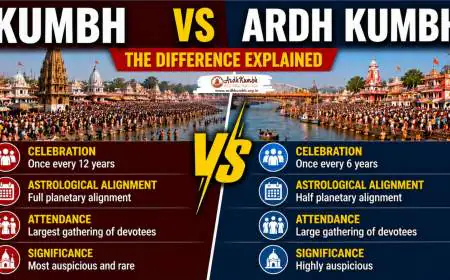
The Poorna Kumbh Mela takes place when Jupiter enters Aquarius—Kumbha Rashi—and the Sun enters Aries—Mesha Rashi—simultaneously. This specific planetary alignment occurs once every twelve years as Jupiter completes its full orbital journey. The configuration is considered astronomically rare and spiritually potent. The combined influence of Jupiter, the planet of wisdom and spiritual expansion, with the Sun, the source of all life and consciousness, during this specific zodiacal arrangement creates what the ancient texts describe as a moment when the nectar of immortality—the amrit from the samudra manthan—is most accessible in the sacred waters.
The Ardh Kumbh Mela occurs at the halfway point of this twelve-year cycle. The Jupiter-Sun alignment is not present in its full form, but the sacred rivers at the four Kumbh locations—Prayagraj, Haridwar, Ujjain, and Nashik—are considered to carry heightened spiritual potency at this six-year interval as well. The astronomical basis for Ardh Kumbh is less precisely defined in the ancient texts than the Poorna Kumbh, which has led some scholars to suggest that Ardh Kumbh developed as a later institutional addition, allowing pilgrims who could not attend the full Kumbh to still receive significant spiritual benefit at the halfway point.
The Mahakumbh, which occurs every 144 years at Prayagraj—twelve complete twelve-year cycles—represents the rarest and most spiritually significant gathering. When pilgrims speak of the Kumbh hierarchy, Mahakumbh sits at the apex, Poorna Kumbh occupies the middle tier, and Ardh Kumbh provides the more frequent but still immensely powerful opportunity for sacred bathing. Understanding this celestial hierarchy helps pilgrims make informed decisions about which gathering to attend.
Trending Guides Now
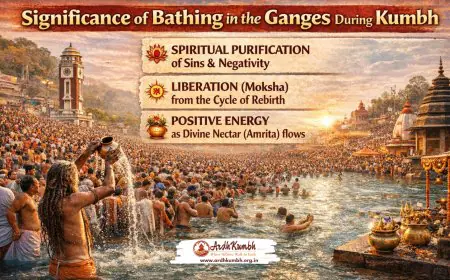
Significance of Bathing in the Ganges During Kumbh Mela Explained
Read Guide →
What Is the Story Behind the Ardh Kumbh Mela?
Read Guide →
Who Are Naga Sadhus and Why They Lead Kumbh
Read Guide →
Biggest Crowds Ever Recorded at Ardh Kumbh
Read Guide →
Best Routes to Reach Haridwar for Ardh Kumbh Mela
Read Guide →
Essential Rules Every Ardh Kumbh 2027 Pilgrim Must Follow
Read Guide →
Ardh Kumbh 2027 Dates: Who Decides Them and How
Read Guide →
Where Ardh Kumbh Is Written in Ancient Scriptures
Read Guide →The Scale Difference: Why Poorna Kumbh Draws Larger Crowds Than Ardh Kumbh 🚶
The most immediately visible difference between Kumbh and Ardh Kumbh is the sheer number of pilgrims who attend. The Poorna Kumbh Mela is widely recognized as the largest peaceful gathering of human beings on the planet. The Ardh Kumbh, while still massive by any ordinary measure, draws significantly smaller crowds.
The Prayagraj Kumbh Mela 2013, a Poorna Kumbh, drew an estimated 120 million pilgrims over its duration. The Prayagraj Ardh Kumbh 2019, by comparison, drew approximately 50 million pilgrims. Both numbers are staggering. Both gatherings would qualify as the largest religious events in the world in any given year. But the Poorna Kumbh operates at a scale roughly two to three times larger than the Ardh Kumbh.
This scale difference has practical implications for every pilgrim. The Poorna Kumbh requires more extensive logistical arrangements, more advance planning for accommodation, and greater patience with the inevitable crowd pressures. The Ardh Kumbh, while still requiring significant preparation, offers a somewhat more manageable experience. The ghats are crowded but not overwhelming. The akhara camps are busy but accessible. The queues for darshan are long but move at a pace that allows for genuine spiritual experience rather than survival-mode endurance.
The akhara participation also differs between the two gatherings. During Poorna Kumbh, every major akhara sends its full contingent of sadhus, mahants, and initiates. The shahi snan processions involve the complete hierarchy of each order, with the most senior mahants leading their followers to the sacred waters. During Ardh Kumbh, many akharas still participate, but some send smaller delegations. The ceremonial grandeur that defines Poorna Kumbh shahi snan days is present but somewhat reduced in scale during Ardh Kumbh.
The Ritual Potency: Does Ardh Kumbh Carry the Same Spiritual Weight as Kumbh? 🔱
The question that most concerns sincere pilgrims is whether the spiritual efficacy of bathing during Ardh Kumbh equals that of bathing during Poorna Kumbh. The answer, grounded in the traditional understanding, is nuanced.
The scriptural references to the Kumbh bathing festival consistently describe the twelve-year cycle as the primary sacred timing. The Puranas that discuss the ritual bathing at Prayagraj, Haridwar, Ujjain, and Nashik emphasize the specific astrological configurations that occur at twelve-year intervals. The Ardh Kumbh, as a formally recognized category, appears less prominently in the ancient texts, leading traditional authorities to view it as a spiritually significant but secondary gathering.
However, this does not mean that Ardh Kumbh bathing lacks spiritual power. The sacred rivers at the four Kumbh locations are considered eternally pure, regardless of which specific astrological configuration is overhead. The Ganga at Haridwar, the Sangam at Prayagraj, the Shipra at Ujjain, and the Godavari at Nashik carry their sanctity continuously. Bathing in these waters at any time brings spiritual merit. Bathing during the Kumbh period, whether Poorna or Ardh, amplifies that merit. The Poorna Kumbh represents the maximum amplification. The Ardh Kumbh represents a significant but not maximal amplification.
The traditional hierarchy can be understood through an analogy. If bathing at the sacred confluence on an ordinary day offers one unit of spiritual merit, bathing during Ardh Kumbh might offer a hundred units, while bathing during Poorna Kumbh might offer a thousand units. These numbers are illustrative rather than literal, but they capture the traditional understanding. Ardh Kumbh is profoundly powerful. Poorna Kumbh is more powerful still.
The Historical Development: When Did the Distinction Between Kumbh and Ardh Kumbh Emerge?
The historical relationship between Kumbh and Ardh Kumbh is itself a subject of scholarly interest. The distinction between the two gatherings did not emerge fully formed from the ancient texts. It developed over centuries as the Kumbh tradition evolved and as the practical needs of pilgrims shaped the institutional response.
The earliest references to Kumbh Mela in the Puranas and the Mahabharata describe the twelve-year cycle at Prayagraj without explicitly mentioning an intermediate gathering at six years. The Ardh Kumbh as a formally organized event appears to have developed during the medieval period, perhaps as early as the 13th or 14th century, when the Kumbh tradition had become sufficiently established that pilgrims who could not wait twelve years for the next full gathering began congregating at the halfway point.
The British colonial administration played a significant role in formalizing the Ardh Kumbh as a recognized category. British officials, tasked with managing the enormous logistical challenges of the Kumbh gatherings, began documenting and categorizing the different types of melas at Prayagraj and other sacred sites. Their administrative records from the 19th century clearly distinguish between the twelve-year Kumbh and the six-year Ardh Kumbh, treating them as related but distinct events with different crowd projections and different resource requirements.
The post-independence period has seen the Ardh Kumbh grow significantly in scale and visibility. Improved transportation networks, increased media coverage, and the general growth of pilgrimage tourism have all contributed to making Ardh Kumbh a major event in its own right rather than a minor precursor to the full Kumbh. The 2019 Ardh Kumbh at Prayagraj, which drew global media attention and required infrastructure investments comparable to the 2013 Poorna Kumbh, demonstrated that the distinction between the two gatherings has narrowed in practical terms even as the traditional hierarchy remains intact.
The Four Locations: How Kumbh and Ardh Kumbh Rotate Through Sacred Sites
The rotation of Kumbh Mela through four sacred locations adds another layer to understanding the difference between the full and half gatherings. Not all four locations host both Kumbh and Ardh Kumbh in the same way.
Prayagraj is the only location that consistently hosts Ardh Kumbh Mela at the six-year interval between its Poorna Kumbhs. This is because Prayagraj, as the site of the Triveni Sangam where Ganga, Yamuna, and the invisible Saraswati converge, holds the preeminent position among the four Kumbh locations. The ancient texts describe Prayagraj as the Tirtharaj—the king of pilgrimage places—and this supremacy is reflected in its privilege of hosting Ardh Kumbh.
Haridwar, Ujjain, and Nashik host Poorna Kumbh Melas at twelve-year intervals according to their respective astrological schedules, but they do not typically host formally designated Ardh Kumbh Melas. Pilgrims may gather at these locations in significant numbers at various times, but the specific designation of Ardh Kumbh applies primarily to the Prayagraj gathering.
The Kumbh Mela cycle rotates through the four locations in a pattern that ensures each site hosts a Poorna Kumbh approximately once every twelve years, though the exact interval varies based on astrological calculations specific to each location. The complete cycle means that a Poorna Kumbh occurs somewhere in India approximately every three years, while Ardh Kumbh at Prayagraj occurs at the six-year midpoint between that site's Poorna Kumbhs.
Practical Differences: Planning Your Pilgrimage Based on Kumbh Type ✅
Understanding the practical differences between Kumbh and Ardh Kumbh allows pilgrims to make informed decisions about which gathering to attend based on their circumstances, goals, and constraints.
Crowd management is the most significant practical consideration. During Poorna Kumbh, the peak bathing days—particularly the shahi snan days when the akharas process to the river—draw crowds that can exceed 30 million people on a single day. The Ardh Kumbh peak days draw significant but substantially smaller crowds. For pilgrims who are elderly, traveling with young children, or managing health conditions, the somewhat reduced crowd pressure of Ardh Kumbh may make the difference between a manageable pilgrimage and an overwhelming experience.
Accommodation availability and pricing differ significantly between the two gatherings. During Poorna Kumbh, accommodation in the Mela grounds and in nearby cities books out months or years in advance. Prices for everything from tent camps to hotel rooms rise dramatically. During Ardh Kumbh, accommodation is still in high demand but generally more available and more affordable. The pilgrim who cannot plan a year in advance may find Ardh Kumbh more accessible.
Akhara accessibility also varies. During Poorna Kumbh, the akhara camps are often so crowded that meaningful interaction with sadhus becomes difficult. The senior mahants are in high demand and have limited time for individual seekers. During Ardh Kumbh, the akhara atmosphere is somewhat more relaxed. Sadhus are more available for conversation, for spiritual guidance, and for the kind of personal connection that many pilgrims seek.
Ritual participation during Poorna Kumbh can feel like being carried by an immense current. The collective energy of tens of millions of pilgrims simultaneously moving toward the sacred waters creates an atmosphere that is electrically charged and undeniably powerful, but also potentially overwhelming. Ardh Kumbh offers a somewhat more contained version of this experience—still immensely powerful, still carrying the collective spiritual energy of millions, but with slightly more space for individual experience and reflection.
The Spiritual Psychology: Why Both Gatherings Matter in Different Ways 🙏
Beyond the astronomical calculations, the crowd statistics, and the logistical considerations, the difference between Kumbh and Ardh Kumbh operates on a psychological and spiritual level that pilgrims often describe in strikingly consistent terms.
The Poorna Kumbh experience is frequently described as overwhelming, transformative, and once-in-a-lifetime. Pilgrims speak of being carried by a force larger than themselves, of losing their individual identity in the collective movement toward the water, of experiencing a dissolution of ego that no solitary meditation practice could produce. The sheer scale of the gathering creates an altered state of consciousness for many participants. This can be profoundly liberating, but it can also be disorienting. The Poorna Kumbh demands a certain spiritual and psychological readiness.
The Ardh Kumbh experience is often described as more intimate, more personally manageable, and still deeply transformative. Pilgrims who have attended both gatherings frequently report that Ardh Kumbh allowed them to engage more deeply with individual rituals, with specific teachers, and with the sacred geography in a way that the overwhelming scale of Poorna Kumbh sometimes prevented. The spiritual current is still present. The water is still sacred. The akharas are still in attendance. But the pilgrim has slightly more room to breathe, to reflect, and to integrate the experience as it unfolds.
Neither experience is objectively superior. They serve different temperaments, different life stages, and different spiritual needs. The young pilgrim in robust health seeking the maximum possible spiritual intensity may find Poorna Kumbh perfectly suited to their condition. The older pilgrim seeking depth rather than intensity, or the first-time visitor seeking orientation rather than overwhelm, may find Ardh Kumbh the wiser choice.
Common Misconceptions About Kumbh and Ardh Kumbh ⚠️
Several misunderstandings about Kumbh and Ardh Kumbh circulate among pilgrims and in media coverage. Clarifying these helps pilgrims make better decisions.
The first misconception is that Ardh Kumbh is a recent invention without traditional legitimacy. While Ardh Kumbh as a formally organized event developed later than the Poorna Kumbh, the practice of pilgrims gathering at Prayagraj at the six-year interval has historical roots extending back several centuries. The gathering is not a modern tourism creation. It emerged organically from the spiritual hunger of pilgrims who could not wait twelve years to return to the sacred confluence.
The second misconception is that bathing during Ardh Kumbh carries no special spiritual merit. The traditional understanding is more nuanced. The Ardh Kumbh bath is considered highly meritorious, carrying significantly more spiritual weight than an ordinary bath at the same location. It simply carries less weight than the Poorna Kumbh bath. For pilgrims who cannot attend Poorna Kumbh due to age, health, finances, or life circumstances, the Ardh Kumbh bath is an immensely valuable opportunity rather than a consolation prize.
The third misconception is that all four Kumbh locations host Ardh Kumbh. As discussed above, Prayagraj is the primary and traditional location for Ardh Kumbh. Pilgrims specifically seeking Ardh Kumbh should plan for Prayagraj rather than expecting a formally designated Ardh Kumbh at Haridwar, Ujjain, or Nashik.
The fourth misconception is that Kumbh and Ardh Kumbh are entirely separate events with different rituals and different traditions. In reality, they are points on a spectrum. The same akharas participate. The same sacred waters are central. The same rituals of snan, darshan, and daan are performed. The difference is one of scale, intensity, and astronomical timing rather than of essential character.
Which Should You Choose: A Guide for the Undecided Pilgrim
The decision between attending Kumbh or Ardh Kumbh ultimately depends on a constellation of personal factors that no universal rule can fully address. But some guiding principles emerge from the experience of pilgrims who have attended both.
Choose Poorna Kumbh if you are in good physical health, can plan your travel and accommodation well in advance, and seek the maximum possible spiritual intensity. Choose Poorna Kumbh if you want to witness the akharas in their full ceremonial glory, if you are prepared for significant crowd pressure, and if you feel called to participate in the largest peaceful gathering in human history. Choose Poorna Kumbh if this may be your only Kumbh pilgrimage and you want the complete experience without wondering what the larger gathering might have been like.
Choose Ardh Kumbh if you have physical limitations, are traveling with family members who may find extreme crowds difficult, or cannot plan more than a few months in advance. Choose Ardh Kumbh if you prefer a slightly more intimate spiritual experience, if you hope to have meaningful personal interactions with sadhus and teachers, or if you are a first-time Kumbh pilgrim who wants to experience the essence of the gathering without the most extreme expressions of its scale. Choose Ardh Kumbh if you attended the previous Poorna Kumbh and wish to maintain the spiritual momentum without waiting the full twelve years.
Many pilgrims ultimately attend both over the course of their lives, discovering that each gathering offers something the other cannot. The Poorna Kumbh provides the overwhelming, ego-dissolving immersion. The Ardh Kumbh provides the more measured, reflective, and personally engaged encounter. Together, they form a complete pilgrimage practice that sustains the spiritual life across decades.
The River Does Not Count the Years
The sacred rivers at Prayagraj, Haridwar, Ujjain, and Nashik flow continuously. They do not check the astrological calendar before deciding whether to purify the pilgrim who steps into their waters. They do not count the years between Poorna Kumbh and Ardh Kumbh. They simply flow, offering their grace to whoever comes with faith, regardless of which specific gathering has brought them to the ghats.
The difference between Kumbh and Ardh Kumbh matters for planning. It matters for understanding the tradition. It matters for making informed choices about which gathering to prioritize. But it does not matter for the essential transaction that occurs between the pilgrim and the sacred water. That transaction—the silent offering of the self to the current, the reception of grace that cannot be measured or quantified—transcends the categories and distinctions that human minds create to organize the ineffable.
When you stand at the Sangam during Ardh Kumbh, the cold water swirling around your body, the first light of dawn catching the river's surface, the distant sound of temple bells and Vedic chanting filling the air, you are not standing at a lesser gathering. You are standing at the same confluence where countless pilgrims before you have stood, receiving the same grace, participating in the same eternal ritual. The river does not ask whether your pilgrimage is Poorna or Ardh. The river only asks whether you have come. And if you have, she receives you exactly as she has received every pilgrim since the first Kumbh was convened in a time so distant that history and myth have merged into a single sacred memory.
Frequently Asked Questions