































































What Is the Story Behind the Ardh Kumbh Mela?
Discover the story behind the Ardh Kumbh Mela, its origin in Samudra Manthan, six-year cycle, and why it holds equal spiritual power as Kumbh.
What Is the Story Behind the Ardh Kumbh Mela?
The Ardh Kumbh Mela is not a reduced or secondary version of the Kumbh Mela. Its story emerges from the same cosmic origin, the same sacred geography, and the same spiritual logic that governs the Maha Kumbh. The word “Ardh” means half in time, not half in spiritual authority.
The story behind the Ardh Kumbh explains why it occurs exactly six years after a full Kumbh, why it is held only at Haridwar and Prayagraj, and why saints and Akharas treat it with the same seriousness as the Kumbh itself.
To understand its story, one must return to the cosmic event that anchors all Kumbh traditions.
Planning to attend the next Ardh Kumbh?
Explore official dates, snan rules, Akharas, and practical guidance in our detailed event guide.
→ Ardh Kumbh Mela 2027 Complete Guide
Trending Guides Now

History of Ardh Kumbh Mela From Samudra Manthan to Modern Times
Read Guide →
How Ardh Kumbh Preserved India’s Oral Traditions
Read Guide →
Why Ardh Kumbh Occurs Every Six Years Explained
Read Guide →
Why Saints Are Called Living Archives of Kumbh
Read Guide →
Best Routes to Reach Haridwar for Ardh Kumbh Mela
Read Guide →
Ardh Kumbh 2027 Dates (Official) - Haridwar Snan Schedule
Read Guide →
How Kumbh Keeps India’s Civilizational Memory Alive
Read Guide →
February Weather Reality at Ardh Kumbh
Read Guide →The Cosmic Origin: Samudra Manthan
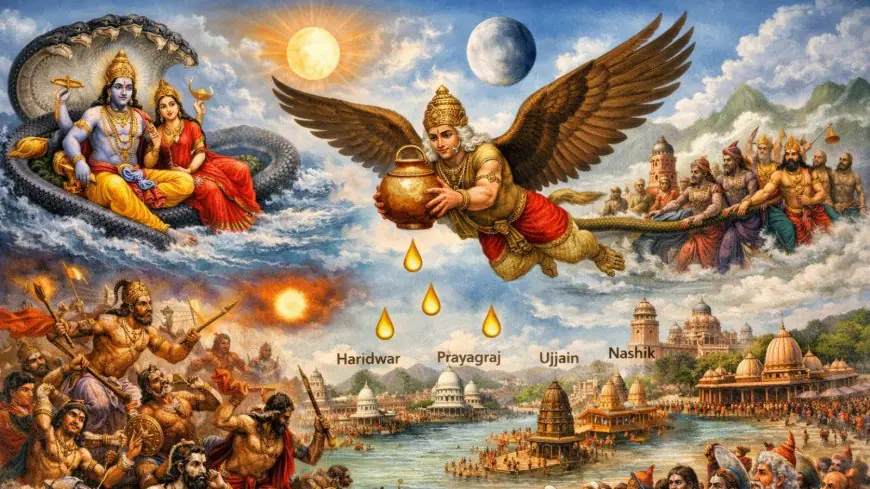
The foundational story behind both Kumbh and Ardh Kumbh begins with the Samudra Manthan—the churning of the cosmic ocean by Devas and Asuras in search of Amrit, the nectar of immortality.
When the Amrit emerged in a Kumbh (sacred pitcher), a struggle followed. To prevent chaos, Lord Vishnu, in the form of Mohini, carried the pot away. During this divine pursuit, drops of Amrit fell at four earthly locations:
-
Haridwar (Ganga)
-
Prayagraj (Triveni Sangam)
-
Nashik (Godavari)
-
Ujjain (Shipra)
These locations became permanently sanctified—not symbolically, but ritually.
Why Ardh Kumbh Exists Within This Story
While the full Kumbh cycle completes every twelve years, Ardh Kumbh occurs at the six-year midpoint. This midpoint is not arbitrary.
Spiritually, it represents:
-
Half of Jupiter’s major transit cycle
-
A renewal of cosmic balance
-
Re-activation of Amrit-charged sacred geography
Just as a spiritual discipline requires periodic recalibration, the cosmic system is believed to reopen the same sacred window halfway through the cycle.
This reopening is Ardh Kumbh.
Also Read | What Is Ardh Kumbh? A Sacred Question Millions Ask
Why Ardh Kumbh Is Held Only at Two Locations
Ardh Kumbh is celebrated only at:
-
Haridwar
-
Prayagraj
This restriction exists because these two sites are governed directly by Jupiter–Sun alignments that allow a six-year repetition of the sacred window.
Nashik and Ujjain require a full twelve-year cycle due to different planetary dependencies.
This is why Ardh Kumbh is not universal—it is astronomically selective.
Also Read | Ancient Scriptures That Clearly Explain Ardh Kumbh
Scriptural and Astrological Authority
The story of Ardh Kumbh is preserved not only in mythology but also in Jyotisha (Vedic astrology) and Panchang traditions.
Its timing depends on:
-
Jupiter’s position in Aquarius or Taurus
-
Solar transitions
-
Lunar tithi synchronization
Once these alignments occur, the Ardh Kumbh is activated. No ruler, administration, or institution has the authority to alter it.
Also Read | What Happens During Ardh Kumbh? Rituals, Processions & Spiritual Meaning Explained
Role of Akharas in Preserving the Story
The Akharas are not participants in the Ardh Kumbh—they are custodians of its continuity.
Their role includes:
-
Maintaining ritual sequence
-
Preserving oral tradition
-
Enforcing bathing hierarchy
-
Protecting spiritual discipline
Through them, the story of Ardh Kumbh is not archived—it is lived.
From the divine legend of Samudra Manthan to today’s massive spiritual gatherings, the History of Ardh Kumbh Mela reflects centuries of faith and devotion. This sacred festival continues to unite millions at holy rivers, blending ancient mythology with modern pilgrimage
Why the Story Is Still Relevant Today
The Ardh Kumbh has survived empires, colonial disruption, modernization, and skepticism because its story does not rely on belief alone.
It operates on:
-
Cyclical time, not linear time
-
Discipline over convenience
-
Continuity over novelty
Modern pilgrims may arrive for many reasons, but the story ensures the ritual remains unchanged.
What the Ardh Kumbh Story Ultimately Teaches
At its core, the story behind the Ardh Kumbh Mela teaches one truth:
Certain moments in time are meant to be honored, not exploited.
The Ardh Kumbh exists to remind humanity that spiritual order requires patience, alignment, and restraint—values that cannot be rushed or replicated.
To truly experience the spiritual power of Ardh Kumbh, every devotee should explore Shahi Snan rituals and Akhara traditions, which explain the sacred bathing process, monastic discipline, and ancient customs that shape this holy gathering. This guide helps pilgrims connect deeply with the true essence of the Mela.
Half in Time, Complete in Meaning
The Ardh Kumbh Mela is called Ardh only because it occurs halfway between two Kumbh Melas. In spiritual weight, ritual authority, and cosmic origin, it stands complete.
Its story is not about a past event.
It is about a recurring opportunity—one that opens only for those willing to align with it.
Frequently Asked Questions