





























































The Untold Stories of Har Ki Pauri
Discover the untold stories of Har Ki Pauri, Haridwar's most sacred ghat. From King Vikramaditya's memorial to hidden inscriptions and ancient legends, explore the lesser-known history beneath the eternal Ganga Aarti.
The King Who Built a Memorial Disguised as a Sacred Ghat 👑
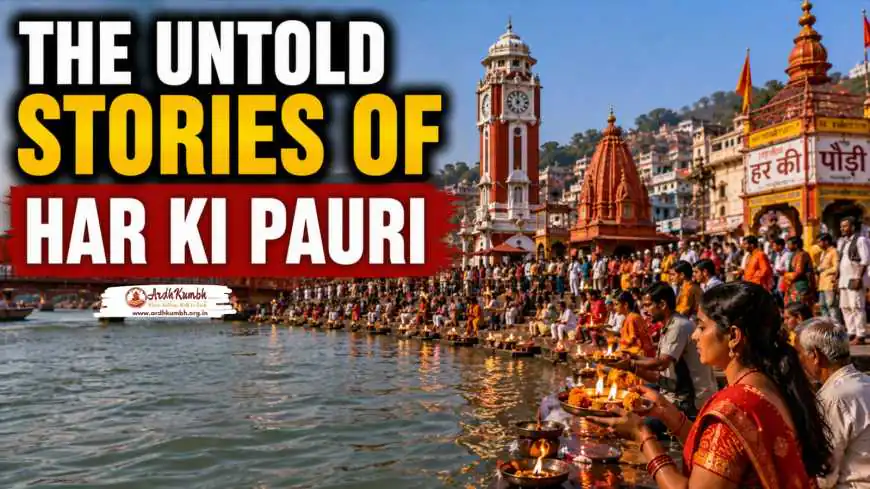
The most widely repeated story of Har Ki Pauri credits its construction to King Vikramaditya, the legendary ruler of Ujjain whose name echoes through centuries of Indian folklore. But the conventional narrative—that the great king simply built a ghat in his brother's memory—conceals a far more complex and human story that deserves to be told in full.
Vikramaditya's brother, Bharthari, is himself a figure of extraordinary legend. According to the traditions preserved in Haridwar and in the folk literature of central India, Bharthari was a king who renounced his throne after discovering the impermanence of all worldly attachments. The story varies across tellings, but its essence remains consistent: Bharthari came to understand, through a series of events involving a fruit of immortality or through the betrayal of someone he loved, that the material world offers no lasting satisfaction. He abdicated his kingdom, left his wife and court, and became a wandering ascetic.
When Bharthari eventually died, his brother Vikramaditya was consumed by grief. The legendary emperor, conqueror of territories and patron of the nine gems of learning, found himself powerless before the simple fact of loss. The grandest monuments, the richest offerings, the most elaborate rituals—none of these could bring back the brother he loved. So Vikramaditya did something remarkable. He came to Haridwar, to the sacred Ganga where his brother had spent his final years in spiritual practice, and he built not a tomb or a palace but a ghat—a place where pilgrims would come for centuries after he himself was gone.
This is the untold story within the story of Har Ki Pauri. The ghat is not a monument to royal vanity. It is a memorial disguised as a gift to humanity. Vikramaditya took his private grief and transformed it into a public blessing. Every pilgrim who bathes at Har Ki Pauri, every devotee who lights a lamp at the evening aarti, is unknowingly participating in a king's memorial to his brother. The tears of an emperor became, through the alchemy of devotion, a source of purification for millions.
Trending Guides Now
What Is the Story Behind the Ardh Kumbh Mela?
Read Guide →
How Saints and Sadhus Define the Ardh Kumbh Tradition
Read Guide →
Ancient Scriptures That Clearly Explain Ardh Kumbh
Read Guide →
Why Saints Are Called Living Archives of Kumbh
Read Guide →
Best Routes to Reach Haridwar for Ardh Kumbh Mela
Read Guide →
Essential Rules Every Ardh Kumbh 2027 Pilgrim Must Follow
Read Guide →
Who Are Naga Sadhus and Why They Lead Kumbh
Read Guide →
Biggest Crowds Ever Recorded at Ardh Kumbh
Read Guide →The Footprint That Preceded the Ghat: A Story Older Than Memory 🛕
The name Har Ki Pauri itself contains a story that predates Vikramaditya by epochs beyond calculation. "Har" is one of the names of Lord Vishnu, the preserver of the cosmos. "Pauri" means steps or footsteps. The ghat is named for the footprint of Vishnu that is believed to be embedded in a stone at the sacred spot known as Brahmakund.
The story of the footprint is among the oldest and most sacred associated with Har Ki Pauri. According to the tradition preserved in the Puranas and in the oral history of the Haridwar pandas, Lord Vishnu himself came to this exact spot during the great churning of the cosmic ocean—the Samudra Manthan—and left his footprint on a stone at the water's edge. The divine footstep sanctified the location, making it forever a place where the boundary between the material world and the divine realm is thinner than anywhere else along the river's course.
What makes this untold layer of the Har Ki Pauri story so significant is its antiquity. The footprint narrative predates every historical structure built at the ghat. Before Vikramaditya, before the temples, before the aarti ceremony, before any of the visible architecture that pilgrims see today, there was the footprint. The stone that bears this sacred mark has been venerated for so long that the beginning of its worship is lost in time. The ghat grew around the footprint, not the other way around.
The Brahmakund where the footprint resides is the ritual center of Har Ki Pauri. It is here that the most auspicious bathing takes place. It is here that the ashes of the deceased are immersed. It is here that the Ganga Aarti is performed each evening. Every layer of ritual significance that has accumulated at Har Ki Pauri across centuries is anchored to this single stone, this divine impression, this moment when the preserver of the universe touched the earth and left a mark that would draw humanity to this spot forever.
The Engineering Secret Hidden Beneath the Sacred Steps
Among the lesser-known stories of Har Ki Pauri is one that belongs to the realm of practical achievement rather than mythology. The ghat as it appears today is not the original construction of Vikramaditya's era. It has been rebuilt, expanded, and reinforced across centuries. The current structure owes much to the engineering vision of the 19th century, when the ghat underwent significant renovation under British supervision—a chapter of its history that is often overlooked in the telling of its sacred story.
The flood control engineering embedded in the ghat's design is remarkable for its era. Haridwar sits at the precise point where the Ganga exits the Himalayan foothills and enters the Gangetic plain. The force of the river at this transition point is immense, particularly during the monsoon months when snowmelt and rainfall combine to create devastating floods. The ghat had to be constructed to withstand forces that would destroy ordinary structures.
The step design of Har Ki Pauri is not merely aesthetic or ritualistic. Each level of steps is engineered to dissipate the energy of the flowing water, protecting the structure from erosion while creating accessible bathing platforms at different water levels throughout the year. The Brahmakund itself is a masterpiece of hydraulic engineering, designed to maintain a certain depth and flow rate regardless of seasonal variations in the river's volume.
The pillars and chains that line the ghat, which modern pilgrims use to hold onto while bathing, are part of this engineering heritage. They were installed during the 19th-century renovations and have saved countless lives by giving bathers something secure to grip when the current runs strong. What appears to be a simple safety feature is actually part of a comprehensive design philosophy that understood the river's power and respected it while making it accessible to pilgrims.
This engineering story is not separate from the sacred story. It is part of it. The ghat was built to last not merely because its builders understood hydraulics but because they understood that this place would need to serve pilgrims for centuries. The engineering is an expression of devotion, a material manifestation of the commitment to preserve sacred access across generations.
The Pandas and Their Vahi: The Living Archives of Har Ki Pauri 📜
The pandas of Har Ki Pauri—the hereditary priests who serve as genealogists, ritual guides, and custodians of pilgrim records—carry an untold story that exists not in stone or inscription but in the fragile pages of their vahis or record books. These volumes, some of them centuries old, contain the handwritten records of pilgrim families who have visited Har Ki Pauri across generations.
The tradition of the vahi is one of the most remarkable and least appreciated aspects of Har Ki Pauri's cultural heritage. When a pilgrim family visits the ghat, they are traditionally received by the panda whose family has served their family, often for generations. The panda opens the vahi and records the visit, adding the names of the current generation to a document that already contains the names of their ancestors. Some of these records stretch back uninterrupted for three, four, or even five hundred years.
The vahis are untold stories in the most literal sense. They contain the names, dates, and ritual details of millions of pilgrims across centuries. They are a genealogical archive, a social history, and a religious record all bound into volumes that are passed from father to son within panda families. When a modern pilgrim opens their family's vahi and sees the signature of a great-great-grandfather who visited Har Ki Pauri in 1780, the connection to the past becomes tangible in a way that no history book can provide.
The pandas themselves are keepers of oral traditions that complement their written records. They know the history of the ghat not from books but from the stories passed down within their families. They know which areas of the ghat were added in which period, which temples have the oldest lineages, which bathing spots are considered most auspicious for specific rituals. This knowledge, transmitted orally across generations, represents a parallel historical record that academic scholarship is only beginning to appreciate.
The Aarti That Began as a Small Family Ritual 🔥
The Ganga Aarti at Har Ki Pauri is now one of the most famous religious ceremonies in the world. Photographs of priests holding multi-tiered oil lamps against the backdrop of the evening river circulate globally. Tens of thousands attend each evening. It is the visual signature of Haridwar. But the story of how this aarti began is far more humble and human than its current spectacle suggests.
The evening aarti tradition at Har Ki Pauri, in its current form, is not ancient. It developed during the 20th century, evolving from much smaller rituals that had been performed at the ghat for generations. Before the grand ceremony, individual priests would perform aarti at the river's edge in the evening, each with their own simple lamp, each offering their own prayers. There was no coordinated choreography, no amplified chanting, no audience of thousands.
The transformation of the aarti into the grand ceremony of today occurred gradually, driven by a combination of devotional impulse and practical recognition. The priests of Har Ki Pauri understood that the evening ritual, performed collectively and with increasing elaboration, could draw pilgrims more deeply into the spiritual atmosphere of the ghat. What began as a modest gathering grew organically, decade by decade, as more lamps were added, more priests participated, and more pilgrims arranged their schedules to be present at sunset.
The untold dimension of the aarti story is that the ceremony, for all its current grandeur, retains the essential character of its humble origins. The mantras chanted are the same mantras that the priests' ancestors chanted. The gestures of the lamp offering are the same gestures. The relationship between the priest, the lamp, the river, and the divine is unchanged. The scale has transformed, but the soul of the ritual has not. The aarti at Har Ki Pauri is a modern spectacle built on an ancient foundation, a ceremony that grew rather than being invented.
The Temple That Disappeared Beneath the River
Among the more haunting untold stories of Har Ki Pauri is the tale of a temple that once stood on the ghat and now exists only in memory and in the occasional glimpse offered by unusually low water levels. The lost temple of Har Ki Pauri is not a legend. It is a documented historical reality that the river has slowly claimed.
The Ganga at Haridwar has shifted its course multiple times across the centuries. The river that flows past the ghat today is not precisely the same river that flowed past it when Vikramaditya's builders first laid the stones. Each shift of the current has altered the ghat, claiming some structures while exposing others. The lost temple stood on what was once dry land adjacent to the ghat, a shrine visited by pilgrims as part of their ritual circuit of Haridwar.
Over decades and centuries, the river eroded the temple's foundations. The structure gradually subsided, its lower levels filling with water and silt, its upper levels eventually collapsing or being dismantled for safety. Today, during periods of exceptionally low water, observant pilgrims can sometimes see the remnants of stonework beneath the surface near the ghat—the last physical traces of a temple that served countless devotees before the river reclaimed it.
The story of the lost temple is not merely a tale of architectural loss. It is a teaching about impermanence that is written into the very geography of Har Ki Pauri. The ghat that pilgrims visit today is not the complete ghat of centuries past. It is what remains after the river has taken its portion. And yet the pilgrimage continues. The rituals persist. The lost temple, though physically absent, remains present in the memory of the pandas and in the awareness that the sacred is not dependent on the permanence of stone.
The Mysterious Iron Pillar That Does Not Rust
Standing quietly near Har Ki Pauri, often overlooked by pilgrims focused on the river and the aarti, is an iron pillar that carries its own remarkable untold story. This pillar, less famous than its counterpart in Delhi but equally intriguing, has resisted corrosion for centuries despite constant exposure to moisture from the river and the humid climate of the Himalayan foothills.
The metallurgical mystery of the pillar has attracted scientific investigation. Analysis has revealed that the iron contains a high phosphorus content and lacks the manganese and sulfur that typically accelerate rusting. The precise technique used to produce this corrosion-resistant iron remains a subject of study and debate among metallurgists. The pillar represents a level of material science that medieval Indian metalworkers possessed and that modern science is still working to fully understand.
The spiritual significance of the pillar is less studied but equally compelling. Local tradition holds that the pillar was erected as a kirti stambha—a victory pillar or fame pillar—marking a significant event or royal donation at the sacred ghat. Some traditions associate it with Vikramaditya himself, suggesting it was part of his original construction. Others connect it to later rulers who made substantial contributions to the ghat's development.
Whatever its precise origin, the pillar stands as a silent witness to the technological sophistication that accompanied the spiritual devotion at Har Ki Pauri. The same civilization that produced the profound philosophy of the Upanishads also produced iron that does not rust. The sacred and the scientific were not separate domains but integrated expressions of a culture that sought excellence in every dimension of human endeavor.
The Night the Lamps Lit Themselves: A Story of Faith 🌟
Among the stories told by the pandas of Har Ki Pauri, passed down through generations of priests who have served at the ghat, is a tale that belongs to the realm of faith rather than verifiable history—yet it has shaped the spiritual imagination of the ghat for as long as anyone can remember.
The story tells of a night many centuries ago when the priests of Har Ki Pauri, exhausted by the demands of a particularly large pilgrimage gathering, fell asleep before they could light the evening lamps at the ghat. When they awoke in the pre-dawn hours, stricken with guilt at having failed in their duty, they hurried to the river's edge. There they found the lamps already burning, their flames steady in the darkness, as though an invisible hand had performed the ritual in their absence.
The interpretation offered by the tradition is that the divine itself intervened to ensure that the sacred ritual was not interrupted. Whether the event occurred as described or exists as a teaching story, its meaning is clear: the worship at Har Ki Pauri is not ultimately sustained by human effort. Something larger than human intention flows through the rituals performed at this ghat, and the continuity of worship here is not dependent on the reliability of any individual or any generation.
This story of the self-lighting lamps is told to young priests as part of their training, not necessarily as literal history but as a reminder that their service at Har Ki Pauri participates in something that exceeds them. They are custodians of a sacred trust, but they are not its origin and they are not its guarantors. The lamps at Har Ki Pauri have burned through centuries of political change, through periods of prosperity and periods of hardship, through the lifetimes of countless priests who each played their part and then passed the responsibility to the next generation.
The Hidden Inscriptions That Most Pilgrims Never See
Har Ki Pauri contains inscriptions in multiple scripts and languages that record its history in stone. Most pilgrims walk past these inscriptions without noticing them, focused on the river, the temples, and the rituals. But for those who pause to look, these carved records tell the story of the ghat across centuries.
The inscriptions include records of donations made by kings, merchants, and ordinary pilgrims who contributed to the construction and maintenance of the ghat. They include dedicatory verses in Sanskrit praising the sacred Ganga and the merit of bathing at this spot. They include dates in various Indian calendars, allowing historians to trace the chronological development of the ghat. Some of the oldest inscriptions are worn nearly smooth by centuries of foot traffic and river water, their messages slowly returning to the stone from which they were carved.
The multilingual character of the inscriptions tells its own story about the diverse communities that have contributed to Har Ki Pauri across time. Sanskrit appears alongside Prakrit, Hindi alongside Persian-influenced scripts, reflecting the changing political and cultural landscapes through which the ghat has persisted. Each inscription represents a moment when someone chose to make a permanent record of their connection to this sacred place.
The untold dimension of these inscriptions is that they constitute a continuous material record of Har Ki Pauri's history that complements and sometimes corrects the textual and oral traditions. Where the Puranas provide mythology, the inscriptions provide dates. Where the pandas' vahis provide genealogies, the inscriptions provide documentation of specific gifts and constructions. Together, these different forms of evidence weave a rich tapestry of the ghat's past.
The Sound That Has Never Stopped
There is a sound at Har Ki Pauri that has continued without interruption for longer than any living memory can trace. It is the sound of mantras being chanted, of bells being rung, of water being offered to the rising and setting sun. This continuous sound is itself an untold story, a living testimony to the unbroken chain of worship that defines this sacred place.
The continuity of ritual sound at Har Ki Pauri is historically remarkable. Temples have been destroyed and rebuilt across India. Pilgrimage traditions have been disrupted by war, by plague, by political suppression. Yet at Har Ki Pauri, the daily rituals have continued through every historical crisis. The morning aarti has been performed. The evening lamps have been lit. The mantras have been chanted. The river has received its offerings.
This continuity is not accidental. It is the result of institutional structures—the panda families, the temple trusts, the akhara presences—that ensured worship would continue regardless of external circumstances. It is also the result of the deep conviction, shared across generations of Haridwar's spiritual community, that Har Ki Pauri is not merely a convenient location for ritual but a place where ritual must be maintained, where the interruption of worship would be a cosmic loss rather than merely a local one.
The sound of Har Ki Pauri—the bells, the mantras, the splashing water, the continuous hum of devotion—is the ghat's most fundamental reality. Before it was a tourist destination, before it was a photographic icon, before it was any of the things it has become in the modern imagination, Har Ki Pauri was and remains a place where human beings have chosen to offer worship to the sacred river without interruption, day after day, century after century, as far back as the memory of the tradition reaches.
The River That Remembers Everything
The Ganga at Har Ki Pauri has witnessed every story told in this article and countless more that will never be told. She has seen the grief of Vikramaditya and the devotion of the unknown pilgrims who left their simple offerings at her edge before the first stone of the ghat was laid. She has absorbed the ashes of the dead and the prayers of the living. She has risen in flood and fallen in drought. Through all of it, she has continued flowing.
The untold stories of Har Ki Pauri are ultimately her stories. The river is the primary text. The ghat, the temples, the inscriptions, the aarti—all of these are commentary. The Ganga herself is the sacred reality that draws humanity to this spot, and her flowing presence is the continuous thread that connects every story told about Har Ki Pauri into a single, sacred narrative that has not yet reached its end.
When you stand at Har Ki Pauri at dawn, watching the first light touch the water, hearing the first mantras of the day rise from the priests at the river's edge, feeling the cold water on your skin as you offer your own prayers, you are entering a story that began long before you and will continue long after. The ghat has received emperors and beggars, saints and sinners, the certain and the doubting. It has received them all with the same flowing embrace. And the stories it holds—the ones told here and the ones that remain hidden in stone, in memory, in the continuous sound of worship—are waiting for those who come with ears to hear and hearts to understand.
Frequently Asked Questions