




























































Archaeological Proof That Kumbh Is Ancient
Explore the archaeological proof that Kumbh is ancient through inscriptions, temple carvings, copper plates, and excavation findings. Discover how material evidence confirms the millennia-old origin of the Kumbh Mela tradition beyond mythological texts.
The Earliest Inscriptions That Mention the Sacred Gathering at Prayag
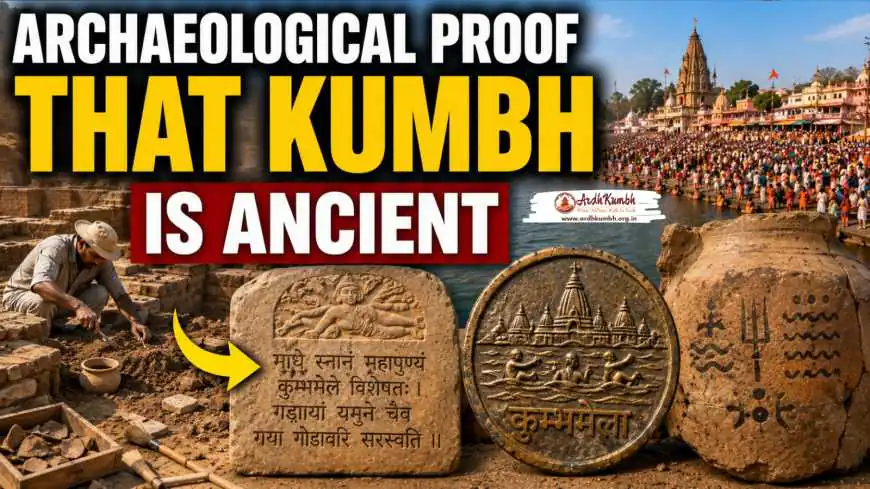
The search for archaeological evidence of Kumbh begins, appropriately, with inscriptions—the most durable form of ancient record-keeping available to historians. Unlike palm leaf manuscripts that decay and must be recopied, inscriptions carved into stone pillars, temple walls, and copper plates survive in their original form, carrying the words of people who lived centuries before anyone thought to question the antiquity of this gathering.
The Allahabad Pillar inscription of Emperor Samudragupta, dated to the 4th century CE, is among the most significant early documents that reference Prayag as a sacred site of paramount importance. While this inscription does not use the word "Kumbh" directly, it establishes Prayag as a tirtha of exceptional sanctity where pilgrims gathered in large numbers. The pillar itself, originally erected by Ashoka in the 3rd century BCE and later inscribed by Samudragupta, demonstrates the continuous sacred significance of this location across different dynasties and centuries.
More specific references appear in inscriptions from the Gupta period and the centuries that followed. Copper plate grants from the 5th and 6th centuries CE record donations made by kings and wealthy merchants specifically for the purpose of supporting pilgrims traveling to Prayag for the sacred bath. These are not mythological texts. They are legal documents recording actual transactions—land grants, tax exemptions, and endowments—made to maintain the infrastructure of pilgrimage at Prayag. When a copper plate records that a certain village's tax revenue was assigned to feed pilgrims at Prayag, we are dealing with material evidence, not legend.
The Kumbh Mela archaeological timeline gained significant support from inscriptions found at temples in central and western India that date from the 8th to 12th centuries CE. These inscriptions use terminology that directly corresponds to the Kumbh tradition—references to specific planetary alignments, to the gathering of ascetics, and to the ritual bathing at the confluence. The language is not vague or mythological. It is specific, calendrical, and practical, describing the same astronomical calculations that determine Kumbh dates today.
Trending Guides Now

What Is the Story Behind the Ardh Kumbh Mela?
Read Guide →
How Saints and Sadhus Define the Ardh Kumbh Tradition
Read Guide →
Ancient Scriptures That Clearly Explain Ardh Kumbh
Read Guide →
Why Saints Are Called Living Archives of Kumbh
Read Guide →
Best Routes to Reach Haridwar for Ardh Kumbh Mela
Read Guide →
Essential Rules Every Ardh Kumbh 2027 Pilgrim Must Follow
Read Guide →
Who Are Naga Sadhus and Why They Lead Kumbh
Read Guide →
Biggest Crowds Ever Recorded at Ardh Kumbh
Read Guide →Temple Carvings That Depict Mass Pilgrimage Gatherings 🛕
Stone does not lie easily. The temple carvings found at numerous sites across India provide visual evidence that mass pilgrimage gatherings involving sacred bathing were well-established practices long before the medieval period. These carvings function as a kind of ancient photography, preserving in stone what the artists saw with their own eyes.
The Khajuraho temples, constructed between the 9th and 11th centuries by the Chandela dynasty, contain several friezes depicting large gatherings of ascetics and pilgrims near water bodies. While these carvings are not labeled "Kumbh Mela" in any language, the scenes they depict—the presence of multiple ascetic orders, the ritual bathing, the ceremonial processions—closely match the descriptions of early Kumbh gatherings found in textual sources. The artists carved what they witnessed, and what they witnessed bears an unmistakable resemblance to the Kumbh tradition.
More direct visual evidence comes from the temple complexes of Odisha, particularly the Lingaraja Temple in Bhubaneswar and the Jagannath Temple in Puri. Carvings dating from the 10th to 12th centuries show large ritual bathing festivals at sacred water bodies, with crowds that include both ascetics and lay pilgrims. The presence of naga sadhus—recognizable by their distinctive appearance—in some of these carvings provides a particularly strong link to the akhara tradition that defines Kumbh.
The South Indian temple carvings at sites like Thanjavur, Madurai, and Srirangam add further weight to the archaeological case. These carvings, created during the Chola and Vijayanagara periods, depict the Maha Makam festival—the Tamil equivalent of Kumbh that occurs according to similar astronomical calculations. The visual record shows that the concept of a great pilgrimage gathering timed to specific planetary positions was pan-Indian, not limited to a single region or a single historical period.
What makes the carving evidence particularly compelling is its incidental nature. These were not propaganda pieces created to prove the antiquity of a tradition. They were decorative elements, narrative friezes, and devotional images that happened to include scenes of mass pilgrimage because such gatherings were a familiar part of the cultural landscape. The artists did not think they were recording something unusual. They were depicting what everyone already knew.
Excavation Findings at Prayagraj That Reveal Continuous Sacred Activity
The archaeological excavations at Prayagraj have produced material evidence that supports the textual and inscriptional record in ways that ground the Kumbh tradition firmly in measurable stratigraphy. When archaeologists dig into the earth at the sacred confluence, they find layers of human activity that go back without interruption to periods well before the Common Era.
The most significant Prayagraj archaeological discoveries come from excavations conducted near the Sangam area and along the ancient ghats. These digs have revealed terracotta figurines, ritual objects, and pottery fragments dating from the Northern Black Polished Ware period (approximately 700-200 BCE), indicating continuous ritual activity at the site. The presence of these artifacts in layers that correspond to pre-Mauryan times establishes that Prayag was a sacred site long before the earliest written records appear.
Particularly telling are the ritual objects recovered from these excavations. Small clay lamps of the type used in river worship, terracotta offerings, and fragments of vessels designed specifically for ritual use rather than domestic purposes all point to the site's continuous function as a place of worship and pilgrimage. When you find the same types of ritual objects in layer after archaeological layer, spanning centuries and dynasties, you are looking at evidence of an unbroken tradition.
The excavations have also revealed structural remains that indicate the presence of facilities for pilgrims—rest houses, bathing ghats, and temple foundations—dating from the Gupta period and continuing through subsequent centuries. These are not the remains of a temporary gathering. They are the infrastructure of a permanent pilgrimage tradition that required year-round maintenance and periodic expansion to accommodate growing numbers of visitors.
The Ashokan pillar at Prayagraj, while primarily known for its inscriptions, is itself archaeological evidence of the site's ancient sacred status. Ashoka did not erect pillars at random locations. He chose sites that already held religious and cultural significance, places where large numbers of people gathered and where his edicts would be seen. The presence of an Ashokan pillar at Prayag confirms that the confluence was a major gathering place in the 3rd century BCE, predating the formal establishment of Kumbh Mela by centuries while establishing the sacred geography upon which the later tradition would develop.
Copper Plate Grants and the Documentary Record of Pilgrimage Support
The copper plate evidence for the antiquity of mass pilgrimage to Prayag constitutes some of the strongest archaeological proof available. Copper plates were the preferred medium for recording legal and administrative documents in ancient India—land grants, tax records, and royal decrees. Unlike palm leaves, copper plates survive centuries of burial, and the information they contain is not mythological but administrative.
Several copper plate grants from the Vakataka dynasty (3rd to 5th centuries CE) and the Gupta empire (4th to 6th centuries CE) record endowments made specifically to support pilgrimage infrastructure at Prayag. These grants assigned the revenue from specific villages to the maintenance of rest houses, feeding houses, and bathing ghats at the sacred confluence. The language is precise and legalistic: so many villages, so much revenue, for such and such purpose. This is not legend. This is administration.
The copper plates of the Kalachuri dynasty (6th to 12th centuries CE) contain particularly detailed records of pilgrimage support. Several of these plates record donations made by kings and queens for the purpose of feeding pilgrims during the sacred bathing festival at Prayag. One notable plate, dated to the 10th century, specifically mentions the gathering of ascetics from multiple orders at the confluence—a description that matches the akhara participation that defines Kumbh to this day.
What makes the documentary evidence so valuable is its incidental character. These copper plates were not created to prove that Kumbh was ancient. They were created to record land transactions, tax arrangements, and administrative decisions. The references to pilgrimage, to sacred bathing, and to the gathering of ascetics appear because these were established facts of the social and religious landscape that the documents needed to account for. A king does not assign tax revenue to feed pilgrims unless there are pilgrims to feed.
The continuity of the record across dynasties and centuries is equally significant. The Vakatakas, Guptas, Kalachuris, Chandelas, and numerous smaller dynasties all left records of supporting pilgrimage at Prayag. When multiple independent administrative traditions, spanning a millennium, all record the same phenomenon at the same location, the cumulative weight of evidence becomes difficult to dismiss.
The Astronomical Basis and Its Archaeological Corroboration
One of the most distinctive features of Kumbh Mela is its astronomical timing. The festival occurs according to specific planetary positions—when Jupiter enters Aquarius (Kumbha) or when the Sun and Moon occupy particular zodiacal relationships. This astronomical basis is not merely mythological. It is a calendrical system that leaves traces in the archaeological record through the construction of observatories, the carving of zodiacal symbols, and the maintenance of precise calendrical calculations.
The astronomical knowledge required to calculate Kumbh dates is sophisticated. It requires accurate observation of planetary movements, precise calendrical mathematics, and a tradition of astronomical learning maintained across generations. The archaeological evidence for this knowledge exists in the form of observatories, astronomical instruments, and inscriptions that record precise calendrical data.
The Jantar Mantar observatories built by Maharaja Jai Singh II in the 18th century represent the most visible astronomical monuments in India, but they are late expressions of a tradition that is far older. Earlier observatories existed at Ujjain, Varanasi, and other sites associated with the Kumbh tradition. Archaeological evidence of these earlier structures, including foundations, instruments, and inscriptions recording astronomical observations, supports the antiquity of the knowledge system upon which Kumbh timing depends.
Ujjain, one of the four Kumbh sites, has been a center of astronomical learning since ancient times. The city was considered the prime meridian for Indian astronomical calculations, the equivalent of Greenwich in the Western tradition. Excavations at Ujjain have revealed evidence of continuous settlement and astronomical activity dating back to the Mauryan period and earlier. The presence of this astronomical tradition at one of the Kumbh sites is not coincidental.
The zodiacal symbolism found in temple carvings across India provides further archaeological corroboration. The Kumbha or Aquarius symbol appears in temple art from the Gupta period onward, often in contexts that suggest calendrical rather than merely decorative significance. When the same zodiacal symbol that gives Kumbh its name appears in carvings from the period when the tradition was supposedly developing, the visual evidence aligns with the textual and inscriptional record.
Comparative Evidence from Other Ancient Pilgrimage Traditions
Placing the archaeological evidence for Kumbh in a broader comparative context strengthens the case significantly. The Kumbh Mela did not develop in isolation. It belongs to a family of mass pilgrimage traditions that existed across the ancient world, and comparing the evidence for Kumbh with the evidence for these other traditions reveals both the uniqueness of the Indian case and the general patterns that mass pilgrimage follows.
The ancient Greek pilgrimage to Eleusis for the Mysteries, documented from at least the 7th century BCE, involved ritual bathing in the sea, processions along sacred ways, and gatherings that drew participants from across the Hellenic world. The archaeological evidence for Eleusis—the Telesterion hall, the sacred way, the purification cisterns—parallels the structural evidence found at Prayagraj. Both sites show the same pattern: permanent infrastructure developed to accommodate periodic mass gatherings centered on ritual purification.
The Hajj pilgrimage to Mecca, whose origins predate Islam and connect to the ancient Arabian pilgrimage traditions, provides another comparative case. The gathering of people from distant regions at a specific sacred site according to a specific calendar, the performance of ritual acts including purification, and the development of infrastructure to support the gathering—all these elements appear in both the Hajj and Kumbh traditions. The archaeological evidence for pre-Islamic pilgrimage at Mecca, including inscriptions and structural remains, supports the general pattern of ancient mass pilgrimage that Kumbh represents.
What distinguishes the Kumbh archaeological record from these comparative cases is its continuity. The Eleusinian Mysteries were suppressed in the 4th century CE. The pre-Islamic Arabian pilgrimage traditions were transformed by the rise of Islam. But the Kumbh tradition at Prayagraj continued without fundamental interruption from at least the Gupta period through the present, producing an unbroken archaeological sequence that few other pilgrimage traditions in the world can match.
Addressing the Skeptics: Why the Absence of Early Written Records Does Not Mean Absence of Tradition
A responsible examination of the archaeological proof for Kumbh's antiquity must address the arguments of those who remain skeptical. The most common objection is the absence of written records that use the specific term "Kumbh Mela" before the medieval period. This objection deserves a serious response.
The argument from terminological absence is weaker than it initially appears. The term "Kumbh Mela" reflects a specific naming convention that may well be medieval even if the gathering it describes is far older. The ancient texts and inscriptions refer to the same phenomenon using different terminology: Magh Mela, Prayag Snan, or simply the sacred bath at the confluence during specific astronomical periods. If the gathering existed under different names in different periods, the absence of the specific term "Kumbh Mela" from early records tells us about naming conventions rather than about the existence or non-existence of the gathering.
The oral transmission of knowledge in Indian culture also explains the absence of early written records for what was clearly an established practice. The astronomical calculations that determine Kumbh dates, the ritual procedures that govern the sacred bath, and the organizational structures that coordinate the gathering were transmitted orally within specific lineages for centuries before being committed to writing. The absence of written manuals does not mean the knowledge did not exist. It means the knowledge was preserved through a different medium that, by its nature, leaves no direct archaeological trace.
The archaeological record consistently reveals that human practices precede their documentation. People performed rituals, built structures, and gathered at sacred sites for centuries before anyone thought to write descriptions of what they were doing. The material evidence—the temple carvings, the ritual objects, the structural remains—shows us what people did. The written records, when they finally appear, describe practices that were already ancient by the time they were documented.
The Living Continuity That Archaeology Cannot Fully Capture
The stone inscriptions, copper plates, temple carvings, and excavation layers provide compelling proof that Kumbh is ancient, but they capture only what can survive burial and exposure. The deeper evidence—the living continuity of practice, the unbroken lineages of the akharas, the astronomical knowledge maintained across generations—cannot be excavated because it never died in the first place.
When a naga sadhu walks toward the Sangam at Prayagraj during Kumbh, following the same path that his predecessors in the akhara have followed for centuries, he is himself archaeological evidence. His ash-smeared body, his specific rituals, his mantras, and his initiation lineage connect him to a tradition that inscriptions can only hint at. The living tradition is the best evidence that the tradition is ancient, because traditions that are not ancient do not develop the depth, complexity, and institutional resilience that the Kumbh tradition displays.
The akhara records themselves, maintained within the orders for generations, contain historical information that has not yet been fully studied by academic archaeologists. Many akharas maintain their own chronicles, recording significant events, lineage successions, and participation in Kumbh gatherings across centuries. These records, while not archaeological in the strict sense, provide documentary evidence that complements the material record.
The continuity of practice at Prayagraj is perhaps the most powerful argument for antiquity. The Kumbh Mela has been held at the same location, following the same astronomical calculations, involving the same akharas, and centered on the same ritual of sacred bathing, for at least the past millennium and almost certainly much longer. This continuity is not an argument against the need for archaeological proof. It is itself a form of evidence that the archaeological record exists to corroborate.
What the Stones Tell Us If We Listen Carefully
The archaeological evidence for Kumbh's antiquity tells a story that is both clear in its broad outlines and tantalizing in its specifics. The sacred confluence at Prayagraj has drawn pilgrims for at least two thousand years, and likely for significantly longer. The material record—inscriptions, carvings, copper plates, excavation layers, and structural remains—consistently points to the existence of a mass pilgrimage tradition centered on ritual bathing at the Sangam, timed to astronomical calculations, and involving multiple ascetic orders.
This evidence does not come from a single dramatic discovery that might be disputed or reinterpreted. It comes from multiple independent sources across different time periods, different locations, and different media. The Ashokan pillar, the Gupta inscriptions, the Khajuraho carvings, the Vakataka copper plates, and the Prayagraj excavation layers all point in the same direction. This convergence of evidence from independent sources is what makes the archaeological case for Kumbh's antiquity so difficult to dismiss.
When you stand at the Sangam during Kumbh, watching the sun rise over the confluence while pilgrims by the thousands enter the sacred waters, you are witnessing something that the stones of Prayagraj have witnessed for centuries before you. The ghats beneath your feet have been trodden by generations whose names are lost to history but whose presence is preserved in the archaeological record. The mantras being chanted are the descendants of mantras that were chanted here when the Gupta emperors ruled, when the Vakatakas made their copper plate grants, and when the unknown pilgrims of the pre-Mauryan period left their simple terracotta offerings at the river's edge.
The archaeological proof that Kumbh is ancient exists in abundance. The stones have been speaking for centuries. The question is whether we are willing to listen.
Frequently Asked Questions