












































Why Charity Is Considered Sacred at Kumbh
Discover why charity is considered sacred at Kumbh Mela. Explore the spiritual philosophy of daan, annadanam, and selfless giving that transforms both the giver and receiver at this ancient pilgrimage.
The Scriptural Foundation of Daan at the Sacred Confluence
The sacredness of charity at Kumbh is not a cultural habit that developed accidentally. It is grounded in specific scriptural declarations that elevate daan or charitable giving to the status of an essential spiritual practice, particularly when performed at a tirtha or sacred crossing place.
The Mahabharata contains an entire section, the Anushasana Parva, devoted to the philosophy and practice of daan. Bhishma, lying on his bed of arrows, instructs Yudhishthira at length about the types of giving, the proper attitude for giving, and the specific places where giving carries amplified spiritual merit. The text is explicit: charity performed at a tirtha, at a sacred river confluence, during an auspicious astrological period, multiplies its spiritual effect many times over. The Kumbh Mela combines all these amplifiers simultaneously—the tirtha of the Sangam, the sacred rivers, and the auspicious planetary configuration.
The Puranas reinforce this understanding with remarkable consistency. The Matsya Purana, the Agni Purana, and the Padma Purana all contain passages describing the multiplied merit of charitable acts performed at Prayagraj during the sacred bathing festival. The texts describe specific types of daan appropriate for the pilgrimage context: anna daan or food offerings, vastu daan or material goods, go daan or the symbolic gift of cows, and vidya daan or the gift of knowledge. Each carries its own spiritual benefit, but all share the common understanding that giving at the sacred confluence is qualitatively different from giving elsewhere.
The Bhagavata Purana provides the theological framework that makes this amplified merit comprehensible. The text explains that certain places and times are particularly permeable to divine grace. The veil between the material and spiritual worlds is thinner at these locations and moments. Actions performed with spiritual intention at these places and times penetrate more deeply into the fabric of consciousness, creating stronger samskaras or spiritual impressions. Charity at Kumbh is not merely a good deed performed in a picturesque setting. It is a spiritually potent act performed at maximum spiritual receptivity.
Trending Guides Now

Complete Guide to Ardh Kumbh Rituals
Read Guide →
Ardh Kumbh Mela Rituals Explained Shahi Snan & Akhara Traditions
Read Guide →
Why Sacred Bathing Is the Heart of Ardh Kumbh
Read Guide →
How Akharas Shape the Soul of Ardh Kumbh
Read Guide →
Best Routes to Reach Haridwar for Ardh Kumbh Mela
Read Guide →
Essential Rules Every Ardh Kumbh 2027 Pilgrim Must Follow
Read Guide →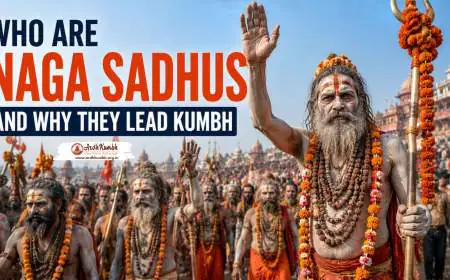
Who Are Naga Sadhus and Why They Lead Kumbh
Read Guide →
Biggest Crowds Ever Recorded at Ardh Kumbh
Read Guide →Annadanam: Why Feeding Pilgrims Is Considered the Highest Charity 🍚
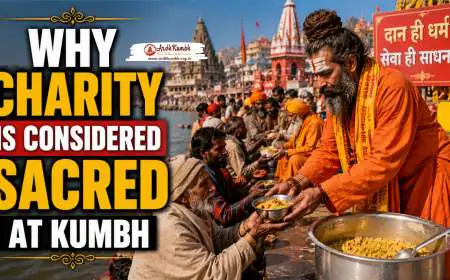
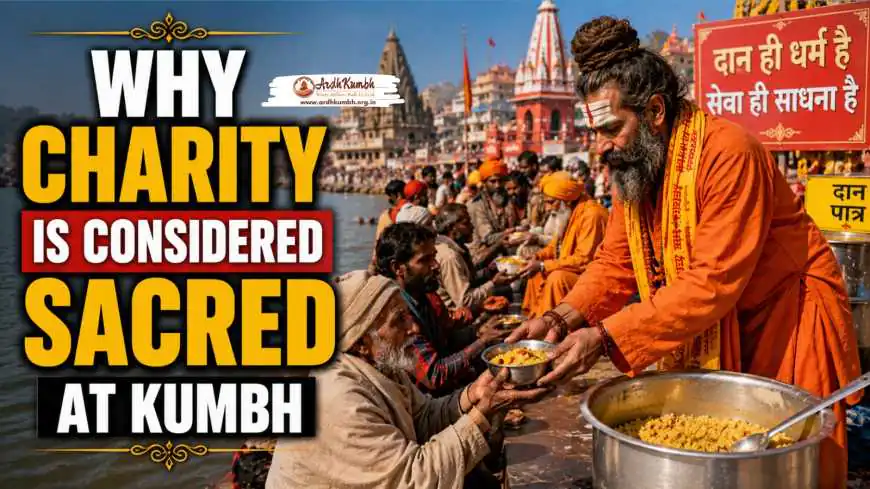
Among all the forms of charity practiced at Kumbh, none carries greater spiritual prestige than annadanam—the offering of food. The Taittiriya Upanishad declares that food is Brahman itself, the very substance of life and consciousness. To offer food is to offer the most fundamental support one being can provide to another. At Kumbh, annadanam becomes not merely feeding the hungry but participating in the cosmic cycle of nourishment that sustains all existence.
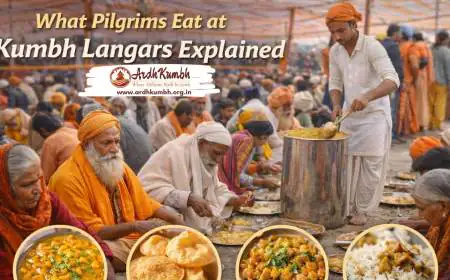
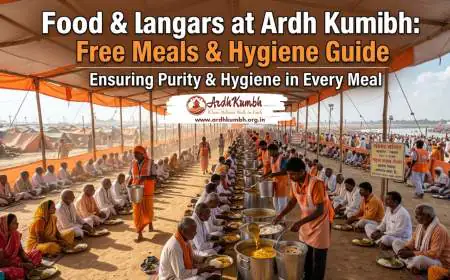
The bhandaras or community kitchens that operate throughout the Kumbh grounds are the most visible expression of annadanam. These massive feeding operations, run by religious organizations, wealthy donors, akharas, and charitable trusts, serve free meals to hundreds of thousands of pilgrims each day. The scale is difficult to comprehend for those who have not witnessed it. Long rows of pilgrims sit cross-legged on the ground while volunteers move continuously through the lines, serving simple but nourishing food—dal, rice, roti, sabzi, and often a sweet.
What makes annadanam sacred at Kumbh is not the quantity of food served but the intention with which it is offered. The traditional understanding holds that the pilgrim receiving the food is not receiving it from the donor but from the divine. The donor is merely the instrument through which divine nourishment flows. This understanding transforms the act of serving food from a charitable transaction into a form of worship. The person being fed is seen as a manifestation of the divine, and the food being offered is prasad—sanctified substance that carries blessing.
The annadanam tradition also serves a practical function that enhances its spiritual significance. The Kumbh Mela gathers millions of pilgrims, many of whom travel long distances with limited resources. The availability of free food throughout the Mela grounds ensures that no pilgrim goes hungry, that the spiritual focus of the gathering is not disrupted by material deprivation. This practical dimension does not diminish the sacred character of annadanam. It enhances it. Spirituality that addresses genuine human need is spirituality grounded in compassion rather than abstraction.
The Bhandara Experience: Sacred Service in Action 🙏
Walking into a Kumbh bhandara during the peak feeding hours is to witness a form of sacred organization that has been refined across centuries. The experience is both humbling and elevating, and understanding what happens inside these massive community kitchens reveals why charity is considered sacred at Kumbh in ways that philosophical explanation alone cannot capture.
The organization of a bhandara is a study in efficient compassion. Volunteers, many of whom are pilgrims themselves, work in coordinated teams. Some prepare the food in enormous vessels that hold hundreds of kilograms of grains and vegetables. Others manage the seating arrangements, directing the continuous flow of pilgrims to the long rows where meals are served. Still others move through the rows, serving each pilgrim with a gesture of respect that transforms the transaction from handout to offering.
The volunteers who serve in bhandaras often describe the experience in spiritual terms. They speak of the joy that comes from serving without expectation of return, of the dissolution of ego that occurs when performing humble tasks in service of fellow pilgrims, of the palpable sense that the food they are serving is somehow not theirs—that they are participating in a flow of grace that precedes and exceeds them. Many pilgrims consider a shift of bhandara seva or service in the community kitchen to be as spiritually valuable as the sacred bath itself.
The pilgrims who eat in the bhandaras also describe the experience in terms that transcend ordinary dining. The food tastes different, they say, when eaten in this context. It is not merely that hunger makes everything taste better. It is that the food has been prepared with prayer, offered with devotion, and received with gratitude. The entire transaction is sanctified at every stage. Eating in a bhandara is not a fallback option for those who cannot afford paid food. It is a spiritual practice that many pilgrims with ample resources choose precisely because of its sacred character.
Dakshina and the Subtle Economics of Sacred Exchange
The practice of dakshina at Kumbh is often misunderstood by those who view it through the lens of modern economic thinking. Dakshina is not a fee. It is not a payment for services rendered. It is not a transaction in which the giver receives a measurable return proportionate to the amount given. Understanding what dakshina actually represents is essential to understanding why charity is sacred at Kumbh.
Dakshina in the traditional understanding is an expression of gratitude that flows spontaneously when the heart recognizes it has received something of immeasurable value. The pilgrim who offers dakshina to a temple, to a guru, to an akhara, or to a sadhu is not paying for a blessing. They are acknowledging that the blessing they have already received—through the sacred bath, through the darshan, through the teachings—is priceless. Dakshina is the gesture that completes the reception of grace. Without it, the spiritual circuit remains open.
The amount of dakshina is not prescribed. It is meant to be proportionate to the giver's means and offered without inner resistance or calculation. A poor pilgrim offering a single coin with a full heart performs the same essential act as a wealthy pilgrim offering a substantial amount. The texts are explicit on this point: it is not the quantity of the gift that matters but the quality of the giving. A small amount given with love carries more spiritual weight than a large amount given with reluctance or with expectation of return.
The recipients of dakshina—the priests, the sadhus, the temple authorities—are not understood to be personal beneficiaries of the gift. They are custodians of sacred traditions who depend on dakshina to maintain the temples, sustain the akharas, and preserve the spiritual infrastructure that makes the Kumbh pilgrimage possible. When a pilgrim offers dakshina, they are participating in the maintenance of a spiritual ecosystem that has served pilgrims for centuries and will serve pilgrims for centuries to come.
The Gift to the Sadhus: Supporting Those Who Have Renounced All 🛕
Among the most sacred forms of charity at Kumbh is the giving directed toward the sadhus and sannyasis who have renounced all material possessions and depend entirely on the generosity of pilgrims for their basic sustenance. This giving carries a particular spiritual significance because it supports those who have dedicated their entire lives to spiritual practice.
The akhara sadhus at Kumbh represent a complete commitment to the spiritual path. They have left behind family, career, property, and all the securities that ordinary life provides. Their ash-smeared bodies, their simple clothing or lack thereof, their minimal possessions, all testify to a radical simplification of existence. They have made themselves deliberately vulnerable to the material world so they can focus entirely on the spiritual. Supporting such individuals is considered a profound spiritual opportunity.
When a pilgrim offers food, clothing, or monetary support to a sadhu at Kumbh, the transaction is understood differently from ordinary charity. The sadhu is not a passive recipient of generosity. The sadhu is offering the pilgrim something in return—spiritual teachings, blessings, or simply the opportunity to perform a meritorious act. The relationship between pilgrim and sadhu at Kumbh is one of mutual giving. The pilgrim gives material support. The sadhu gives spiritual support. Both are necessary. Neither is complete without the other.
The tradition of feeding sadhus is particularly emphasized at Kumbh. Many pilgrims consider it a special blessing to offer a meal directly to a sadhu, to serve them with their own hands, to receive their acknowledgment and blessing in return. This practice, sometimes called sadhu bhoj, transforms the act of feeding from anonymous charity into personal spiritual encounter. The pilgrim looks into the eyes of the renunciate, sees the life they have chosen, and offers sustenance with the awareness that they are supporting something rare and precious—a life entirely devoted to the search for truth.
The Invisible Charity: Seva That Seeks No Recognition
Not all sacred charity at Kumbh takes the form of material giving. Some of the most spiritually significant acts of service at the gathering are invisible to casual observation, performed by volunteers who seek no recognition and often receive none.
The Kumbh Mela grounds require an enormous amount of behind-the-scenes labor to function. The pathways must be maintained. The sanitation facilities must be cleaned. Lost pilgrims must be guided. The sick must be cared for. The elderly must be assisted to the ghats. Much of this work is performed by volunteers who consider their labor a form of karma yoga—the yoga of selfless action that purifies the heart through service performed without attachment to results.
These invisible volunteers are often pilgrims themselves, people who have come to Kumbh for the sacred bath but who feel called to contribute to the gathering in practical ways. They sweep the paths, they serve in the medical camps, they help lost children find their families, they guide first-time visitors through the overwhelming complexity of the Mela grounds. They do this without pay, without recognition, and often without even knowing the names of those they help.
The spiritual significance of this seva is profound. The Bhagavad Gita teaches that action performed as an offering, without attachment to the fruits of action, purifies the mind and prepares it for higher knowledge. The Kumbh Mela provides an unparalleled field for such action. The needs are immense. The opportunities for service are everywhere. And the spiritual atmosphere of the gathering amplifies the purifying effect of selfless action, making seva at Kumbh qualitatively different from volunteer work performed elsewhere.
The Trap of Ego in Sacred Giving and How Kumbh Dissolves It ⚠️
The practice of charity carries an inherent spiritual danger that the Kumbh tradition addresses with remarkable psychological insight. Giving can strengthen the ego rather than dissolve it. The giver can feel superior to the receiver. The act of charity can become a performance designed to enhance social status rather than a genuine offering of the heart. The Kumbh tradition contains safeguards against these distortions.
The anonymity of Kumbh is the first and most powerful safeguard. In a gathering of millions, the individual donor is invisible. A wealthy merchant who funds a bhandara at Kumbh is not known to the pilgrims who eat there. The food is simply food, offered without a name attached. This anonymity strips charity of its ego-feeding potential. The giver gives without being seen giving. The act is purified of the desire for recognition.
The scale of need at Kumbh is the second safeguard. No matter how much a pilgrim gives, the need is always greater. This constant awareness keeps the giver humble. You may have fed a hundred pilgrims, but thousands more are hungry. You may have donated generously to a temple, but many temples are in need. The scale of Kumbh constantly reminds the giver that their contribution, however generous, is a drop in an ocean of need and an ocean of grace.
The spiritual teachings that surround charity at Kumbh provide the third safeguard. Pilgrims are constantly reminded—by the priests, by the sadhus, by the very atmosphere of the gathering—that the true giver is the divine, that the giver and the receiver and the gift itself are all manifestations of the same underlying reality. This understanding, when internalized, transforms charity from an act of personal generosity into a participation in the divine flow of grace. The ego that might have swelled with pride at its own generosity dissolves in the recognition that there is only one Giver, and that Giver is not the individual self.
The Ripple of Sacred Charity Beyond the Mela Grounds
The charity practiced at Kumbh does not end when the Mela concludes and the pilgrims return home. The spiritual momentum generated by sacred giving at the confluence continues to ripple outward in ways that transform both individual lives and communities.
Many pilgrims describe a shift in their relationship to giving after experiencing the Kumbh tradition of daan. The practice of giving without calculation, without expectation, and without attachment—learned or deepened at Kumbh—becomes a lasting part of their spiritual life. They return home with a different understanding of wealth, of generosity, and of the relationship between material resources and spiritual growth. The charity that was sacred at Kumbh becomes sacred in their daily lives.
The organizations that operate bhandaras and other charitable services at Kumbh often continue their work throughout the year, maintaining schools, hospitals, and feeding programs that serve communities far beyond the Mela grounds. The donations received during Kumbh sustain these ongoing activities. A pilgrim who contributes to a bhandara at Kumbh is not just feeding a pilgrim on that particular day. They are supporting an infrastructure of service that operates continuously, reaching people who will never set foot at the Sangam.
The example of Kumbh charity also influences broader cultural attitudes toward giving. The spectacle of millions being fed for free, of massive donations being made without expectation of return, of service being performed by volunteers who seek no recognition—this public demonstration of sacred giving challenges the assumption that human beings are fundamentally self-interested. It provides a living counterexample to the economic model of rational self-maximization. At Kumbh, people give because giving is sacred. And their giving inspires others to give.
The Giver, the Receiver, and the Gift Are One
The deepest understanding of why charity is considered sacred at Kumbh is also the simplest. It is the understanding expressed in the Isha Upanishad: the entire universe is the dwelling place of the divine. Everything that exists is a manifestation of the same underlying reality. When you give to another, you are giving to yourself. When you feed a hungry pilgrim, you are feeding the divine in that pilgrim's form. When you support a sadhu who has renounced everything, you are supporting the divine in that sadhu's form. The giver, the receiver, and the gift are not three separate entities. They are three expressions of the one reality that the Kumbh gathering exists to celebrate.
This non-dual understanding transforms charity from a moral obligation into a natural expression of spiritual insight. The person who truly understands the oneness of all existence does not need to be persuaded to give. Giving flows from them as naturally as the Ganga flows from the Himalayas. The river does not ask whether it should nourish the fields. It simply flows. The sun does not ask whether it should give light. It simply shines. The pilgrim who has been touched by the grace of the Kumbh does not calculate whether to give. They simply give, because they have recognized, even if only for a moment, that the distinction between self and other is ultimately illusory.
This is the sacred heart of Kumbh charity. It is not about the quantity of the gift. It is not about the social recognition of the giver. It is not about earning spiritual merit points in a cosmic ledger. It is about the dissolution of the separate self in the flow of grace. The bath in the sacred river begins this dissolution. The charity that follows completes it. And the pilgrim who has both bathed and given, who has both received and offered, who has both taken the water and given the food, walks away from the Sangam carrying something that cannot be quantified or described—a living understanding that the river, the pilgrim, the gift, and the divine are all one single, flowing, sacred reality.
Frequently Asked Questions