





















































Is Ardh Kumbh Worth Attending at Least Once?
Is Ardh Kumbh worth attending at least once? Discover why this once-in-six-years pilgrimage offers profound spiritual depth, life-changing simplicity, and a manageable scale that makes it an unmissable human experience.

The Spiritual Potency That Does Not Diminish at the Halfway Mark 🛕
There is a quiet but persistent assumption among some pilgrims that the Ardh Kumbh somehow carries only half the spiritual power of the full Kumbh. This is both theologically shallow and practically untrue. The sacred rivers do not check a calendar to decide how much grace to release. The Shipra at Ujjain, the Godavari at Nashik, the Ganga at Haridwar, and the Sangam at Prayagraj are not less divine at the six-year mark than they are at twelve. The astrological configurations that sanctify the Ardh Kumbh are different in detail but not diminished in effect.
The traditional understanding holds that the twelve-year Kumbh represents the maximum amplification of spiritual opportunity, but the six-year gathering is still a profoundly charged moment. The akharas still process to the river with their eternal dhuni fires. The pandas still open their ancient vahis. The yagyas still burn continuously. The mantras still vibrate through the pre-dawn air. If you are waiting for "the big one" while ignoring the Ardh Kumbh, you are letting the perfect become the enemy of the profoundly good.
Many seasoned pilgrims and sadhus actually point out that the spiritual atmosphere of the Ardh Kumbh can feel more accessible. The collective energy of millions is still present, but it does not tip over into the overwhelming, almost disorienting intensity that the largest bathing days of the Mahakumbh can produce. For someone seeking to actually absorb the experience—to stand in the water and feel something shift within—the Ardh Kumbh often provides the ideal container. The grace is not diluted. It is simply quieter, and quiet grace is often exactly what a noisy modern soul requires.
The Manageable Scale That Preserves Your Sanity and Deepens Your Experience 🚶
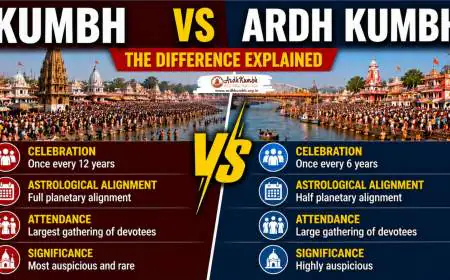
The most significant, practical difference between the Ardh Kumbh and the Poorna Kumbh is scale. A Poorna Kumbh at Prayagraj can draw a hundred and twenty million pilgrims. An Ardh Kumbh draws perhaps fifty or sixty million. The numbers are still staggering, but in the context of the largest gathering on earth, that difference is everything. It is the difference between being able to breathe and feeling like you are drowning in humanity. It is the difference between walking to the ghat under your own power and being carried by a crowd whose movement you cannot control.
Trending Guides Now

Are Special Facilities Available for Elderly Pilgrims?
Read Guide →
Ardh Kumbh vs Maha Kumbh: The Real Difference Explained
Read Guide →
Is Ardh Kumbh Really Different From Kumbh Mela?
Read Guide →
How Many Days Are Actually Enough for Ardh Kumbh?
Read Guide →
Best Routes to Reach Haridwar for Ardh Kumbh Mela
Read Guide →
Essential Rules Every Ardh Kumbh 2027 Pilgrim Must Follow
Read Guide →
The Untold Stories of Har Ki Pauri
Read Guide →
How Akharas Were Formed and Why They Matter
Read Guide →At the Ardh Kumbh, you can still find space on the ghat steps. You can still approach a sadhu for a personal blessing without being jostled aside. The queues for the community kitchens move at a pace that allows for gratitude, not just relief. The shuttle buses are crowded but functional. The pontoon bridges, while busy, do not feel like they might buckle under the weight of a million feet. This manageability is not a compromise. It is a feature.
For the first-time pilgrim, the Ardh Kumbh offers a gentler introduction to the chaotic, beautiful, and utterly unique world of the Mela. You will still be tested. You will still be cold. You will still be pushed beyond your comfort zone. But you will be able to process what is happening to you. You will have the mental and emotional bandwidth to pray, to reflect, to receive. You will return home with memories that are vivid and meaningful rather than a blur of survival.
The Community You Will Find, Not the Crowd You Fear 🤲
People often ask about the crowds at Kumbh as if they were an obstacle to the spiritual experience. The pilgrim who has attended even once knows the truth: the crowd is the spiritual experience. At the Ardh Kumbh, the scale is large enough to teach this lesson but manageable enough that you can actually learn it. You stand shivering next to a stranger at 4 AM, and without a word, you share a cup of chai. You help an elderly woman down the slippery steps. A sadhu catches your eye and offers a blessing that feels meant only for you. These moments of spontaneous, unspoken connection are the very fabric of the pilgrimage.
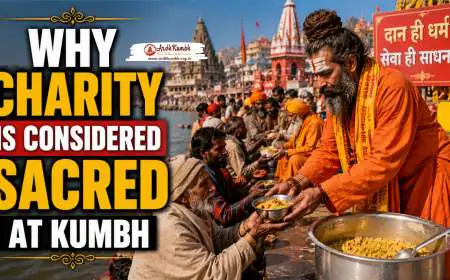
The community kitchens, the bhandaras, are the beating heart of this lesson. You sit cross-legged on the ground in a line that stretches as far as you can see. A volunteer slaps a hot roti onto your palm-leaf plate. The dal is simple. The vegetables are plain. And yet, surrounded by thousands of others eating the same food in the same humble posture, you will taste something that no five-star restaurant can replicate: the profound, nourishing flavor of human equality.
For the modern seeker, isolated by screens and schedules, this immersion in a community of faith is worth the journey alone. The Ardh Kumbh will show you that you are not alone, that your spiritual longing is shared by millions, and that a gathering of this magnitude can be organized not around fear or force but around a shared, peaceful purpose. It is a lesson in hope that the news never delivers.
The Simplicity You Will Miss and Then Long to Recreate 🏠
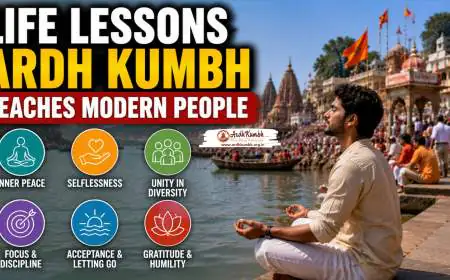
You will return from the Ardh Kumbh and find your house strangely cluttered. You will open your refrigerator and feel a vague unease at the sheer number of choices. You will sit on your comfortable sofa and remember the surprising peace of sitting on a thin mat on cold ground, wrapped in a single shawl, asking nothing more of the moment than what it already contained. The pilgrimage teaches simplicity not through sermons but through the undeniable evidence of your own experience: you were happier with less.
This radical simplification is one of the most compelling reasons to attend the Ardh Kumbh at least once. The modern world is engineered to make you accumulate—possessions, commitments, information, debt. The Mela strips all of that away. Your day is organized around the sun and the rituals, not the clock and the calendar. Your possessions are what you can carry. Your food is what is given. Your purpose is to walk to the water, to stand in the cold, to offer your prayers, and to help the person next to you do the same.
When you come home, this memory of simplicity will haunt you in the best possible way. It will make you question what you truly need. It will inspire you to clear out a corner of your life—perhaps literally, perhaps metaphorically—for something more spacious, more still. The Ardh Kumbh is worth attending at least once because it implants a seed of intentional simplicity that can grow for the rest of your life, gradually reshaping your relationship with the material world.
The Physical Challenge That Reveals Your True Strength 💪
There is no way around it: attending the Ardh Kumbh will push your body. You will walk miles in the dark. You will shiver in the pre-dawn cold. You will immerse yourself in water that steals your breath. You will sleep on surfaces that are far from your memory-foam mattress. If you are elderly, if you have health conditions, you must prepare carefully and honestly. But for most people, this physical challenge is not a flaw in the pilgrimage design. It is a central feature.
The tapas, the spiritual heat generated by willingly enduring discomfort, is an ancient and powerful technology of transformation. The modern world has made us soft, not just in our bodies but in our souls. We expect comfort as a right and experience inconvenience as an outrage. The Ardh Kumbh will not indulge this. It will demand something of you. And in meeting that demand, you will discover reserves of strength, patience, and resilience that you did not know you possessed.
The cold water of the snan is the most direct teacher. When you step into it, your mind goes completely silent. Every worry, every plan, every regret—all of it vanishes into the shocking, immediate reality of being cold and wet and alive. This forced presence, this involuntary meditation, is more effective than months of mindfulness training. You will come home and find that the same traffic jam, the same difficult colleague, the same nagging anxiety no longer has the power to unsettle you. You have stood in a freezing river at dawn, surrounded by a million strangers, and you have emerged cleansed. After that, the ordinary stresses of life feel manageable.
The Encounter with Living Traditions That Books Cannot Provide 📜
You can read about the akharas in a library. You can watch a documentary about the naga sadhus on your television. But until you have sat before a dhuni fire that has been burning for three hundred years, tended by a lineage of ascetics whose names are lost to memory, you have not truly encountered the living heart of India's spiritual tradition. The Ardh Kumbh is a living museum, but the exhibits are not behind glass. They are breathing, chanting, and offering you a blessing.
The oral traditions come alive in this space. You will hear mantras recited with an intonation that has been preserved without error for millennia. You will see rituals performed that the Vedas describe, not as a reenactment but as a continuation. You will meet sadhus who have dedicated their entire existence to the pursuit of the absolute, and their very presence will raise questions about your own life that no amount of casual entertainment can drown out.
For the spiritually curious who may not even identify as religious, this encounter with a living, functioning, ancient tradition is intellectually and emotionally riveting. The Ardh Kumbh offers an immersive experience of cultural continuity that is vanishingly rare in a world of rapid change. It connects you to a past that is not dead but alive, not a relic but a resource.
The Return Home: A Pilgrimage That Never Really Ends 🔄
The real reason the Ardh Kumbh is worth attending at least once is what happens after you leave. The gathering will dismantle itself. The tents will fold. The river will flow on, indifferent to the departure of the millions. And you will return to your life, to your job, to your family. But you will not be the same. You will have seen what human beings are capable of when they gather in peace. You will have felt what silence feels like in the middle of a crowd. You will have experienced a simplicity that made you happier than complexity ever did.
The practices you bring home—the morning silence, the simpler meals, the regular charity, the patience in difficulty—are the continuation of the pilgrimage. The Ardh Kumbh gives you a template for a different way of living, and the years that follow give you the chance to implement it. The gathering is not an escape from reality. It is a training ground for reality.
The memory of the water will return to you at unexpected moments. In the middle of a stressful meeting, you will remember the shock of the cold river and the stillness that followed. You will remember the face of the old woman who blessed you on the ghat steps. You will remember the taste of the simple dal, eaten with your fingers, sitting on the ground, completely content. These memories are not just nostalgia. They are anchors. They remind you of who you became at the Kumbh, and they invite you to become that person again.
A Single Yes That Echoes Across a Lifetime
To ask is Ardh Kumbh worth attending at least once is to ask whether you are willing to be transformed. It is to ask whether you can endure temporary discomfort for lasting insight, whether you can step into a crowd to find yourself, whether you can leave behind the familiar and discover something truer. The Ardh Kumbh does not promise a comfortable holiday. It promises something far more valuable: a genuine encounter with the sacred, with humanity, and with the depths of your own heart.
If you go once, you will understand why millions return, cycle after cycle, lifetime after lifetime. You will understand that the Kumbh is not a festival on the calendar but a rhythm in the soul. And you will find that the journey to the river, taken with faith and preparation, is one of the very few things in life that is not just worth doing but worth building your life around.
The river is waiting. The planets are aligning. The akharas are preparing. The only question remaining is whether you will give yourself the permission to say yes. If you do, the Ardh Kumbh will not be just a trip you took. It will be a story you tell for the rest of your life, a quiet fire you carry in your heart, a single, luminous proof that the world is more sacred, more connected, and more hopeful than you ever dared to believe.
Frequently Asked Questions