





























































Why Early 2027 Planning Will Decide Your Experience
Discover why early 2027 planning will decide your Kumbh Mela experience. Learn how booking ahead, choosing peak bathing dates, and preparing your body and mind transforms a chaotic pilgrimage into a seamless spiritual journey.

The Hidden Booking Window That Opens in 2027 ⏰
Most pilgrims only think about logistics a few months before the Mela. By then, the hidden booking window has already slammed shut. The Indian Railways opens reservations 120 days in advance for most trains, but for special Mela services, tickets often go on sale six to eight months ahead. If you wait until late 2027 or early 2028, you will find that every sleeper berth on every train bound for Ujjain has already been snapped up by people who understood that the spiritual journey begins at the booking counter.
The accommodation near the ghats follows an even more unforgiving timeline. The permanent hotels and dharamshalas in Ujjain are limited, and their owners start taking block bookings from large pilgrim groups as early as mid-2027. By October 2027, the better guesthouses within walking distance of the ghats will be fully committed. The pilgrim who arrives in 2028 hoping to find a room near the river will discover that “near” now means a town forty kilometers away. The Mela administration’s own tent cities open for bookings closer to the event, but the premium camps—with attached bathrooms and decent bedding—sell out almost instantly when the booking portal opens.
This advance-booking discipline is not about paranoia. It is about recognizing that the Kumbh is not a normal event. It is the largest peaceful gathering of human beings in the history of the planet. The logistics that work for a weekend trip to a hill station collapse under the weight of fifty million pilgrims. The earlier you plan, the closer you sleep to the sacred river. The later you plan, the more time you spend commuting instead of meditating.
The Peak Dates That Dictate Everything 🗓️
Not all moments at the Kumbh are equal. The shahi snan and the other major bathing days carry a spiritual potency that the ordinary days do not. The 2028 Ujjain Simhastha will be governed by precise astrological calculations that determine exactly when Jupiter’s transit through Leo makes the Shipra’s water most charged with amrit-like grace. These dates will be published well in advance, likely in early 2027, giving you a clear target around which to build your entire pilgrimage.
Trending Guides Now
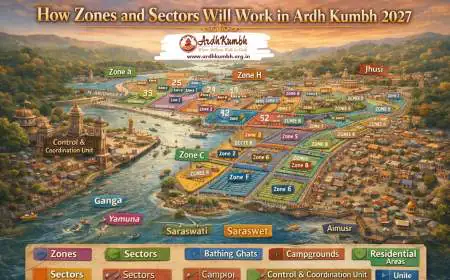
How Zones and Sectors Will Work in Ardh Kumbh 2027
Read Guide →
Why Ardh Kumbh 2027 Will Be Spiritually Significant
Read Guide →
A Full Day at Ardh Kumbh Mela: Dawn to Night Guide
Read Guide →
Why Ardh Kumbh 2027 Is Not Just Another Kumbh Mela
Read Guide →
Best Routes to Reach Haridwar for Ardh Kumbh Mela
Read Guide →
Essential Rules Every Ardh Kumbh 2027 Pilgrim Must Follow
Read Guide →
Biggest Crowds Ever Recorded at Ardh Kumbh
Read Guide →
The Untold Stories of Har Ki Pauri
Read Guide →If you arrive a week after the second shahi snan, you will have missed the most spectacular akhara processions and the most powerful bathing moments. You will find the Mela half-empty, the sadhus already beginning to disperse, the spiritual atmosphere already waning. The pilgrim who plans in 2027 marks these peak dates on their calendar the moment they are announced, applies for leave, books their travel, and structures their entire year around being present at the ghats on those specific mornings.
The arrival and departure strategy also depends on knowing these dates. It is wise to arrive two or three days before your target bathing day. This gives you time to acclimatize, to scout the route to the ghat, to understand the flow of the crowds, and to participate in the rituals without the pressure of having just stepped off a train. The pilgrim who arrives on the morning of the shahi snan, having traveled all night, will be exhausted, disoriented, and unable to fully absorb the experience they spent so much effort to reach.
The Physical Preparation That Early Planning Makes Possible 💪
Kumbh Mela is a physical event. You will walk eight, ten, fifteen kilometers a day on the major bathing dates. You will stand for hours in cold water. You will carry your own bag because no vehicle can enter the pedestrian zones. If your body is not ready, your spirit will not have the chance to soar because your feet will be blistered and your back will be aching and your mind will be filled with nothing but the desire to sit down.
Early 2027 planning gives you an entire year to prepare your body. A daily walk of thirty minutes, gradually extended to an hour and then two, builds the stamina you will need. A few months of basic yoga or stretching prevents the muscle strains that come from sudden, unaccustomed exertion. If you are not used to cold water, you can begin acclimatizing by ending your daily shower with a minute of cold water, training your body to handle the shock of the Shipra in April.
Health precautions also require lead time. Visit your doctor in 2027 to discuss vaccinations, to refill any prescription medications you will need, and to get a frank assessment of your fitness for the rigors of the pilgrimage. If you have underlying conditions—cardiac issues, respiratory problems, severe arthritis—you need to know, well in advance, what you can safely undertake. The Kumbh will push your body to its limits. Early preparation ensures those limits are wide enough to accommodate the demands.
The Mental and Spiritual Preparation That Cannot Be Rushed 🧘
The external journey to Ujjain is easy compared to the internal journey that the Kumbh demands. If you arrive at the Shipra’s edge with a mind still cluttered by office politics, family tensions, and the endless chatter of social media, you will bathe in the sacred water and feel nothing. The purification the Kumbh offers requires a receptive vessel, and that vessel must be prepared over time.
A year of spiritual preparation transforms the pilgrimage from a tourist visit into a genuine encounter with the sacred. Read the scriptures or listen to discourses that explain the significance of the Simhastha. Learn the story of the Samudra Manthan and why the drops of amrit fell at Ujjain. Familiarize yourself with the mantras you will chant at the ghat. A daily practice of even ten minutes of meditation, started in 2027, will make you far more sensitive to the subtle atmosphere of the Mela than the person who arrives without any inner preparation at all.
Simplify your life in the months leading up to the Kumbh. Reduce your screen time. Eat lighter, sattvic food. Practice silence for a few minutes each day. The Kumbh will ask you to live simply—to wake before dawn, to walk in the cold, to eat plain food from a community kitchen. If your body and mind are already accustomed to this simplicity, the transition will be seamless. If they are not, the first few days will be a shock from which you may not recover before the peak bathing dates have passed.
The Financial Planning That Makes the Pilgrimage Possible 💰
Attending the Kumbh is not a luxury reserved for the wealthy, but it does require financial planning. A year’s lead time allows you to set aside a small amount each month, building a dedicated pilgrimage fund that covers your travel, accommodation, food, and donations without straining your household budget.
The costs of Kumbh vary enormously depending on your choices. A pilgrim who books early can secure a tent in a decent camp for a fraction of what the last-minute traveler pays for a room in a neighboring town. Train tickets booked in advance cost their standard fare, while last-minute travel often requires expensive alternatives. Early planning allows you to make choices based on value rather than desperation.
Dakshina and daan are integral parts of the pilgrimage, and planning for them in advance elevates them from an afterthought to a conscious spiritual practice. Decide in 2027 how much you intend to give—to the temples, to the bhandaras, to the sadhus—and set that money aside. When you give at the Kumbh, you will be giving from a place of intention rather than impulse, and the spiritual merit of such giving is immeasurably greater.
The Packing List That Takes a Year to Get Right 🎒
A Kumbh packing list is not something you throw together the night before your train. The right gear—warm layers for pre-dawn baths, sturdy walking shoes that have been broken in, a water-resistant jacket, a reliable torch, a basic medical kit—can make the difference between comfort and misery. These items need to be acquired, tested, and refined over time.
Shoes are the most critical purchase. You will walk more at the Kumbh than you have walked anywhere else in your life. Buy your pilgrimage shoes in early 2027 and wear them regularly. Break them in. Learn where they rub and how to prevent blisters. By the time you reach Ujjain, your shoes should feel like extensions of your feet, not foreign objects strapped to them.
Clothing layers require similar forethought. The April weather in Ujjain is warm during the day but can be surprisingly cool before dawn and after sunset. You need a system of layers that you can add and remove as the temperature swings. Gathering these layers gradually over the year, perhaps one piece each month, makes the expense manageable and ensures you have exactly what you need.
The Information Advantage That Early Planners Possess 📚
The pilgrim who plans in 2027 becomes a student of the Kumbh. They read the accounts of previous gatherings. They watch documentaries. They join online communities of experienced pilgrims who share practical tips that no official guidebook contains—which ghat is less crowded at dawn, which akhara camp welcomes respectful visitors, which bhandara serves the best simple food.
This information advantage is impossible to replicate at the last minute. You cannot cram the Kumbh the way you might cram for an exam. The knowledge you need is practical, embodied, and accumulated through the shared experience of generations. The early planner has time to absorb this wisdom, to ask questions, to refine their understanding. By the time they arrive at Ujjain, they will know what to expect, and that knowledge will keep them calm when the crowds surge and the noise rises and the sheer scale of the Mela threatens to overwhelm.
Language and cultural preparation also matter, especially for international visitors or Indians from regions where Hindi is not the first language. A few months of learning basic phrases, understanding the customs of the ghats, and familiarizing yourself with the etiquette of approaching sadhus will open doors that remain closed to the unprepared.
The Spiritual Intent That Crystallizes Over Time 🙏
The sankalpa—the sacred intention that you formulate before entering the water—is the heart of the Kumbh snan. A sankalpa made in a hurry, on the ghat steps, with the crowd pressing around you, is not the same as a sankalpa that has been nurtured for a year. When you begin planning in 2027, your intention has time to ripen. You sit with it. You refine it. You discover, perhaps, that the thing you thought you wanted from the Kumbh is not what you truly need.
This deepening of intention is the most precious gift of early planning. The pilgrimage becomes not just an event on your calendar but a thread that runs through your entire year, pulling you toward the sacred, shaping your choices, reminding you of what matters. By the time you finally stand at the Shipra’s edge, you will know exactly why you are there. The water will receive not just your body but your fully formed, fully conscious offering. And that makes all the difference.
The First Step of the Pilgrimage Is Taken at Home
The Kumbh Mela does not begin at the Ujjain railway station. It does not begin when you first glimpse the Shipra or hear the temple bells or smell the incense from the akhara camps. It begins the moment you decide to attend, and the quality of that decision—the seriousness with which you prepare, the time you give yourself, the intention you cultivate—determines the quality of everything that follows.
The pilgrim who starts in 2027 will arrive in 2028 already halfway to the sacred. Their body will be ready. Their mind will be quiet. Their heart will be open. They will know where to go, when to bathe, what to carry, and why they have come. They will be able to receive what the Kumbh offers because they have made themselves into a vessel capable of receiving it.
The pilgrim who waits until the last minute will arrive flustered, exhausted, and overwhelmed. They will spend their precious days in Ujjain solving problems—finding a room, locating their train, treating their blisters—that the early planner solved months ago. They will stand in the sacred water with a mind still racing, and they will wonder, perhaps, why they feel nothing.
The choice is made not at the Sangam but at home, not in 2028 but in 2027. The early 2027 planning is not merely practical wisdom. It is the first act of devotion, the first offering, the first step of the pilgrimage itself. The river will be waiting. The planets will align. The sadhus will process to the ghats. The only question is whether you will be ready to meet them.
Frequently Asked Questions