




















































Can Women Fully Participate in All Kumbh Rituals
Can women fully participate in all Kumbh rituals? Yes, the sacred snan and core traditions welcome all. Discover how female pilgrims, sadhvis, and saints engage deeply, and learn about practical safety and spiritual inclusivity.
The Core Ritual of Snan Has No Gender 🌊
The heart of the Kumbh Mela is the snan, the sacred bath. Every other ritual—the yagyas, the processions, the discourses—radiates outward from this central, non-negotiable act. And the snan is, in its deepest spiritual logic, completely free of gender. The scriptures that extol the power of bathing at the Sangam during the Kumbh do not speak of men and women separately. They speak of souls, of pilgrims, of those who have faith. The Puranas describe the merit of the Kumbh snan in universal terms: anyone who bathes with devotion at the auspicious moment is purified of lifetimes of accumulated karma and takes a profound step toward liberation.
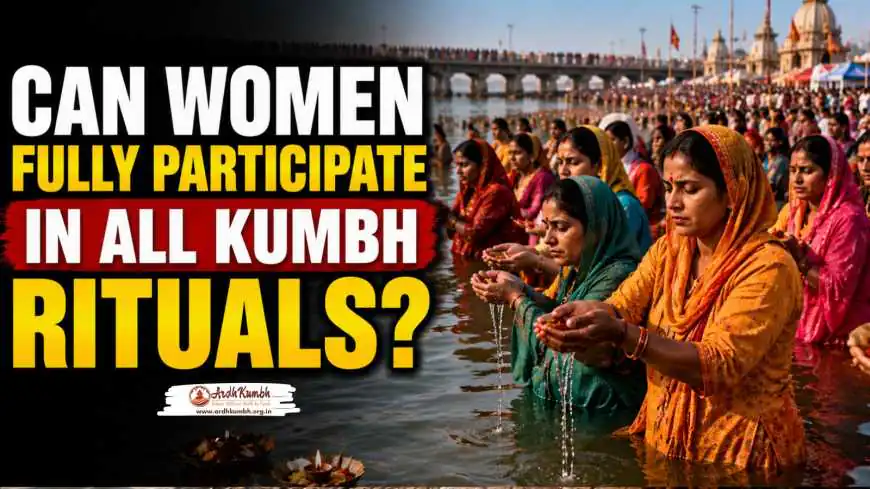
This is not a modern, progressive interpretation. It is the foundational theology. The Ganga, Yamuna, and Saraswati are themselves goddesses, divine feminine forces, and their embrace is not a masculine domain into which women must beg entry. A woman who walks into the cold water at 4 AM, formulates her sankalpa from the depths of her being, and offers herself to the river is performing the ritual in its most complete and potent form. The ritual accessories—the flowers, the diya, the chanting of a mantra—can be performed by anyone. There is no requirement for a male priest to mediate this primary encounter. The river is the priest. The sun is the witness. The woman is the offerer and the offering, and this direct, unmediated access is the spiritual birthright of every being.
The Divine Feminine at the Center of Kumbh Worship 🛕
One of the reasons the question of women’s participation can feel paradoxical is that the Kumbh Mela is itself a celebration of the divine feminine to an extraordinary degree. The entire pilgrimage revolves around the worship of sacred rivers, all of which are goddesses: Ganga Ma, Yamuna Ji, and the invisible Saraswati. The central mythological event, the Samudra Manthan, features the goddess Lakshmi emerging from the cosmic ocean, and the pot (kumbha) of amrit is itself a symbol of the creative, life-giving womb. The very ground of the Mela is understood as an expression of Shakti, the primordial feminine power.
Given this, the spiritual authority of women at the Kumbh is not borrowed from a male-dominated hierarchy. It is inherent. The women who come to the Kumbh—as pilgrims, as mothers, as widows, as seekers—are not entering a foreign, male space. They are coming home to the Mother. This is powerfully visible in the way women participate in the rituals. You will see them singing bhajans with an abandon born of deep intimacy, offering their tears to the river, and performing their own pujas with a quiet, commanding authority. Their devotion is not a lesser, auxiliary form of the “official” male rituals. It is the very lifeblood of the Kumbh, the raw, emotional, and embodied faith that sustains the entire pilgrimage.
Trending Guides Now

Are Special Facilities Available for Elderly Pilgrims?
Read Guide →
Ardh Kumbh vs Maha Kumbh: The Real Difference Explained
Read Guide →
How Many Days Are Actually Enough for Ardh Kumbh?
Read Guide →
Is Ardh Kumbh Really Different From Kumbh Mela?
Read Guide →
Best Routes to Reach Haridwar for Ardh Kumbh Mela
Read Guide →
Ardh Kumbh 2027 Dates (Official) - Haridwar Snan Schedule
Read Guide →
How Kumbh Keeps India’s Civilizational Memory Alive
Read Guide →
February Weather Reality at Ardh Kumbh
Read Guide →Female Sadhvis and the Matriarchal Monastic Orders 🔱
The area where the question of full participation becomes nuanced is the monastic sphere, specifically the akhara system. The famous naga sadhu orders, like the Juna and Niranjani akharas, are traditionally male-only institutions. The initiation into their ranks, with its specific martial and ascetic vows, has historically been closed to women. This is the source of the idea that women cannot “fully” participate in all Kumbh rituals, because the grand, public spectacle of the naga sadhus charging into the water for the shahi snan is an exclusively male event.
However, this picture is far from complete. There is a robust, ancient, and often overlooked tradition of female sadhvis (nuns) and sannyasinis who have their own orders and participate in the Kumbh. The most prominent are the female branches of the main akharas, as well as independent orders of female ascetics. These women are initiated, wear gerua or white, maintain their own dhunis, and follow a strict spiritual discipline. While they may not be part of the naked naga processions, they have their own encampments, their own rituals, and their own lineage of female gurus that command immense respect. The Maha Nirvani Akhara, for instance, is known for its history of initiating women. There are also women who have been formally initiated as naga sadhvis in certain akharas in recent decades, a gradual and significant evolution. These female sadhvis are a living testament that the renunciate path is not closed to women, and their presence at the Kumbh, though less visually dominant than the male nagas, is a profound assertion of women’s full spiritual authority.
The Historical and Scriptural Fluidity of Gender Roles 📜
The idea that women were ever fully excluded from the heights of spiritual life is a historical inaccuracy. Ancient and medieval India produced a galaxy of revered female saints whose teachings and poems form the bedrock of the Bhakti movement. Andal in the south, Akka Mahadevi in Karnataka, Mirabai in the north, Lalleshwari in Kashmir—these were not marginal figures. They were radical, liberated voices who defied social conventions, including those of gender, to pursue direct union with the divine. Akka Mahadevi famously wandered naked, an act of radical renunciation that was a profound spiritual statement.
The Kumbh Mela is the inheritor of this Bhakti tradition, a tradition far more democratic and accessible than the highly structured Vedic ritualism that often excluded women. The path of devotion, of personal, emotional connection to the divine, was always open to women, and it is this path that the Kumbh most powerfully amplifies. In the vast, anonymous crowd at the Sangam, a woman’s tears of devotion are as potent as a priest’s most elaborate yagya. The historical record shows that women, especially from royal families and wealthy merchant classes, were major patrons of pilgrimage infrastructure, building ghats and funding bhandaras. Their names are carved into the stone of the ghats themselves, a permanent testament to their central role.
The Practical Reality: Safety, Space, and Sacred Intentions 🤲
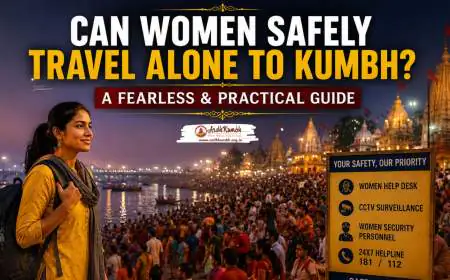
For the modern woman pilgrim, the question is often less about scriptural permission and more about a practical one: can I participate safely and comfortably? The Kumbh is an intense environment. The crowds are immense, personal space is non-existent, and the facilities can be basic. However, the Mela administration has become increasingly responsive to the needs of women. There are designated women-only bathing ghats and changing areas, especially on the main snan days, to provide a safe and dignified space. Women police officers and volunteers are highly visible. Many women choose to travel in groups, either with family or with organized tour operators that specialize in women-centric pilgrimage experiences.
The key for a woman to fully participate is to plan practically. This means wearing the right clothing—a comfortable salwar kameez or sari that can be easily managed when wet, with a warm shawl for the cold dawn. It means staying in accommodation that is secure and ideally located closer to the main areas to minimize long, dark walks. It means connecting with other women pilgrims, forming an impromptu sangha that provides mutual support. The inner rituals, the snan and the sankalpa, are intensely private, and a woman can manage them with absolute autonomy. The external chaos can be navigated with a calm, assertive presence. The Kumbh, at its core, is a safe space because of the overwhelming spiritual focus of the crowd; the energy is devotional, not predatory. A woman with a clear, confident intention will find her way.
Menstruation and the Question of Ritual Purity ⚠️
No discussion of women’s participation in Hindu rituals is complete without addressing the sensitive and often painful issue of menstruation. In many temple traditions, menstruating women are asked not to participate in pujas or enter sanctums. This can lead a woman planning her pilgrimage to the Kumbh to feel anxiety: what if her period arrives on the main snan day?
The spiritual truth of the Kumbh, as understood by the most respected gurus and the living tradition of the river herself, overrides the ritual purity norms that govern daily temple worship. The Ganga is not an idol in a closed sanctum. She is a living, flowing, ever-pure goddess, and her purifying power is so absolute that she is believed to purify even the gods. To suggest that a natural biological process could render a woman impure before the Ganga is a profound theological error. Many modern spiritual teachers at the Kumbh explicitly advise women that they can and should take the sacred bath regardless of their menstrual cycle. The river is a source of cleansing; she does not contract impurity from anyone. A woman who bleeds is not spiritually barred; she is experiencing a powerful, cyclic expression of the feminine Shakti that the Kumbh itself honors. If a woman feels personally more comfortable waiting, she can, but the ancient, powerful voice of the river does not demand it.
Common Misconceptions That Diminish Women's Spiritual Authority ❌
Several misconceptions persist that prevent women from fully owning their spiritual power at the Kumbh. The first is that the most “authentic” rituals require a male priest or family member to perform them on her behalf. This is simply false for the core Kumbh practices. While a panda can guide a specific sankalpa, a woman can stand alone at the river’s edge, speak her intention from her heart, and immerse herself. Her prayer is as valid as any purohit’s chant. The second misconception is that women are primarily at the Kumbh as caretakers for their families, not as spiritual agents in their own right. While many women do attend as part of a family unit, millions come as widows, as solo travelers, and as groups of female friends, driven by their own deep, personal longing for the divine. The third is the idea that the female sadhvis are a fringe, modern phenomenon. They are not. They are the inheritors of a long, sacred lineage of women who chose the path of fierce renunciation, and their presence is a direct challenge to the idea that spiritual mastery has a gender.
Women Who Embody the Pilgrimage Today 🕊️
Walk through the Kumbh Mela with open eyes, and you will see women embodying the pilgrimage in all its diverse, powerful forms. You will see the elderly woman, her body frail but her spirit unbreakable, walking miles to the Sangam with a look of absolute, radiant peace, having saved for years for this one journey. You will see the young woman, perhaps on her first solo trip, navigating the crowd with a map in one hand and a flower for the river in the other, her face a mixture of anxiety and fierce determination. You will see the female sadhvi, sitting by her dhuni, her eyes holding a depth of silence and wisdom that speaks more than any scripture. You will see groups of women from a village, their brightly colored saris forming a moving garden of devotion, singing bhajans that echo across the pontoon bridges.
These women are not peripheral to the Kumbh. They are its beating heart. They are not asking for permission. They are claiming their ancient, sacred inheritance. They are the living proof that the river of liberation does not ask whether you are a man or a woman before she washes your karma away. She only asks if you have come with faith. And these women, in their millions, answer with their presence, their tears, and their unshakeable, quiet courage.
The Mother Who Welcomes All Her Children Home
The Ganga is called Ma—Mother. Not Father. Not King. Not Lord. Mother. This is the most important theological fact for any woman wondering about her place at the Kumbh. You are not entering the house of a distant, masculine authority. You are returning to the lap of your own divine Mother. And a true mother does not have favorite children. She does not check credentials. She does not say to a daughter, “You are less welcome than my son.” She opens her arms, and she embraces everyone with the same unconditional, purifying, and liberating love.
The question can women fully participate in all Kumbh rituals is, in the end, answered by the river herself. She has been receiving the ashes of the dead and the prayers of the living for millennia, and she has never once turned a woman away. The monastic rules of specific akharas are a small, historically conditioned footnote to the vast, inclusive, and deeply feminine mystery of the Kumbh. A woman who walks into the Sangam with a heart full of devotion is not participating in a lesser way. She is fully, completely, and eternally home. The rest is just detail.
Frequently Asked Questions