


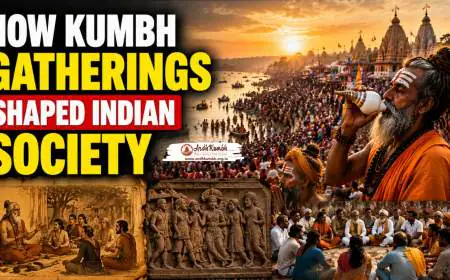






































How Kumbh Gatherings Shaped Indian Society
Discover how Kumbh gatherings shaped Indian society—from social equality and economic networks to political legitimacy and cultural exchange. Explore the lasting impact of this ancient pilgrimage.
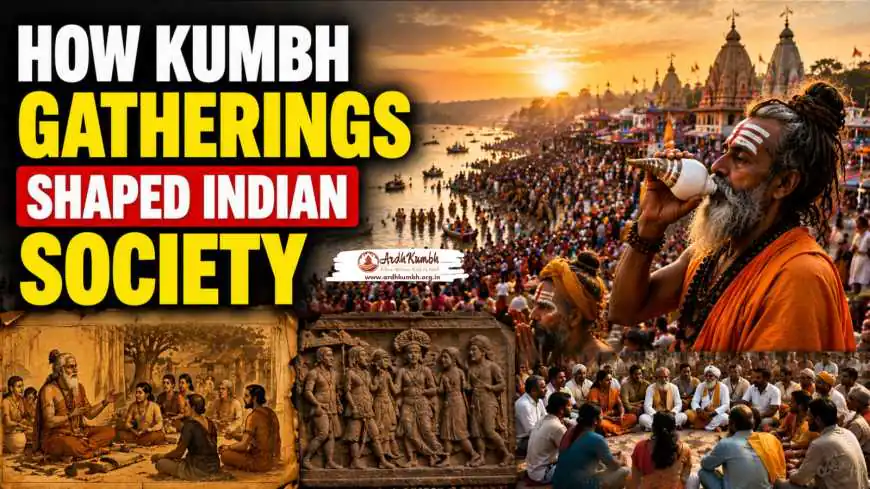
The Great Social Leveler: Dissolving Caste and Class at the Water’s Edge 🤲
The most radical societal impact of the Kumbh Mela has been its function as a temporary but powerful social equalizer. The sacred waters of the Sangam, the Shipra, or the Godavari do not recognize the man-made distinctions that govern life on dry land. At the moment of the snan, the Brahmin and the Dalit stand in the same cold water. The wealthy merchant and the landless laborer wrap themselves in the same humble cotton, shivering under the same sky. The queen and the widow cup their hands in identical gestures of offering to the sun.
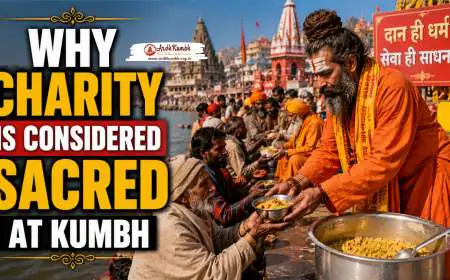
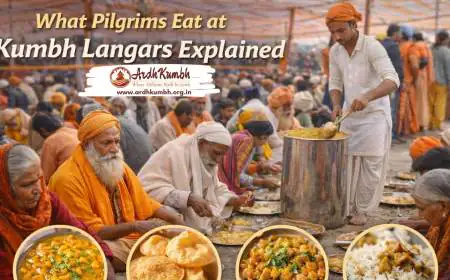
This erosion of hierarchy is not a modern, reformist interpretation. It is woven into the very theology of the pilgrimage. The bhandaras—the massive community kitchens—are its most tangible expression. Everyone sits on the ground in long, unbroken rows. Volunteers serve the same simple food of dal, rice, and roti to every outstretched hand without inquiring about lineage or income. This is not charity; it is a practical demonstration of the Advaitic truth that the same divine essence resides in all. For many pilgrims across the centuries, this was the only meal of the year where they ate as absolute equals.
Historical records and travelers’ accounts repeatedly highlight this extraordinary suspension of social norms. Hiuen Tsang, writing in the 7th century, noted the mixing of kings and commoners at the Prayag confluence. Mark Twain, in the 19th century, was astonished by the “orderly disorder” of a society where status seemed to vanish. The Kumbh Mela offered a proto-democratic space long before modern political equality was conceived, teaching a deeply ingrained hierarchical society that another way of being was possible. This recurring, lived experience of an egalitarian community seeped into the cultural psyche, contributing to the Bhakti movement’s emphasis on direct devotion over priestly mediation and laying the groundwork for later social reform movements that challenged caste discrimination.
The Economic Engine That Connected the Subcontinent 💰
Beyond its spiritual core, the Kumbh Mela has shaped Indian society as a colossal, recurring economic engine that integrated local economies into a pan-Indian network. For centuries, the gathering was the world's largest temporary marketplace, a dazzling bazaar where goods, ideas, and currencies from every corner of the subcontinent converged. The pilgrimage routes functioned as the arteries of the Indian economy, with the Kumbh acting as the beating heart that pumped prosperity through them.
Trending Guides Now
What Is the Story Behind the Ardh Kumbh Mela?
Read Guide →
The Untold Stories of Har Ki Pauri
Read Guide →
How Saints and Sadhus Define the Ardh Kumbh Tradition
Read Guide →
How Akharas Were Formed and Why They Matter
Read Guide →
Best Routes to Reach Haridwar for Ardh Kumbh Mela
Read Guide →
Ardh Kumbh 2027 Dates (Official) - Haridwar Snan Schedule
Read Guide →
What Foreign Travelers Wrote About Kumbh
Read Guide →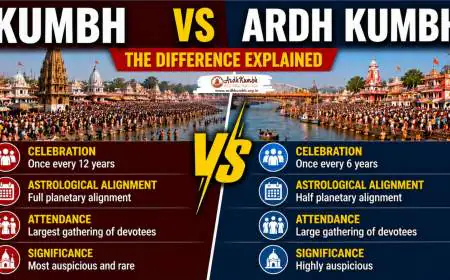
Kumbh vs Ardh Kumbh: The Difference Explained
Read Guide →The economic impact operated on multiple levels. For the artisanal class, the Mela was a once-in-a-lifetime market. Potters who made clay diyas for the Ganga aarti, weavers who produced the coarse cotton preferred by sadhus, metalsmiths who crafted brass puja vessels—all found a concentrated customer base of millions. This sustained entire hereditary craft traditions that might otherwise have vanished, creating a reliable economic cycle that lasted for generations. The textile trade, in particular, flourished as pilgrims from different climates brought regional fabrics to trade and gift, spreading weaving techniques and design motifs across vast distances.
On a macro scale, the Kumbh Mela was a logistical marvel that required—and thus created—a sophisticated infrastructure of roads, rest houses, and river transport. Local rulers and wealthy merchants competed to build sarais and dharamshalas not merely for religious merit but also to facilitate the taxable trade that accompanied the pilgrims. The gathering significantly influenced the agrarian calendar; farmers timed their harvests to coincide with the Mela, knowing they could sell surplus grain, milk, and fodder at premium prices to feed both the pilgrims and their animals. The economic linkages forged at the Kumbh were so strong that they could determine the prosperity of entire regions for the year.
The Stage for Political Legitimacy and the Dance of Power 🔱
No institution that draws millions of souls can remain separate from politics, and the Kumbh Mela has shaped Indian society by being a theater of political legitimacy for over a thousand years. For a ruler, being seen at the Kumbh—bathing at the sacred moment, donating lavishly to the akharas, feeding the masses—was not just an act of piety. It was a declaration of sovereignty, an assertion that the cosmos itself sanctioned their rule.
The akharas, with their warrior sadhu traditions, were themselves powerful political actors. During the tumultuous periods of the Delhi Sultanate and the Mughal Empire, the akharas were not merely monastic orders; they were armed ascetic republics that controlled pilgrimage routes, managed vast tracts of land, and could field armies to defend their interests. A ruler who secured the blessing of the powerful Juna or Niranjani akharas gained access to an intricate intelligence network and a formidable, if unconventional, military force. The shahi snan, the royal bath processions, were originally an explicit negotiation of political hierarchy—a ritualized display of who held precedence, not just in heaven but on earth.
Yet, the Kumbh also served as a sanctuary for dissent and a laboratory for self-governance. The Mela grounds, with their temporary, extraterritorial nature, often provided refuge for those fleeing political persecution. More importantly, the akharas modeled a system of decentralized, democratic administration within their camps. They resolved disputes through internal councils, managed resources collectively, and elected their leaders, known as mahants. This living example of functional anarchy—a society maintaining complex order without a central state—offered a subtle, continuous critique of autocratic rule and demonstrated that Indians were capable of sophisticated self-organization long before modern democratic institutions arrived.
The Cultural Crucible: Preserving Language, Arts, and Knowledge 🎭
The Kumbh Mela’s most profound influence on Indian society might be its role as a living archive and a cultural crucible. In a world before the printing press, and for a civilization that privileged oral transmission over the written word, the Kumbh was the central, sacred backup system for the entire cultural operating system. It ensured that a vast body of knowledge—from Vedic phonetics to classical music, from ayurvedic recipes to yoga’s subtlest techniques—was not just preserved but actively debated and refined.
The oral traditions of the akharas and the pandas are a feat of civilizational memory that has no parallel. The Vedas are chanted here with an intonation frozen in time for over three millennia, cross-verified by different schools in a continuous, open peer-review process. The Kumbh was the grand intellectual conference where philosophers of competing schools debated metaphysics in front of a public audience, democratizing knowledge that in other societies was locked behind monastery walls. This kept Indian philosophical traditions dynamic and relevant.
Furthermore, the Kumbh acted as a patron for the performing arts. Musicians of the Dhrupad and Khyal traditions, folk theater troupes performing the Ramlila, and storytellers reciting the Puranas all converged here. They competed for the attention of the crowd, honing their craft and transmitting regional variations of common myths back across the subcontinent. The linguistic exchange was immense. A pilgrimage from a Tamil village to Prayagraj was a journey through a dozen linguistic regions, and the Mela became a melting pot where words, idioms, and grammatical structures bled into one another, contributing to the evolution of a pan-Indian vernacular.
The Forge of National Integration and a United Consciousness 🇮🇳
Long before the political map of India was united under a single constitution, the Kumbh Mela shaped Indian society by forging a pan-Indian consciousness. The sacred geography of the four Kumbh sites—Prayagraj in the north, Haridwar in the Himalayan foothills, Ujjain in the central plains, and Nashik in the western ghats—was a masterstroke of cultural engineering. It forced the four cardinal directions of the subcontinent into a single, rotating, sacred cycle.
A pilgrim’s life was mapped by this cycle. To attend multiple Kumbhs was to walk the length and breadth of India, to see the snows of the north, the forests of the center, and the rivers of the west. This physical movement created a shared mental map. The pilgrim from Kanyakumari who traveled to Haridwar did not feel like an alien in a strange land. The pandas, with their hereditary genealogical records, provided a vital link. When a panda opened his vahi and traced a family’s name back ten generations, he was affirming that this southern family belonged to the Ganga as much as any local. This genealogical network created an emotional and spiritual unity that transcended the fragmented political boundaries of princely states and sultanates.
The Kumbh also facilitated inter-regional social ties. Pilgrim groups, or kafila, formed intricate, multi-ethnic traveling communities. These journeys built bonds of friendship and mutual obligation between people who would otherwise have never met. During times of crisis, these networks morphed into mutual-aid societies. This sense of being part of a single, sacred civilization—a Bharatavarsha that was more than the sum of its warring kingdoms—was nurtured not in courts but on the dusty roads to the Kumbh. It was a grassroots nationalism of the spirit, which later provided the fertile soil in which the modern independence movement could grow.
Shaping Public Health, Sanitation, and the Ethics of Care
A less sung but vital way the Kumbh Mela shaped Indian society is through its pioneering role in public health management and the ethics of collective care. Hosting the largest temporary city on earth, long before the germ theory of disease, forced the organizers to develop sophisticated systems of sanitation, clean water supply, and medical care that were centuries ahead of their time.
The bhandaras themselves were a public health intervention, ensuring that no one, however poor, went hungry—preventing social unrest and disease born of malnutrition. The yagya fires burning across the grounds were not just rituals; the smoke from ghee and specific woods was, and is, a scientifically documented antimicrobial agent, purifying the air in the world’s densest human gathering. The siting of latrines downstream, the strict separation of bathing and drinking water, and the rapid burial of the dead were all managed not by a modern municipality for most of history but by the akharas and community volunteers.
This created a tradition of seva, or selfless service, as a core societal value. The volunteer who cleaned the ghats, the doctor who offered free Ayurvedic consultation, the wealthy merchant who anonymously funded a water station—these acts were woven into the spiritual fabric of the event. They taught society that care for the stranger was not merely a moral good but a religious duty. The Kumbh Mela institutionalized the idea that the collective’s health is a sacred responsibility, a principle that has profoundly influenced Indian social work and volunteerism to this day.
The Mela as a Mirror and an Agent of Change
The Kumbh Mela has always held a mirror up to Indian society, reflecting its glories and its fractures, and in doing so, it has acted as an agent of profound change. It is a gathering that repeatedly asked, and still asks, a single transformative question: What would India look like if it lived by its highest spiritual ideals, not just in the privacy of a temple, but in the full, messy, open chaos of a temporary city? The answer it provides—a place of radical equality, immense charity, decentralized order, and cultural continuity—has seeped into the very groundwater of Indian civilization. The Kumbh did not just survive Indian society; it built it, one step, one bath, and one shared meal at a time.
Frequently Asked Questions