












































































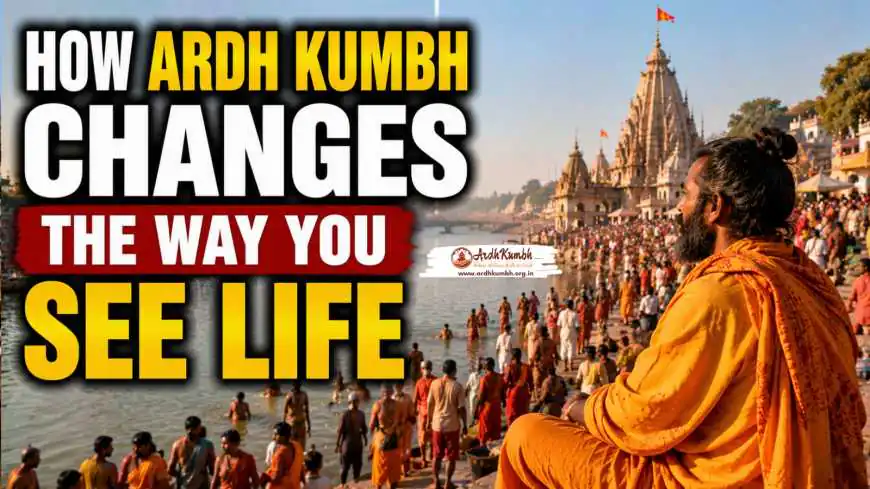
How Ardh Kumbh Changes the Way You See Life
Discover how Ardh Kumbh changes the way you see life. From dissolving ego to revealing the beauty of simplicity, learn how this pilgrimage permanently transforms your perspective on time, purpose, and human connection.
The Cold Shock That Redefines Your Limits ❄️
The first and most immediate way the Ardh Kumbh changes your perspective arrives in the form of freezing water. At 4 AM, when the fog hangs thick over the Sangam and the air temperature hovers just above freezing, you will be asked to step into a river that steals your breath. Your mind will scream that this is impossible, that you should turn back, that no spiritual merit is worth this physical agony. And then you will watch an elderly woman, bent with age, walk past you into the water with a look of absolute peace on her face. And something in you will shift forever.
The cold snan teaches a lesson that no amount of comfortable meditation on a cushion can impart: your limits are not where you think they are. The voice that says "I cannot" is not the voice of truth. It is the voice of a mind that has been coddled by central heating and on-demand comfort. When you emerge from that water, gasping and alive and electrified, you have not just bathed in a sacred river. You have broken through a barrier you did not even know existed. The Ardh Kumbh changes how you see your own capacity. The next time life presents you with something cold, difficult, and apparently impossible, you will remember the river at dawn. You will know that you can step in.
This redefinition of personal limits extends far beyond physical endurance. The pilgrimage constantly places you in situations that your ordinary self would avoid: dense crowds, unfamiliar food, loss of privacy, disruption of routine. And you discover, day by day, that you are fine. More than fine. You are thriving. The Ardh Kumbh reveals that the comfort zone you have spent your life constructing was never protecting you. It was imprisoning you. The cold water sets you free.
The Crowd That Teaches You Are Not Alone 🤲
Modern life is an epidemic of loneliness disguised as connectivity. We have hundreds of online friends and no one to share a meal with. The Ardh Kumbh shatters this illusion with the force of a revelation. You are surrounded by millions of people—walking, bathing, eating, praying—and in that vast, anonymous crowd, you discover a profound truth: you have never been alone. The isolation you feel in your daily life is an artifact of a society that has forgotten how to gather.
Trending Guides Now

Is Ardh Kumbh a Once-in-a-Lifetime Experience?
Read Guide →
Can Ardh Kumbh Change Your Life Priorities?
Read Guide →
What Makes Ardh Kumbh Spiritually So Powerful?
Read Guide →
Is Ardh Kumbh Mentioned in the Puranas?
Read Guide →
Ardh Kumbh 2027 Dates (Official) - Haridwar Snan Schedule
Read Guide →
Dharamshala Stay During Ardh Kumbh: Free & Budget Guide
Read Guide →
Official Progress Report of Haridwar Ardh Kumbh 2027 Infrastructure Projects
Read Guide →
Is October a Good Time to Visit Haridwar Before Ardh Kumbh 2027?
Read Guide →The community at the Ardh Kumbh is not performative. It is not networking. It is the raw, ancient human experience of moving through the world as part of a collective body. When you sit in the long rows of the bhandara, shoulder to shoulder with strangers, eating the same simple food from the same leaf plates, a deep, cellular memory awakens. This is how humans are meant to live—not in isolated nuclear units, but in a flowing, interdependent community. The Ardh Kumbh changes how you see other people. You return home less judgmental, more patient, and more willing to extend a hand to the stranger in need. The crowd that you feared would crush you has instead taught you how to love.
This shift in social perception is one of the pilgrimage's most enduring gifts. The person who annoyed you in traffic, the colleague who seemed hostile, the family member you have been holding a grudge against—they all look different after you have sat beside strangers who shared their blanket with you when you were cold. The Ardh Kumbh retrains your social instincts. It reminds you that beneath the surface differences, every human being you meet is a fellow pilgrim, walking the same difficult path toward the same sacred goal.
The Impermanence That Liberates You From Fear 🏕️
The Ardh Kumbh is a city of millions that exists for a few weeks and then vanishes. The tents are dismantled. The pontoon bridges are removed. The roads that carried endless streams of pilgrims return to being empty fields. This spectacle of impermanence, witnessed firsthand, works a deep change in the psyche. You have spent your life clinging to things—relationships, possessions, identities—as though they were permanent. The Kumbh shows you, in the most concrete terms imaginable, that everything is temporary. And instead of depressing you, this truth liberates you.
The temporary city teaches a lesson that a lifetime of reading philosophy cannot impart. When you walk through the Mela grounds on the final day, watching the structures that seemed so solid being folded away, you understand that the impermanence of all things is not a tragedy. It is what makes them precious. The conversation you had with the sadhu that moved you to tears—it could only happen because you were both there, in that moment, and the moment passed. The beauty of the aarti flames reflected on the river—it was only beautiful because it would end. The Ardh Kumbh changes how you see time itself. You stop trying to hold onto moments and start learning to live inside them.
This acceptance of impermanence transforms how you relate to loss, to aging, to the ultimate reality of death. The pilgrimage does not make these things less painful, but it makes them less terrifying. You have seen a world built and unbuilt in a matter of weeks, and you have seen that the river continues to flow regardless. The Ardh Kumbh gives you a direct experience of the truth that the sages have always taught: the only thing that endures is the consciousness that witnesses all change. Everything else is the tent, the bridge, the crowd—beautiful, meaningful, and passing.
The Simplicity That Exposes the Lie of More 🏠
You will return from the Ardh Kumbh to a home filled with things. Closets of clothes. A refrigerator stocked with choices. Screens in every room. And for the first few days, all of it will feel slightly obscene. Not because you have become an ascetic, but because the pilgrimage has shown you, with undeniable clarity, how little you actually need to be happy. This is one of the most radical ways Ardh Kumbh changes how you see life. It dismantles the consumerist programming that has been running in your subconscious since childhood.
At the Kumbh, you live with a single bag. You wear the same warm layers day after day. You eat simple dal and rice, and it tastes extraordinary because you are present while eating it. You are not bombarded by advertisements. You are not comparing your life to curated social media feeds. You are simply alive, in your body, in the moment, and it is enough. More than enough. It is joyful. The Ardh Kumbh teaches that the constant craving for more—more money, more status, more possessions—is not natural human ambition. It is a cultural sickness. The cure is the lived experience of simplicity, and the pilgrimage provides that cure in its most potent form.
This shift in your relationship with material things does not mean you will come home and throw away all your belongings. But you will look at them differently. You will feel less attached to them. You will begin, perhaps slowly, to clear space—physical space in your home, and psychological space in your mind. The Ardh Kumbh changes your definition of wealth. You realize that the richest you have ever felt was when you owned almost nothing, surrounded by millions of people who were also owning almost nothing, and everyone was fed, everyone was warm enough, and everyone was smiling.
The Faith That Becomes More Than Belief 🙏
The Ardh Kumbh does not demand that you adopt a specific theology. But it does something far more profound: it gives you a direct, sensory experience of what faith actually feels like. Faith is not intellectual assent to a set of propositions. It is the willingness to step into cold water before dawn because something in you, deeper than reason, knows that this act is meaningful. It is the trust that the crowd will carry you rather than crush you. It is the quiet confidence that the ancient Rituals are not empty gestures but living channels of grace.
After the Ardh Kumbh, your understanding of faith expands beyond the narrow confines of religious doctrine. You see faith everywhere—in the farmer who plants a seed, in the mother who wakes at night to feed her child, in the volunteer who serves food to thousands of strangers. Faith, you realize, is simply the decision to act as though the universe is fundamentally good, even when the evidence seems mixed. The pilgrimage embeds this decision in your bones. You have seen too much kindness, too much order within chaos, too much unexpected grace to ever fully return to cynicism.
This deepened faith is not a fragile thing that shatters when life becomes difficult. It is a resilient, tested trust that has survived the cold, the crowd, and the dismantling of everything you thought you needed. The Ardh Kumbh changes how you see the divine—not as a distant, judging figure, but as a presence that flows through rivers, through communities, through the simple act of sharing food. You return home not necessarily more religious in the conventional sense, but more alive to the sacred dimension of ordinary existence.
The Ego That Dissolves in a Sea of Humanity 🔱
There is a particular moment at the Ardh Kumbh when the ego simply cannot sustain itself. Perhaps it comes when you are standing in the crowd, unable to move in any direction except the one the collective chooses. Perhaps it comes when you sit in the bhandara, indistinguishable from every other hungry pilgrim. Perhaps it comes when you look at the river and realize that your personal problems, which seemed so enormous in your living room, are utterly insignificant in the context of this ancient, flowing immensity. Whenever it comes, the dissolution of ego is one of the most liberating experiences a human being can have.
Modern life is an ego-construction project. We build identities, curate personas, and defend our sense of specialness against all threats. The Ardh Kumbh demolishes this project with a gentle, relentless force. You are not special here. You are one among millions. Your achievements, your status, your carefully crafted self-image—none of it is visible. None of it matters. And instead of feeling like a loss, this feels like a release from prison. The Ardh Kumbh changes how you see yourself. You discover that the self you have been defending so fiercely is not your true essence. It is a costume you have been wearing, and the pilgrimage gives you permission to take it off.
This ego dissolution has lasting effects. When you return home, you find that you are less reactive to criticism. Less attached to being right. Less driven by the need for recognition. You have experienced the peace of anonymity, the freedom of being no one in particular, and you know that this peace is always available beneath the noisy surface of the ego. The Ardh Kumbh teaches that humility is not self-deprecation. It is the simple recognition of the truth: you are a small, precious, temporary wave in a vast and ancient ocean. And that is not a diminishing thought. It is the most liberating thought you have ever had.
The Return Home: Seeing the World With New Eyes 🌅
The true measure of the Ardh Kumbh's power to change your life is not what happens at the Sangam. It is what happens in the weeks, months, and years after you return. You walk into your home, and it feels different. The rooms seem quieter. The possessions seem less necessary. The routines you once followed without question now seem optional. You have been rewired, and the rewiring is permanent.
The traffic jam that once triggered rage now feels like an opportunity to practice the patience you learned on the pontoon bridge. The difficult conversation you have been avoiding now feels manageable because you have stood in freezing water and survived. The anxiety about the future that used to wake you at 3 AM has quieted because you have seen a city built and dismantled, and you know that everything passes. The Ardh Kumbh has changed the way you see life by giving you a new baseline. You have experienced a different way of being—simpler, more present, more connected—and you can never fully un-experience it.
You may not become a daily temple-goer. You may not adopt the external markers of a religious life. But something has shifted at the core. You have seen what human beings are capable of when they gather in peace. You have felt the river's cold, purifying grace. You have eaten food that tasted like love. You have sat in silence that was more nourishing than any entertainment. The Ardh Kumbh does not give you a new set of beliefs. It gives you a new set of eyes. And with those eyes, the world—your ordinary, everyday, previously unremarkable world—reveals itself as what it has always been: a sacred river, flowing endlessly, inviting you to step in.
Frequently Asked Questions