





























































How Ardh Kumbh Became a Civilizational Anchor
Discover how Ardh Kumbh became a civilizational anchor through sacred rituals, astrological alignments, and spiritual continuity that has shaped Indian culture for millennia.

How the Ardh Kumbh Embodies the Eternal Spirit of Indian Civilization
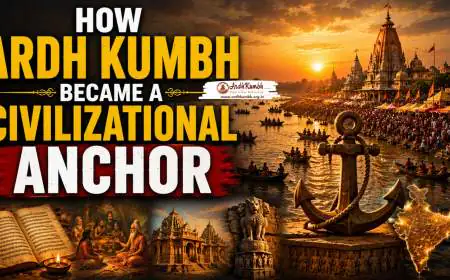
The Ardh Kumbh Mela has earned its status as a true civilizational anchor because it encapsulates everything that defines Indian culture: spiritual devotion, community participation, ritual precision, and philosophical depth. Unlike the Purna Kumbh, which occurs every twelve years, the Ardh Kumbh offers more frequent opportunities for spiritual renewal while maintaining the full weight of sacred significance. The term Ardh, meaning "half," indicates its position midway between two full Kumbh Melas, yet its civilizational impact is immense and enduring.
What makes this gathering truly foundational to Indian civilization is its remarkable continuity. Despite political upheavals, foreign invasions, colonial rule, and rapid modernization, the Ardh Kumbh has persisted as an unbroken tradition spanning thousands of years. This continuity demonstrates the resilience of India's spiritual culture and its ability to adapt while preserving core values. The festival serves as a powerful reminder that Indian civilization has maintained its spiritual compass even as the world around it has transformed dramatically.
The confluence of sacred rivers at Prayagraj, where the Ganga, Yamuna, and the mythical Saraswati meet, creates the Triveni Sangam, known as Teerthraj or the "King of Pilgrimages." This sacred geography holds profound civilizational significance, representing the meeting point of purity, devotion, and transcendent knowledge. For pilgrims, this location offers a unique opportunity for inner transformation and spiritual evolution, connecting them to a tradition that has attracted seekers for millennia.
The civilizational anchoring of the Ardh Kumbh manifests through multiple interconnected dimensions. Spiritual continuity ensures that ancient practices survive and flourish. Cultural preservation keeps traditions alive through generations. Social cohesion brings together millions across all divisions of caste, creed, and economic status. Economic vitality sustains entire communities and regions. In 2017, UNESCO recognized these contributions by inscribing the Kumbh Mela on its Representative List of the Intangible Cultural Heritage of Humanity, acknowledging its role in preserving living traditions transmitted across generations.
Trending Guides Now
What Is the Story Behind the Ardh Kumbh Mela?
Read Guide →
The Untold Stories of Har Ki Pauri
Read Guide →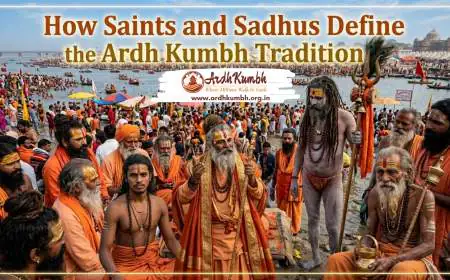
How Saints and Sadhus Define the Ardh Kumbh Tradition
Read Guide →
Ancient Scriptures That Clearly Explain Ardh Kumbh
Read Guide →
Best Routes to Reach Haridwar for Ardh Kumbh Mela
Read Guide →
Ardh Kumbh 2027 Dates (Official) - Haridwar Snan Schedule
Read Guide →
Why Early Mornings Are Sacred
Read Guide →
Why Ardh Kumbh Encourages Inner Silence
Read Guide →The Ardh Kumbh also demonstrates how Indian civilization has maintained its spiritual core despite numerous historical challenges. From foreign invasions to colonial rule to modern urbanization, the festival has provided continuity and stability. It offers a powerful counter-narrative to Western notions of linear progress, showing instead a civilization that values cyclical renewal, spiritual evolution, and the eternal return of sacred traditions.
The Mythological Origins That Give Ardh Kumbh Its Sacred Foundation
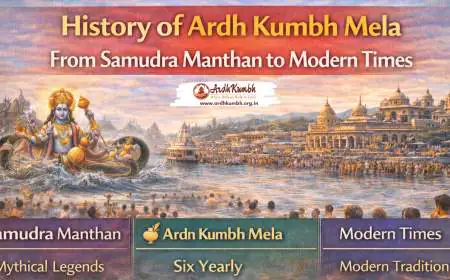
The mythological origins of the Ardh Kumbh Mela lie in one of Hinduism's most profound cosmic narratives: the legend of Samudra Manthan, the churning of the cosmic ocean. This story, preserved in the Bhagavata Purana, Vishnu Purana, and the Mahabharata, describes a celestial event of immense significance when the Devas and Asuras united to churn the ocean of milk in search of Amrit – the nectar of immortality.
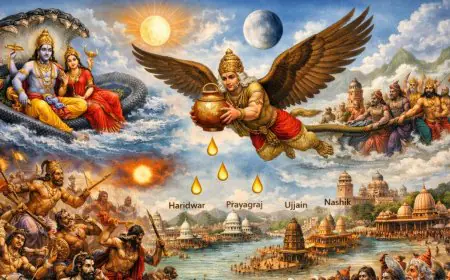
The churning produced numerous divine treasures, but when the coveted pot of nectar finally emerged, a fierce battle erupted. To protect the nectar, Jayant, son of Indra, seized the pitcher and fled across the heavens. During his twelve-day celestial journey – corresponding to twelve human years – drops of the sacred nectar fell at four locations: Prayagraj, Haridwar, Ujjain, and Nashik-Trimbakeshwar. These sites became eternally sanctified, establishing where the Kumbh Mela would be celebrated in rotation.
The Ardh Kumbh derives its specific significance from this mythological timeframe. Since Jayant carried the pot for twelve divine days, the Ardh Kumbh, celebrated every six years, represents the halfway point of this cosmic journey. This connection to the Samudra Manthan narrative imbues the Ardh Kumbh with profound spiritual potency, as pilgrims believe that bathing in the sacred rivers during this auspicious period allows them to access the same spiritual energies that manifested when the nectar touched these holy waters.
The gaathas – the mythological stories surrounding the Kumbh – are not merely ancient tales but living experiences that continue to shape rituals and pilgrimages. As scholars observe, the Kumbh Mela represents "the greatest living phenomenon of these gaathas, anchored in faith that transcends time and sustains itself in the face of life's struggles." These stories translate directly into lived spiritual practice, connecting contemporary pilgrims to the cosmic events that sanctified the river confluences.
The Astrological Science Behind Ardh Kumbh Celebrations
The timing of the Ardh Kumbh Mela is determined by precise astrological calculations that reflect the sophisticated astronomical knowledge developed by ancient Indian civilization. Unlike ordinary religious gatherings, the Kumbh Mela's occurrence and its most auspicious bathing dates are intricately linked to the positions of celestial bodies, specifically the Sun, Moon, and Jupiter (Brihaspati) , as described in Vedic scriptures.
For the Ardh Kumbh at Prayagraj, the auspicious celestial alignment occurs when the Sun is in Capricorn (Makara) and Jupiter is in Taurus (Vrishabha) . This specific conjunction of planetary bodies is believed to amplify the spiritual potency of the sacred rivers at the Triveni Sangam. The mathematical precision behind these calculations demonstrates how ancient Indian civilization integrated spiritual practice with sophisticated astronomical observation.
These astrological configurations are believed to create a cosmic gateway through which spiritual energies flow more intensely. When the planets align in these specific positions, the sacred rivers become especially purifying, making the holy dip significantly more meritorious. Ancient texts prescribe specific times for sacred baths, with each moment carefully calculated to maximize spiritual benefits.
The specific bathing dates determined by these astrological calculations include Makara Sankranti, Paush Purnima, Mauni Amavasya, Basant Panchami, Maghi Purnima, and Maha Shivaratri. Each of these dates carries its own spiritual significance, with Mauni Amavasya considered the most important. On this day, the silent nature of the soul meets the purifying waters of the Ganga, creating an opportunity for profound inner transformation.
Sacred Rituals That Transform the Ardh Kumbh Experience
The Ardh Kumbh Mela is defined by a series of sacred rituals that transform the physical landscape into a realm of profound spiritual possibility. These rituals create an environment where pilgrims can experience direct connection with the divine.
The Divine Dip: Shahi Snan Tradition
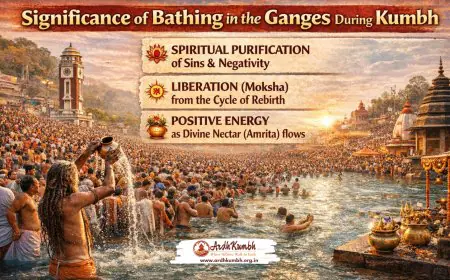
The Shahi Snan – the Royal Bath – stands as the most significant ritual, occurring on the most auspicious bathing dates. This is not merely a bath but a sacred act of purification, renewal, and spiritual resetting. On these days, lakhs of pilgrims gather before dawn to immerse themselves in the holy waters.
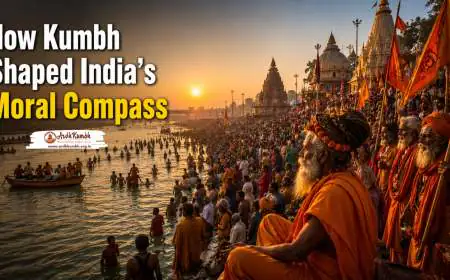
The Shahi Snan on Mauni Amavasya is considered the most important among all bathing dates. On this day, the silent nature of the soul meets the purifying waters. The sight of millions of pilgrims entering the waters together creates a spectacle of faith that is both humbling and awe-inspiring. This collective immersion reinforces the civilizational value of equality before the divine, as all distinctions dissolve in the sacred waters.
The Grand Akhara Processions
The Ardh Kumbh features elaborate rituals performed by various akharas – the monastic orders that have been custodians of Hindu spiritual traditions for centuries. These akharas arrive with magnificent Peshwai processions, where spiritual leaders ride on decorated chariots, elephants, and palanquins, displaying the martial and spiritual heritage of India.
The Peshwai processions feature traditional music, rhythmic chanting, and the ceremonial display of ancient weapons. These serve as reminders of the warrior-saint tradition that has protected Indian spirituality through the ages. The akharas arrive in a specific hierarchical order determined by ancient tradition, reflecting the organizational sophistication of these spiritual institutions.
The presence of Naga sadhus – ascetics who practice extreme renunciation including nudity – provides one of the most striking visual elements. These sadhus, their bodies smeared with sacred ash, represent complete detachment from material existence. Their appearance reminds pilgrims of the ultimate goal of spiritual practice: liberation from the cycle of birth and death.
Darshan and Spiritual Guidance
The ritual of darshan – the act of seeing and being seen by the divine – plays a central role. Pilgrims queue for hours for glimpses of revered saints, seeking their blessings and spiritual guidance. This transfer of spiritual energy from enlightened beings to seekers is considered one of the most powerful aspects of the festival.
The satsangs – spiritual discourses conducted by learned saints – provide pilgrims with philosophical understanding and practical guidance. These gatherings create opportunities for collective spiritual learning, reinforcing the civilizational value of guru-shishya parampara.
The Living Presence of Akharas and Sadhus
The akharas and their sadhus form the spiritual backbone of the Ardh Kumbh Mela, preserving and transmitting the ancient traditions that give the festival its profound significance. These monastic orders, established by legendary spiritual figures including Adi Shankaracharya, represent various sampradayas that have maintained unbroken traditions for centuries.
The Dashanami Sampradaya, founded by Shankaracharya, consists of ten orders of sanyasis who trace their spiritual lineage directly to the great philosopher. These include the Giri, Puri, Bharati, Tirtha, Ashrama, Vana, Aranya, Parvata, Sagara, and Saraswati sects, each contributing uniquely to the spiritual tapestry of the Ardh Kumbh.
The role of these spiritual custodians extends beyond mere ritual performance. They serve as living libraries of ancient knowledge, preserving Vedic chants, yoga techniques, philosophical systems, and sacred texts through oral transmission. Their presence ensures that these traditions continue to thrive.
How Ardh Kumbh Promotes Unity and Social Cohesion
The Ardh Kumbh Mela serves as a powerful force for unity and social cohesion, bringing together millions across all distinctions. This gathering of diverse humanity around a common spiritual purpose creates bonds that transcend ordinary social divisions, reinforcing the civilizational value of unity in diversity.
The sangam (confluence) of rivers at Prayagraj serves as a metaphor for the confluence of people, cultures, and spiritual traditions. Just as the rivers merge their waters, pilgrims merge their devotional intentions, creating a collective spiritual energy that elevates everyone who participates.
The festival also provides opportunities for communities to interact and exchange cultural traditions. Regional musical styles, culinary traditions, artistic expressions, and ritual practices are shared, enriching the cultural tapestry of Indian civilization.
Modern Challenges and the Preservation of Tradition
The Ardh Kumbh faces challenges including environmental concerns, crowd management, and maintaining authenticity. Recent initiatives have focused on environmental conservation, with the Namami Gange program making significant investments in cleaning the sacred river.
Managing the massive crowds requires sophisticated planning, with the Kumbh Mela administration developing remarkable temporary infrastructure including tent cities, transportation networks, and medical facilities. These demonstrate the civilizational value of hospitality and ensuring pilgrim safety.
Preserving authenticity in the face of commercialization remains crucial. The role of akharas, sadhus, and traditional practitioners ensures the festival's spiritual core is not lost amid commercial opportunities.
The Ardh Kumbh as a Living Symbol of Sanatan Dharma
The Ardh Kumbh Mela stands as a living symbol of Sanatan Dharma, embodying all its essential characteristics: connection to cosmic rhythms, emphasis on personal spiritual practice, respect for multiple paths, and celebration of unity in diversity.
The cyclical nature of the Ardh Kumbh reflects the Sanatan worldview that time moves in cycles rather than linear progression. By participating in this cyclical festival, pilgrims connect to a worldview that offers hope for renewal and transformation.
The inclusive nature of the Ardh Kumbh, attracting visitors from all backgrounds, reflects the Sanatan principle that all genuine spiritual paths lead to the same ultimate reality.
The Eternal Call of the Sacred Waters
The Ardh Kumbh Mela continues to call millions to its sacred riverbanks because it addresses the deepest longings of the human heart. In a world of constant change, the festival offers the promise of stability, renewal, and communion with something greater than individual existence.
The devotional atmosphere creates a space where ordinary concerns fade and deeper questions emerge. Pilgrims reflect on the nature of existence, the purpose of life, and their spiritual journey. This reflective dimension ensures each generation engages with the fundamental questions that have shaped Indian spirituality.
The eternal call of the sacred waters will continue to resonate as long as humans seek meaning, connection, and transformation. In a changing world, this constancy provides the civilizational anchor that Indian culture needs to navigate future challenges while remaining rooted in its eternal spiritual foundations.
Frequently Asked Questions