




































































Cultural Legacy of Ardh Kumbh
Discover the enduring cultural legacy of Ardh Kumbh. Explore how this six-yearly pilgrimage has preserved oral traditions, classical arts, crafts, folk performances, and the timeless spirit of Indian civilization across centuries.

The Oral River: Preserving the Vedas and Sacred Sound 🕉️
The most ancient and perhaps the most astonishing element of the cultural legacy of Ardh Kumbh is its role in preserving the Vedas—not as written texts, but as a living, breathing oral tradition of staggering precision. For over three thousand years, the Vedas were not primarily read; they were heard, memorised, and chanted. The Kumbh was the great convocation where this oral library was publicly verified and safeguarded against the erosion of time. Vedic pandits from different regions, trained in different schools, would gather at the Sangam and chant together. Their recitations utilized complex, interlocking patterns—the Jata, the Ghana, and others—which acted as a built-in, fail-safe error-correction system. A single mispronounced syllable in a thousand-hour recitation would be instantly detected by a master from another lineage. This was a massive, decentralized, real-time peer review of the civilization's most sacred knowledge, and the Ardh Kumbh, with its regular six-year rhythm, ensured this verification happened frequently enough to maintain absolute fidelity. The legacy is not just the content of the Vedas but the very discipline of perfect oral transmission, a cultural technology that the Kumbh kept alive and rigorous, protecting the sacred sound from the decay that inevitably afflicts written manuscripts.
Beyond the Vedas, the Ardh Kumbh preserved an entire universe of oral literature. The great epics, the Ramayana and the Mahabharata, and the rich, colourful tales of the Puranas were not just texts for scholarly study. At the Kumbh, they were performed. Professional storytellers, wandering bards, and grandmothers in pilgrim camps narrated these stories to wide-eyed children and attentive adults. Each telling was unique, infused with the local dialect, the personal emotion, and the cultural flavour of the narrator. The Kumbh became the great, recurring festival of this narrative tradition. A child who heard the story of King Harishchandra's unwavering truthfulness at the Kumbh would grow up and tell it to their own grandchildren, carrying forward not just a plot but a moral compass. This oral legacy democratized the deepest wisdom of the civilization, making it accessible to the illiterate farmer as much as to the learned scholar. The Kumbh ensured that these stories were not dead words on a page but living, breathing, and evolving vehicles of cultural memory.
The Living Arts: Sustaining India's Classical and Folk Traditions 🎭
The Ardh Kumbh was one of the greatest patrons of the performing arts in Indian history. Before the age of government grants and ticketed concerts, the Mela provided a vast, ready-made, and deeply appreciative audience for musicians, dancers, and theater troupes. Musicians of the Dhrupad and Khyal traditions, the fountainheads of Indian classical music, considered a performance at the Kumbh a pinnacle of their spiritual and artistic journey. They sang not for money but for the devotional fervour of the crowd, and in doing so, they transmitted the complex grammar of raga and tala across regions. A pilgrim from the south might hear a northern Dhrupad maestro and carry a love for that style back home. The Kumbh was a crucible of musical exchange, where local, folk traditions were exposed to classical forms, and vice versa, creating a dynamic, evolving, and deeply integrated pan-Indian musical culture.
Folk theatre, too, found its grandest stage at the Kumbh. Troupes performing the Ramlila, the divine play of Lord Rama's life, would enact the epic for tens of thousands, their makeshift stages becoming portals to a mythic past. This tradition preserved not only the story but also the local dialects, costumes, acting styles, and musical idioms unique to each region. The Kumbh ensured the survival of countless local performance genres that might otherwise have faded into obscurity. The cultural legacy here is immense: the Kumbh acted as a cultural corridor, allowing the folk arts of the Deccan to travel to the Gangetic plain, and the classical traditions of the north to filter down to the south. It was an artistic democracy, where the greatest master and the humblest village performer shared the same sacred ground and the same vast, receptive audience.
Trending Guides Now
What Is the Story Behind the Ardh Kumbh Mela?
Read Guide →
History of Ardh Kumbh Mela From Samudra Manthan to Modern Times
Read Guide →
Historical Records of Ardh Kumbh Gatherings
Read Guide →
How Ardh Kumbh Quietly Strengthened Faith Networks
Read Guide →
Ardh Kumbh 2027 Dates (Official) - Haridwar Snan Schedule
Read Guide →
Dharamshala Stay During Ardh Kumbh: Free & Budget Guide
Read Guide →
Official Progress Report of Haridwar Ardh Kumbh 2027 Infrastructure Projects
Read Guide →
Where to Find 24-Hour Pharmacies in Haridwar During Ardh Kumbh 2027 Emergencies
Read Guide →The Hands of the Artisan: Preserving Craft Traditions for Centuries 🏺
Walk through the bustling markets of any Ardh Kumbh, and you witness another profound layer of its cultural legacy: the preservation of India's hereditary craft traditions. The massive demand created by millions of pilgrims for ritual items provided a crucial, recurring economic lifeline for families of potters, weavers, metalworkers, and woodcarvers. The simple, beautiful clay diyas (lamps) offered to the Ganga, the brass and copper pots used for puja, the hand-woven cotton clothes preferred by sadhus, the intricate rudraksha malas, the vibrant garlands of marigold—each object was a repository of generational skill and cultural memory. A potter who shaped a diya at the Kumbh was using a technique passed down through his family for three hundred years. The pilgrimage did not just give him an income; it gave his ancient craft a reason to survive.
The Ardh Kumbh was a marketplace not just of goods but of design, technique, and regional style. An artisan from the Himalayan foothills, selling intricately carved wooden statues of gods, would see the work of a metalworker from the Deccan, and an exchange of ideas would occur. This cross-pollination enriched and innovated regional crafts, preventing them from becoming stagnant. The demand for specific, regionally sacred items—like the Shriphal (coconut) from the Konkan coast or specific fragrant incense from Ujjain—created specialized, long-distance trade routes that were culturally significant. The Kumbh ensured that these crafts were not just hobbies but viable, respected professions, passing from father to son, mother to daughter, cycle after cycle. The cultural legacy is visible in the continued existence of these art forms, many of which owe their survival, at least in part, to the regular, guaranteed patronage of the Kumbh Mela.
The Confluence of Tongues: A Marketplace of Languages 🗣️
The Ardh Kumbh is a living laboratory of linguistic diversity and exchange, a Babel of devotion where a dozen major languages and countless dialects mingle in the cold air. A pilgrim from Bengal hears the rustic Hindi of a Kabir bhajan and is moved. A sadhu from the Tamil south teaches a mantra to a farmer from Madhya Pradesh. The pandas, the hereditary pilgrim priests, are often polyglots, speaking three or four languages to serve the diverse families who have been coming to them for generations. This is not a passive linguistic landscape; it is an active, vibrant, and deeply human process of cultural exchange. Words, idioms, and pronunciations are shared, borrowed, and carried back to distant villages, subtly enriching regional languages. The Kumbh acts as a powerful counterforce to linguistic isolation, a recurring reminder that India's many tongues are branches of a single, ancient, and sacred tree.
This linguistic legacy is particularly potent in the realm of devotional music. The songs of the Bhakti saints—Kabir, Mirabai, Chaitanya, Tukaram—were composed in the vernacular languages of the common people. The Kumbh was the amplifier that broadcast these songs across the subcontinent. A pilgrim who did not understand a word of Marathi could be profoundly stirred by the melody and devotion of a Tukaram abhang. This shared, non-literate, emotional vocabulary of devotion, learned at the Kumbh, created a powerful pan-Indian cultural bond that transcended regional linguistic barriers. The Kumbh nurtured a sacred, sonic map of the nation, where a tune could carry meaning and feeling across a thousand miles.
The Stage for Reform: Bhakti and the Democratization of the Sacred 🔱
The cultural legacy of Ardh Kumbh is inseparable from the great Bhakti movement, which used the pilgrimage as its most powerful stage for a profound, centuries-long social and spiritual revolution. Saints like Kabir, the weaver; Ravidas, the leather-worker; Mirabai, the queen; and Chaitanya, the ecstatic devotee, preached a radical, anti-caste, and deeply personal gospel of love. They rejected the empty ritualism and rigid hierarchies of the religious establishment, declaring that the divine was accessible to all, regardless of birth or learning. The Kumbh, with its millions-strong, diverse audience, was the perfect platform for this transformative message. The singing of their bhajans, in the languages of the people, directly challenged the social order and democratized spirituality on an unprecedented scale. This is a legacy that has profoundly shaped the egalitarian and emotional tenor of modern Hinduism.
The Kumbh also provided a rare, sanctioned space of spiritual agency for women. While many formal religious institutions were patriarchal, the pilgrimage itself allowed a woman to travel, often with her family or as part of a group of female pilgrims, and to have a direct, unmediated encounter with the divine Mother Ganga. She did not need a male priest to offer her tears to the river. The presence of revered female sadhvis and their akharas offered a powerful alternative model of womanhood, demonstrating that a life of spiritual authority and radical freedom was possible. This quiet, persistent expansion of women's roles within the tradition is an integral part of the Kumbh's cultural legacy.
The Unbroken Chain: Passing Heritage Across Generations 👣
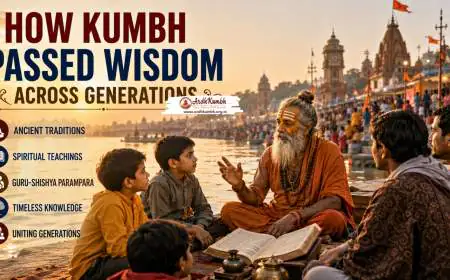
The ultimate cultural legacy of the Ardh Kumbh lies in its genius for generational transmission. The pilgrimage is a tradition that is handed down, almost biologically, from parent to child. A grandfather leads his grandson into the cold water, and in that single, powerful act, he transmits not just a ritual but an entire universe of cultural meaning—the stories, the values, the sense of belonging to an ancient, sacred lineage. The pandas' vahis (genealogical records) make this legacy tangible, showing a child the name of their great-great-grandfather who came to the Sangam a century ago. The Kumbh is the great, recurring classroom where this sacred knowledge is not taught didactically but absorbed through immersion, through the body, through the shared experience of the journey, the cold, the crowd, and the grace. The child who walks the ghats, tastes the bhandara food, hears the ancient chants, and feels the collective devotion of millions is being imprinted with a cultural identity that will last a lifetime. They will, in turn, bring their own children, and the legacy will continue, unbroken, into an eternal future.
The Gift That Outlasts the Gathering
When the river returns to its quiet, ordinary flow, the cultural legacy of Ardh Kumbh continues its silent, powerful work. It lives in the lullaby a mother in Bengal sings, a tune she first heard as a melody at the Sangam. It lives in the hands of a potter in Ujjain, shaping clay with a skill his ancestors perfected for the Mela. It lives in the precise, sacred syllable chanted by a young Vedic student, a syllable that was verified and preserved by the great convocation of the Kumbh. The Ardh Kumbh is not an event that ends. It is an eternal, living stream of culture, a recurring pulse that has kept the heart of a civilization beating for over a thousand years. Its legacy is not a monument of stone but a living flame, passed from one hand to another, one voice to another, one generation to another, illuminating the past, sanctifying the present, and gently, lovingly, lighting the way into the future.
Frequently Asked Questions