













































































Historical Records of Ardh Kumbh Gatherings
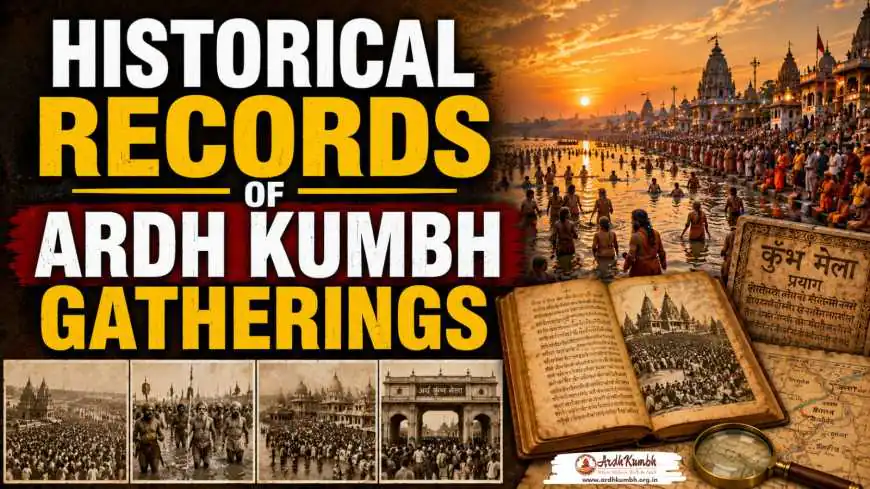
Explore centuries of recorded history at Ardh Kumbh. From medieval Akhara battles to British accounts and modern crowd records. Journey through time.
Quick Answer: Historical Records of Ardh Kumbh Gatherings
Historical records of Ardh Kumbh gatherings provide a window into the long-standing tradition of large Hindu pilgrimages centered on sacred bathing, religious observances, and spiritual assemblies. Records from different periods may describe the participation of pilgrims, saints, ascetics, religious groups, and local communities, although the level of documentation varies considerably by era. 📜
When studying Ardh Kumbh historical gatherings, it is important to distinguish between contemporary administrative records, historical writings, religious accounts, newspaper reports, and later estimates. Attendance figures can also differ because methods of counting large pilgrimage crowds have changed over time. Historical records may therefore reveal not only the scale of gatherings but also how rituals, pilgrimage practices, religious institutions, crowd organization, and public participation evolved. Comparing records across different periods can help explain the enduring religious and cultural importance of Ardh Kumbh while avoiding unsupported claims about exact crowd sizes or historical events.
The Violent Birth of Recorded History (1253 - 1760)
The earliest specific records of the Kumbh at Haridwar are not gentle. Historian Sarkar notes a tradition that in 1253 A.D., a decisive victory was won at Haridwar by the Naga Sannyasis (followers of Shiva) over the Bairagis (followers of Vishnu) . This was not a debate; it was a war for precedence—who gets the sacred water first?
The fighting did not stop. By 1640, the Dabistān-i-Mazāhib (a Persian text) records another bloody clash where the Sannyasis emerged victorious . The worst violence, however, occurred in 1760. A "pitched battle" at the Kumbh Parva resulted in a staggering 1,800 casualties . These were not just pilgrims; they were armed ascetics—Warrior Saints.
Trending Guides Now

History of Ardh Kumbh Mela From Samudra Manthan to Modern Times
Read Guide →
How Saints and Sadhus Define the Ardh Kumbh Tradition
Read Guide →
Why Saints Are Called Living Archives of Kumbh
Read Guide →
Kumbh vs Ardh Kumbh: The Difference Explained
Read Guide →
Ardh Kumbh 2027 Dates (Official) - Haridwar Snan Schedule
Read Guide →
Dharamshala Stay During Ardh Kumbh: Free & Budget Guide
Read Guide →
Official Progress Report of Haridwar Ardh Kumbh 2027 Infrastructure Projects
Read Guide →
Where to Find 24-Hour Pharmacies in Haridwar During Ardh Kumbh 2027 Emergencies
Read Guide →Why such violence? Because the Shahi Snan (royal bath) is the ultimate stamp of spiritual authority. To be first in the water was to declare your sect supreme. These historical records paint a picture of the Mela as a fierce battleground for sectarian supremacy, a far cry from the serene image of modern unity.
The Mughal Period: Timur and the Persian Chroniclers
One of the darkest entries in the Kumbh's ledger comes from the invasion of Timur (Tamerlane). It is recorded that in A.D. 1398, Timur massacred a large number of devotees in Haridwar . Historians strongly infer that this massacre coincided with the Kumbh Mela year .
However, the Mughal era also gave us the first official naming of the event. The Khulāṣu-t-Tawārīkh (composed in 1695) provides a definitive reference: "every twelfth year when Jupiter enters the sign of Aquarius and the sun is in Aries large number of people assemble at Haridvāra from remote distance for ritual bathing" . This text confirms that the astrological basis we use today was fully crystallized by the late 17th century.
The British Raj: Pacifying the Warrior Saints
When the British East India Company took control, they looked at the Kumbh—a massive assembly of armed, militant ascetics—with deep suspicion. The carnage of 1760 was too much. After a particularly nasty fight in 1796 (where 500 Shaivites were killed by Sikh ascetics), the British realized they had to impose order .
Captain Thomas Hardwicke, the first English writer to record the Kumbh in 1796, described the scene . To stop the "bloody struggles among the akharas," the British government laid down strict rules of precedence :
-
Shaiva Nāgā Sannyāsīs (first)
-
Vaiṣṇava Bairāgīs (second)
-
Udāsī Nānaka Panthīs (third)
-
Nirmalā Sikh ascetics (last)
This British-mandated hierarchy is, with minor modifications, the system that governs the Shahi Snan processions even today in 2027. It was a colonial solution to a medieval religious war.
The 1906 Dispute: Cavalry on the Ghats
The British rules did not end the disputes; they merely paused them. In 1906, a quarrel erupted at Prayag between the Nirvani and Nirmohi Akharas over precedence . The dispute was so severe that it "necessitated the intervention of a squadron of cavalry" . Imagine mounted soldiers charging through the tent city to separate fighting monks. This event shocked the colonial administration and led to a stricter enforcement of the bathing schedules that are rigidly adhered to today. The order we see at the 2027 Ardh Kumbh is a result of these violent 20th-century crackdowns.
The First Modern Numbers (1954 - 1962)
The post-independence era brought modern record-keeping and the horrifying spectacles of the modern crowd.
-
1954 (Prayagraj Kumbh): This is the "Kumbh of the Stampede." Due to mismanagement, a massive crowd crush killed hundreds. The recorded statistics, however, are staggering. By early February 1954, an estimated 45 lakh (4.5 million) pilgrims had already visited . The government had to impose a "terminal tax" to manage the rail traffic, underscoring the logistical nightmare of the era .
-
1956 (Haridwar Ardh Kumbh): This provides the earliest specific record of the Ardh Kumbh as we know it. The Times of India reported on April 13, 1956: "An estimated 8 lakhs of pilgrims bathed in the waters of the Ganga here amidst the chanting of vedic mantras and singing of devotional songs... principal day of the Ardh Kumbh Mela" . Just a day later, the paper noted that 6-7 lakhs had gathered, marking the "week-long religious festival held every six years" .
-
1962 (Haridwar Kumbh): The mood shifted from tragedy to triumph. The U.P. administration proudly announced that April 1962 was the "first accident-free Kumbh of the twentieth century" . The 1962 event was a watershed moment, proving that modern planning could tame the massive crowds without violence.
The 2021 Anomaly and the 2027 Upgrade
The Covid-19 pandemic devastated the 2021 Kumbh Mela. With the virus spreading, the event was curtailed, allowing only "symbolic" royal baths . Millions of devotees were unable to fulfill their spiritual duties. This historical anomaly is the direct cause of the grandeur planned for 2027.
Chief Minister Pushkar Singh Dhami has explicitly stated that the 2027 Ardh Kumbh will be "divinely and grandly as the Purna Kumbh" to make up for the loss of 2021 . For the first time, an Ardh Kumbh will feature four Amrit Snans (Royal Baths) instead of the usual three .
The Akhara Disputes of 2025
History repeats itself. As we prepare for 2027, a controversy erupted in November 2025 that echoes the battles of 1760. The Juna Akhara expelled two of its top leaders, Mahamandaleshwar Swami Yatindranand and Swami Prabodhanand, after they questioned the government’s decision to grant full Kumbh status to the Ardh Kumbh .
The saints argued: "The Ardh Kumbh traditionally does not feature camp establishments, flag hoisting, or the Shahi Snan... In such a situation, how can it be celebrated as Kumbh?" . The government retaliated by calling their statements "anti-Sanatan." This dispute is a fascinating historical echo, showing that the fight over precedence and tradition is still alive, resolved today by expulsion orders rather than cavalry.
The 2027 Timeline: The Historical Snapshot
As of April 2026, Mela Officer Sonika Singh has declared the finalized schedule for the Ardh Kumbh . The Ardh Kumbh will span from January to April 2027. The timeline is as follows:
-
January 14, 2027: Makar Sankranti (1st Snan)
-
February 6, 2027: Mauni Amavasya
-
February 11, 2027: Basant Panchami
-
February 20, 2027: Magh Purnima
-
March 6, 2027: Mahashivratri (1st Amrit Snan)
-
March 8, 2027: Phalguna Amavasya (2nd Amrit Snan)
-
April 7, 2027: Nav Samvatsar (Hindu New Year)
-
April 14, 2027: Mesh Sankranti (3rd Amrit Snan)
-
April 15, 2027: Ram Navami
-
April 20, 2027: Chaitra Purnima (4th Amrit Snan)
This schedule is now part of the historical record, awaiting the arrival of 17 crore pilgrims .
The Blood in the Water
When you take your sacred snan in 2027, remember the history beneath the surface. The Ganga has flowed over the bones of Timur's massacre in 1398. The stones have witnessed the blood of the 1760 battle where 1,800 ascetics died for a spot in line . The Shahi Snan order you witness is a compromise forged by British bayonets after the chaos of 1796 and 1906 .
The Ardh Kumbh is not sacred because it is peaceful. It is sacred because it survived. It survived invasions, pandemics, and its own violent internal wars. The discipline of the queue, the order of the Akharas, and the grandeur of 2027 are the hard-won victories of centuries of struggle. When you dip your head in the water, you are joining a river of history that is as much about blood as it is about faith.
Frequently Asked Questions