




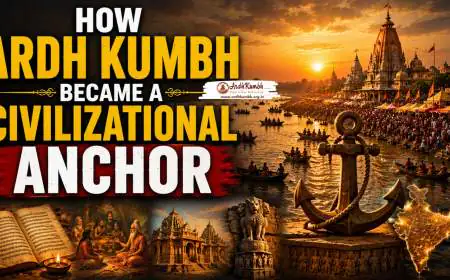





































































How Ardh Kumbh Became a National Pilgrimage
Discover how the Ardh Kumbh transformed from a local ritual into India's national spiritual event, driven by railways, nationalism, and political vision.

The Mythological Blueprint: The Four Drops of Amrit
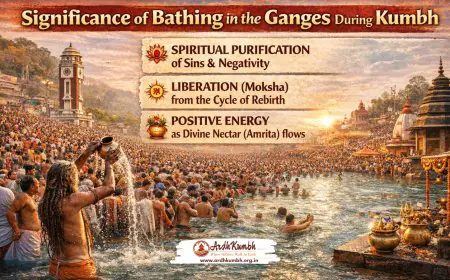
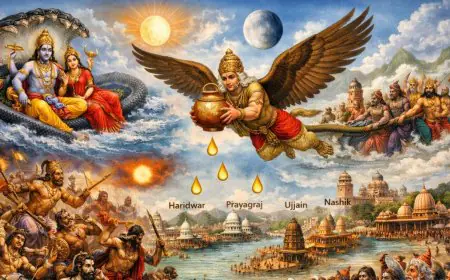
Before it was national, the Kumbh was cosmic. The Puranas tell us that when the Devas (gods) and Asuras (demons) churned the ocean for amrit (nectar of immortality), a divine battle ensued. Lord Vishnu, as the enchantress Mohini, seized the kumbha (pitcher) of nectar and flew across the sky. As she flew, four drops of amrit fell to earth—at Haridwar, Prayagraj, Ujjain, and Nashik-Trimbakeshwar .
These four sites became the anchors of the Kumbh Mela cycle. The Ardh Kumbh (meaning "half") occurs every six years at Haridwar and Prayagraj, marking the halfway point between the twelve-year Purna Kumbhs . This mythological origin gave the Kumbh a sacred geography that spanned the subcontinent—from the Ganga in the north to the Godavari in the south. It was a spiritual map of India long before the nation existed as a political entity.
The Organizer: Adi Shankaracharya's 8th Century Vision
While the mythology is ancient, the institutionalization of the Kumbh as a regular, pan-Indian gathering is widely attributed to the 8th-century philosopher and reformer Adi Shankaracharya . Shankaracharya traveled across the subcontinent, establishing four mathas (monastic centers) in the four cardinal directions. He recognized that the Kumbh Melas—the gatherings at the amrit sites—were perfect opportunities for sadhus, scholars, and seekers from different regions to meet, debate, and disseminate Vedantic knowledge .
Shankaracharya organized the dashanami (ten-named) orders of sannyasis into akharas—monastic armies. In a volatile medieval landscape, these akharas were not just spiritual orders but armed militias tasked with protecting Hindu pilgrims and defending the dharma . The Kumbh became their parliament and their mustering ground. This 8th-century intervention transformed the Kumbh from a local river festival into a networked , organized , national phenomenon.
Trending Guides Now
What Is the Story Behind the Ardh Kumbh Mela?
Read Guide →
How Akharas Were Formed and Why They Matter
Read Guide →
The Untold Stories of Har Ki Pauri
Read Guide →
How Saints and Sadhus Define the Ardh Kumbh Tradition
Read Guide →
Ardh Kumbh 2027 Dates (Official) - Haridwar Snan Schedule
Read Guide →
Dharamshala Stay During Ardh Kumbh: Free & Budget Guide
Read Guide →
Official Progress Report of Haridwar Ardh Kumbh 2027 Infrastructure Projects
Read Guide →
Is October a Good Time to Visit Haridwar Before Ardh Kumbh 2027?
Read Guide →The Imperial Patron: Harshavardhana and the Royal Endorsement
History records a specific moment of royal patronage that elevated the Kumbh's status. The Pushyabhuti king Harshavardhana (c. 590–647 CE), one of ancient India's most powerful rulers, is credited with formally organizing the Kumbh Mela at Prayagraj . According to accounts, Harsha held a great assembly at the Sangam every five or twelve years, where he distributed his entire treasury to the pilgrims—a ritual of renunciation that echoed the spiritual core of the Mela.
The Chinese pilgrim Xuanzang (Hiuen Tsang), who visited India in the 7th century, described a massive fair at Prayag where hundreds of thousands gathered. While historians debate whether this was specifically the Kumbh or an earlier Magh Mela, the description matches the scale and spirit of the Kumbh . Royal endorsement from a pan-Indian emperor like Harsha gave the Prayag gathering a national character that other melas lacked.
The Colonial Catalyst: Trains, Tents, and Timetables
The true transformation of the Ardh Kumbh into a mass national pilgrimage began in the 19th century, and the engineer was not a saint but the railway. The British Raj built railway lines connecting the remote pilgrimage sites to the major cities of the subcontinent. For the first time, a pilgrim from Chennai or Kolkata could reach Haridwar in days rather than months.
The Indian Railways began running Kumbh Mela special trains—a practice that continues to this day . They published timetables and fare schedules for the Mela season. This infrastructure did not just serve the existing pilgrims; it created new ones. The Kumbh became accessible to the middle class, the urban dweller, and the distant traveler. The railway turned the Kumbh from a regional event into a national one. As the Britannica notes, the Kumbh is now recognized as the "largest peaceful congregation of pilgrims on earth" .
The Nationalist Stage: Kumbh in the Freedom Struggle
By the late 19th and early 20th centuries, the Kumbh Mela had become something more than a religious event. It was a political platform. The massive crowds that gathered at Haridwar and Prayag were a captive audience for nationalist leaders. The Kumbh was one of the few places where Indians from different regions, castes, and classes could meet freely, away from the close scrutiny of the colonial state.
Swami Vivekananda, Bal Gangadhar Tilak, and Mahatma Gandhi all used the Kumbh to spread their message. Gandhi attended the 1925 Kumbh in Haridwar and was deeply disappointed by the hypocrisy and corruption he saw among some sadhus . Yet, he did not dismiss the Mela. He saw it as a crucible where the nation could be forged. Historian Rakesh Pandey notes, "During the freedom struggle, the melas were a venue to spread nationalist thought" .
The Kumbh became a metaphor for India itself—diverse, chaotic, spiritual, and unquenchable. To attend the Kumbh was to participate in the nation.
The Tragedy of 1954: A Reborn Nation Confronts Disaster
The Kumbh Mela of 1954 at Prayagraj was the first to be held in independent India. It was meant to be a celebration of national renewal. Instead, it became a national trauma. On the most auspicious day of the Mela, a stampede broke out, killing hundreds—estimates range from 400 to over 1,000 . The 1954 disaster shocked the young nation and exposed the massive gaps in crowd management and infrastructure.
In the aftermath, the government stepped in. The Mela Committee was restructured. Permanent infrastructure—bridges, roads, hospitals—was built. The Kumbh was no longer just a religious responsibility; it became a state responsibility. The 1954 tragedy forced the nation to take ownership of the Mela. The Kumbh was now a national project—and a national problem.
The 2019 Naming Controversy: Politics Meets Tradition
The Ardh Kumbh of 2019 in Prayagraj was a watershed moment. The Uttar Pradesh government, led by Chief Minister Yogi Adityanath, made a controversial decision: they officially dropped the prefix "Ardh" (half) and rebranded the event simply as "Kumbh Mela" .
The rationale was political. The government wanted to project the event as grander, more significant, and more national in scope. Critics, including astrologers and historians, pointed out that the naming had a specific astrological basis—the Kumbh at Haridwar occurs when Jupiter is in Aquarius (Kumbh rashi), while the Ardh Kumbh does not meet that condition . The naming controversy sparked a debate about tradition versus political messaging. It revealed how the Kumbh had become a battleground for national identity itself.
The RSS and the Sangh Parivar: Ideological Capture
The 2019 Ardh Kumbh also witnessed an unprecedented ideological mobilization. Nearly 300 activists of the Rashtriya Swayamsevak Sangh (RSS)—the ideological parent of the BJP—marched through the Mela grounds in full uniform, accompanied by a martial band . This was not a pilgrimage; it was a show of force. The RSS had historically kept its distance from the sadhu akharas, but by 2019, the lines had blurred.
The Kumbh has become a stage for Hindu nationalist messaging. Prime Minister Narendra Modi has described the Kumbh as a "grand Mahayajna of Unity" that has "strengthened India's national consciousness" for thousands of years . The Kumbh is now explicitly invoked as a symbol of Hindu India—a particular, exclusionary vision of the nation. The Ardh Kumbh has been nationalized not just in scale, but in ideology.
The 2027 Upgrade: Ardh Kumbh Becomes Purna Kumbh
The latest chapter in this story is unfolding now. In November 2025, Uttarakhand Chief Minister Pushkar Singh Dhami met with the representatives of all 13 Akharas on the banks of the Ganga in Haridwar and made a historic announcement: the 2027 Ardh Kumbh will be celebrated "as divinely and grandly as the Purna Kumbh" .
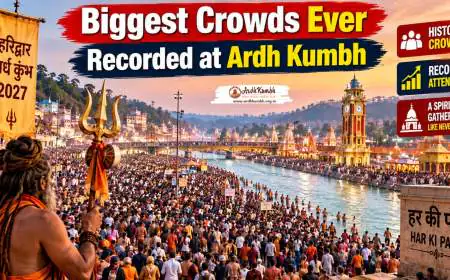
For the first time in history, the Ardh Kumbh will feature full Shahi Snan (royal bath) processions by the akharas—a privilege previously reserved for the twelve-year Kumbh . The 2021 Kumbh had been curtailed due to Covid-19, and Dhami stated that the 2027 event would compensate for that loss. The state government is preparing for an estimated 17 crore (170 million) devotees .
This upgrade is not merely logistical; it is symbolic. The government is investing over ₹1,252 crore in infrastructure—roads, bridges, ghat renovations, and police barracks . The Ardh Kumbh is being nationalized through state spending. It is being transformed from a spiritual event into a national spectacle.
The Naming Row Refuses to Die
Despite the government's push, the naming controversy has not faded. In March 2026, former Ganga Sabha president Ashok Tripathi flagged the "violation of a sacred religious tradition," sparking renewed protests . Astrologer Prof. B D Joshi asserted that calling the 2027 event a Kumbh has "no astrological basis" .
The opposition has also weighed in, alleging political motives. Former Congress councillor Ashok Sharma claimed the government aimed to "extract electoral gains" by projecting the event on a grander scale . Yet, the Mela officer Sonika Singh has defended the decision, stating that it was based on "consultations with the community of seers" .
This debate is itself evidence of how national the Kumbh has become. The naming of a festival is now a matter of national politics. The Kumbh is no longer just a gathering of sadhus; it is a lever of governance and a symbol of cultural assertion.
The Eternal River, The Eternal Nation
How did the Ardh Kumbh become a national pilgrimage? It became national because the railways made it accessible. It became national because nationalists used it as a stage. It became national because the state poured money into it. And it became national because politicians fought over its name.
But beneath all of this—the trains, the speeches, the budgets, the controversies—the Kumbh remains what it has always been: a gathering of faith. When you stand at Har Ki Pauri in 2027, the water will not ask whether you call it Kumbh or Ardh Kumbh. The Ganga will not check your party affiliation. The sadhus will not ask for your voting card.
The nation has claimed the Kumbh. But the Kumbh has always claimed something larger than the nation. It has claimed the soul. And that is why, whether you call it Ardh or Purna, local or national, the Kumbh will endure. The river flows. The pilgrims walk. The nation watches. And the faith—quiet, stubborn, ancient—refuses to be reduced to any single label.
Frequently Asked Questions