












































































Official Digital Services Planned for Haridwar Ardh Kumbh 2027 Pilgrims
Discover the official digital services planned for Haridwar Ardh Kumbh 2027 pilgrims, from QR-based digital IDs and e-passes to AI chatbots and lost-and-found portals.

Official Digital Services Planned for Haridwar Ardh Kumbh 2027 Pilgrims
Quick Answer ⚡ The official digital services planned for Haridwar Ardh Kumbh 2027 pilgrims represent the most ambitious technology deployment in the history of the Kumbh Mela. The centrepiece is a ₹45 crore Digital Kumbh proposal from the Information Technology Development Agency (ITDA), which divides the mela into six digital categories and includes digital IDs, e-passes, an AI chatbot, a digital lost-and-found portal, an integrated command and control centre, a multilingual mobile app and website, drone-based mapping, AI cameras, geo-tagging and virtual Ganga snan . Alongside this, the railway ministry is deploying a ₹29.13 crore integrated e-surveillance system across Haridwar and Rishikesh railway stations, with IP-based CCTV, video analytics and face recognition . A dedicated cyber police station is being established for the mela, and AI-based crowd management and IoT-enabled monitoring will support pilgrim safety and traffic management . For a pilgrim, the practical benefits are: a digital identity that speeds up entry, an AI assistant that answers questions in your language, a lost-and-found system that actually works, and a command centre that watches the crowd so you do not have to.
At a Glance 🔎 The Digital Services Ecosystem for Kumbh 2027
| Digital Service | What It Does | Who Runs It | Key Detail |
|---|---|---|---|
| QR-Based Digital Registration | Free digital registration for domestic, NRI and foreign pilgrims | ITDA / Mela Administration | Similar to Char Dham registration; QR-based |
| Digital ID | Unique pilgrim identity for crowd control and security | ITDA | Issued to all pilgrims; linked to e-pass |
| E-Pass | Digital vehicle pass for airport, railway, hotel and emergency movement | Mela Administration | QR-based vehicle passes |
| AI Chatbot | Answers Kumbh-related questions in multiple languages | ITDA | Handles FAQs, routes, facilities |
| Digital Lost and Found Portal | Online platform for reporting and matching lost persons and belongings | ITDA | Replaces handwritten registers; links all centres |
| Multilingual Mobile App and Website | Information on snan dates, routes, parking, ghats and emergency services | ITDA | Official Kumbh 2027 app and website |
| Virtual Ganga Snan | Digital experience of Ganga snan for remote pilgrims | ITDA | For those who cannot travel |
| Integrated Command and Control Centre (CCR-2) | Central monitoring of security, health and traffic | Mela Administration / Police | Helipad on roof; real-time monitoring |
| AI-Based Crowd Management | Real-time crowd alerts and traffic management | Mela Administration | AI and IoT-enabled |
| AI CCTV and Face Recognition | Surveillance at railway stations and mela area | Railway / Police | ₹29.13 crore railway project |
| Cyber Police Station | Dedicated station for cybercrime complaints | Kumbh Police | IT and cyber experts deployed |
| QR Code Signage | Physical signage with QR codes for site information | Mela Administration | Historical and religious significance |
| RailOne App | Train information, status and ticketing | Indian Railways | Awareness campaign at stations and dharamshalas |
The Digital Kumbh Blueprint: ITDA’s Six-Category Plan
The ITDA has prepared a ₹45 crore proposal for the Digital Kumbh, dividing the mela into six digital categories . This is not a collection of isolated apps. It is an integrated architecture.
The Six Categories
-
Digital Platform and Citizen Services: The integrated command and control centre, the Kumbh 2027 website and mobile app, the AI chatbot, the digital lost-and-found portal, e-passes and digital IDs for all, digital monitoring of sanitation and tents, and digital land allocation for departments .
-
Planning and Geospatial Mapping: Drone-based base mapping of the entire Kumbh area, GPS-based maps, and geo-tagged CCTV and AI cameras .
Trending Guides Now

Latest Infrastructure Projects Approved for Haridwar Ardh Kumbh 2027
Read Guide →
Latest Official Road Development Projects for Haridwar Ardh Kumbh 2027
Read Guide →
Latest Official Tent City Development Updates for Haridwar Ardh Kumbh 2027
Read Guide →
Uttarakhand Considers Restricted Zones Ahead of Ardh Kumbh 2027 in Haridwar
Read Guide →
Ardh Kumbh 2027 Dates (Official) - Haridwar Snan Schedule
Read Guide →
Dharamshala Stay During Ardh Kumbh: Free & Budget Guide
Read Guide →
Official Progress Report of Haridwar Ardh Kumbh 2027 Infrastructure Projects
Read Guide →
Is October a Good Time to Visit Haridwar Before Ardh Kumbh 2027?
Read Guide → -
Crowd Management and Surveillance: AI cameras, real-time crowd monitoring, suspicious activity detection, and IT-based crowd surveillance systems .
-
Pilgrim Facilitation: Virtual Ganga snan, multilingual mobile app and website, and information dissemination .
-
Railway Integration: Digital services for rail passengers, including the RailOne app .
-
Security and Cyber Infrastructure: Cyber police station, digital surveillance, and command and control .
Expert Tip 💡 The six-category structure tells you something important: these services are designed to work together. Your digital ID feeds into the e-pass system; the AI chatbot draws on the app’s data; the lost-and-found portal connects to the command centre. Use the official app as your single entry point — it will link to the other services .
Digital ID and E-Pass: The Foundation of the System
The digital ID and e-pass are the two credentials every pilgrim will need during Kumbh 2027.
Digital ID
The digital ID is being introduced for all pilgrims and sadhus . The Akhil Bharatiya Akhara Parishad president has proposed making ID mandatory for all devotees and saints to curb fake sadhus and enhance security . The digital ID will be issued to pilgrims and will serve as the primary identity document within the mela area .
What it enables:
-
Faster entry and exit at sector checkpoints.
-
Verification for accommodation and camp allocation.
-
Emergency identification if you are separated or injured.
-
Integration with the e-pass system for vehicle movement.
E-Pass
The e-pass is a digital vehicle pass for airport pickup, railway pickup, hotel transfers and emergency movement . It is QR-based, meaning it can be scanned at checkpoints without manual verification .
Why it matters: During Shahi Snan days, private vehicles are stopped outside the city . An e-pass allows authorised vehicles — hotel transfers, emergency vehicles, registered DMC vehicles — to move through designated corridors. If you are booking a hotel that offers airport or station pickup, confirm whether the vehicle has an e-pass .
The Registration Process
The MyGov policy recommendation report calls for free QR-based digital registration for every domestic, NRI and foreign pilgrim, similar to the Char Dham registration system . The report also recommends a live government dashboard showing registered pilgrims, expected arrivals, and current crowd data .
Pro Tip 🧭 Register before you travel. The registration portal will be linked from the official Kumbh 2027 website. Carry a screenshot of your digital ID and e-pass on your phone and a printed copy in your bag — network coverage can be unreliable in crowds .
The AI Chatbot and the Multilingual App: Your Digital Guide
The AI chatbot and the multilingual mobile app are the pilgrim-facing layer of the Digital Kumbh.
The AI Chatbot
An AI chatbot is being developed to answer Kumbh-related questions . It will handle FAQs, route queries, ghat information, snan dates and general guidance . The chatbot is part of the first digital category — platform and citizen services .
What to expect: You will be able to type or speak a question and receive a direct answer. The chatbot will not replace human help desks for complex problems — lost persons, medical emergencies, complaints — but it will handle the routine queries that clog help desks during peak days.
The Multilingual App and Website
A multilingual mobile app and website are being developed to provide accurate information on snan dates, traffic routes, parking, ghats and emergency services . The official Kumbh 2027 logo, website and theme song were launched by Chief Minister Pushkar Singh Dhami in October 2026 .
What the app will include:
-
Snan dates and muhurats.
-
Route maps and traffic advisories.
-
Parking locations and shuttle timings.
-
Ghat information and crowd status.
-
Emergency contacts and help desk locations.
-
QR code scanning for on-ground signage .
QR Code Signage
The Chief Secretary has directed that proper signage be installed within the Kumbh area, with QR codes embedded on them to provide essential information, including the historical and religious significance of the respective sites . Scanning a QR code at a ghat or temple will give you its story, its rituals and its access rules .
Expert Advice ✨ Download the official app before you leave home and test the chatbot with a simple question — “What are the snan dates?” or “How do I reach Mansa Devi?” . Familiarity with the interface saves minutes when you are in a crowd .
KumbhDoot: The Voice-First AI Agent for Pilgrims
KumbhDoot is a proposed personal AI agent designed to help pilgrims navigate the Kumbh across smartphones, feature phones and voice interfaces .
What KumbhDoot Is Designed to Do
-
Operate in 20+ Indian languages.
-
Coordinate with civic and business agents for travel, accommodation, payments, navigation and emergency assistance .
-
Work on feature phones — not just smartphones.
-
Provide voice-first interaction — useful for pilgrims who cannot read or type .
The Architecture
KumbhDoot is built on three layers:
-
Edge Agent Layer: The personal agent runs on smartphones, feature phones and voice interfaces, providing personalised assistance while protecting sensitive information locally .
-
Ecosystem Integration Layer: Civic, transport, health, camp and commercial agents expose services that can be discovered and coordinated by the pilgrim agent. This layer connects with UPI, DigiLocker, ABDM and travel systems .
-
Sovereign Agent Platform: Provides identity and consent management, agent discovery, policy enforcement, auditing and governance .
The Current Status
KumbhDoot is a proposed system, not yet an officially launched service for Haridwar 2027. It has been piloted and proposed for Nashik Kumbh 2027 , and the architecture is designed to be scaled to other Kumbh events. The Haridwar administration is building its own AI chatbot and app, which may incorporate similar features .
Expert Tip 💡 Do not wait for KumbhDoot to be launched in Haridwar. Use the official app and chatbot — they will be live before the mela. KumbhDoot is the future; the official app is the present.
The Digital Lost and Found Portal: Reuniting Families
The digital lost-and-found portal is, for families, the most important digital service of the entire Kumbh.
The Problem It Solves
At the Kumbh Mela, thousands of people are separated from their families every day — elderly pilgrims, children, people who speak only a regional dialect and often carry no phone. The traditional system is volunteers shouting names over loudspeakers and handwritten registers at around 10 Khoya-Paya centres that cannot talk to each other .
How the Digital Portal Works
The ITDA’s digital lost-and-found portal will record every complaint digitally, link all Khoya-Paya Kendras on a shared platform, and allow police and authorised staff to search across centres . A report filed at one kiosk will be visible at every other kiosk .
Advanced features being proposed (from the Khoya·Paya project):
-
Multilingual voice and text intake — Hindi, Marathi, Bhojpuri, English, code-mixed .
-
Semantic matching — the system understands that “saffron dhoti” ≈ “orange traditional clothes” and “around 70” ≈ “elderly, maybe 65” .
-
Multilingual reunion coordination — loudspeaker announcements in every relevant language .
-
Safety verification — before a child or elderly person is handed over, the system generates challenge questions only the genuine family could answer, and forces human or police sign-off .
What You Should Do
Register your child’s or elderly parent’s details at the nearest Khoya-Paya Kendra on arrival. Collect a wristband if available. Note the centre’s location. If a separation happens, you will already have a record and a known reporting point.
Local Insight 📍 The digital portal is a back-end system. You will still walk into a Khoya-Paya Kendra to file the report. The difference is that your report will be visible everywhere, instantly — not stuck in one register.
The Integrated Command and Control Centre (CCR-2): The Brain of the Mela
The CCR-2 is the most expensive and most important digital infrastructure project of Kumbh 2027.
What CCR-2 Is
The central control room-2 (CCR-2) is being built near Har Ki Pauri at an estimated cost of over ₹50 crore . It will be a four-storey building with a helipad on the roof, allowing helicopters to land directly on the CCR tower for emergency deployment and VIP movement .
What It Will Do
-
Integrated command centre for security, health services and traffic management .
-
Real-time monitoring of the mela area .
-
Replacement of the existing control system .
-
Coordination of all technical, security and communication units .
The AI and IoT Layer
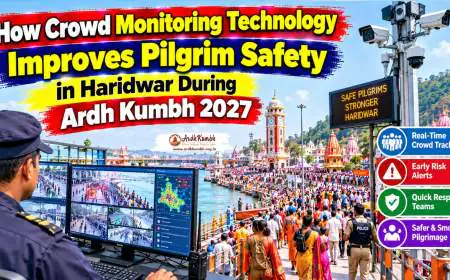
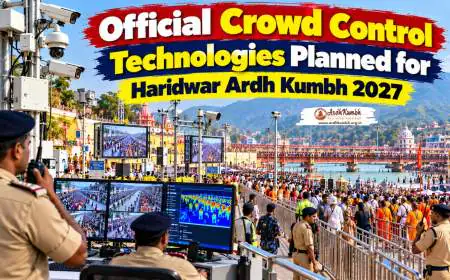
The CCR-2 will be the hub for AI-based crowd management and IoT-enabled monitoring to improve pilgrim safety and traffic management . The AI system will generate alerts when large crowds gather suddenly or traffic pressure rises on a route, enabling immediate action by the mela administration .
Expert Advice ✨ The CCR-2 is not a pilgrim-facing service. You will not visit it. But its existence means that help is closer and faster than in any previous Kumbh. If you see a drone overhead or a camera on a pole, that is the CCR-2’s eye. It is watching the crowd so that the crowd can be kept safe .
AI Surveillance, Cyber Security and the Railway Digital Overhaul
The digital services extend beyond the mela area into surveillance, cyber security and railway infrastructure.
AI CCTV and Face Recognition at Railway Stations
Provigil Surveillance Limited, a subsidiary of Magellanic Cloud, has received a ₹29.13 crore order from Northern Railway, Moradabad Division, for CCTV and integrated e-surveillance infrastructure at railway stations between LRJ–HW and HW–RKSH for Kumbh Mela 2027 . The deployment includes IP-based CCTV cameras, video analytics, face recognition systems, and centralised monitoring infrastructure .
Why it matters: Haridwar railway station is the primary arrival point for crores of pilgrims. AI-enabled surveillance will monitor crowds, detect suspicious activity and support security operations at the station and along the Haridwar–Rishikesh corridor .
The Cyber Police Station
A dedicated cyber police station is being established for Kumbh 2027, staffed with IT and cyber experts . Pilgrims will be able to report cybercrime and online fraud complaints without running from pillar to post . The Kumbh Mela police have proposed approximately 35 police stations for the mela area .
What this means for you: If you are defrauded by a fake tent booking, a fake travel agent or an online payment scam, you can report it at the cyber police station. The earlier you report, the better the chance of freezing the transaction .
The RailOne App
The railway is running a widespread awareness campaign to connect pilgrims with digital services, especially the RailOne app . Banners and posters are being placed at stations, dharamshalas and ashrams to inform pilgrims that they can check train arrival and departure, train status, and ticketing facilities on their mobile .
Pro Tip 🧭 Download RailOne before you travel. Haridwar Junction will be crowded, and the enquiry counters will have long queues. Checking your train status on your phone is faster than standing in line .
Virtual Ganga Snan: The Digital Pilgrimage
One of the most innovative digital services planned for Kumbh 2027 is virtual Ganga snan.
What It Is
Virtual Ganga snan is a digital experience that allows pilgrims who cannot travel to Haridwar to experience the Ganga snan remotely . It is part of the pilgrim facilitation category of the Digital Kumbh plan .
Who It Is For
-
Elderly pilgrims who cannot travel.
-
Pilgrims with disabilities who cannot reach the ghats.
-
International devotees who cannot attend in person.
-
Anyone who wants to participate in the ritual from a distance.
How It Works
The exact implementation is still being developed, but it is expected to involve a digital platform that simulates or streams the snan experience and provides a ritual framework for remote participation. It is a supplement to, not a replacement for, the physical snan.
Expert Advice ✨ Virtual snan is for those who cannot be there. If you can travel, the physical snan at Har Ki Pauri is the real thing. Use the digital service as a bridge, not a substitute.
Final Digital Services Checklist for Kumbh 2027 Pilgrims
-
Register for your digital ID on the official Kumbh 2027 portal before you travel .
-
Download the official Kumbh 2027 app and test the AI chatbot with a simple query .
-
Download RailOne for train status and ticketing .
-
Carry a screenshot and a printed copy of your digital ID and e-pass .
-
Scan QR codes on signage for site history and access rules .
-
Register children and elderly family members at the Khoya-Paya Kendra on arrival .
-
Note the nearest Khoya-Paya Kendra and the sector help desk.
-
Save the cyber police station contact if you are booking services online .
-
Use the app for crowd and route updates — do not rely solely on phone maps .
-
Report sanitation and safety issues through the app or help desk .
-
Check the CCR-2 alerts if the app notifies you of a crowd diversion .
-
Do not wait for KumbhDoot — use the official app, which will be live and integrated .
The digital services planned for Haridwar Ardh Kumbh 2027 are not a gimmick. They are a response to the scale of the event — crores of pilgrims, a 97-day mela, and a city that cannot expand its roads. Digital IDs, AI chatbots, lost-and-found portals and command centres will not replace the faith that brings people to Haridwar. They will make the pilgrimage safer, faster and more navigable — so that the faith has room to breathe. Use them, learn them before you arrive, and let them do the logistics while you do the darshan.
Frequently Asked Questions