









































































Is Ardh Kumbh a Path of Self-Discipline
Yes, the Ardh Kumbh is a profound path of self-discipline. Discover how its physical demands, mental challenges, and sacred routines forge inner strength, mastery over desire, and lasting spiritual freedom.

The Body as the First Disciple: Physical Austerity and Self-Mastery 💪
The path of self-discipline at the Ardh Kumbh begins with the body. For the duration of the pilgrimage, your physical comfort is no longer a priority. You will wake in the freezing, pitch-black hours of the Brahma Muhurta, not because a gentle alarm coaxes you awake but because the entire city of tents is stirring with a single, sacred purpose. There is no snooze button. The cold bites your skin, and your body protests, craving the warmth of a bed that no longer exists. The discipline to rise anyway, to dress in the dark, and to step out into the mist is the first victory of the day. This is not an act of self-punishment; it is the deliberate, conscious choice to place the soul's purpose above the body's comfort. Every morning you win this battle, you are forging a will that is stronger than your impulses.
The discipline continues with the long walk to the Sangam. You will walk ten, fifteen, sometimes twenty kilometers a day on uneven, crowded paths. Your feet will ache. Your muscles will burn. The modern mind, accustomed to instant comfort and effortless transport, will rebel. It will offer a thousand compelling reasons to take a rickshaw, to skip the bath, to rest. The discipline is to observe these thoughts and keep walking. The body, once a pampered master, is being trained to become a willing, obedient servant of the spirit. The cold water of the snān itself is the ultimate physical discipline. The shock is total, a full-body command to be present. You learn to breathe through the panic, to calm the racing heart, and to find, on the other side of the shock, a profound, vibrant stillness. This is the discipline not of gritting your teeth but of surrendering to a sensation and mastering it, a skill that translates directly into the ability to handle any difficult emotion or situation in your daily life.
The Mind's Crucible: Mental Stillness Amidst Chaos 🧠
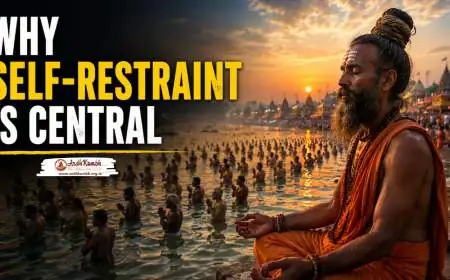
If the body is the first disciple, the mind is the reluctant, cunning, and often rebellious novice. The Ardh Kumbh is the most intense sensory environment on the planet. The noise—temple bells, blaring loudspeakers, chanting, shouting, crying—is relentless. The smells of incense, smoke, sweat, and river mud are a dizzying cocktail. The visual chaos of millions of moving bodies, bright colors, and endless processions overwhelms the senses. In this environment, the undisciplined mind becomes a frantic, exhausted mess. The path of self-discipline here is to cultivate an inner stillness that is completely independent of the outer chaos. This is the yogic science of pratyahara, the withdrawal of the senses, practiced not in a quiet cave but in the roaring heart of the world's largest gathering.
The discipline is to learn to walk through a screaming, jostling crowd with your mind resting quietly on a single mantra, your gaze soft, your heart calm. It is to wait in an endless, shuffling queue for a meal without irritation, transforming the frustration into a practice of patience. It is to sit by the river, surrounded by a million people, and find a silence so profound that the noise becomes no more than the distant sound of waves. This mental discipline is forged in the fire of constant, unavoidable challenge. The Kumbh does not give you a quiet corner to meditate; it teaches you that true meditation is not an escape from the world but a stillness that you carry within you, unbroken by any external circumstance. The pilgrim who learns this skill returns home with a mind that is no longer a slave to every passing irritation but a calm, clear lake, unshakeable even in a storm.
Trending Guides Now

Is Ardh Kumbh a Once-in-a-Lifetime Experience?
Read Guide →
Can Ardh Kumbh Change Your Life Priorities?
Read Guide →
What Makes Ardh Kumbh Spiritually So Powerful?
Read Guide →
What Ardh Kumbh Symbolizes in Sanatan Dharma
Read Guide →
Ardh Kumbh 2027 Dates (Official) - Haridwar Snan Schedule
Read Guide →
Dharamshala Stay During Ardh Kumbh: Free & Budget Guide
Read Guide →
Official Progress Report of Haridwar Ardh Kumbh 2027 Infrastructure Projects
Read Guide →
Where to Find 24-Hour Pharmacies in Haridwar During Ardh Kumbh 2027 Emergencies
Read Guide →The Clock of the Cosmos: Temporal Discipline and the Sacred Schedule ⏳
At the Ardh Kumbh, you do not manage your own time. You surrender to a sacred, cosmic schedule that has governed the gathering for millennia. The day is structured around the snān timings, the astrologically calculated Muhurta that dictates the most potent hours for bathing. Everything else—the meals at the bhandara, the opening and closing of the temple gates, the movements of the akhara processions—revolves around this celestial clock. This is a profound training in temporal discipline. The modern, self-directed individual, accustomed to controlling their own schedule, is forced to submit to a rhythm that is larger than their personal preferences. You eat when the bhandara serves food, not when you feel hungry. You wake when the Mela stirs, not when your body feels rested. This discipline is not restrictive; it is liberating. By removing the exhausting burden of constant choice, the sacred schedule frees up immense mental energy.
You learn that discipline is not a rigid, joyless adherence to a personal timetable but a graceful alignment with a universal order. The early morning, the Brahma Muhurta, is not a penance but a gift, a window of pure, sattvic energy that the disciplined pilgrim learns to treasure. The long wait for the main snan day is not a frustrating delay but a period of sacred anticipation, a slow, deliberate preparation of the soul. The Ardh Kumbh teaches you that your time is not your own; it is a sacred trust, and living in harmony with the cosmic rhythm is the highest form of temporal discipline. You return home no longer a slave to the tyranny of the urgent but a master of your own presence, able to structure your day not around distractions but around what is truly sacred.
The Ego's Surrender: Humility and the Discipline of Anonymity 🤲
The most subtle and challenging form of self-discipline at the Ardh Kumbh is the discipline of the ego. Modern life is an obsessive project of self-construction. We build our identities, curate our social media profiles, and tirelessly defend our specialness. The Kumbh is a demolition site for this elaborate structure. In the vast, anonymous crowd of millions, your social identity dissolves completely. Your job title, your bank balance, your achievements—none of it is visible, and none of it matters. You are simply one dark shape among millions, shivering in the same cold, moving toward the same river. The ego, which thrives on recognition and differentiation, suddenly finds itself out of a job. It screams in panic, trying to reassert itself through judgment, comparison, or a desperate clinging to its own story. The discipline here is to let this happen. To allow the ego to be starved of its fuel and to discover, in that starvation, a strange, liberating peace.
This is the discipline of humility. It is the willingness to be nobody, to be just one soul among souls. In the endless queues, you are not more important than the old woman ahead of you. In the bhandara, you eat the same food as the poorest pilgrim beside you. The Ardh Kumbh trains you in the discipline of surrendering the need to be seen, to be acknowledged, to be special. This is the most difficult discipline of all, for it requires the death of the false self. But the pilgrim who learns to sit quietly in the anonymity of the crowd, who feels the profound relief of not having to perform an identity, has discovered a freedom that no amount of worldly success can provide. They have learned the sacred discipline of a quiet, humble, and authentic self.
The Bhandara and Beyond: The Discipline of Service and Simplicity 🍚
The Ardh Kumbh teaches self-discipline through its radical simplification of life. You live out of a single bag, wearing the same few clothes day after day. You eat simple, sattvic food from a leaf plate, often just dal and roti. There is no menu of choices to indulge the senses, no endless snacking to pacify a restless mind. This is the discipline of vairagya, not as a grim rejection of the world but as a joyful discovery of how little you actually need to be content. The craving for more—more variety, more comfort, more stimulation—is a relentless mental noise. The Kumbh silences that noise by simply not offering the choices. You learn to eat with gratitude, to find deep satisfaction in a single, humble meal, and to feel a lightness that comes from being unburdened by excess.
Beyond simplicity, the Kumbh offers the discipline of seva, of selfless service. Many pilgrims find that the most transformative part of their journey is the hours spent volunteering in the bhandaras, serving food to strangers, or cleaning the ghats. This is a direct discipline of the ego. When you serve, you place yourself in the position of a humble instrument. You are not the hero of your own story; you are just a pair of hands, ladling dal into an endless stream of bowls. This practice chips away at the arrogance of the self and cultivates a quiet, service-oriented heart. The discipline of seva teaches that true strength is not in dominating others but in being useful to them, without any expectation of recognition or reward.
The Long Road Home: Integrating Discipline Into Daily Life 🏠
The true test of the self-discipline learned at the Ardh Kumbh is not how firmly you stood in the cold water but how you live when you return home. The pilgrimage provides the intense, immersive training; daily life provides the marathon where that training must be applied. The post-Kumbh period is a vulnerable time. The old habits, the familiar comforts, and the seductive pull of the undisciplined world are waiting. The discipline you must now cultivate is the discipline of integration. It is the slow, patient work of building small, sustainable practices that keep the fire of the Kumbh alive. You may not be able to wake at 3:30 AM every day, but you can commit to waking thirty minutes earlier than before, dedicating that time to silent meditation or prayer. You may not be able to live out of a single bag, but you can commit to decluttering your home, simplifying your meals, and consciously reducing your consumption.
The discipline is to turn the peak experience of the pilgrimage into a sustainable, daily rhythm. You learn to recognize the cravings of the undisciplined mind and to gently, firmly, choose a different path. The traffic jam becomes an opportunity to practice the patience you learned in the Kumbh's queues. The difficult colleague becomes the annoying crowd, a chance to practice inner stillness. The Ardh Kumbh gave you a powerful, embodied memory of what it feels like to be centered, strong, and free. The daily discipline is simply the act of returning to that center, again and again, until the path of self-discipline is no longer a foreign journey but the very landscape of your life.
Common Pitfalls: When Discipline Becomes Rigidity ⚠️
The path of self-discipline is a razor's edge. On one side lies the swamp of indulgence; on the other, the cold, hard rock of rigid self-punishment. The Ardh Kumbh teaches a discipline that is alive, flexible, and rooted in love, not a grim, joyless adherence to rules. A common pitfall for pilgrims is to turn the discipline into a new identity, a way of feeling spiritually superior. The person who returns home and constantly judges others for their lack of "spiritual discipline" has had their ego co-opt the entire process. True discipline is humble and non-comparative. It is a quiet, inner strength, not a badge of honor.
Another pitfall is mistaking the external forms of discipline—the waking early, the simple eating—for the inner reality. You can perform all the right actions with a heart full of resentment and pride, and it will be spiritually empty. The Ardh Kumbh teaches that the essence of discipline is not the rule but the loving surrender behind it. The cold water is not holy because it is cold; it is holy because you enter it with faith and a willingness to be transformed. Finally, beware of burnout. The Kumbh is an intense period, and attempting to maintain that same level of austerity at home can lead to exhaustion and a backlash of indulgence. The discipline of the householder is a middle path, a gentle, steady flame, not a roaring bonfire that quickly consumes itself.
Practical Steps to Cultivate Your Ardh Kumbh Discipline ✅
To walk the path of self-discipline with the Ardh Kumbh as your guide, practical, grounded strategies are essential. First, before you even leave for the pilgrimage, define your sankalpa with absolute clarity. A clear, sacred intention is the anchor that will hold you steady when the storms of resistance arise. Write it down. Revisit it daily. Second, during the Mela, treat every hardship as a conscious exercise. When you are cold, internally name it: "This is the fire of tapas, burning my resistance." When you are impatient, say to yourself: "This is training in patience." Reframing difficulty as a deliberate practice transforms it from a source of suffering into a source of strength. Third, build deliberate periods of silence into each day. Even just fifteen minutes sitting by the river, without your phone, without speaking, is a powerful training in the discipline of inner stillness.
Fourth, learn from the sadhus. They are the master practitioners of discipline. Observe their daily routines, their calmness, their complete lack of fuss. Sit near them and absorb the silent teaching. Fifth, when you return home, choose one small, non-negotiable daily practice—ten minutes of Morning Silence, a weekly simple meal, a regular act of anonymous giving—and commit to it without exception. This single, consistent act is the bridge between the pilgrimage and your ordinary life. Finally, be endlessly patient and kind with yourself. Discipline is not a sprint; it is a lifetime's gentle, persistent cultivation. You will fail, and you will begin again. The true discipline is not in never falling but in always, with a quiet heart, returning to the path.
The Fruit of Discipline: The Freedom of a Mastered Self 🕊️
The world misunderstands discipline. It sees it as a cage, a restriction, a joyless denial of life's pleasures. The Ardh Kumbh reveals the profound, liberating truth: self-discipline is the only path to genuine freedom. A person who is a slave to their impulses—to the craving for comfort, for entertainment, for the approval of others—is not free. They are a puppet, dancing on the strings of their own unruly mind. The disciplined pilgrim, forged in the cold water and the long walks of the Kumbh, has broken those strings. They are no longer a victim of every passing desire or aversion. They have discovered a deep, unshakeable center, a quiet, sovereign self that can choose its actions consciously, out of love and wisdom, rather than reacting blindly out of fear and habit.
This is the ultimate gift of the Ardh Kumbh. The discipline you learn there is not a heavy burden you must carry for the rest of your life. It is a set of wings. It lifts you above the petty tyrannies of the ego and allows you to soar into a vast, open sky of inner peace. The sadhu sitting silently by the dhuni fire, the pilgrim walking miles with a calm smile, the grandmother entering the freezing river with a look of absolute, radiant serenity—these are not people who have been imprisoned by discipline. They are people who have been liberated by it. The Ardh Kumbh is a path of self-discipline because self-discipline is the path home, the royal road that leads from the noisy, chaotic prison of the untrained mind to the silent, boundless, and joyful kingdom of the mastered self.
Frequently Asked Questions