






















































What You Should and Should Not Carry
Discover what you should and should not carry to the Kumbh Mela. A comprehensive, practical packing guide covering essentials, prohibited items, and the spiritual wisdom of traveling light.
The Golden Rule: If You Can Leave It, Leave It ✅
Before you place a single item into your bag, you must absorb the foundational principle of Kumbh packing: you will carry everything yourself, for miles, in a crowd of millions. There are no porters. No luggage carts. No bellhops. The roads are often unpaved, sometimes muddy, and always crowded. The pilgrim who arrives with a large suitcase on wheels quickly discovers that wheels are useless on a dirt path and that a heavy suitcase becomes a dangerous tripping hazard for others and a source of immense personal misery. The golden rule is ruthless but liberating: pack your bag, then remove half of what you packed. You need far less than you think you do. At the Kumbh, you will discover that you can live joyfully for days with a single change of clothes, a warm shawl, and a small satchel of essentials. The simplicity that feels like deprivation at home becomes, on the pilgrimage, a profound and unexpected freedom. Every item you choose not to bring is a weight you will never have to carry, a worry you will never have to hold. Packing light is not just a convenience; it is a sadhana, a spiritual discipline that prepares the mind for the inner journey.
The Non-Negotiable Essentials: What You Absolutely Must Carry 🎒
Within the small bag you bring, there is a sacred core of items that are not optional. These are the non-negotiable essentials that will keep you safe, healthy, and oriented. First and foremost, your identity documents. Carry a valid, government-issued photo ID at all times—Aadhaar card, voter ID, passport, or driver’s license. Keep the original in a waterproof pouch hidden deep within your bag, and carry a clear photocopy in your pocket. These documents are essential for security checks, for accessing your pre-booked accommodation, and are your lifeline if you get lost or need medical assistance. Without ID, you are an unknown entity in a highly secured zone.
Next, a mobile phone and a power bank. The network at the Kumbh is often strained, especially on peak days, and you may go hours without a reliable signal. A fully charged power bank ensures your phone, which is your camera, your map, your torch, and your emergency contact device, remains functional. However, do not rely on having constant internet. Download offline maps and keep your accommodation details saved as a screenshot. Third, a small, basic medical kit. This should include any prescription medications you take, along with remedies for the most common pilgrimage ailments: pain relievers, anti-diarrheal medication, rehydration salts, band-aids for blisters, antiseptic cream, and cough and cold medicine. The cold, the crowd, and the change in diet can challenge even the strongest constitution. A small, prepared kit can prevent a minor ailment from ruining your pilgrimage. Finally, a reusable water bottle. Staying hydrated is critical. There are filtered water stations throughout the Mela, and having your own bottle is both environmentally responsible and a guarantee that you always have water at hand.
The Right Clothing: Warmth, Modesty, and Practicality 🧣
The clothing you carry to the Kumbh must serve three masters: warmth, modesty, and practicality. The pre-dawn hours, when the most sacred bathing takes place, are bitterly cold, with temperatures often dropping below 5°C. The key to comfort is layering. Your base layer should be a thermal or close-fitting cotton garment that wicks moisture away from your skin. Your middle layer should provide insulation: a thick woolen sweater, a fleece jacket, or a warm hoodie. Your outer layer must be a windproof and water-resistant jacket that can block the biting pre-dawn breeze and the damp river mist. A warm cap, gloves, and thick woolen socks are not luxuries; they are essential survival gear. Heat escapes fastest from your head and extremities, and keeping them covered will transform your experience of the cold.
Trending Guides Now

Entry Rules and Conduct Guidelines for 2027
Read Guide →
Entry Rules Every Pilgrim Must Follow
Read Guide →
Live Like a Sadhu for One Day at Kumbh Mela
Read Guide →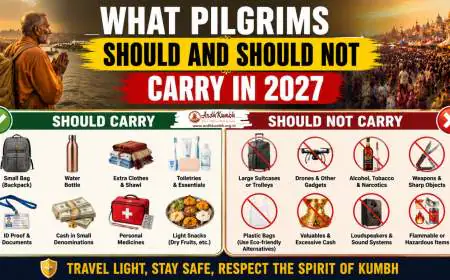
What Pilgrims Should and Should Not Carry in 2027
Read Guide →
Best Routes to Reach Haridwar for Ardh Kumbh Mela
Read Guide →
Ardh Kumbh 2027 Dates (Official) - Haridwar Snan Schedule
Read Guide →
Why Zone Awareness Will Matter in 2027
Read Guide →
How Oral Traditions Preserved Kumbh Wisdom
Read Guide →Modesty is not just a cultural expectation at the Kumbh; it is a form of spiritual respect. Both men and women should wear loose, comfortable, and non-revealing clothing. A salwar kameez or a simple kurta-pajama is ideal. Tight, transparent, or revealing clothing is deeply inappropriate in a sacred space. A large, warm shawl or chadar is the single most versatile item you can carry. It provides extra warmth, can be used as a head covering during temple visits, can be spread on the ground for sitting, and even serves as a makeshift towel. Sturdy, well-broken-in walking shoes are perhaps the most critical item on your entire packing list. You will walk ten to fifteen kilometers a day on uneven, sometimes slippery terrain. Your shoes must be comfortable, durable, and, crucially, they must not be new. Break them in for at least a month before your journey. A pair of simple, slip-on sandals is also useful for navigating the ghats and entering the water. Pack a small, lightweight towel that dries quickly. Carry your wet clothes in a separate, waterproof bag after bathing.
The Sacred and the Practical: Small Items with Great Value 🛕
Beyond the core essentials, there are a few small items that carry immense practical and spiritual value. A small torch or headlamp is invaluable. The pre-dawn walk to the ghat is through dark, uneven paths, and a torch is far more reliable than your phone light. Carry extra batteries. A small notebook and pen allow you to journal the insights and experiences that will flood your mind, creating a treasured record of your inner journey. A mala or a small sacred text can be a powerful anchor for your mind amidst the chaos. If you intend to make offerings, carry a small amount of cash in low denominations; it is impractical and unwise to carry large amounts of money. Keep this cash in a concealed money belt or a secure inner pocket, not in a back pocket or an easily accessible bag. A reusable cloth bag is useful for carrying small purchases or food and aligns with the increasing environmental regulations against plastic. Do not carry expensive jewelry, watches, or any item of high monetary or sentimental value. The Kumbh is not the place for displays of wealth. The loss or theft of a cherished item can cause a spiritual derailment that far outweighs its material worth. Wear simple, functional clothing, and leave your valuables safely at home.
The Prohibited: What Must Never Enter the Sacred Grounds 🚫
The Kumbh Mela has a strict list of prohibited items that must never be carried into the Mela grounds. These rules are enforced for the safety and spiritual purity of the gathering. Alcohol, tobacco, and all intoxicating substances are absolutely banned. The Kumbh is a strictly sober, sacred space. Possession of these will not only result in confiscation but can lead to detention. Weapons of any kind—firearms, knives, sharp instruments, even large metal water bottles that could be used as projectiles—are prohibited. Your bag will be scanned at security checkpoints, and these items will be confiscated. Professional camera equipment with large lenses and tripods often requires a special media pass. While a small personal camera or phone is fine for respectful photography, large equipment is seen as disruptive and commercial.
Plastic bags are increasingly banned across the Mela grounds for environmental reasons. Carry a cloth bag instead. Large suitcases are not prohibited by law but are an act of profound self-sabotage. You will be walking for miles on rough terrain; dragging a wheeled suitcase is a guaranteed path to misery. Drones are strictly forbidden and will be confiscated. Large amounts of cash or valuables, as mentioned, are a magnet for anxiety and potential theft. The principle is simple: the Kumbh is a place of renunciation, a temporary world where we live simply. Bringing items that belong to the world of accumulation and display is not just logistically foolish; it is spiritually counterproductive. The security check is your final opportunity to let go of what you do not need.
The Snan Day Satchel: What to Carry to the Sacred Bath 💧
On the day of your main sacred snan, you will need a smaller, streamlined version of your packing list. You will be walking in the dark, in a dense crowd, and you will need your hands free. A small, waterproof cross-body bag is ideal. Into it, place a copy of your ID, a small amount of cash, your phone in a waterproof pouch, and your essential medical items. Carry a small, quick-dry towel and a complete change of dry clothes, including undergarments and warm socks, in a waterproof bag. The moment you emerge from the freezing water, you must change out of your wet clothes immediately to prevent hypothermia. The dry clothes should include your warm shawl and cap. You can leave your larger bag, with non-essential items, securely locked in your accommodation. Do not carry your original passport or all your cash to the ghat. The snan day satchel should contain only what you absolutely need for the bath and the immediate aftermath. Traveling light to the water allows you to focus entirely on the sacred act, unencumbered by the weight and worry of possessions.
The Spiritual Packing List: What You Carry in Your Heart 🙏
The most important things you will carry to the Kumbh cannot be placed in any bag. They are carried in the heart. The first is a clear, simple sankalpa—a sacred intention. Spend the weeks before your journey refining this. Know why you are going. Let your purpose be a guiding light when the chaos of the Mela threatens to overwhelm you. The second is a deep well of patience. The Kumbh will test your patience at every turn. You will wait in queues. You will be pushed in crowds. Your plans will fall apart. If you carry an ample supply of patience, these moments will become opportunities for practice; if you do not, they will become sources of intense suffering. The third is an open, non-judgmental heart. The Kumbh is a mirror. It will show you beauty and chaos, profound devotion and human frailty, the sublime and the absurd. Approach it all with a gentle, accepting heart, and the pilgrimage will teach you more than any scripture. Finally, carry faith—not necessarily a rigid belief in a specific doctrine, but a quiet trust that the journey you are undertaking is meaningful, that the river is sacred, and that you are exactly where you need to be.
The Lightness That Frees the Soul
The pilgrim who walks toward the Sangam at dawn, with a small, light bag on their shoulder and a clear, quiet heart within their chest, is the pilgrim who is truly ready. They have understood the secret of the Kumbh: that the journey to the sacred is, at its core, a journey of unburdening. Every kilogram left behind is a worry shed. Every unnecessary possession released is a little bit of the ego dissolved. The packing list of the Kumbh is, in this sense, a spiritual curriculum. It teaches us, in the most practical way imaginable, that we can live with less, that we can be happy with less, and that the things we truly need—warmth, nourishment, faith, and community—are either already within us or freely given by the grace of the pilgrimage. When you stand in the cold water, with nothing but the clothes on your back and the prayer on your lips, you will feel a lightness you may not have felt since childhood. That lightness is the true gift of the Kumbh, and it begins with the simple, sacred discipline of knowing what to carry and what to leave behind.
Frequently Asked Questions