




























































How Oral Traditions Preserved Kumbh Wisdom
Discover how oral traditions preserved Kumbh wisdom across millennia. From Vedic chanting to guru-shishya lineages and akhara storytelling, explore the indestructible human memory system that saved the sacred knowledge of the world's largest pilgrimage.

The Living Book: Why Voice Was Chosen Over Text 🕉️
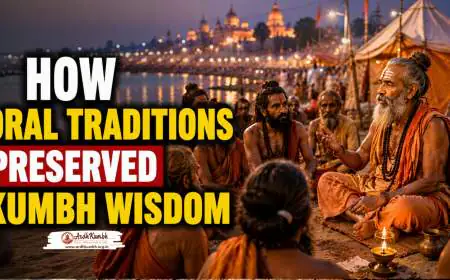
The ancient rishis who gave birth to the Vedic civilization were not ignorant of writing. They made a deliberate, conscious choice to transmit their most sacred knowledge orally. This was not a limitation. It was a profound insight into the nature of wisdom and the vulnerability of physical media. A written text, once separated from a living teacher, becomes a dead object, open to misinterpretation, corruption, and destruction. A mantra, on the other hand, lives. It is carried in the breath, which is prana, life itself. It is learned through years of intimate, daily contact with a guru who not only corrects the pronunciation but transmits the subtle inner state, the bhava, without which the mantra remains an empty shell.
This is the foundational principle of how oral traditions preserved Kumbh wisdom. The Kumbh's knowledge is not merely information, like a list of dates or ingredients. It is transformative, experiential wisdom. The precise intonation of a Vedic hymn, the correct sequence of a ritual offering, the inner visualization during a meditation—these cannot be fully captured in writing. They must be heard, imitated, corrected, and internalized over many years. The guru's voice carries the living fire of the tradition. When a young sadhu at the Kumbh chants a mantra he learned from his guru, who learned it from his guru, stretching back to the Vedic dawn, the voice you hear is not an echo. It is the original transmission, alive and uncorrupted. The Kumbh Mela is the great amplifier of this living book, the place where tens of thousands of these oral repositories gather and their individual recitations merge into a single, thunderous, and flawless cosmic sound.
The Human Hard Drive: Vedic Memorization and Error Correction 🧠
The technical mastery of the oral traditions that preserved Kumbh wisdom is staggering. The Vedas were memorized not in a single, straightforward way, but through multiple complex recitation patterns called pathas. The Samhita Patha is the continuous recitation, word after word. The Pada Patha breaks it down, word by isolated word. The Krama Patha is a stepped pattern, where the first and second words are joined, then the second and third, and so on. Beyond these are the incredibly intricate Jata Patha (a braided pattern of words), and the most complex of all, the Ghana Patha, which involves a dense, mathematically precise weaving of words back and forth.
This system was a genius-level error correction code developed millennia before the modern computer. By learning the text in multiple, overlapping patterns, any error in pronunciation, grammar, or sequence became immediately obvious. If a student in a Vedic school in Tamil Nadu made a mistake, a visiting pandit from Kashmir, hearing the Ghana recitation, would instantly detect the deviation because the interlocking patterns would not match. The Kumbh Mela was the great cross-verification event. Pandits and sadhus from every corner of India would gather and chant together, their recitations acting as a massive, decentralized, real-time peer review of the entire Vedic corpus. This was the spiritual equivalent of a blockchain—a distributed, unalterable ledger of sacred sound. The Kumbh ensured that the wisdom stored in this human hard drive was constantly defragmented, checked for errors, and transmitted to the next generation with absolute, uncompromising fidelity.
Trending Guides Now
History of Ardh Kumbh Mela From Samudra Manthan to Modern Times
Read Guide →
How Saints and Sadhus Define the Ardh Kumbh Tradition
Read Guide →
Why Saints Are Called Living Archives of Kumbh
Read Guide →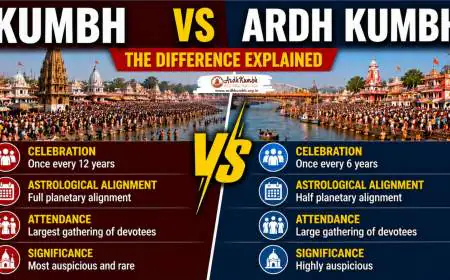
Kumbh vs Ardh Kumbh: The Difference Explained
Read Guide →
Best Routes to Reach Haridwar for Ardh Kumbh Mela
Read Guide →
Ardh Kumbh 2027 Dates (Official) - Haridwar Snan Schedule
Read Guide →
Why Early 2027 Planning Will Decide Your Experience
Read Guide →
Why Daily Routines Matter So Much at Kumbh
Read Guide →The Guru-Shishya Parampara: A Chain of Souls 🔱
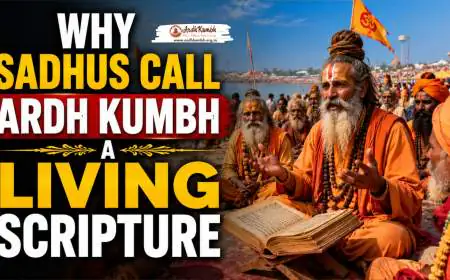
The institutional heart of the oral preservation of Kumbh wisdom is the guru-shishya parampara, the unbroken teacher-disciple lineage. The Kumbh is not just a gathering of individuals; it is a gathering of lineages. Every akhara, every panda family, and every school of philosophy that sets up camp on the riverbank is a link in a chain that has been forged, one human soul at a time, for centuries or millennia. The transmission of wisdom in these lineages is not a classroom lecture. It is a total immersion. The disciple lives with the guru, serves the guru, and observes the guru's every action. Knowledge is transmitted not just through words but through the guru's very presence, through silence, through the quality of their awareness.
At the Kumbh, this becomes spectacularly visible. You see an aged, frail mahant, his eyes shining with a light that seems to come from another world, surrounded by dozens of young, bright-faced sadhus who hang on his every word. That mahant was once a young boy, sitting at the feet of his own master at a Kumbh decades ago, absorbing the teachings that would shape his entire life. The wisdom he carries—the specific interpretation of a Vedanta sutra unique to his akhara, the secret technique of a pranayama that awakens a dormant energy, the precise herb mixture for a medicinal remedy—was never written down. It was entrusted to him, and he will, in turn, entrust it to a chosen disciple when the time is right. The Kumbh Mela is the grand reunion of these living chains, a temporary network where all these lineages reconnect, share their unique insights, and reaffirm their shared roots. It is a celebration of the fact that the most profound human knowledge does not reside in a cloud server but in the sacred, living bond between two human beings.
The Pandas and the Vahis: Oral Genealogies That Span Generations 📜
While the pandas (hereditary pilgrim priests) are famous for their written vahis (record books), their role in the oral tradition of the Kumbh is equally profound and often overlooked. The vahi is a written document, but the knowledge of how to interpret it, the stories of the families recorded in it, and the sacred geography of the ghats are all transmitted orally. A young panda learns his profession not from a manual but by sitting beside his father and grandfather at each Kumbh, listening to them address pilgrim families by name, recounting the story of their great-grandfather's pilgrimage in 1890, and knowing exactly which ghat is appropriate for their specific family rituals.
This is oral history in its most intimate and living form. When a panda opens a vahi and sees an entry from 1750, he may also carry an oral tradition passed down through his family about what that particular Kumbh was like, what the weather was, which kings were in attendance, and if there were any special miracles or events. The written record is the skeleton; the oral tradition is the flesh and blood and breath. At the Kumbh, these thousands of pandas, each with their own localized knowledge base, create a vast, distributed oral archive of the social and genealogical history of India. A pilgrim who visits their family panda is not just registering their visit. They are participating in an oral tradition that updates and renews the collective memory, ensuring that the sacred connection between a family and the river is a living story, told and retold, generation after generation.
The Stories That Carry the Spirit of the Kumbh 🎭
Beyond the high Vedic Sanskrit and the philosophical debates, a rich, vibrant, vernacular oral tradition preserves the very soul of the Kumbh Mela. These are the stories told by grandmothers to wide-eyed children around the campfire at night, the local legends of the river narrated by boatmen to pilgrims on their way to the Sangam, and the tales of the great akhara saints and their miraculous deeds passed down among the sadhus. These stories are not trivial entertainment. They are the cultural DNA of the pilgrimage, the vehicles that carry the meaning, the faith, and the emotional power of the Kumbh across generations.
A child who hears the story of King Bhagiratha's penance to bring the Ganga to earth, told in the flickering light of a dhuni fire, will never forget it. The pilgrim who hears the local legend of a specific, nameless ghat where a mysterious sadhu once gave a life-changing blessing is forever connected to that spot. These oral narratives encode the sacred geography, the ethical values, and the spiritual aspirations of the tradition. They explain why the Kumbh is worth the immense hardship. They are the language of the heart, and they are transmitted in the most natural and powerful way possible: through the shared, present, emotionally charged moment of storytelling. The Kumbh Mela without its stories would be an empty shell of rituals. The oral tradition fills it with meaning, color, and a palpable sense of the divine mystery that words alone can never fully capture.
The Dharma of Sound: Why Chanting Is a Spiritual Technology 🎶
The oral traditions at the Kumbh are not just about memorizing words. They are a sophisticated science of sacred sound, a Nada Yoga that understands the vibrational power of correctly pronounced Sanskrit syllables. The mantras chanted during the snan, the yagya, and the aarti are not prayers in the ordinary sense. They are precise sonic technologies designed to purify the environment, calm the mind, and awaken higher states of consciousness. The oral transmission of these mantras preserves not just their intellectual meaning but, more critically, their exact pitch, rhythm, and tonal quality, which are believed to be essential for their spiritual efficacy.
At the Kumbh, this ocean of sacred sound is overwhelming. The combined chanting of thousands of sadhus, each syllable perfectly formed according to an oral tradition thousands of years old, creates a palpable vibrational field. You do not just hear the Gayatri Mantra at the Sangam; you feel it resonate in your bones. This is the ultimate purpose of the rigorous oral discipline. It is not about archiving information. It is about generating a transformative spiritual energy in the present moment. The Kumbh is the pinnacle of this ancient sound technology, a gathering where the accumulated sonic power of the world's oldest continuous oral tradition is unleashed in a single, focused, collective act of devotion. The wisdom is not just preserved; it is activated, and its purifying, liberating power is made available to every single person present.
The Decentralized Network That No Enemy Could Destroy 🌐
The genius of the oral tradition in preserving Kumbh wisdom is ultimately a strategic and historical one. It made the knowledge indestructible by making it decentralized. There was no single, central library where the "master copy" of the Kumbh's ritual manual or the Vedas was kept, a single point of failure that a hostile army could target. The knowledge was distributed across thousands of nodes—the minds of the sadhus and pandits spread across the entire subcontinent. The destruction of Nalanda University was a catastrophic cultural loss, but the wisdom of the Kumbh survived it. It survived because even as the flames consumed the manuscripts, the same sutras and shlokas were alive in the memories of countless pandits in the south, in the Himalayan caves, and in the wandering orders of sadhus.
The Kumbh Mela was the ultimate backup and restoration system. When the political climate shifted and the gathering could be held openly again, all these distributed nodes would converge at the Sangam. A pandit whose grandfather had memorized a rare astrological text could recite it, and a dozen young students could learn it, effectively restoring the "data" to a region where it had been lost. This resilience, born of decentralization and the human voice, is why the Kumbh is not a historical reconstruction but a living, breathing, unbroken event. The wisdom it preserves was never a dead artifact in a museum case. It was a living fire, and the oral tradition passed it from torch to torch, ensuring that even the fiercest winds of history could not extinguish it. The Kumbh is the blazing, communal bonfire where all those individual flames still gather to show that the light has never, and will never, be extinguished.
The Voice That Will Never Be Silenced
At the next Ardh Kumbh, when you stand in the pre-dawn darkness and the silence is broken by a single, resonant "OM" that rolls across the water, you are not hearing a sound that was invented yesterday. You are hearing the same vibration that has been traveling, unbroken, from the lips of a Vedic rishi over three thousand years ago, passed through the breath of countless generations to reach your ears in this sacred moment. The young sadhu who chants it learned it from his guru, who learned it from his, in a chain of human voices that is the longest, most faithful, and most sacred recording of wisdom the world has ever known.
This is the final, most profound lesson of how oral traditions preserved Kumbh wisdom. It teaches us that the deepest truths cannot be captured in ink or pixels. They must be lived, breathed, and sung. They must be entrusted to the human heart, which is the only library that cannot be burned. The Kumbh Mela is the celebration of this indestructible human archive. It is the regular, rhythmic, and joyful proof that as long as there is a single voice to chant, a single ear to listen, and a single soul ready to receive, the ancient, liberating wisdom of the sages will never, ever be silenced.
Frequently Asked Questions