











































































How Kumbh Created India’s Spiritual Map
Discover how Kumbh created India’s spiritual map by rotating among four sacred cities, weaving pilgrim routes, and forging a unified sacred geography that connected the subcontinent long before political maps existed.

The Four Pillars: How the Rotation Circuit Was Chosen 🌐
The spiritual map of India rests on four great pillars, the four locations of the Kumbh Mela: Prayagraj at the confluence of the Ganga, Yamuna, and the mystical Saraswati; Haridwar, where the Ganga leaves the mountains and enters the plains; Ujjain on the banks of the sacred Shipra; and Nashik on the Godavari. These sites were not chosen randomly. They represent a profound and ancient understanding of sacred geography, each one associated with a specific astrological configuration and a specific moment in the great myth of the Samudra Manthan, when drops of amrit (the nectar of immortality) fell to earth. The Kumbh rotates among them according to the transit of Jupiter and the Sun, creating a twelve-year cycle that mirrors the cosmic rhythm.
This rotation circuit is the foundational act of India's spiritual cartography. It effectively created a sacred compass, anchoring the four cardinal and sub-cardinal directions of the subcontinent to a single, recurring, and universally recognized event. A pilgrim who visited the Kumbh at Haridwar would naturally hear of its power at Prayagraj and Ujjain, creating a mental map of holy places that transcended regional kingdoms. The four sites are geographically diverse—the Himalayan foothills, the Gangetic plain, the central Malwa plateau, and the western Deccan—forcing the pilgrim, in mind or in body, to traverse the vastness of India. The Kumbh, therefore, mapped the nation not by drawing lines on a page but by planting sacred seeds in the four corners of the land and letting the faith of the people connect them.
The Life-Giving Routes: How Pilgrimage Created Infrastructure 🚆
The spiritual map created by the Kumbh was not just a set of points; it was a network of lines—the great pilgrimage routes that crisscross the subcontinent. For centuries before the railway, millions of pilgrims walked these routes every six or twelve years. They moved in massive caravans called kafilas, often accompanied by sadhus, merchants, and storytellers. These routes became the arteries of the subcontinent's spiritual and economic life. They were lined with dharamshalas (rest houses), stepwells, and temples built by kings and wealthy merchants who sought religious merit. The Kumbh, as the ultimate destination, was the single most powerful force in creating and maintaining this pre-modern infrastructure.
These pilgrimage routes were a form of national integration long before the concept of a nation-state existed. A pilgrim starting from a village in Tamil Nadu would walk for months, crossing through different linguistic zones, climates, and cultures. By the time they reached the Sangam, they had experienced the staggering diversity of India firsthand. They had traded goods, shared meals, and exchanged stories with people from regions they would never otherwise encounter. The route to the Kumbh was an education in itself. The roads became sacred. The river crossings became tirthas. The entire journey, not just the destination, was charged with spiritual significance. The Kumbh created a map of connectedness, proving that the land was not a collection of isolated kingdoms but a single, sacred geography united by the flow of pilgrims.
Trending Guides Now

Who Are Naga Sadhus and Why They Lead Kumbh
Read Guide →
Significance of Bathing in the Ganges During Kumbh Mela Explained
Read Guide →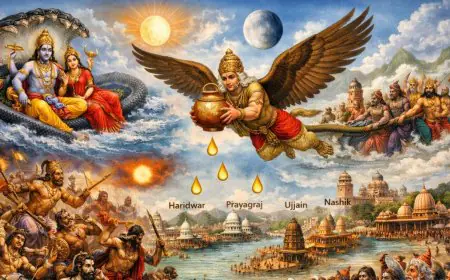
What Is the Story Behind the Ardh Kumbh Mela?
Read Guide →
The Untold Stories of Har Ki Pauri
Read Guide →
Ardh Kumbh 2027 Dates (Official) - Haridwar Snan Schedule
Read Guide →
Dharamshala Stay During Ardh Kumbh: Free & Budget Guide
Read Guide →
Official Progress Report of Haridwar Ardh Kumbh 2027 Infrastructure Projects
Read Guide →
Where to Find 24-Hour Pharmacies in Haridwar During Ardh Kumbh 2027 Emergencies
Read Guide →The Unifying Rivers: Sacred Waters That Know No Boundaries 🌊
The spiritual map of the Kumbh is drawn in water. Each of the four sites is anchored by a sacred river: the Ganga, the Yamuna, the Shipra, and the Godavari. These rivers are not just physical bodies; they are living goddesses, and they form a sacred hydrography that binds the subcontinent together. The Ganga, originating in the Himalayas and flowing to the Bay of Bengal, is the central axis. The Godavari, rising in the Western Ghats and flowing east to the Bay of Bengal, is often called the "Dakshin Ganga"—the Ganga of the South. By including the Godavari at Nashik, the Kumbh explicitly extended its spiritual map into the Deccan, ensuring that the south was not a peripheral region but an integral part of the sacred landscape.
This sacred hydrography created a map that was fluid, literally and metaphorically. The rivers did not respect political borders. They flowed through kingdoms and empires, carrying the stories of the Kumbh with them. A pilgrim bathing in the Godavari at Nashik during the Kumbh knew that they were participating in the same cosmic event as a pilgrim bathing in the Ganga at Haridwar. The water was different, but the grace was the same. This was a radical and unifying idea. It meant that a farmer in Maharashtra did not have to travel a thousand miles to the Ganga to receive the Kumbh's blessing. The sacred map had come to him. The Kumbh created a spiritual map where the entire hydrological system of India became a single, interconnected network of grace, with the four Kumbh sites as its pulsating nodes.
The Akhara Network: A Monastic Internet Across the Subcontinent 🔱
A hidden layer of India's spiritual map was woven by the great akhara orders, the monastic warrior-sadhu lineages that are the institutional backbone of the Kumbh. Established and formalized by Adi Shankaracharya in the 8th century, the Dashanami akharas, along with the later Vaishnava and Udasin orders, created a pan-Indian network of monasteries, training centers, and branch camps. The akharas were not confined to the four Kumbh sites. They had a permanent, distributed presence across the subcontinent, from the Himalayan caves to the southern mathas. Their wandering sadhus were the living threads that connected the entire spiritual map.
These akhara sadhus were in constant, slow motion. They would walk from their parent monastery to the Kumbh, stopping at villages and towns along the way, teaching, blessing, and collecting alms. They were the original communication network, carrying news, philosophical ideas, and spiritual practices from one end of India to the other. The Kumbh was their grand general assembly, where the distributed network would physically converge, exchange information, resolve disputes, and then disperse again, refreshed and re-synchronized. This akhara network ensured that the spiritual map of the Kumbh was not a static image but a living, breathing, constantly updated web of human relationships and sacred knowledge. It was a spiritual internet, millennia old, with the Kumbh as its central server.
The Pandas and the Vahis: Personalizing the Sacred Map 📜
The spiritual map of the Kumbh was made deeply personal by the pandas, the hereditary pilgrim priests, and their remarkable genealogical registers, the vahis. A family from a remote village in Karnataka would have a specific panda at Prayagraj, whose family had served their family for generations. The panda's vahi recorded the visits of their ancestors, connecting the family's personal lineage directly to the sacred geography of the Sangam. This created a profound, emotional bond between a specific place on the map and a specific family line.
This genealogical mapping was a stroke of genius. It meant that every family that attended the Kumbh became a node in the spiritual map, permanently linked to one of the four sites. The map was not just an abstract concept of holy places; it was populated by millions of real people, each with a recorded history of pilgrimage. The pandas themselves were expert geographers of the sacred. They knew the routes, the safe havens, and the local customs of every region from which their pilgrim families came. The Kumbh’s spiritual map was thus a living atlas, one that was intimately connected to the ancestral memory of countless families across the subcontinent.
The Mythological Cartography: Stories That Shaped the Land 🎭
A map is not just a collection of places; it is a collection of stories about those places. The Kumbh Mela's spiritual map is richly layered with mythological narratives that explain why a particular bend in a river, a specific ghat, or a seemingly ordinary field is, in fact, a cosmic portal. The story of the Samudra Manthan and the drops of amrit is the master narrative, but each of the four sites has its own dense web of local legends. Prayagraj is the Tirtharaj, the king of pilgrimage places, where Brahma performed the first yagya. Haridwar is the Gateway to Hari (Vishnu), the place where the Ganga descended to earth through the matted locks of Shiva. Ujjain is the ancient city of Mahakal, the lord of time, and a prime meridian for Hindu astronomy. Nashik is where Rama, Sita, and Lakshmana lived during their exile, and where the Godavari was brought to earth by the sage Gautama.
These stories function as sacred coordinates. They tell the pilgrim not just where to go, but why the place is holy, what happened there, and how to properly engage with its power. A pilgrim arriving at the Godavari in Nashik is not just looking at a river; they are stepping into the epic of the Ramayana. This mythological cartography gave the land a meaning and a sacred density that no political map could ever achieve. The Kumbh Mela became the great storytelling event, where these local legends were constantly retold and reinforced, ensuring that the spiritual map remained vividly alive in the collective imagination for generation after generation.
The National Pilgrimage: Forging the Idea of Bharatavarsha 🇮🇳
Centuries before the political unification of India, the Kumbh Mela had already united it in the spiritual imagination. The concept of Bharatavarsha, a sacred land extending from the Himalayas to the oceans, was not a political slogan. It was a lived reality for the pilgrim who walked from the Godavari to the Ganga, from the Shipra to the Sangam. The Kumbh provided the experiential proof that this vast, diverse land was a single, coherent, holy entity. The four Kumbh sites acted as the four corners of a sacred mandala, a geographic yantra that encompassed the entire subcontinent.
This sense of national pilgrimage was a powerful force for unity in a land of fragmented kingdoms. A pilgrim from the Chola kingdom in the south and a pilgrim from a Rajput kingdom in the north would meet at the Sangam, bathe in the same water, and recognize each other as part of the same spiritual family. The Kumbh created a shared identity that transcended language, caste, and regional loyalty. It was the original Indian Union, not of politics, but of faith. When the modern Indian state was formed, it inherited a subcontinent that, on a deep, popular level, was already unified by the sacred geography that the Kumbh had so brilliantly and persistently woven. The political map was simply overlaid upon a much older and more deeply felt spiritual one.
The Map That Lives in the Heart
The tents of the Kumbh are temporary. The pontoon bridges are dismantled. But the spiritual map of India that the Kumbh Mela created is permanent. It lives in the heart of every pilgrim who has ever felt the pull of the sacred river. It lives in the songs of the bhajans that mention the four holy cities. It lives in the genealogical records of the pandas, in the oral traditions of the akharas, and in the collective memory of a civilization. The Kumbh did not just draw a map. It etched a sacred design into the soul of a people, a design so deep that even after centuries of political change, it remains the truest and most enduring map of India.
The next time you see a pilgrim walking, with their bundle on their head, toward one of the four great Kumbh sites, remember that they are not just traveling. They are tracing one of the oldest sacred routes on earth. They are reaffirming a geography of grace that has held a civilization together for millennia. The Kumbh Mela is not just an event on a map. It is the event that made the map sacred, turning the whole vast, beautiful, chaotic subcontinent into a single, luminous, and interconnected home for the human spirit.
Frequently Asked Questions