




























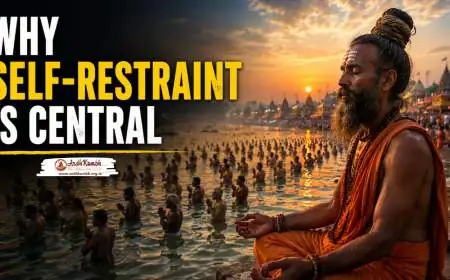














































What Makes Ardh Kumbh Spiritually Demanding
Discover what makes Ardh Kumbh spiritually demanding. From physical exhaustion and sensory overload to emotional purging and the dark night of the soul, learn why the pilgrimage's tests are its greatest gifts.

The Body's Trial: Why Physical Exhaustion Is a Spiritual Prerequisite 💪
The spiritual demand of the Ardh Kumbh begins with the body. You will walk ten, fifteen, sometimes twenty kilometers a day on uneven ground, in the cold, often in the dark. You will wake at three in the morning, shivering, and force yourself out of whatever warmth you have managed to find. You will stand in freezing water until your skin burns and your breath stops. You will carry everything you need on your back. This is not incidental hardship. It is a deliberate, time-tested technology of transformation. The body, pampered by modern life, is the ego's first and most powerful fortress. When the body is tired, cold, and hungry, the ego's constant demands for comfort and its illusions of control begin to crumble. The physical exhaustion of the pilgrimage is a form of sacred tapas, a spiritual fire that burns away the superficial layers of resistance and leaves the pilgrim raw, open, and strangely receptive.
This physical demand teaches a profound lesson: you are not your body. When your legs ache and every step is a negotiation with pain, you discover that you can continue. Something deeper than the physical—a will, a faith, a stubborn soul—takes over. This is a revelation that no amount of gym training can provide. The Kumbh's physical challenge forces you to locate a source of strength that you did not know you possessed. The long walk to the Sangam is a meditation in motion. The cold water is a baptism that kills the old, comfort-addicted self and births a new, more resilient one. The spiritual demand of the body is not a punishment. It is an initiation. It is the body itself becoming a prayer, an offering of sweat and shivering endurance laid at the feet of the divine.
The Mind's Battlefield: Navigating the Fog of Sensory Overload 🌫️
If the body is tested by exhaustion, the mind is tested by an unrelenting assault on the senses. The Ardh Kumbh is the most intense sensory environment on earth. The noise is constant: temple bells, loudspeakers, chanting, shouting, crying, laughing. The smells are a dizzying mix of incense, woodsmoke, flowers, sweat, and river mist. The visual field is a kaleidoscope of colors, processions, and a sea of faces stretching to the horizon. The physical crush of the crowd eliminates all personal space. For a mind accustomed to the curated, quiet, and controllable environments of modern life, this is a profound and disorienting shock. The spiritual demand here is to find a center of stillness within the chaos, to practice pratyahara—the yogic withdrawal of the senses—not in a quiet cave, but in the heart of a roaring tempest.
This is the mind's battlefield. The constant temptation is to become overwhelmed, to mentally shut down, to react with irritation, or to simply flee. The spiritual work is to witness the chaos without being consumed by it. The pilgrim learns to walk through the crowded lanes as if in a bubble of silent meditation. They learn to hear the sacred syllable "Om" hidden beneath the cacophony. The demand is to discipline the attention, to keep the mind fixed on the sankalpa—the sacred intention—rather than on the distracting, ever-changing surface of the Mela. This is a skill that is far more difficult to develop than any physical endurance. It is the training of the inner warrior, and the Kumbh provides the ultimate training ground. The noise is the distraction, and the task is to find the silence. The chaos is the illusion, and the task is to see the underlying, divine order.
Trending Guides Now

Is Ardh Kumbh a Once-in-a-Lifetime Experience?
Read Guide →
Can Ardh Kumbh Change Your Life Priorities?
Read Guide →
What Makes Ardh Kumbh Spiritually So Powerful?
Read Guide →
Is Ardh Kumbh Mentioned in the Puranas?
Read Guide →
Ardh Kumbh 2027 Dates (Official) - Haridwar Snan Schedule
Read Guide →
Dharamshala Stay During Ardh Kumbh: Free & Budget Guide
Read Guide →
Official Progress Report of Haridwar Ardh Kumbh 2027 Infrastructure Projects
Read Guide →
Is October a Good Time to Visit Haridwar Before Ardh Kumbh 2027?
Read Guide →The Ego's Crucible: Annihilation in a Sea of Anonymity 🤲
Modern culture is an obsessive project of ego-construction. We build personal brands, curate social media profiles, and chase achievements to prove our specialness. The Ardh Kumbh is a demolition crew for this elaborate structure. In the vast, anonymous crowd of millions, your identity dissolves. Your job title, your social status, your wealth, your carefully crafted image—none of it is visible, and none of it matters. You are just one dark shape among millions, moving toward the river. This is a profound and terrifying spiritual demand. The ego, which thrives on differentiation and recognition, suddenly finds itself out of work. It screams in panic. It tries to reassert itself through comparison, judgment, or a desperate clinging to any marker of identity. But the Mela is relentless. The crowd has no interest in who you are. The river does not ask for your business card.
This ego dissolution is one of the hardest but most liberating aspects of the pilgrimage. The demand is to let it happen, to surrender the need to be someone important, and to discover the strange, weightless freedom of being nobody in particular. For a few sacred days, you can exist not as the character in your personal drama but as a soul among souls. The peace of anonymity is a revelation. You are not special, and that is a profound relief. The spiritual demand of the ego's crucible is to allow this false self to be stripped away, trusting that what remains—the silent, witnessing awareness beneath the persona—is your true, indestructible essence. The Kumbh does not just teach you about egolessness; it shoves you into an experience of it, and that experience, though initially terrifying, is ultimately the most liberating gift the pilgrimage offers.
The Emotional Purge: Facing the Inner Storms You Avoid 🌧️
The combination of physical exhaustion, sensory overload, and ego-dissolution creates the perfect conditions for a deep, often unexpected, emotional purge. Stripped of your usual coping mechanisms—work, entertainment, social media, comfort food—the buried grief, anger, and fear you have been carrying for years begin to surface. A pilgrim might find themselves weeping uncontrollably during the evening aarti, not from sadness but from a sudden, inexplicable release. An old, forgotten wound may resurface with vivid intensity. Irrational irritation or profound anxiety may grip you in the middle of a crowd. This is not a sign that something is wrong. It is the samskara shuddhi, the purification of deep mental impressions, that the pilgrimage is designed to facilitate.
The spiritual demand here is immense. It requires the courage to feel what you have spent a lifetime avoiding. The demand is not to suppress the emotion, not to judge it, and not to create a dramatic story around it. The demand is to simply let it move through you, like a storm passing over the river. The Kumbh provides a vast, non-judgmental container for this release. The river will carry your tears. The collective devotional energy will hold the space for your healing. The pilgrim who can sit with their own pain, without running from it, is doing some of the most difficult and important spiritual work a human being can do. The emotional demand is the demand to feel, to heal, and to let go. The grace of the Kumbh is that it gives you the strength to do this, washing you clean not just of physical dirt but of the toxic emotional residue of a lifetime.
The Dark Night of the Pilgrim: When Faith Itself Is Tested 😔
For many pilgrims, the spiritual demand reaches its peak in a moment of profound inner crisis. This is the "dark night of the soul" on the pilgrimage. After the initial excitement has faded, after the body is exhausted and the mind is overwhelmed, a deep sense of doubt, emptiness, or meaninglessness may descend. The pilgrim may look at the Rituals and feel nothing. They may question why they came, what they believe, and whether any of it is real. The sacred water may feel like just cold water. This is a terrifying experience, and many pilgrims believe they have failed the pilgrimage when it happens. But the tradition understands this as a sacred, necessary passage. It is the final, deepest purification: the death of spiritual expectation.
The spiritual demand of the dark night is to persist when all the pleasurable feelings of devotion have vanished. It is to continue walking, continue bathing, and continue offering prayers not because you feel like it, but because you have made a commitment. This is faith stripped of all sentimentality, reduced to its bare, essential core: the simple, stubborn act of showing up. The demand is to sit with the emptiness and not run away to fill it with distractions. This is the most difficult test of all, but it is the one that yields the most lasting fruit. The pilgrim who passes through the dark night and continues to the river's edge emerges with a faith that is not dependent on good feelings. It is an unshakeable, grounded trust, tempered in the fire of doubt, that becomes a permanent, quiet anchor in the soul.
The Demand of Surrender: Letting Go of the Illusion of Control 😌
Underlying all the other demands—physical, mental, emotional, and spiritual—is a single, overarching requirement: the demand of surrender. The modern self is built on the illusion of control. We plan, we optimize, and we manage our lives as if we were the CEOs of our own destiny. The Ardh Kumbh systematically dismantles this illusion. You cannot control the crowd. You cannot control the weather. You cannot control when the akhara procession passes or when the food is served. Your carefully planned itinerary will fall apart. Your expectations will be shattered. The pilgrimage will not conform to your will. The spiritual demand is to stop fighting this reality and to surrender to it. To let go of the need to orchestrate your experience and trust that the river, the tradition, and the divine know what you need better than your anxious, planning mind.
This surrender is not passive resignation. It is an active, conscious release. It is the decision to flow with the sacred current rather than exhausting yourself by swimming against it. The pilgrim who learns to accept the long wait, the unexpected detour, and the plan that fell apart, with a calm and open heart, has learned one of the most profound lessons of the spiritual life. The demand of surrender is the demand to trust that you are held by something larger than yourself. The Kumbh is the great teacher of this trust. It places you in a situation where you have no choice but to let go, and in that letting go, you discover a peace that all your controlling efforts could never produce. The river flows, and it will carry you where you need to go. Your only task is to stop paddling.
Practical Strategies for Meeting the Spiritual Demands ✅
To navigate the spiritual demands of the Ardh Kumbh without breaking, you need both inner resolve and practical wisdom. First, prepare your body well in advance. The spiritual journey is made infinitely harder by a body that is shocked by the sudden demands. Walk daily, acclimate to cold water, and build your stamina. Second, anchor your mind with a simple, portable practice. A short mantra, a prayer, or simply watching your breath can be your lifeline in moments of overwhelm. When the chaos peaks, return to this anchor. Third, set a single, clear sankalpa (sacred intention) and let everything else be secondary. Your sankalpa is your compass. When you feel lost, exhausted, or empty, remember why you came.
Fourth, manage your energy, not your time. The Kumbh is a marathon. Prioritize rest and nourishment. Do not try to see everything. A short, peaceful snan followed by an hour of quiet sitting by the river is worth more than a frantic day of running between ghats. Fifth, find your sangha, even if it is just one other pilgrim. Sharing the burden of the journey makes the spiritual demand feel lighter. Sixth, and most importantly, be kind to yourself. The pilgrimage is not a contest of spiritual endurance. You are not a failure if you need to rest, if you skip a crowded day, or if you struggle with doubt. The divine Mother does not judge her tired children. The spiritual demand of the Kumbh is immense, but so is the grace. Trust that you are exactly where you need to be, and that the pilgrimage is working on you, even—and perhaps especially—when it feels like it is breaking you.
The Gift Hidden Inside the Demand
The Ardh Kumbh is spiritually demanding because it is a compressed, intense version of the spiritual path itself. It strips away the non-essential, burns away the ego, and forces a direct confrontation with the self. It is a pilgrimage that asks everything of you, and in return, it offers everything. The exhaustion of the body, the chaos of the mind, the purging of the emotions, and the dark night of the soul are not obstacles to the pilgrimage. They are the pilgrimage. They are the sacred fire that transforms the raw ore of the soul into gold. The pilgrim who has walked those miles, shivered in that water, wept those tears, and faced that emptiness returns home not with a simple memory of a nice trip, but with an unshakeable core of peace, resilience, and self-knowledge.
The spiritual demand of the Ardh Kumbh is the price of this transformation. And the secret, which every veteran pilgrim knows, is that the demand itself is a form of grace. The hardship is not a punishment. It is the loving, firm hand of the divine Mother, stripping away everything that stands between you and your own liberation. The river is cold so that you may feel truly alive. The crowd is dense so that you may discover your connection to all beings. The night is dark so that you may learn to trust the coming dawn. The Ardh Kumbh is not for the faint of heart. It is for the soul that is ready to be reborn.
Frequently Asked Questions