The Sacred Gaze: How the Divine Witness Enforced Righteousness 👁️
The foundation of moral order at the Ardh Kumbh was not a system of punishments but a deeply internalized awareness of being watched by the divine. The pilgrim who walked toward the Sangam did so under the silent, all-seeing gaze of the Ganga Ma, the sun, and the stars that had aligned to sanctify the moment. This was not a fear of a punishing god but a profound sense of being in the presence of a sacred witness. When you stand at the edge of the holy river, about to perform the most sacred act of your life, the voice of your own conscience becomes thunderous. The minor dishonesties, the unkind words, the hidden resentments of the past year—all of them rise to the surface, not because a policeman has caught you, but because the river sees you. This internal regulation was the most powerful force for moral order at the Kumbh. The pilgrimage itself was a ritual of confession and purification, and the pilgrim arrived with a heart already inclined toward righteousness.
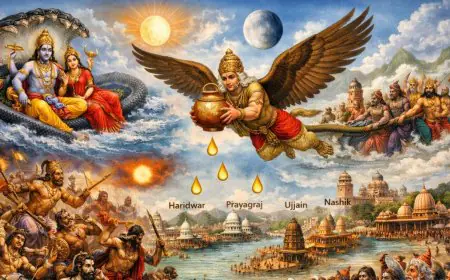
This sacred gaze was reinforced by the very geography of the Mela. The river was the central axis, and every step toward it was a step away from the mundane world and its compromises. The closer you came to the water, the more the invisible pressure to be your best self intensified. The story of the Samudra Manthan, the cosmic churning, reminded every pilgrim that the drops of amrit had sanctified this ground, and to act with impurity here was to invite a cosmic imbalance. The moral order of the Kumbh was a participatory act. You were not obeying a law; you were aligning yourself with the sacred order of the universe. The river was the judge, the sun was the witness, and your own heart, in its quietest moments, was the jury.
The Akhara and the Sadhu: Living Models of Righteous Conduct 🔱
The akhara camps were the visible anchors of moral order at the Kumbh. Here lived the sadhus, the living embodiments of a life governed entirely by spiritual discipline. Their ash-smeared bodies, their simple possessions, their vow of non-violence and truthfulness, and their dedication to a life of renunciation were not just personal choices; they were a public, daily sermon on the possibility of a righteous life. The presence of these holy men and women, some of whom had not spoken a word or committed a single act of selfishness in decades, acted as a powerful moral compass for the entire Mela. A pilgrim who might be tempted to cut a queue or speak harshly would see a silent, meditating naga baba and feel a sudden, sharp awareness of their own pettiness. The sadhus were the spiritual aristocracy, and their moral authority was immense.
The akhara system also provided a model of self-governance. Disputes within an akhara were settled by the Mahant or a council of senior sadhus, according to the ancient traditions of the order. This demonstrated a functional, just system of resolving conflict without resorting to external authorities. For the lay pilgrim, the akharas were proof that a community could regulate itself through shared values and a commitment to Dharma. The warrior-sadhus, the nagas, while fearsome in their martial aspect, were bound by a strict code of honor. Their role as protectors of the pilgrimage was itself a moral act, a defense of the sacred. The akharas modeled a society where power was not used for personal gain but for the protection of the spiritual quest of every soul.
The Bhandara: The Great Equalizer That Dissolved Social Sin 🍚
Much of the disorder in the ordinary world is born of inequality, resentment, and the desperate struggle for resources. The Ardh Kumbh addressed this at the root through the institution of the bhandara, the free community kitchen. When a millionaire and a landless laborer sit side by side on the same cold earth, eating the same simple dal and roti from the same type of leaf plate, the hierarchies that breed social sin are temporarily dissolved. Envy, theft, and competition for status lose their meaning. The bhandara was a daily, practical lesson in the Upanishadic truth that the same divine self resides in all beings. Feeding a stranger was not charity; it was worship. And the stranger who received the food knew they were being honored, not pitied.
This radical equality was a cornerstone of the Kumbh's moral order. It removed the desperation that drives so much of human wrongdoing. No one starved. No one was turned away. The immense logistical feat of feeding millions, performed by volunteers and donors without any expectation of return, was a powerful demonstration of a society built on generosity rather than greed. The pilgrim who ate at a bhandara was participating in a sacred transaction that reoriented their moral compass. They learned, through a full stomach and a grateful heart, that sharing is not a loss but a profound joy. The bhandara was the Kumbh's most effective school of ethics, teaching compassion, humility, and the sacred dignity of every human being without uttering a single word of doctrine.
The Public Witness: How Shame and Honor Regulated Conduct 👀
In the vast, anonymous crowd of the Kumbh, a paradox emerged: you were completely unknown, yet your actions were constantly on display. The dense, interwoven nature of the Mela meant that every act of kindness or cruelty was witnessed by a multitude. A young man who helped an elderly pilgrim was seen, and the quiet nod of approval from a passing sadhu or a fellow pilgrim was a powerful reinforcement of his good deed. Conversely, a person who tried to cheat a vendor or shove their way through a queue was met with a thousand silent, disapproving stares. The collective gaze of the Mela was a powerful regulator of conduct. There were no hidden corners in the temporary city, and the fear of public shame was a far more effective deterrent than any police baton.
This community enforcement of moral order was gentle but pervasive. It was not a mob justice of violence but a quiet, collective expression of what was and was not acceptable in this sacred space. The Kumbh had its own unwritten code of honor. Theft, violence, and disrespect were simply unthinkable, not because they were against a posted rule, but because they were a violation of the sacred purpose that united everyone. The pilgrim knew, instinctively, that a dishonest act at the Kumbh was not just a crime against a person; it was a desecration of the holy ground itself. This internalized sense of the sacred, reinforced by the silent witness of the crowd, created a self-regulating community far more effective than any system of external control.
The Sankalpa: The Personal Vow That Aligned the Individual With the Good 💭
At the heart of every pilgrim's journey was the sankalpa, the sacred vow or intention made at the moment of the snan. This was a deeply personal, formal commitment to a path of righteousness. A pilgrim might vow to give up a destructive habit, to forgive a family member, to speak only truth for a year, or to perform a specific act of charity. The sankalpa was not a casual wish; it was a solemn promise, made in the presence of the divine, the river, and the cosmos. This vow transformed the pilgrim from a passive recipient of grace into an active agent of their own moral reform. The Ardh Kumbh preserved moral order by facilitating millions of these individual, private revolutions of the heart.
The beauty of the sankalpa was its personal and voluntary nature. It was not imposed by a priest; it was chosen by the individual. This made it far more powerful and enduring than any externally enforced rule. The pilgrim who had vowed to speak truthfully for a year carried the Kumbh's moral force with them long after they left the ghats. They became a walking ambassador of the pilgrimage's ethical order in their own village. The sankalpa was the seed of a more righteous life, planted in the fertile soil of the sacred moment, and the collective effect of millions of such seeds, planted at every Kumbh, was a slow, steady renewal of the moral fabric of the entire society.
The Oral Tradition of Moral Stories: The Itihasa and Purana as Ethical Guides 📜
The nights at the Kumbh are filled with stories. The Ramayana and the Mahabharata, the tales of the Puranas, and the lives of the saints are narrated by pandits, sadhus, and grandmothers to wide-eyed pilgrims of all ages. These are not just entertainments. They are the carriers of the civilization's moral order. The story of Rama's unwavering commitment to truth, even in the face of immense personal loss, is a lesson in integrity. The tale of Yudhishthira's struggles with dharma is an advanced course in ethical complexity. The simple, powerful songs of Kabir and Ravidas teach that caste is a lie and that only a pure heart matters. The Kumbh was the great, recurring festival of this moral education.
This oral tradition preserved and transmitted the ethical code of the civilization without a single textbook. The stories were memorable, emotionally resonant, and featured heroes and villains that a child could understand. They taught the consequences of adharma—of greed, of lying, of cruelty—not through abstract philosophy but through gripping narrative. The pilgrim who heard the story of Harishchandra, the king who gave up everything for truth, was imprinted with a lifelong model of righteous conduct. The Kumbh ensured that every generation was re-exposed to these foundational moral narratives, refreshing the collective conscience and reinforcing the shared values of compassion, honesty, and duty that held the society together.
The River as the Final Arbiter of Truth and Purity 🌊
Ultimately, the moral order of the Ardh Kumbh rested on the simplest and most powerful belief: that the river was a living goddess who saw and purified all. You could deceive a police officer. You could hide your sin from your neighbors. But you could not hide it from the Ganga. This belief, held with absolute sincerity by millions, was the ultimate regulator of conduct. The pilgrim who immersed themselves in the sacred water believed, with every fiber of their being, that their inner impurities—their greed, their lust, their anger, and their dishonesty—were being washed away. But this purification was not automatic. It required a genuine inner act of contrition and a sincere resolve to be better. The river purified those who came to her with a pure heart, and for those who harbored secret malice, the bath was a confrontation they could not escape.
The Ardh Kumbh preserved moral order by making this direct, personal encounter with the divine the central event of the pilgrimage. The snan was the great equalizer and the great confessional. There were no VIP lines to a cleaner conscience. Everyone, from the king to the beggar, stood equally naked and vulnerable before the mother. This shared vulnerability, and the shared aspiration to be cleansed, created a profound sense of moral solidarity. The river was the ultimate guarantor of justice, and her silent, flowing presence ensured that the moral order of the Kumbh was not a human construct but a divine reality, as eternal and as undeniable as the water itself.
The Gathering That Taught a Civilization How to Be Good
When the tents are folded and the pilgrims depart, the moral order of the Ardh Kumbh does not vanish. It flows back into the villages and cities of India, carried in the hearts of millions who have been reminded of what it means to be good. The pilgrimage is a periodic, powerful reset of the collective moral compass, a time when a civilization gathers on the banks of its sacred rivers and recommits itself to the ancient, simple, and eternal values of truth, compassion, generosity, and self-discipline. The Kumbh proves that a large, complex human society can regulate itself not through force but through a shared sacred purpose, a living tradition of righteousness, and the unshakeable belief that the divine sees all, loves all, and calls every soul, without exception, toward the light of the good.