


























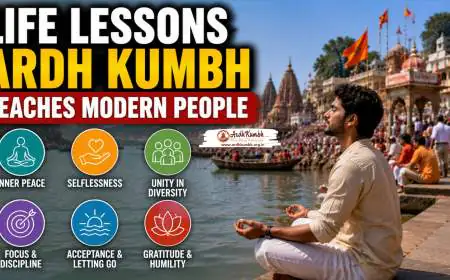







































Can Ardh Kumbh Reshape Daily Living
Discover how Ardh Kumbh can reshape daily living. Explore how the pilgrimage's simplicity, silence, and discipline transform your home routine, priorities, and inner peace long after you leave the Sangam.

The Morning Anchor: Bringing the Brahma Muhurta Home 🌅
At the Kumbh, your day began in the Brahma Muhurta, the auspicious pre-dawn hour when the mind is naturally still and the veil between the worlds is thin. You woke not because an alarm forced you but because the entire city of tents was stirring with a single, sacred purpose. You walked through the cold mist toward the river, and that walk became a meditation. The first and most powerful way the Ardh Kumbh reshapes daily living is by permanently altering your relationship with the morning. You have experienced, in your own body, the profound peace of the early hours. You know, now, what the sages meant when they said that the time before dawn is the most spiritually potent of the entire day. This knowledge does not leave you. When you return home, the old habit of sleeping until the last possible moment, of starting the day in a frantic rush of notifications and caffeine, begins to feel deeply unsatisfying. You have been given a template for a different kind of morning, and you find yourself naturally drawn to recreate it.
This does not mean you must wake at 3 AM every day and walk miles in the dark. The reshaping is gentler and more sustainable than that. It begins with waking just thirty minutes earlier than you used to, and dedicating that sacred time to silence. You might sit with a cup of tea and simply breathe, watching the sky lighten. You might read a few verses of a sacred text, or repeat the mantra that echoed in your mind at the Sangam. The key is not the specific practice but the intention: to begin the day from a center of stillness, not from the reactive chaos of the world. The morning ritual you brought back from the Kumbh is an anchor. It is a daily act of rebellion against the tyranny of urgency. It tells your mind, every single day, that the first moments belong to the soul, not to the inbox, and that single shift in priority has the power to transform the entire architecture of your life.
The Simplicity That Sticks: Living With Less, Feeling Richer 🏠
You returned from the Kumbh to a home filled with things. Closets of clothes you had forgotten you owned. A refrigerator of choices. Screens in every room. And for the first few days, all of it felt slightly obscene. Not because you had become an ascetic but because the pilgrimage had shown you, with undeniable clarity, how little you actually need to be deeply, genuinely content. You lived for days with a single bag. You wore the same warm layers. You ate the same simple, sattvic food from a leaf plate, and it tasted extraordinary because you were hungry and present. This experience of radical simplicity is one of the most powerful ways the Ardh Kumbh reshapes daily living. It dismantles the consumerist programming that has been running in your subconscious since childhood. You have seen, with your own eyes, that the richest you have ever felt was when you owned almost nothing, surrounded by millions of people who were also owning almost nothing, and everyone was fed, everyone was warm enough, and everyone was smiling.
The reshaping happens in the slow, quiet clearing out that follows. You find yourself opening your closet and wondering why you need so many choices. You start giving things away—not out of guilt but out of a genuine, joyful sense that they are burdens, not treasures. You simplify your meals, finding deep satisfaction in a simple khichdi or a bowl of dal that reminds you of the bhandara. You unsubscribe from the endless marketing emails, turn off the non-essential notifications, and begin to curate your environment with the same intentionality that the Kumbh curated your pilgrim existence. This is not a grim, self-denying minimalism. It is a liberation. The Kumbh taught you that joy is not found in accumulation but in presence, and every possession you release is a little bit of that presence you reclaim.
Trending Guides Now

What Makes Ardh Kumbh Spiritually So Powerful?
Read Guide →
Can Ardh Kumbh Shape Your Daily Discipline? A Journey That Lasts Longer Than the Dip
Read Guide →
What Ardh Kumbh Symbolizes in Sanatan Dharma
Read Guide →
Why Ardh Kumbh Becomes a Turning Point in Life
Read Guide →
Best Routes to Reach Haridwar for Ardh Kumbh Mela
Read Guide →
Ardh Kumbh 2027 Dates (Official) - Haridwar Snan Schedule
Read Guide →
Why Zone Awareness Will Matter in 2027
Read Guide →
Is It Safe to Attend Ardh Kumbh Alone
Read Guide →The Priority Reset: What the Cold Water Taught You About Time 💧
The freezing water of the Sangam did more than cleanse your body. It shocked your mind into a state of pure, involuntary presence. In that moment, every worry about the past and every anxiety about the future were extinguished. There was only the cold, only the breath, only the sacred water. This is the ultimate lesson in priority. The Ardh Kumbh reshapes daily living by giving you a visceral, unforgettable reference point for what truly matters. The promotion you were obsessing over, the grudge you were nursing, the hours you were losing to mindless scrolling—all of it was stripped away in that single, gasping instant of total presence. And when you emerged, you knew, in your bones, that most of what you had considered urgent was simply noise.
This priority reset manifests in the weeks and months after your return. You find yourself saying no to commitments that drain you, not out of laziness but out of a clear-eyed recognition that your time is sacred. The long walk to the ghat taught you that slowing down is not laziness; it is the only way to notice that you are alive. You start carving out unstructured time in your day, time that is not dedicated to productivity but to simply being. You sit with your children without checking your phone. You take a walk without a destination. You understand, finally, that the most important things in life—love, presence, peace—cannot be scheduled or optimized. They are available only when you create the space for them, and the Kumbh gave you the courage to create that space.
The Silence That Traveled Home With You 🧘
In the midst of the roaring, chaotic, magnificent noise of the Kumbh, you found a silence you had never known existed. It was not the silence of an empty room but the silence of a still mind, a quiet that existed beneath the chanting, the bells, and the ceaseless shuffle of millions of feet. You sat by the dhuni fire, watching the flames, and the internal monologue that had been your constant companion for as long as you could remember simply fell away. The Ardh Kumbh reshapes daily living by making this silence portable. You carry it home with you, a secret sanctuary that is always available. In the middle of a stressful meeting, in the chaos of the family dinner, in the lonely hours of the night, you can close your eyes, take a breath, and return to that stillness by the river. It is a permanent acquisition, a skill your soul learned in the intense training ground of the Mela.
You begin to build small silences into your day. You turn off the car radio on your commute. You eat one meal in silence, tasting each bite. You sit for five minutes on the edge of your bed before sleep, simply breathing. These are not grand spiritual disciplines; they are the practical, daily expressions of the peace you found at the Kumbh. They are the acknowledgment that silence is not an absence but a presence, a living, nourishing reality that is your true nature. The pilgrimage gave you a direct experience of this silence, and your daily life becomes the practice of returning to it, again and again, until the silence is no longer a place you visit but the very ground of your being.
The Bhandara Spirit: How Serving Others Became a Daily Practice 🤲
At the Kumbh, you sat in long rows on the cold ground and ate the same food as a million strangers, served by volunteers who looked you in the eye and offered the meal as a blessing. You were not a customer; you were a pilgrim receiving grace. And perhaps, for an hour or a day, you became the server, ladling dal into outstretched bowls, feeling the quiet joy of being useful without expectation of reward. This experience of seva, of selfless service, is one of the most powerful ways the Ardh Kumbh reshapes daily living. It awakens a hunger that no amount of personal success can satisfy: the hunger to be of use, to contribute, to be part of something larger than yourself.
When you return home, this hunger does not fade. You find yourself looking for ways to serve, not out of duty but out of a genuine, quiet longing to recreate the spirit of the bhandara. You start volunteering in your community. You cook a meal for a sick neighbor. You listen, truly listen, to a friend in need, without offering advice, simply offering your presence. You give anonymously, without expectation of recognition. These acts of service become the anchors of your daily life, the moments that remind you that you are not an isolated self but a part of a vast, interconnected web of being. The Kumbh taught you that feeding another person is feeding the divine, and this sacred economics of grace reorients your entire relationship with the world.
The Sankalpa in Action: The Vow That Guides Your Days 💭
Before you entered the sacred water, you formulated a sankalpa, a sacred intention. It was not a casual wish but a formal vow, made in the presence of the divine, the river, and the cosmos. You may have vowed to let go of a resentment, to speak only truth, to dedicate time each day to meditation, or to serve a specific cause. The Ardh Kumbh reshapes daily living by anchoring this vow in the most powerful moment of your life. When the old habits return, when the world tries to seduce you back into forgetfulness, you have a secret weapon: the memory of the cold water, the fire of the aarti, and the silent, powerful commitment you made. The sankalpa is a compass that you can consult every morning, a guiding star that helps you navigate the countless small decisions that make up a life.
The reshaping happens in the daily recommitment to this vow. You write it down and place it where you will see it. You build your daily schedule around it. If your sankalpa was to meditate, you protect that time fiercely. If it was to practice patience, you use every traffic jam and difficult conversation as a training ground. The pilgrimage gave you the inspiration; the sankalpa gives you the daily discipline. This combination of sacred inspiration and practical commitment is what transforms a fleeting spiritual experience into a permanent, lived reality. The vow you made at the Sangam is a living thing, and it grows in power every time you honor it.
The Digital Detox That Became a Lifestyle 📵
At the Kumbh, your phone became almost irrelevant. The network was unreliable. The cold made you want to keep your hands in your pockets. And the sheer, overwhelming power of the present moment made the digital world seem pale, distant, and faintly ridiculous. You did not miss it. You felt, instead, a profound relief, a lightness that came from being liberated from the constant, low-grade anxiety of being perpetually online. The Ardh Kumbh reshapes daily living by giving you a taste of this freedom, and you return home with a new relationship with your devices. The hours of mindless scrolling no longer feel like relaxation; they feel like a theft.
The practical reshaping happens in the boundaries you set. You delete the most addictive apps from your home screen. You turn off all non-essential notifications. You establish sacred, tech-free zones in your home and in your day: the bedroom, the dinner table, the first hour after waking and the last hour before sleep. You begin to use technology as a tool, not as a master. This digital discipline, born from the enforced detox of the Kumbh, is one of the most tangible and powerful changes you bring home. It creates the space for the silence, the simplicity, and the presence that are the true gifts of the pilgrimage.
The Community You Build: Finding Your Sangha in the Ordinary World 👥
At the Kumbh, you were never alone. You were part of a vast, peaceful, and purposeful community, a temporary sangha of millions. This experience of belonging, of being held by a collective spiritual intention, was one of the most healing aspects of the pilgrimage. The Ardh Kumbh reshapes daily living by awakening a deep longing for authentic community, and you return home determined to find or create it. You seek out a local meditation group, a study circle, or a service organization. You prioritize relationships that are grounded in shared values and mutual support. You understand, now, that the spiritual path is not meant to be walked alone, and you actively cultivate the connections that will sustain your daily practice.
This does not mean you abandon your old friends. It means you bring a new quality of presence and intention to all your relationships. The patience you learned in the Kumbh's queues informs how you listen to your partner. The compassion you felt in the bhandara informs how you respond to a colleague's struggle. The Kumbh taught you that every human interaction is a potential moment of sacred connection, and you begin to treat the ordinary encounters of your daily life—the cashier, the mail carrier, the neighbor—with the same reverence you offered to fellow pilgrims at the Sangam.
The Everyday Pilgrimage: Living Each Day as a Sacred Journey 🕊️
The ultimate reshaping that the Ardh Kumbh offers is a fundamental shift in how you perceive your own life. You came to the Sangam as a pilgrim seeking a sacred destination. You return home understanding that the real pilgrimage was not the journey to the river but the inner journey the river initiated. And that inner journey does not end. Every morning is now a small Kumbh. The cold water of your shower is the snan, the simple meal is the bhandara, the traffic jam is the patient queue, and the challenging person is the guru who teaches you patience. Your entire life becomes the sacred geography, and every moment becomes an opportunity for presence, service, and grace.
This is not a delusion. It is a conscious, disciplined practice of seeing the sacred in the ordinary. The Kumbh stripped away the illusion that the divine is only found in special, faraway places. It showed you that the Ganga flows within you, that the dhuni fire burns in your own heart, and that the Sangam is the meeting point of every breath with the eternal. The pilgrimage reshapes your daily living by transforming you from a person who occasionally visits sacred places into a person who is a sacred place, a walking sanctuary of peace, carrying the river's quiet grace into every room you enter, every word you speak, and every life you touch.
Frequently Asked Questions