


































































How Kumbh Preserved India’s Spiritual Lineage
Discover how Kumbh preserved India’s spiritual lineage across millennia through guru-shishya parampara, oral Vedic transmission, and akhara initiations that kept the sacred knowledge alive, unbroken, and indestructible.

The Guru-Shishya Parampara: The Unbroken Chain of Souls 🔱
At the very core of how the Kumbh preserved India's spiritual lineage lies the guru-shishya parampara, the sacred teacher-disciple succession. This is not a system of education as the modern world understands it. It is a total transmission of being. A text can be read. A lecture can be heard. But a spiritual lineage—with its unique flavor of realization, its specific techniques, its accumulated subtle power—can only be passed from a living master to a living disciple. The guru does not just teach; they awaken. They transmit, through years of intimate proximity, the very state of consciousness that the lineage is meant to produce. The Kumbh is the grand gathering of these lineages. Within the akhara camps, the great mahants (abbots) and their successors are present, their relationships visible to all. A young novice who has been trained in a Himalayan cave will meet his guru's guru at the Kumbh, linking his personal practice to a chain of adepts that vanishes into the mists of prehistory.
This lineage transmission is what gives Indian spirituality its astonishing continuity. A mantra taught to a disciple at the Kumbh in 2025 was taught to his guru's guru at the Kumbh of 1965, and to his guru's guru's guru at the Kumbh of 1905. The same words. The same pronunciation. The same inner, silent realization that the words are meant to awaken. The written scriptures are a support, but the lineage is the living reality. The Kumbh is the place where the integrity of these thousands of independent lineages is publicly affirmed. A guru will present his disciple to the assembly of his peers, and that disciple is thereby recognized not just by his own master but by the entire spiritual community. This public, communal validation is one of the invisible but essential functions of the Kumbh. It ensures that the lineage is not a private, self-serving claim but a recognized link in a vast, unbroken, and sacred chain.
The Oral River: Vedic Transmission at the Confluence 🕉️
Before the written word became the dominant storage medium for human knowledge, the Kumbh Mela had already perfected a far more durable technology: the oral transmission of the Vedas. The spiritual lineage of India is, at its most ancient layer, a lineage of sound. The Vedic mantras are not ordinary language. They are considered to be shruti—that which is heard—eternal vibrations that were perceived by the rishis in states of profound meditation and have been passed down, flawlessly, through an unbroken chain of voices ever since. The Kumbh is the great verification event for this oral river. Vedic pandits from different regions, trained in different schools, gather at the Sangam and chant together. Their recitations, which utilize complex, interlocking patterns like the Jata and Ghana pathas, act as a built-in error-correction system. A single mispronounced syllable in a thousand-hour recitation would be instantly detected and corrected.
This oral preservation of lineage is why the Vedas still exist in their pristine form after thousands of years. Libraries have been burned. Empires have fallen. But the sound, living in the breath and memory of the trained human voice, has proven indestructible. The Kumbh is the place where this distributed oral network synchronizes. A young student hears the perfect Ghana recitation from a master from the opposite end of the subcontinent, and his own practice is purified and perfected in that moment. The lineage of sound is directly, physically transmitted. This is why, when you hear the chanting of the Rudram or the Gayatri at the Kumbh, you are not listening to a performance. You are listening to a living fossil of human consciousness, a sound that has been traveling, without a single deviation, for over three thousand years. The Kumbh is the guarantee that this sacred sound will continue to travel for another three thousand.
Trending Guides Now

History of Ardh Kumbh Mela From Samudra Manthan to Modern Times
Read Guide →
How Saints and Sadhus Define the Ardh Kumbh Tradition
Read Guide →
Why Saints Are Called Living Archives of Kumbh
Read Guide →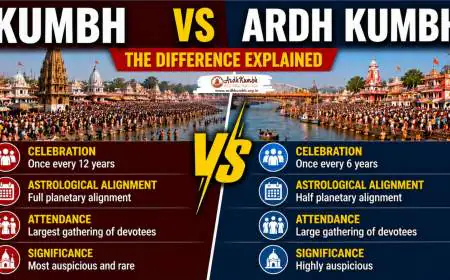
Kumbh vs Ardh Kumbh: The Difference Explained
Read Guide →
Best Routes to Reach Haridwar for Ardh Kumbh Mela
Read Guide →
Ardh Kumbh 2027 Dates (Official) - Haridwar Snan Schedule
Read Guide →
How Kumbh Protected Knowledge Without Books
Read Guide →
How Ardh Kumbh Unified Diverse Sampradayas
Read Guide →The Akhara Initiations: Where Spiritual Birth Replaces Social Birth 🔱
The great akhara orders, the warrior-monastic communities that form the institutional backbone of the Kumbh, preserve a particular kind of lineage: the lineage of sannyasa, of total renunciation. When a young man or woman is initiated into an akhara at the Kumbh, they undergo a radical transformation. Their old self—their birth name, their caste, their family, their social identity—is ritually destroyed. They are given a new name, a new lineage, and a new guru. They are reborn, not of a human mother and father, but of the Vedas and the sacred fire. This initiation (diksha) is the most powerful mechanism for the preservation of spiritual lineage. It severs the initiate's connection to the mundane world and grafts them directly onto the living tree of their akhara's spiritual ancestors.
The akhara lineages are meticulously maintained. Each akhara, whether Juna, Niranjani, or Mahanirvani, has its own unbroken succession of mahants, its own unique treasury of yogic techniques, and its own philosophical emphasis. These are not written down in a single, vulnerable book. They are embodied in the person of the guru and transmitted in secrecy and sanctity. The Kumbh is the grand public display of these initiations. The shahi snan processions, where the newly initiated naga sadhus charge into the water, are a celebration of their spiritual rebirth. The gathering ensures that these lineages do not become stagnant. The akharas meet, debate, and even compete, which drives the evolution and refinement of their spiritual technology. The Kumbh is the forge in which the raw human metal is transformed into the golden chain of the renunciate lineage, a chain that can never be broken as long as there is a single guru to give diksha and a single disciple to receive it.
The Pandas and the Vahis: Ancestral Lineage of the Household Pilgrim 📜
The preservation of spiritual lineage at the Kumbh is not limited to the monastic elite. It extends, with equal power, into the domestic lives of millions of ordinary families through the institution of the pandas, the hereditary pilgrim priests, and their genealogical registers, the vahis. When a pilgrim family arrives at the Kumbh, they seek out the panda whose family has served their family for generations. The panda opens a handwritten ledger and finds the names of the pilgrim's ancestors who visited the Sangam in 1750, 1820, and 1910. The visit of the current generation is added to the page, continuing the family's spiritual biography. This is a lineage of devotion, a lineage of faith, that connects a modern, urban householder directly to their agrarian ancestors who walked to the Kumbh centuries ago.
This vahi system is a decentralized, distributed database of India's spiritual lineage. It proves, in tangible, written form, that the sacred geography of the Kumbh is not just a place on a map but a spiritual home that a family has been visiting for three, five, or even ten generations. The pandas themselves are a lineage of record-keepers, their knowledge of the rituals, the families, and the sacred sites passed from father to son. The Kumbh is the moment when this genealogical lineage is renewed. A grandfather brings his grandson, shows him the name of his own grandfather in the vahi, and a new link is forged in the family's spiritual chain. This is lineage as lived, inherited experience, and it is the powerful, grassroots foundation upon which the grand edifice of the Kumbh rests.
The Sampradaya: The River of Philosophical Lineage 🧠
Beyond the specific guru-disciple chains, the Kumbh preserves the broader philosophical lineages known as sampradayas—the great rivers of Indian thought and devotion. The Shaiva lineages, with their emphasis on non-dualism and yogic practice; the Vaishnava lineages, with their passionate devotion to Vishnu and his avatars; the Shakta lineages, honoring the divine feminine; the syncretic Udasin and Sikh-influenced traditions—all gather at the Kumbh. This is not merely a peaceful coexistence. It is an active, dynamic, and often competitive engagement that has kept India's philosophical lineage alive and sharp for millennia. The tradition of shastrartha, public philosophical debate, was a core feature of the Kumbh. A scholar from the Advaita Vedanta school would debate a scholar from the Dvaita school, and thousands of listeners would learn and be inspired.
This philosophical lineage was preserved not by a single, central authority but by the decentralized network of these sampradayas, each fiercely guarding its own interpretations while being forced, by the very nature of the Kumbh, to engage with the others. The result was a marketplace of ideas where only the most rigorous and experiential philosophies survived. The Kumbh was the ultimate peer-review process. A new commentary on the Brahma Sutras had to survive not just a reading in a monastery but a public grilling in front of a Kumbh audience. This constant, pressured testing ensured that India's philosophical lineage remained a living, breathing, and evolving conversation, not a dead set of dogmas.
The Invisible Lineage: Yogic and Tantric Transmission in Secret 🧘
Beneath the public rituals and the grand processions, the Kumbh preserves the most secret and powerful of India's spiritual lineages: the yogic and tantric traditions. These are lineages of direct, experiential transformation, dealing with the subtle body, the awakening of kundalini, and the attainment of supernormal powers. This knowledge is not, and can never be, fully written down. It is guhya vidya, secret knowledge, passed directly from a master to a disciple under the strictest vows of secrecy. The Kumbh is the great, hidden meeting place for these traditions. In the quieter corners of the akhara camps, away from the crowds and cameras, tantric gurus from Assam meet with Nath yogis from the Himalayas. They exchange techniques. They test each other's attainments. They identify the rare, qualified disciples to whom they will transmit their lineage's complete treasury.
This hidden transmission is the most precious jewel of the Kumbh's preservation of lineage. These are lineages that, in many cases, have no public profile whatsoever. They survive through the direct, physical, and energetic transmission from one master to a single, worthy disciple. The Kumbh is the marketplace where this spiritual knowledge is traded, verified, and kept alive. A master who has been guarding a specific technique for decades may, at the Kumbh, finally encounter the disciple he has been waiting for, a young sadhu from a different order who has the unique karmic readiness to receive the teaching. The lineage jumps, like a spark, from one lamp to another. This is the deepest and most mysterious layer of the Kumbh's preservation work, and it is why the gathering has been, and remains, absolutely essential for the survival of India's most advanced spiritual technologies.
The Kumbh as the Great Synapse: Connecting the Nodes of the Lineage Network 🌐
Imagine each spiritual lineage in India as a neuron. For six or twelve years, these neurons are active in their local regions—teaching, meditating, initiating—but they are relatively isolated. Then, at the Kumbh, all these neurons fire simultaneously, and a massive, national synaptic connection occurs. This is the Kumbh's ultimate function in preserving lineage. It is the event where the distributed network physically converges, shares its updates, resolves its errors, and re-synchronizes with the central, cosmic clock of the astrological calendar. The guru from the south meets his peer from the north. The mahant from the west exchanges disciples with the mahant from the east, broadening the lineage's reach. Disputes over succession or doctrine are settled by the collective assembly of the akharas. The Kumbh is the great council, the parliament of the spirit, where the decentralized, non-institutional body of Indian spirituality governs itself.
This synaptic function is what prevents the lineages from drifting into isolation and eventual extinction. A lineage that operated in complete seclusion for two hundred years might become idiosyncratic, its practices diverging. The Kumbh pulls it back into the gravitational center of the tradition. Its sadhus can chant with others, learn the correct intonations, and re-align their practice with the unbroken, mainstream current. The Kumbh is the great health check for India's spiritual lineage. It ensures that the thousands of independent, autonomous streams of wisdom remain part of a single, coherent, and indestructible river, all flowing toward the same eternal ocean of liberation.
The Gathering That Holds the Memory of the Sages
When you stand at the Sangam during the Ardh Kumbh and watch a young, ash-smeared sadhu walk into the water, you are not seeing an isolated individual. You are seeing the living, breathing tip of a lineage that may be a thousand years old. The gesture of his hands, the intonation of his mantra, the specific manner in which he immerses himself—all of these were taught to him by his guru, who was taught by his guru, in an unbroken chain of transmission that stretches back to the very dawn of Indian civilization. The Kumbh is the periodic, sacred moment when this chain is revealed, renewed, and strengthened. It is the guarantee that the fire of spiritual wisdom, which was kindled on the banks of these same rivers by the ancient rishis, will never be extinguished.
The preservation of India's spiritual lineage is not an act of archiving the past. It is an act of ensuring the future. The Kumbh Mela is the great, recurring, and joyful declaration that the wisdom of the sages is not a dead letter in a forgotten manuscript. It is a living, breathing, evolving reality, carried in the hearts and voices of countless masters and disciples, and it is available, fully and freely, to every soul who walks to the sacred river with faith. The lineage continues. It has never been broken. And as long as the planets move and the rivers flow, the Kumbh will gather, the gurus will teach, and the chain will add another golden link, stretching onward into eternity.
Frequently Asked Questions