






























































How Ardh Kumbh Shaped National Consciousness
Discover how Ardh Kumbh shaped national consciousness for centuries by forging a shared sacred map, unifying pilgrimage routes, and creating a pan-Indian identity that transcended caste, language, and regional kingdoms.
The Sacred Map: How the Four Kumbh Sites Drew a Nation 🗺️
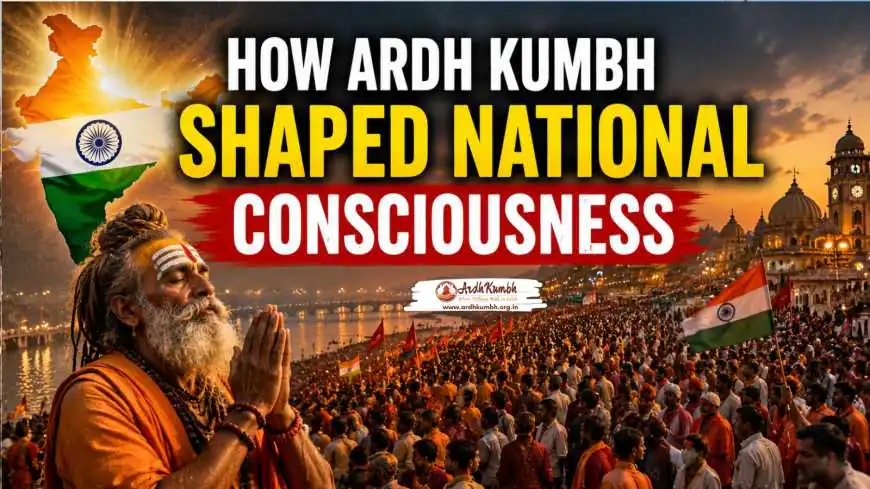
The first and most foundational way the Ardh Kumbh shaped national consciousness was by creating a sacred map of the subcontinent. The Kumbh Mela rotates among four great pilgrimage sites—Prayagraj at the confluence of the Ganga and Yamuna, Haridwar where the Ganga enters the plains, Ujjain on the Shipra in the heart of the country, and Nashik on the Godavari in the western Deccan. These four sites are not random. They anchor the four directions: north, center, west, and south. They are linked by a single, shared mythology—the drops of amrit that fell during the cosmic churning—and by a single, precise astrological clock that summons pilgrims to a different site every few years. This rotation was a stroke of civilizational genius. It meant that the entire subcontinent was periodically activated as a sacred whole. A pilgrim from Tamil Nadu might travel to Nashik, and then, six years later, feel the pull of Prayagraj. The holy geography was a single, interconnected entity in the popular imagination, long before a political map existed.
This sacred cartography taught a powerful lesson: the land itself is holy. The rivers Ganga, Yamuna, Godavari, and Shipra were not regional waterways. They were divine mothers whose grace encompassed the entire subcontinent. The Godavari, flowing through the Deccan, was consciously linked to the Ganga as the "Dakshin Ganga," ensuring that the south was not a peripheral afterthought but an integral, honored part of the sacred landscape. The pilgrim who walked from their village to a Kumbh site was physically tracing the outline of a unified spiritual nation. They were learning, through their aching feet, that Bharatavarsha was not an abstract concept but a lived, geographical reality. This shared sacred geography, imprinted on the collective mind through repeated pilgrimage, was the first and most profound draft of a national map.
The Pilgrimage Routes: The Arteries of a Shared Identity 🚶
The sacred map was given life by the pilgrimage routes that connected the four Kumbh sites and countless other tirthas across the land. For centuries before the railway, millions of pilgrims walked these routes in massive, self-organized caravans called kafilas. These were not just journeys; they were moving, temporary communities where people from different regions, castes, and languages lived, ate, and prayed together for months on end. The routes were lined with dharamshalas, stepwells, and temples built by kings and merchants from different regions, creating a shared infrastructure of faith. The Ardh Kumbh was the ultimate destination, the great gathering that pulled these human rivers from every corner of the subcontinent into a single, temporary sea at the Sangam.
Walking these routes was an education in national consciousness. A pilgrim from a small village in Gujarat would walk alongside a group from Bengal, sharing food, exchanging folk songs, and realizing that their devotion to the same sacred river and the same cosmic event made them part of a single, extended family. The journey itself was a powerful solvent of regional prejudices. The shared hardship, the shared meals, and the shared purpose forged bonds of mutual understanding and respect. These pilgrimage routes became the arteries of a pan-Indian identity, circulating not just people and goods but also ideas, languages, and a sense of belonging to a civilization that was infinitely larger than any single kingdom or linguistic region. By the time they reached the Kumbh, the pilgrims had already, in a very real sense, experienced the unity of the land.
Trending Guides Now
What Is the Story Behind the Ardh Kumbh Mela?
Read Guide →
The Untold Stories of Har Ki Pauri
Read Guide →
How Akharas Were Formed and Why They Matter
Read Guide →
How Saints and Sadhus Define the Ardh Kumbh Tradition
Read Guide →
Best Routes to Reach Haridwar for Ardh Kumbh Mela
Read Guide →
Ardh Kumbh 2027 Dates (Official) - Haridwar Snan Schedule
Read Guide →
Why Snan Dates Create Massive Spiritual Momentum
Read Guide →
How Ardh Kumbh Changes the Way You See Life
Read Guide →The Pandas and Vahis: Weaving a National Family Tree 📜
One of the most intimate and powerful ways the Ardh Kumbh shaped national consciousness was through the institution of the pandas—the hereditary pilgrim priests—and their genealogical registers, the vahis. A family from a remote village in Karnataka would have a specific panda at Prayagraj, whose ancestors had served their ancestors for generations. The panda's vahi recorded the names, dates, and even the village details of the pilgrim's forefathers who had visited the Sangam in 1750, 1820, 1890, and 1940. When a modern pilgrim arrived and saw their great-grandfather's name written in fading ink, they were being given a direct, tangible link to a shared, national past.
This genealogical network was a decentralized, nation-building force of immense power. It transformed the abstract idea of a unified land into a personal family story. The pilgrim did not just belong to their village; they belonged to a sacred geography that had been honored by their ancestors for centuries. The pandas themselves were a pan-Indian network, with knowledge of pilgrim families and safe routes across every region. They were a neutral, unifying social force that predated and outlasted every political kingdom. The vahi was a pre-modern national database, a record of a civilization's shared devotion to the sacred rivers. It proved, in the most personal way imaginable, that the people of this land were a single, interconnected family, bound together by a common spiritual heritage that no political border could sever.
The Akhara Network: A Pan-Indian Monastic Brotherhood 🔱
The great akhara orders, the warrior-monk lineages that are the institutional backbone of the Kumbh, were another powerful force for national integration. Established and formalized by Adi Shankaracharya, the Dashanami akharas, along with the later Vaishnava and Udasin orders, created a pan-Indian network of monasteries, training centers, and branch camps that spanned the entire subcontinent. These akharas did not respect regional boundaries. A sadhu initiated in the Juna Akhara at Prayagraj could be assigned to a monastery in the Himalayas, sent on a mission to the south, or join a wandering party that traversed the entire land. They were living threads that connected the spiritual map.
At the Ardh Kumbh, this distributed monastic network would physically converge. Sadhus from every corner of India would gather, bringing with them the news, the dialects, and the spiritual practices of their respective regions. The Kumbh became a grand syncing event, a national assembly where the akharas would reaffirm their shared identity, debate philosophy, and coordinate their activities. The spectacle of the shahi snan, where akharas from different regions and traditions processed in a single, coordinated order, was a powerful public demonstration of unity in diversity. The akhara network ensured that the spiritual leadership of the land was a single, interconnected body, operating across every political and linguistic boundary. This monastic brotherhood provided a stable, enduring framework for a pan-Indian consciousness that functioned independently of any king or court.
The Temporary City: A Living Model of Unity in Diversity 🏕️
For a few sacred weeks, the Ardh Kumbh creates a temporary city of millions that is itself a living, breathing model of national consciousness. This vast metropolis, with its hospitals, markets, sanitation systems, and police force, is not organized by a single, centralized authority. It emerges from the coordinated, self-organizing activities of the akharas, the pandas, the pilgrim groups, and the administration. In this city, a Bengali trader sets up a stall next to a Gujarati farmer. A sadhu from the Tamil south gives a discourse attended by pilgrims from Punjab. The bhandaras serve food to everyone, regardless of caste, class, or region. This is the nation not as a political theory but as a lived, bustling reality.
The temporary city of the Kumbh is a powerful, recurring demonstration that the staggering diversity of India is not a weakness but a strength. It proves that a community of millions, speaking different languages and following different customs, can coexist peacefully and cooperate for a shared, sacred purpose. The experience of living in this city, even for a few days, imprints on the pilgrim's soul a vision of a united, functioning, and compassionate society. It is a vision that stands in stark contrast to the divisions of the outside world. This memory of a harmonious, pan-Indian community is one of the Kumbh's most profound gifts to the national consciousness. It is a lived refutation of the idea that India is merely a collection of disparate regions, and a powerful affirmation of its deep, underlying civilizational unity.
The Bhakti Voice: Singing a Nation into Being 🎶
The Ardh Kumbh has always been a great amplifier for the voices of the Bhakti saints—Kabir, Ravidas, Mirabai, Chaitanya, and countless others—whose devotional poetry transcended the boundaries of caste, language, and region. These saints sang in the vernacular tongues of the people, not in elite Sanskrit, and their message was a radical one of direct, personal, and egalitarian devotion. The Kumbh, with its massive, diverse audience, was the perfect stage for this casteless, boundary-dissolving gospel. The singing of their bhajans, in languages from Hindi to Marathi to Bengali, created a shared, emotional, and musical landscape that was truly pan-Indian.
A pilgrim from the south might not understand the words of a Kabir bhajan sung by a northern sadhu, but they could feel its spiritual power. The melodies, the ecstatic devotion, and the core message of love and surrender were a universal language. The Bhakti movement, amplified by the Kumbh, did more than perhaps any formal political movement to democratize Indian spirituality and create a shared, popular culture of devotion. It gave the common people a direct, emotional connection to the divine and, in doing so, helped dissolve the rigid hierarchies that divided them. The Kumbh, as the grand stage for this singing revolution, was a potent force for shaping a national consciousness rooted not in power but in love, not in uniformity but in a harmonious, polyphonic devotion.
The Kumbh and the Freedom Movement: A Silent Nationalist Platform 🇮🇳
While the Kumbh was never explicitly a political rally, its very existence and its immense, peaceful gatherings were a powerful, silent assertion of Indian civilizational identity under colonial rule. The British administration, which viewed large assemblies of Indians with suspicion, was forced to engage with and manage the Kumbh, implicitly acknowledging a sphere of Indian life that was beyond its full control. The gathering was a massive, recurring display of a self-organizing, ancient Indian society that operated by its own rules. This implicit nationalist undercurrent did not go unnoticed by the leaders of the freedom movement.
Nationalist leaders and thinkers saw the Kumbh as a vital symbol of India's enduring unity and cultural strength. It was a place where the idea of a self-reliant, spiritually sovereign India was not just discussed but was visibly functioning, cycle after cycle. While large political gatherings were often banned or suppressed by the colonial state, the Kumbh, due to its sheer scale and religious nature, continued. It became a space where a pan-Indian consciousness could be experienced and renewed without the overt trappings of a political movement. The shared identity forged on the ghats of the Sangam over centuries became the fertile soil in which the seeds of modern political nationalism could grow. The deep, pre-existing sense of being a single people, cultivated by the Kumbh, was the cultural prerequisite for the political demand for a single nation.
The Enduring Legacy: A Consciousness Woven by Faith
The Ardh Kumbh Mela did not shape India's national consciousness through a single, dramatic event. It did so through the quiet, persistent, and irresistible force of a recurring sacred rhythm. Every six years, the cosmic clock struck the hour, and millions of souls, from every corner of the subcontinent, felt the same pull toward the same sacred waters. This rhythm, repeated for over a thousand years, created a deep, almost cellular sense of belonging to a single, sacred land. It taught that the rivers that flowed from the Himalayas to the seas were a single, interconnected system of grace. It taught that the people who bathed in those rivers, whatever their language or caste, were a single, interconnected family of pilgrims.
This is the profound and enduring legacy of the Ardh Kumbh. Long before the political nation-state of India was founded, the pilgrimage had already created a national consciousness in the hearts of its people. It was not a consciousness of borders and passports, but of sacred geography, shared ancestry, and a common spiritual destiny. This consciousness is the cultural DNA of modern India, the invisible, sacred bond that holds the world's most diverse democracy together. The Ardh Kumbh is not just a gathering of faith. It is the recurring, joyful, and awe-inspiring celebration of the idea of India itself—an idea that was not invented in a constitution hall, but was first whispered by the sages and then walked, sung, and bathed into existence by millions of pilgrims, for millennia, on the banks of her sacred rivers.
Frequently Asked Questions