
































What Self-Restraint Really Means at Kumbh
Discover what self-restraint really means at Kumbh Mela. Beyond control and rules, a heartfelt look at the art of holding back in a sea of millions.
What Self-Restraint Really Means at Kumbh
Let me ask you a personal question, and I want you to answer honestly. When was the last time you did something difficult simply because it was good for your soul, not because someone was forcing you or because you would get a reward? If you are like most of us living in 2026, the answer is probably "not recently." We live in an age of instant gratification. Want food? Order it in ten minutes. Want entertainment? Scroll for two seconds. Want a relationship? Swipe right. We have almost forgotten what it feels like to wait, to sacrifice, to hold back. And that is exactly why the Kumbh Mela is more relevant today than it has ever been. Because the Kumbh is a university of self-restraint. It takes you away from every comfort and every distraction and every excuse, and it asks you one simple question: who are you when you have nothing? Let me walk you through what that question really means.
Self-Restraint Is Not Deprivation – It Is Choice
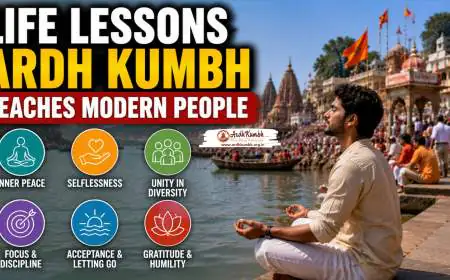
Here is the biggest misunderstanding about self-restraint that I need to clear up right now. Most people think it means suffering. They imagine a sadhu in a cave, eating one leaf a day, looking miserable. That is not self-restraint. That is self-torture, and it is completely different. Real self-restraint at the Kumbh is not about hating yourself. It is about choosing what serves you and rejecting what does not. When a pilgrim walks past a hundred food stalls selling delicious, greasy, tempting samosas and chooses to eat only the simple bhandara khichdi, they are not torturing themselves. They are saying: my spiritual goal is more important than my tongue's pleasure right now. That is choice, not punishment. And that tiny shift in mindset changes everything. You stop feeling like a victim of your own discipline. You start feeling like the captain of your own ship. That is what the Kumbh teaches. Self-restraint as empowerment, not as chains.
The Cold Water – Your First Test
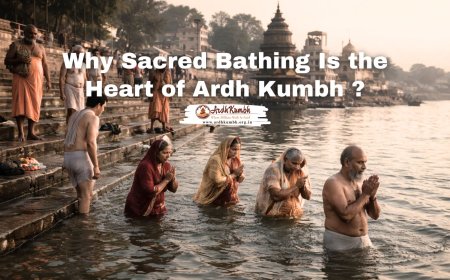
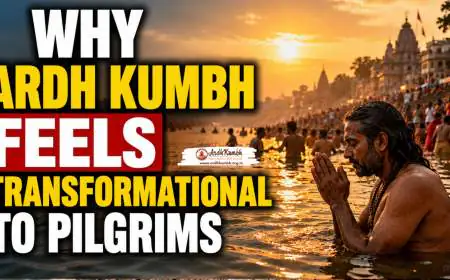
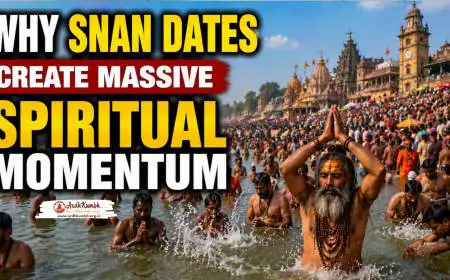
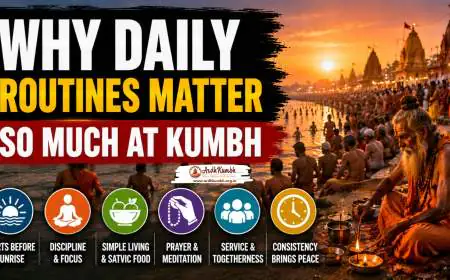
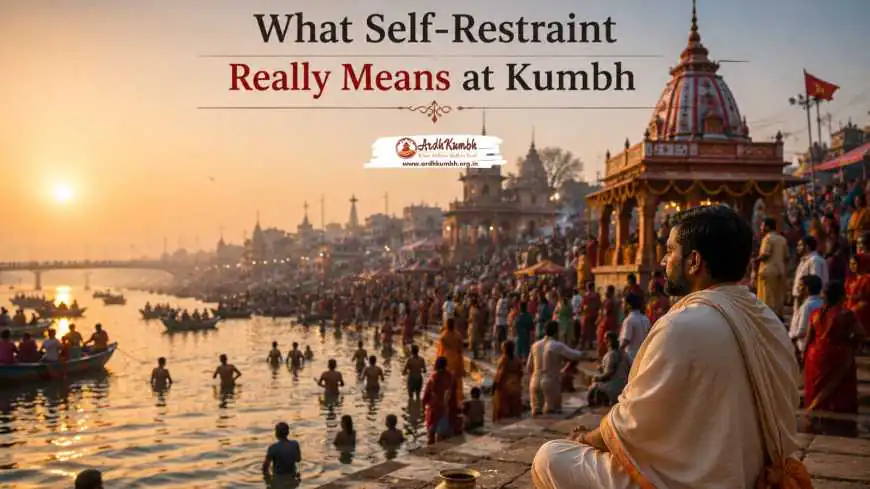
Let me describe the first morning of the Shahi Snan for you. You wake up at 3 AM. It is January. The temperature is hovering around 2 to 4 degrees Celsius. Your tent has no heater. Your blanket is thin. Your teeth are already chattering under the blanket. And then someone shouts: "Ganga mein chalo!" (Let's go to the Ganges!). Every single cell in your body says no. Your brain gives you a hundred logical reasons to stay. "You will get sick." "You can go later when the sun is up." "One missed dip won't matter." But you see the grandmother next to you, who is 70 years old and has arthritis, already wrapping her shawl and heading out. And you feel ashamed. So you go. You walk to the river. You step into that water. And for the first ten seconds, you cannot breathe. The cold is a physical punch to your chest. Your muscles scream. Your toes go numb. And then, something shifts. By the thirtieth second, your body stops fighting. By the sixtieth second, you are no longer cold. You are awake. You are alive. You are praying. That is self-restraint in action. You said no to your comfort for five minutes, and in return, you got a clarity that no warm bed could ever give you. That trade is the entire lesson of the Kumbh.
Fasting – When the Stomach Learns to Bow
Let us talk about food, because food is where most of us fail at self-restraint every single day. At the Kumbh, you will see millions of pilgrims practicing some form of fasting (upvaas). Some eat only once a day. Some eat only fruits. Some drink only water. Some eat nothing at all for 24 hours or longer. And here is the secret that no one tells you: after the first few hours of hunger, something magical happens. The hunger stops being painful and starts being clean. You feel lighter. Your thoughts slow down. Your prayers feel louder because your stomach is not constantly interrupting. The fasting at the Kumbh is not about impressing God. God does not care if you skip a meal. The fasting is for you. It is a reminder that you are not your hunger. You are not your cravings. You are something much bigger, sitting behind the screen of your body, watching it all happen. When you learn to say no to food for a day, you learn that you can say no to anger for a day. You can say no to laziness. You can say no to gossip. Self-restraint at the Kumbh starts in the stomach, but it ends in the soul.
Trending Guides Now
Har Ki Pauri Ganga Aarti Time Today in Haridwar
Read Guide →
Complete Guide to Ardh Kumbh Rituals
Read Guide →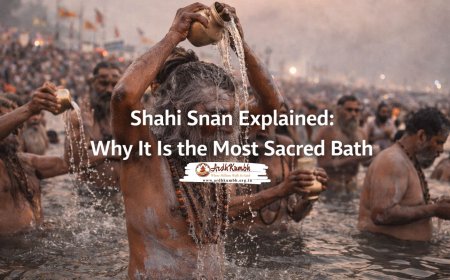
Shahi Snan Explained: Why It Is the Most Sacred Bath
Read Guide →
Ardh Kumbh Mela Rituals Explained Shahi Snan & Akhara Traditions
Read Guide →
Best Routes to Reach Haridwar for Ardh Kumbh Mela
Read Guide →
Ardh Kumbh 2027 Dates (Official) - Haridwar Snan Schedule
Read Guide →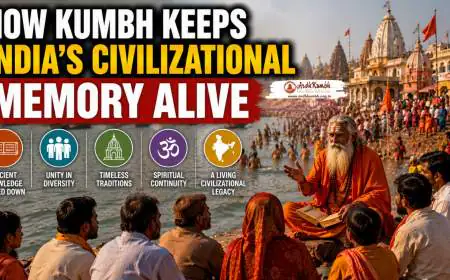
How Kumbh Keeps India’s Civilizational Memory Alive
Read Guide →
February Weather Reality at Ardh Kumbh
Read Guide →Brahmacharya – Not What You Think
This is the awkward one, but let us be adults here. Brahmacharya is often translated as celibacy, but at the Kumbh, it means something much wider and much more practical. Brahmacharya at the Kumbh means using your energy wisely. It means not wasting your life force on things that drain you. For the Naga Sadhus and many pilgrims, this does mean celibacy during the pilgrimage. But for the average householder visiting the Kumbh, brahmacharya means something simpler: it means not looking at your phone for six hours. It means not engaging in unnecessary arguments. It means not feeding every desire that pops into your head. The Kumbh is a place of intense spiritual energy. If you waste that energy on cheap distractions, you have missed the point. Real self-restraint is knowing that your attention is your most valuable currency. And at the Kumbh, you learn to spend it wisely — on prayer, on service, on silence, on the river. Everything else is just noise.
The Discipline of Silence (Mauna)
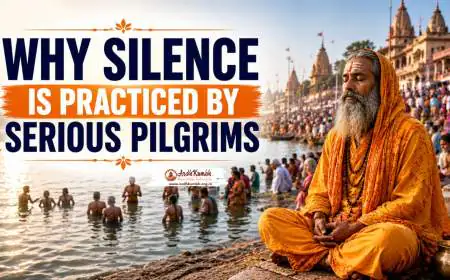
Try this experiment at home. Sit for two hours without speaking a single word. No phone. No TV. No books. Just you and your thoughts. How long did you last? Be honest. Most people cannot last twenty minutes without reaching for a distraction. Now imagine the Kumbh, where thousands of pilgrims take a vow of silence (mauna) for days or even the entire Mela. They do not speak. They do not whisper. They communicate through gestures and written notes if absolutely necessary. Why? Because they have learned something that we have forgotten: most of our words are useless. We talk to fill silence. We talk to impress. We talk to complain. We talk to avoid our own thoughts. When you take mauna at the Kumbh, you realize how much mental energy you usually waste on chatter. You hear your own breathing. You hear the river. You hear the distant chanting. And slowly, you hear something else — a stillness inside you that has always been there, but was always buried under your own voice. That is self-restraint of the tongue. And it is one of the hardest, most rewarding things you will ever do.
Patience – The Longest Walk
You cannot talk about self-restraint at the Kumbh without talking about patience. Because the Kumbh will test your patience in ways you cannot imagine. You will stand in a line for the toilet for forty-five minutes. You will walk for two hours just to reach a Shahi Snan ghat that is one kilometer away as the crow flies, but the crowd has turned it into a ten-kilometer maze. You will wait in the cold for your turn to dip. You will wait for food. You will wait for your family to find you after getting separated. And through all of this waiting, you have a choice. You can become angry, frustrated, bitter. Or you can become patient. The Kumbh teaches you that patience is not passive. Patience is active self-restraint. It is the decision to keep your heart soft when the world is giving you every reason to harden it. And when you finally take that dip after four hours of waiting, that dip tastes sweeter than any instant gratification ever could. Because you earned it. Self-restraint turned waiting into a meditation.
Letting Go of Attachment (Vairagya)
Here is the deepest layer of self-restraint at the Kumbh. It is called Vairagya — detachment. Not the cold, emotionless detachment of a robot. But the warm, wise detachment of someone who knows that nothing in this world is permanent. At the Kumbh, you will lose things. You will lose your favorite pair of shoes in the mud. You will lose your expensive water bottle. You might lose your wallet or your phone or your way back to your tent. And every time you lose something, you have a choice. You can cry. You can panic. You can curse the crowd. Or you can say: it was just a thing. I am still here. The river is still here. God is still here. That is Vairagya. That is self-restraint applied to your possessions. The Kumbh teaches you that you do not own anything. You are just borrowing it for a while. And when you truly believe that, your grip on money, on status, on everything becomes looser. And a loose grip is a free grip. That is the freedom I talked about at the very beginning.
The Naked Truth – Why Sadhus Wear Nothing
You cannot avoid this question, so let me answer it directly. Why do Naga Sadhus wear no clothes? Is it madness? Is it attention-seeking? No. It is the ultimate act of self-restraint. Because wearing nothing is actually harder than wearing something. Think about it. You are completely exposed. No ego hiding behind a designer brand. No status hiding behind a watch. No identity hiding behind a shirt. You are just a human animal standing in front of millions of people. The Naga Sadhu has restrained the desire to hide. He has restrained the desire to look good. He has restrained the desire to fit in. His nakedness is his honesty. It is his way of saying: I have nothing to protect. I have nothing to prove. I am not this body. I am something else. You do not have to become a Naga Sadhu to learn from him. But the next time you spend thirty minutes choosing an outfit for a party, ask yourself: how much of my energy is going into covering myself up? That question is a gift from the Kumbh.
When the Mind Learns to Say No
All of this — the cold water, the fasting, the silence, the patience, the detachment — is really training for one muscle. Your mind. The Kumbh is a boot camp for your thoughts. Because your thoughts are the hardest thing to control. Your stomach will obey after a few hours of fasting. Your tongue will obey after a day of silence. But your mind? Your mind will wander to a million places. It will miss your phone. It will miss your bed. It will miss your favorite food. It will complain. It will compare. It will judge. And the real self-restraint is catching your mind every time it runs away and gently bringing it back to the present moment. Back to the sound of the Ganges. Back to the feeling of your breath. Back to the mantra you are chanting. This is meditation. This is self-restraint of the mind. And unlike the other forms of restraint, this one has no finish line. You practice it for a lifetime. The Kumbh just gives you the first push.
What the River Whispered to Me
I have written a lot of words. But let me leave you with one image that I will never forget. On my last night at the Ardh Kumbh, I sat on a broken step at Har Ki Pauri long after midnight. Most people had gone back to their tents. The crowd was thin. The aarti was over. And I just sat there, watching the Ganges flow. And I realized something. The river does not restrain itself. It simply flows. It does not stop for a rock. It goes around it. It does not fight the cold. It becomes cold. It does not resist the mud. It carries the mud. Self-restraint at the Kumbh is not about fighting yourself. It is about flowing like the river. You do not fight the cold. You become the cold. You do not fight hunger. You become the hunger. You do not fight the crowd. You become the crowd. And in that becoming, you lose your small self and find your big self. That is what self-restraint really means at the Kumbh. Not a wall. Not a prison. But a river — choosing its own path, surrendering to gravity, and arriving at the ocean anyway. Now go find your ocean.
Frequently Asked Questions