












































































Is Ardh Kumbh About Renunciation or Inner Awareness?
Do you have to give up everything to find yourself? Or can you stay in the world and still wake up? The honest truth about Kumbh's deepest purpose.
1. Renunciation Looks Different for Different People
Let us start with a definition. Renunciation (tyag) does not always mean throwing away your possessions. It can mean throwing away your attachment to those possessions.
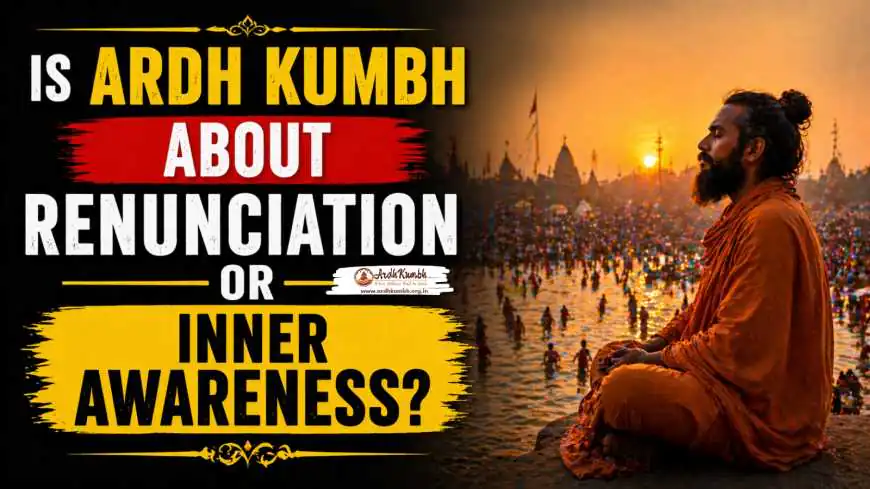
The Naga Sadhu who owns nothing has made external renunciation. That is his path. It is valid. It is hard. It is not for everyone.
The householder who owns a house, a car, and a bank account can still practice internal renunciation. They can say, "I own these things, but they do not own me. I can lose them without losing my peace."
At the Kumbh, both types of renunciation are present. The sadhu models the extreme. The householder practices the moderate. The river accepts both.
The real question: Which one are you capable of? Do not try to be a sadhu if you are still attached to your WiFi. Start where you are. Renounce one small attachment this week. See how it feels.
2. Inner Awareness Does Not Require a Cave
Here is a misconception. Many people think inner awareness (self-knowledge, enlightenment, awakening) requires isolation. You must go to a Himalayan cave, sit in meditation for years, and ignore the world.
The Kumbh disproves this daily. Millions of people in the middle of chaos—noise, mud, crowds, smells—find moments of deep awareness. They are not in a cave. They are in a tent with 50 snoring strangers. And yet, the awareness comes.
Inner awareness is not about where you are. It is about how you are. You can be aware in a boardroom if you practice. You can be asleep in a cave if you do not.
The real question: Are you using "I need to renounce the world first" as an excuse to postpone your inner work? The Kumbh says: Start now. Here. In the mud.
3. The Dip Is a Symbol of Both
The holy dip (snan) is the central ritual of the Ardh Kumbh. What does it mean?
-
Renunciation interpretation: You are washing away your sins (karma). You are letting go of the past. You are renouncing your old self. When you come out of the water, you are born again—a new person with no baggage.
Trending Guides Now

What Is Ardh Kumbh Mela? Meaning, History & Significance
Read Guide →
Who Decides Ardh Kumbh Dates and Why They Never Change
Read Guide →
What Happens During Ardh Kumbh? Rituals, Processions & Spiritual Meaning Explained
Read Guide →
Why It’s Called Ardh Kumbh: The Real Meaning
Read Guide →
Ardh Kumbh 2027 Dates (Official) - Haridwar Snan Schedule
Read Guide →
Dharamshala Stay During Ardh Kumbh: Free & Budget Guide
Read Guide →
Official Progress Report of Haridwar Ardh Kumbh 2027 Infrastructure Projects
Read Guide →
Is October a Good Time to Visit Haridwar Before Ardh Kumbh 2027?
Read Guide → -
Inner awareness interpretation: The cold water shocks you into the present moment. You cannot think about your EMI or your argument with your spouse when the Ganga is freezing your skin. You are forced into awareness. The dip is not about erasing the past. It is about waking up to the now.
Which one is correct? Both. The dip is a flexible symbol. It means what you need it to mean. That is the genius of the Kumbh.
4. The Saints Teach Renunciation; The Crowd Teaches Awareness
At the Kumbh, you have two teachers:
-
The saints (sadhus, mahants, gurus). They teach renunciation by their example. Look at them. They own nothing. They fear nothing. They are free. That is the ideal.
-
The crowd (the millions of ordinary pilgrims). They teach awareness by their presence. You cannot be lost in your thoughts when you are being shoved from all sides. You must be awake. You must notice where you are stepping. You must see the child who is crying, the elderly woman who needs help, the stranger who offers you water.
You need both teachers. The saint shows you the destination (renunciation). The crowd shows you the path (awareness). Ignore one, and you are incomplete.
5. You Can Renounce Without Leaving Home
Here is a liberating thought. The Kumbh does not require you to join an Akhara or shave your head. You can practice renunciation in your living room tomorrow morning.
-
Renounce the first hour of your day (give it to silence instead of screens).
-
Renounce one meal a week (fast, and donate the money you saved).
-
Renounce the need to be right in an argument (let the other person "win").
-
Renounce one possession you do not need (donate it to someone who does).
These are small renunciations. They are not as dramatic as a sadhu's renunciation. But they are real. And they build the muscle of detachment. The Kumbh blesses small renunciations as much as big ones.
Why this matters: Do not wait until you are perfect to start. Start messy. Start small. The Ganga does not check the size of your sacrifice. Only the sincerity.
6. Inner Awareness Is the Goal; Renunciation Is a Tool
Let me give you a hierarchy. Inner awareness (knowing yourself, waking up to reality) is the goal of almost every spiritual tradition, including the Kumbh.
Renunciation is a tool to achieve that goal. Why? Because attachments (to money, status, relationships, comfort) cloud your awareness. They distract you. They make you anxious. They keep you asleep.
So you renounce (let go) to clear the fog. When the fog clears, awareness arises naturally. You do not "achieve" awareness. You uncover it by removing what covers it (attachments).
At the Kumbh, the sadhus have removed almost everything. Their awareness is therefore very clear. The householder has removed very little. Their awareness is cloudy. But both are on the same continuum. The householder can remove one attachment at a time, slowly, over years. That is fine. The Kumbh has patience.
7. The Kumbh Is a "Renunciation Boot Camp" for Householders
Think of the Ardh Kumbh as a temporary renunciation for normal people. You leave your home. You leave your comfortable bed. You leave your daily routine. You live in a tent. You eat simple langar food. You walk kilometers in mud. You bathe in cold water.
For two weeks, you are practicing renunciation. Not permanent renunciation (you will go home). But temporary renunciation. And temporary practice strengthens you for permanent change.
When you go home, you might find that you need less than you thought. You might find that comfort is not as important as you believed. The temporary renunciation of the Kumbh has permanent effects.
Why this matters: You do not need to become a sadhu. You just need to visit them for a few weeks. Their renunciation will rub off on you. That is the magic of proximity.
8. Inner Awareness at the Kumbh Is Unavoidable
Here is a secret. Even if you come to the Kumbh with zero interest in inner awareness—you are just a tourist, a photographer, a curious foreigner—the Kumbh will force awareness on you.
Why? Because the sensory overload is so intense that your default mode network (the part of your brain that daydreams about the past and future) shuts down. You cannot ruminate about your ex when a Naga Sadhu is staring at you. You cannot worry about your mortgage when 10 million people are chanting in your ears.
You are pulled into the present moment against your will. That is awareness. It does not ask for your permission. It just happens.
Why this matters: You do not need to "try" to be aware at the Kumbh. Just show up. The Kumbh will do the rest. It is a machine for producing awareness. The only raw material it needs is you.
9. The Paradox: Renouncing the Need to Renounce
Here is a spiritual trap that catches many pilgrims. They become obsessed with renunciation. They think, "I must give up everything. I must be like the sadhus. I am not holy enough because I still want chai and blankets."
This obsession with renunciation is itself an attachment. You are attached to the idea of being detached. That is a paradox and a prison.
The real teaching of the Kumbh is: Renounce the need to renounce. Let go of perfectionism. Let go of comparing yourself to sadhus. Let go of guilt about your comforts.
Take your dip. Drink your chai. Sleep in your tent. Go home. Love your family. Do your job. Be a householder. That is your dharma (duty). That is your path. Do it fully. Do it awake. That is enough.
Why this matters: The Kumbh is not a competition in who can suffer the most. It is a celebration of consciousness. However you show up—with your luxury tent or your rag blanket—is perfect. Just show up awake.
10. The Literal Meaning of "Kumbh" Points to Awareness
Let me give you a linguistic clue. The word Kumbh means pitcher or pot. In the mythology, the gods and demons churned the ocean and a pot of nectar (amrit) emerged. Four drops fell on Earth—at Haridwar, Prayagraj, Ujjain, and Nashik. That is why we have the Kumbh Mela.
But the pot is also a symbol in yoga and meditation. Your body is a pot. Your mind is the water inside. The nectar (amrit, bliss, awareness) is already inside you. You do not need to renounce your body to find it. You just need to stop the churning (the constant thinking, wanting, avoiding). When the churning stops, the nectar rises.
The Kumbh Mela is an external drama that points to an internal truth. The river outside is the river inside. The dip outside is the dip inside (into your own awareness). The renunciation outside (giving up possessions) is a mirror for the renunciation inside (giving up attachments).
Why this matters: Do not get trapped in the external. Use the external (the crowds, the chants, the dips) as pointers to the internal. The real Kumbh is happening inside you. The one in Haridwar is just the invitation.
11. The Householder Saint: The Unsung Hero of the Kumbh
We glorify the Naga Sadhu. We take photos of the ash-covered monk. But there is another saint at the Kumbh who gets less attention. The householder saint.
This is the grandmother who has raised six children, buried one husband, survived poverty, and still chants the name of Ram every morning. She owns clothes, a kitchen, a small bank balance. She has not renounced the world. She has transformed her relationship to the world. She is detached without being distant. She is aware without being aloof.
She is the living proof that renunciation is not necessary for inner awareness. She is the Kumbh's best kept secret.
Why this matters: Look for the householder saints at the Kumbh. They are everywhere. They are the aunty serving prasad, the uncle helping a stranger with their luggage, the teenager giving up her phone to sit with her grandmother at the ghat. Learn from them. They are your teachers. Because they are living the life you are living.
12. So, Which Is It? Renunciation or Awareness?
After all of this, here is my answer. The Ardh Kumbh is ultimately about inner awareness. Renunciation is a path to that awareness, but not the only path, and not the required path for everyone.
The Kumbh accepts all paths:
-
The Naga Sadhu on the path of extreme renunciation.
-
The householder on the path of moderate renunciation (letting go of attachments without letting go of responsibilities).
-
The tourist on the path of zero renunciation (just here for the spectacle), who accidentally stumbles into awareness anyway because the Kumbh is magic.
The river does not judge. The dip does not discriminate. The Kumbh does not have a gatekeeper asking, "How much have you renounced? Show me your certificate."
You come as you are. You leave as you will become. The transformation is between you and the Ganga. No one else needs to know.
13. Your Kumbh Is Whatever You Need It to Be
Here is my final whisper to you. The Ardh Kumbh is a mirror. It shows you yourself. If you are ready to renounce, you will see renunciation everywhere. If you are hungry for awareness, you will find awareness in every chant and dip.
Do not ask the Kumbh to be one thing. It is many things. It is renunciation for the sadhu. It is awareness for the seeker. It is tradition for the grandmother. It is chaos for the policeman. It is home for the homeless.
And for you? The Kumbh is waiting to be whatever you need it to be. But you have to show up first. You have to take the dip. You have to open your eyes in the cold water and ask yourself: "What am I really doing here?"
The answer will not come from me. It will come from the Ganga. And the Ganga never speaks in words. She speaks in silence, in cold, in grace. Go listen.
Frequently Asked Questions