
















































































Cash, UPI or Cards? Choosing the Best Payment Method in Haridwar
Confused about cash, UPI or cards in Haridwar? Compare payment methods, know where each works best, and get practical tips for a hassle-free spending experience.
Cash, UPI or Cards? Choosing the Best Payment Method in Haridwar
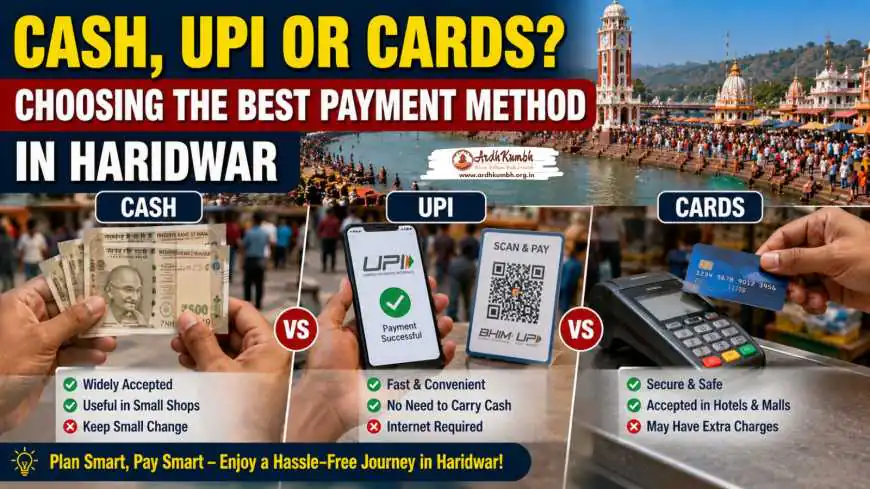
So, you are all set for your Haridwar pilgrimage, bags packed, itinerary ready, but there is that one nagging question: how do you actually pay for things once you get there? Should you rely on cash, scan a QR code, or swipe your credit card? Let us cut through the confusion right now. The honest answer is that you will need all three payment methods in Haridwar, but knowing when to use each will save you time, money, and plenty of stress .
Haridwar is a fascinating mix of the ancient and the modern. One moment you are at a centuries-old temple where only cash is accepted, and the next, you are paying for chai at a roadside stall by scanning a tiny QR code. UPI has taken India by storm, and Haridwar is no exception, but cash still has its sacred place . And while card payments are growing, they are not as widely accepted as you might expect . This guide will help you navigate the payment landscape of Haridwar, ensuring you are never caught off guard.
UPI (Unified Payments Interface): The Digital King of Haridwar 📱
If there is one payment method that has revolutionized spending in India, it is UPI. This real-time payment system allows instant bank-to-bank transfers through a mobile app . In Haridwar, you will find UPI QR codes almost everywhere, from established shops to the smallest street vendors .
Where UPI Works Best
In Haridwar, you can confidently use UPI at:
Trending Guides Now

Ardh Kumbh Budget Guide: Travel, Stay And Food Costs
Read Guide →
Exact Budget Needed for Ardh Kumbh Mela Pilgrims
Read Guide →
Real Cost of Attending Ardh Kumbh Mela Guide
Read Guide →
Haridwar Weather by Month: Best Time to Plan Your Visit
Read Guide →
Ardh Kumbh 2027 Dates (Official) - Haridwar Snan Schedule
Read Guide →
Dharamshala Stay During Ardh Kumbh: Free & Budget Guide
Read Guide →
Official Progress Report of Haridwar Ardh Kumbh 2027 Infrastructure Projects
Read Guide →
Is October a Good Time to Visit Haridwar Before Ardh Kumbh 2027?
Read Guide →-
Cafes, restaurants, and eateries, including many of the family restaurants near Har Ki Pauri .
-
Auto-rickshaws and taxis .
-
Pharmacies, grocery stores, and convenience stores.
-
Hotel front desks and guesthouses .
-
Many shops in the bustling Bara Bazaar .
-
Modern stores like the Wildcraft outlet in Jwalapur, which accepts UPI, QR codes, and net banking .
The Catch for International Travelers
Here is the catch for foreigners. UPI was built on Indian bank accounts and Indian phone numbers. A Visa or Mastercard cannot simply scan a UPI QR code . However, there is a solution.
Tourist UPI Wallets
You can sign up for a "tourist wallet" through apps like Cheq. You fund this wallet with your foreign debit/credit card. The KYC process (which involves showing your passport and visa stamp) must be completed in person after you arrive in India . Once set up, you can scan UPI QR codes and pay like a local. Keep in mind:
-
There is typically a fee of about 2.58% when loading money into the wallet .
-
A tourist wallet usually only allows merchant payments, not person-to-person transfers .
-
The app is tied to your Indian SIM card's ID number, so ensure your SIM is working .
Pros and Cons of UPI
| Pros | Cons |
|---|---|
| Real-time payments, great for fast checkouts | Requires internet connectivity and a smartphone |
| Typically very low or zero merchant fees | Some users find the process of switching apps or approving requests cumbersome |
| Works well for QR-based in-store payments | Subject to bank-imposed daily transaction limits |
| Reduces the need for physical cash for daily purchases | Foreign travelers need a tourist wallet, which comes with fees and KYC requirements |
Cash: The Undisputed King in Temples, Markets, and Tipping 💵
Despite the digital revolution, cash is still king in many parts of Haridwar . There are places where UPI and cards simply do not work, or where using cash is just more practical.
Where Cash is Essential
-
Temples and Religious Sites: Many temples require a cash donation. You also need cash to pay the shoe minder or for a priest's blessing . The Mansa Devi Temple and Chandi Devi Temple, while accessible via the Udan Khatola ropeway, still have donation boxes and small counters that may prefer cash.
-
Bara Bazaar: The oldest and busiest market in Haridwar, located behind Har Ki Pauri, is a traditional maze where many small vendors do not accept digital payments .
-
Street Food and Small Vendors: For a quick aloo puri from Mohan Ji Puri Wale or the famous falooda from Prakash Lok, cash is expected .
-
Tipping: It is customary to tip hotel porters, housekeeping staff, drivers, and tour guides with cash. A hundred-rupee note is the right denomination .
-
Small Rural Transactions: If you venture outside the main city, network coverage can be patchy, and even if a vendor has a QR code, it may not work .
How Much Cash to Carry
A reasonable cash buffer for a short trip (3-5 days) is between ₹5,000 and ₹10,000, kept in a mix of denominations . Aim for a handful of ₹100, ₹200, and a few ₹500 notes. Avoid carrying only large bills like ₹2000, as vendors often cannot break them .
Getting Cash: ATMs and Banks
ATMs are available throughout Haridwar. However, a few tips:
-
ATMs dispense cash, but usually only in ₹500 and ₹2000 notes. Getting smaller bills can be a problem . You can ask for change at larger hotels or restaurants .
-
Bank ATMs inside the city are often better than airport ATMs, which have the worst rates and highest fees .
-
PNB has a CLPC branch in Haridwar (IFSC: PUNB0628200) which participates in NEFT, RTGS, and IMPS if you need to transfer funds .
Pros and Cons of Cash
| Pros | Cons |
|---|---|
| Universally accepted for in-person transactions, especially in temples and traditional markets | High risk of theft and physical loss |
| No transaction fees and offers complete transaction privacy | Inconvenient for large or online purchases |
| Works even when internet connectivity is poor | No built-in digital trail for expense tracking |
| Helps control spending as you physically see money leave your wallet | You need to hunt for change for smaller bills |
Credit and Debit Cards: Convenient but Not Always Reliable 💳
Credit and debit cards are more widely accepted in Haridwar than you might expect, but you cannot rely on them exclusively . They are best suited for mid-level to premium establishments and for larger purchases.
Where Cards Work
-
Mid-level and Luxury Hotels: Most hotels with a card machine will accept cards. However, as a traveler on Tripadvisor notes, even hotels sometimes struggle to have change for cash, but they readily accept cards .
-
Restaurants: Many sit-down restaurants, especially those near Har Ki Pauri like Satvik Appetite and Vyanjan Restaurant, accept credit and debit cards.
-
Modern Retail Stores: Brands like Wildcraft accept debit cards and net banking . The Patanjali Mega Store also accepts credit and debit cards .
-
Online Bookings: Cards are essential for booking train tickets, hotels, and flights online.
The Catch with Cards
-
Machines Can Be Broken: A common issue in India is that the card machine may be out of order .
-
Foreign Transaction Fees: Your bank may charge a foreign transaction fee of about 3% on every international swipe .
-
Dynamic Currency Conversion: Some terminals offer to convert the transaction to your home currency, which often has a worse rate. Always choose to pay in rupees (INR).
-
Not for Small Vendors: Most small shops, street vendors, and temple shops do not accept cards.
Credit Card vs. Debit Card
For travelers, a credit card is often safer and more rewarding than a debit card.
-
Credit Cards: Offer excellent fraud protection, rewards, cashback, and travel benefits . They also help build a credit history. The risk is that failure to pay bills in full can trigger high interest charges .
-
Debit Cards: Directly deduct money from your bank account. While convenient, they often have fewer rewards and offer less protection against fraud compared to credit cards .
| Feature | Credit Card | Debit Card |
|---|---|---|
| Source of Funds | Credit line provided by the issuer | Directly linked to a bank account |
| Payment | Pay later within the billing cycle | Instant debit from the account |
| Rewards | Reward points, cashback, travel benefits | Fewer rewards or cashback offers |
| Fraud Protection | Excellent; zero liability in many cases | Limited; fund recovery can be slower |
| Credit History | Helps build a credit score | Does not build a credit score |
How to Choose: A Simple Rule of Thumb 🎯
If you remember only one heuristic from this guide, make it this one :
-
Use UPI for anything that has a printed price, a counter, or a register.
-
Use Cash for anything that involves a temple, a tip, or a tiny rural seller.
-
Use Cards for online bookings, large expenses, and premium hotel stays.
Haridwar-Specific Payment Tips 📍
1. Payment at Famous Eateries
-
Satvik Appetite (Rooftop Restaurant): Accepts all major payment methods including UPI, cards, and cash.
-
Curry Leaf (South Indian): UPI and cards are widely accepted.
-
Prakash Lok Falooda: Cash is still the traditional way at this 66-year-old shop.
-
Mohan Ji Puri Wale: Cash only for this legendary breakfast spot.
2. Payment at Temples and Ghats
-
Har Ki Pauri: While the area has embraced UPI, having cash on hand is still recommended for donations and small offerings.
-
Mansa Devi and Chandi Devi Temple: The Mansa Devi and Chandi Devi ropeway ticket price can often be paid via UPI or cash. However, temple donations are usually cash.
-
Khoya Paya Kendra: No payment is needed here, but keep your ID proof ready.
3. Payment in Markets
-
Bara Bazaar: This is a cash-heavy zone. Many century-old shops in the narrow lanes deal primarily in cash .
-
Jwalapur Shops: Many shops like Wildcraft, and local stores, accept cash, UPI, debit cards, and net banking .
4. Payment at Accommodations
-
Hotels in Haridwar with free parking: Most hotels accept cards and UPI for the room bill. However, smaller guesthouses may prefer cash.
-
Haridwar Railway Station retiring rooms: It is wise to have cash, as the station counters may not always have a functioning card machine.
Security Tips for Payments in Haridwar 🛡️
-
Cash: Do not flash large amounts of cash in crowded markets. Use a money belt or a secure inner pocket .
-
UPI: Only scan QR codes from trusted sources. Be wary of fake QR codes that could redirect your payment . Use a strong PIN or biometric lock on your UPI app .
-
Cards: Always cover the keypad when entering your PIN. Keep SMS and email alerts activated to track transactions in real-time .
Final Thoughts ✨
Choosing the right payment method in Haridwar is about balance. Relying on only one form of payment can leave you stranded. Your best bet is to carry a small cash buffer for the spiritual and traditional side of the city, load a tourist UPI wallet for everyday modern purchases, and keep a credit card tucked away for online bookings and emergencies.
Haridwar is a city where the sacred Ganga flows alongside the latest digital payment systems. Embrace both the ancient and the modern to make your pilgrimage smooth, safe, and spiritually fulfilling. 🪷
Frequently Asked Questions