










































































How Authorities Maintain Order Without Force
Discover the subtle art of crowd management at Kumbh Mela—AI surveillance, strategic bus networks, and the power of collective faith rather than batons.

Quick Answer: How Authorities Maintain Order Without Force
Authorities maintain order during large religious gatherings like Ardh Kumbh 2027 through careful planning, public cooperation, communication, and crowd-management strategies rather than relying only on physical force. The approach focuses on preventing confusion, reducing overcrowding, guiding pilgrims, and resolving problems peacefully. Police personnel, volunteers, administrative teams, and religious representatives can work together to manage visitor movement and maintain a safe environment.
Important measures include public announcements, designated entry and exit routes, barricading, crowd monitoring, help desks, emergency response teams, and clear instructions for pilgrims. Volunteers also help visitors find facilities, follow bathing arrangements, and avoid restricted areas. Respectful communication and cooperation from devotees play an equally important role. 🙏 The objective of peaceful crowd management during Kumbh Mela is to protect visitors, maintain discipline, and ensure that religious activities continue smoothly while minimising unnecessary confrontation.
The Silent Sentinel: AI and Predictive Surveillance
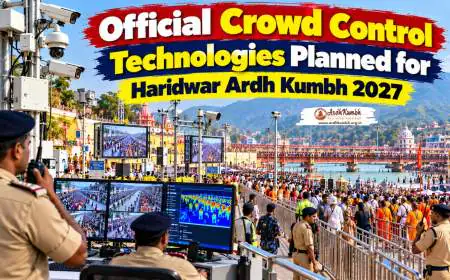
The most powerful tool in the Kumbh administrator's arsenal is no longer the baton; it is the algorithm. For the 2027 Simhastha Kumbh, authorities are deploying a staggering 4,011 AI-enabled CCTV cameras and 18 drones . But these are not just recording devices. They are a part of the "Kumbh AI Stack" —a system designed to watch the crowd and talk to the control room before humans even realize there is a problem .
How does this keep the peace without force? Predictive analytics. The system monitors the "density thresholds" of the crowd. If a particular ghat or pathway starts getting too crowded, the AI does not wait for a stampede to happen. It sends a "preventive alert" to the Integrated Command and Control Centre (ICCC) . The authorities then divert the flow of pilgrims upstream, slowing the arrival rate, or open a secondary gate.
Trending Guides Now

Ardh Kumbh 2027 Dates (Official) - Haridwar Snan Schedule
Read Guide →
Ardh Kumbh Mela 2027 Complete Guide – Dates, Snan, History, Akharas & Sacred Meaning
Read Guide →
How Ghats Are Prepared for Sacred Snan
Read Guide →
Prem Nagar Ghat Haridwar Complete Guide for Ardh Kumbh 2027 Visitors
Read Guide →
Dharamshala Stay During Ardh Kumbh: Free & Budget Guide
Read Guide →
Best Routes to Reach Haridwar for Ardh Kumbh Mela
Read Guide →
Official Progress Report of Haridwar Ardh Kumbh 2027 Infrastructure Projects
Read Guide →
Where to Find 24-Hour Pharmacies in Haridwar During Ardh Kumbh 2027 Emergencies
Read Guide →This is order without coercion. You are not being told to "move back" by a policeman shouting at you. You are simply guided by signage or subtly redirected by the flow of the crowd itself. The goal is to ensure that safety thresholds are never crossed, making physical force unnecessary.
The KumbhDoot: Your Digital Guide
A major source of chaos in large gatherings is confusion. People do not know where to go, where to park, or where the nearest water station is. Frustration leads to pushing, which leads to disorder. To solve this, the Nashik-Trimbakeshwar Kumbh Mela Authority (NTKMA) is developing KumbhDoot —an AI-powered multilingual assistant .
This assistant will be accessible via WhatsApp, a dedicated mobile app, and even IVR (Interactive Voice Response) for those without smartphones . Instead of yelling instructions through loudspeakers that no one can hear, the administration places the information in the palm of the pilgrim's hand. It answers queries about routes, lost and found, and medical facilities. When the crowd is informed, the crowd is calm. KumbhDoot maintains order by answering questions, thereby removing the anxiety that often leads to unruly behavior.
The Bus Network: Removing the Road Rage
One of the biggest threats to order at the Kumbh is the private vehicle. Cars, taxis, and buses fighting for space on narrow roads leading to Har Ki Pauri or Ramkund create gridlock and tension. The 2027 strategy in Nashik offers a remarkable solution: the 4,500-bus shuttle system .
Vehicles are stopped at the city's edge in designated parking nodes . From there, pilgrims are transferred to a fleet of MSRTC (Maharashtra State Road Transport Corporation) buses painted specifically for the Kumbh .
-
3,000 buses are dedicated to road shuttles.
-
1,500 buses connect the railway stations (Nashik Road, Deolali, etc.) to the holy sites .
By taking the steering wheel out of the hands of millions of individual drivers and putting it in the hands of trained professionals, the administration eliminates the chaos of traffic jams and road rage. During the Amrit Snan days, the core areas become pedestrian-only zones . When there are no cars, there are no collisions—physical or temperamental.
Mastering the Terrain: Disaster Preparedness
Order is maintained not just by what you see, but by the planning you never see. Long before the 2027 Kumbh, the Nashik Police conducted extensive workshops on Disaster Management . They did not just sit in offices; they called in retired officers who had survived previous Kumbhs to share the "ground reality."
A dedicated team of Nashik police even traveled to Prayagraj to study the Maha Kumbh 2025 . They studied how to manage "theft, accidents, and missing people" using new technologies. This learning is being integrated into a Rs 1,100 crore security budget . By anticipating the problems—medical emergencies, lost children, or sudden weather changes—the authorities maintain a state of preparedness rather than reaction. When the crowd sees that the system is functioning smoothly, they trust it, and trust prevents panic.
The Psychology of the Queue: Leadership Over Lathi
Ultimately, the Kumbh maintains order because the pilgrims themselves want order. The Naga Sadhus and Akhara leaders play a crucial role. They adhere to a strict bathing schedule—a hierarchy that has been respected (after centuries of fighting) since the British imposed rules in the 1790s.
By following their saints, the millions of ordinary devotees follow a behavioral script. They accept that they must wait in the queue. They accept that they must walk the designated path. This is soft power. The police are present, but their role is often to help a lost child or escort an elderly person, not to scold or strike. Chief Minister Devendra Fadnavis of Maharashtra reminded the public that the Kumbh represents the "inclusive spirit of Sanatan culture" where people gather "without discrimination" . By appealing to this spiritual unity, the administration ensures that the loudest voice enforcing the rules is conscience, not the constable.
Accessibility and Inclusivity
Order is also maintained by ensuring that no demographic feels left out. A stressed pilgrim is a difficult pilgrim. The Nashik Kumbh plans specifically for the elderly and women.
-
Dedicated Assistance: Centres for senior citizens and women are being set up .
-
Tech Accessibility: The KumbhDoot AI assistant is being designed to work even on basic feature phones, not just smartphones, ensuring that rural pilgrims are not left in the dark .
When basic needs (safety, information, sanitation) are met for everyone, the primary drivers of social unrest—inequality and neglect—are neutralized.
Learning from the Past
The 2027 approach is not happening in a vacuum. The administration in Nashik is building directly on the lessons of 2025 (Prayagraj) and the disaster of 1954. They have realized that force is a reaction to failure. The Kumbh Mela is so large that you cannot push back against the river of humanity; you must learn to flow with it, steering it gently.
By setting up Integrated Command and Control Centres (ICCCs) that merge drone feeds, CCTV data, and social media analytics, the state can now track the mood of the crowd . If people are stopping in the middle of a bridge to take selfies, causing a bottleneck, the AI spots it. A drone is dispatched. A volunteer is sent to ask them to keep moving. It is a gentle nudge—a force of guidance.
The Gentle Giant
The Ardh Kumbh is a miracle of logistics. It proves that you do not need an army to control the people if you give the people the tools to control themselves. The 4,011 cameras watch, the 4,500 buses move, the KumbhDoot guides, and the faith leads .
When you visit Haridwar or Nashik in 2027, you will likely not even notice the administrators—and that is precisely their intention. They are the invisible architects of a safe, sacred, and serene space, proving that the strongest force in human governance is not the baton, but the bus schedule.
Frequently Asked Questions