













































Can Ardh Kumbh Actually Change Your Life Direction?
Quit your job. Start a business. End a marriage. Find a guru. Does a 6-year pilgrimage really change lives? The honest answer with real transformations.

1. The "Reset Button" That Your Brain Cannot Find at Home
You cannot change your life direction from the same room where you got stuck. Your environment has inertia. Your bedroom remembers your depression. Your office chair remembers your burnout. Your kitchen table remembers your arguments.
When you go to the Ardh Kumbh, you leave all those physical anchors behind. You sleep in a new place. You eat different food. You wake up at different times. Your brain has no choice but to reboot. The neural pathways that kept you stuck go quiet because the cues for those pathways are 500 miles away.
How this changes life direction: In that neural silence, new thoughts can enter. "What if I quit?" "What if I move?" "What if I am allowed to be happy?" You did not "think" these thoughts. The Kumbh created the space for them to arrive.
2. The Crowd Shows You What You Are Not
Here is a strange thing about the Kumbh. You see millions of people living lives completely different from yours. A sadhu who owns nothing and seems happier than your CEO. A farmer who walks 200 miles and smiles more than your neighbor with the new BMW. A family with seven children living in one tent and laughing louder than your dinner parties.
Seeing these contrasts punches a hole in your excuses. "I cannot quit because I need the money." Then you meet a sadhu with no money who is radiant. "I cannot leave my unhappy marriage because of the children." Then you meet a single mother at the Kumbh who is thriving.
How this changes life direction: The Kumbh shows you proof that your prison might have an open door. You just never looked up to see it.
3. The Dip Is a Death (And You Get to Choose What Comes Next)
Let me get symbolic but also real. The holy dip in the Ganga is supposed to "wash away sins." But forget sins for a moment. Think of it as washing away your old story.
When you go under that cold water, your body experiences a shock. Your heart rate spikes. Your breath stops. For a second, you die—symbolically. When you come up, gasping and alive, your brain is primed for rebirth. It is not magic. It is physiology. Extreme temperature change + ritual context = psychological reset.
How this changes life direction: In the 30 seconds after the dip, while you are still shivering and dripping, your defenses are down. If you whisper to yourself, "I am starting over," your brain believes you. That whisper becomes a marching order for the next year.
4. The Absence of Distraction Forces Big Questions
At home, you have distractions everywhere. Netflix. Instagram. News. Work emails. House chores. You never sit with the big questions because the small questions are louder.
At the Kumbh, what distractions are there? You have no WiFi (mostly). You have no delivery apps. You have no TV. You have... yourself. And miles of walking. And hours of waiting. And cold nights when you cannot sleep.
In that vacuum, the big questions rise: "Why am I doing this job?" "Why am I with this person?" "Why am I living in this city?" "What do I actually want?"
How this changes life direction: The questions are the compass. The Kumbh does not give you answers. It forces you to ask the right questions. And the right question is 90% of the answer.
Trending Guides Now

Is Ardh Kumbh a Once-in-a-Lifetime Experience?
Read Guide →
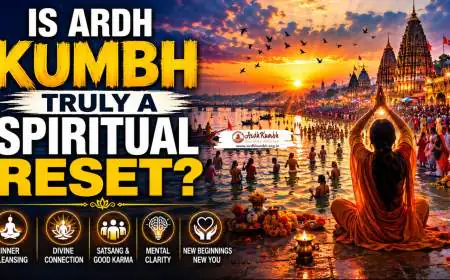
Why Ardh Kumbh Feels Like a Spiritual Reset
Read Guide →
Is Ardh Kumbh a Gateway to Spiritual Life? Or Just a Dip in Cold Water?
Read Guide →
Ardh Kumbh Meaning: Beyond Holy Bath Explained
Read Guide →
Best Routes to Reach Haridwar for Ardh Kumbh Mela
Read Guide →
Essential Rules Every Ardh Kumbh 2027 Pilgrim Must Follow
Read Guide →
Who Are Naga Sadhus and Why They Lead Kumbh
Read Guide →
Biggest Crowds Ever Recorded at Ardh Kumbh
Read Guide →5. You Meet Your "Alternative Future Self"
At the Kumbh, you will meet people who made the leap you are afraid to make. The corporate lawyer who became a yoga teacher. The doctor who quit to run an NGO. The engineer who now paints icons for temples.
These are not fantasies. They are flesh and blood. They have wrinkles and worries like you. But they also have peace in their eyes that you envy. And they will tell you, "I did it. You can too."
How this changes life direction: Seeing a living example of your dream life destroys the excuse that "it is impossible." If Rajesh from Indore can quit his bank job to make puppets, maybe you can quit your marketing job to open that bakery.
6. The Hardship Breaks Your "I Can't" Muscle
You think you "cannot" quit your job because you "cannot" handle uncertainty. The Kumbh disagrees with you. Look at what you voluntarily endured: cold, hunger, tiredness, getting lost, bathroom lines, sleeping on the ground.
You did it. You survived. And you are proud of yourself. The hardship at the Kumbh is not punishment. It is evidence. Evidence that you are stronger than your fears.
How this changes life direction: When you return home and your boss stresses you out, you think, "I slept on a railway platform for three days. I can handle a deadline." The Kumbh raises your tolerance for discomfort. And life change requires tolerating discomfort.
7. The "Chance Encounter" That Changes Everything
Here is the magic that skeptics hate. People at the Kumbh constantly report "coincidences" that seem too perfect. You meet a guru who gives you a mantra that solves your anxiety. You meet a business partner while waiting for chai. You meet your future spouse in the langar line.
Is it divine intervention? Or is it just statistics? When you are surrounded by millions of people for weeks, the probability of a life-changing encounter is extremely high. The Kumbh is a density engine for serendipity.
How this changes life direction: You cannot plan these encounters. But you can show up for them. Go to the Kumbh with open hands, not a tight schedule. Say "yes" to chai with strangers. Sit next to people on the train. The encounter that changes your life is statistically waiting for you.
8. The Silence After the Kumbh (The Real Transformation)
Here is the part no one talks about. The Kumbh itself is chaotic. The transformation does not happen during the Kumbh. It happens in the weeks after, when you are back in your normal life and the contrast hits you.
You sit at your desk and think, "I chanted with a million people at sunrise. Why am I worried about this spreadsheet?" You look at your partner and think, "I bathed in a river to wash away my sins. Why am I holding onto this grudge?" You look at your shopping cart and think, "I slept on the ground and was happy. Why do I need this thing?"
How this changes life direction: The real change happens when the Kumbh becomes your new baseline. Your old "normal" now looks small. And you will naturally move toward bigger things.
9. Real Stories: The Lawyer Who Quit
I met a corporate lawyer at the Ardh Kumbh. He was 42. He had a house, a car, a six-figure salary, and ulcers. He came to the Kumbh because his mother begged him. He was miserable the first two days. "Too many people. Too much dirt. No coffee."
On the third day, he sat by the Ganga at sunset. He watched a boatman rowing his boat with effortless joy. The boatman had nothing. The lawyer had everything. The lawyer started crying and did not know why.
He went home. He gave his three months' notice. He took a pay cut and joined a legal aid clinic for the poor. He makes less money. His ulcers are gone. He goes to the Kumbh every six years now—not as a tourist, but as a pilgrim.
What changed? The Kumbh did not give him a new job. It gave him permission to choose peace over prestige. He already had the courage inside him. The Kumbh unlocked it.
10. Real Stories: The Marriage That Ended
A woman I spoke with (she asked to remain anonymous) came to the Kumbh with her husband. The marriage had been dead for years. They stayed together "for the children" and "for society." At the Kumbh, they could not pretend anymore. In the crowd, they lost each other. She did not look for him for three hours. And in those three hours, she felt relief. Not panic. Relief.
When they found each other, she said, "I do not want to look for you anymore. Not here. Not at home." They separated after the Kumbh. The children were upset for a year. Then they saw their mother laugh for the first time in a decade. Now they thank her.
What changed? The Kumbh created distance—physical and emotional—that made the truth unavoidable. Sometimes you need 10 million strangers to remind you that you do not have to stay miserable just because you made a promise 15 years ago.
11. Real Stories: The Business That Started
A young man from a small town was working a call center job he hated. He came to the Kumbh with his uncle. He had no intention of changing anything. In the Mela grounds, he kept seeing handmade products—clay cups, wooden toys, natural soaps, incense sticks. He thought, "People are buying these. Why is no one selling them online?"
He took photos. He collected business cards. He went home, researched, and started an e-commerce store selling Kumbh-inspired handicrafts. Within two years, he was making three times his call center salary. He now employs 15 artisans from his village.
What changed? The Kumbh is an economic ecosystem. If you have business eyes, you will see opportunities everywhere. The crowd is not just pilgrims. It is consumers. It is suppliers. It is markets. The Kumbh changed his career because he paid attention.
12. Why It Might Not Work For You (Honesty Time)
I have to be honest. The Kumbh does not change everyone. Some people go, take the dip, eat the prasad, and go home and nothing changes. Why?
Because they went as tourists, not pilgrims. They stayed in their comfort bubble (VIP tents, private cars, bottled water). They did not talk to strangers. They did not sit in the cold. They did not walk the extra mile. They watched the Kumbh like a movie. They were never in it.
The rule: The Kumbh changes you in direct proportion to how much you participate. If you volunteer at a langar, you will change more than if you hire a private chef. If you walk to the ghat instead of taking a car, you will change more. If you talk to the sadhu instead of photographing him from a distance, you will change more.
You get out what you put in. The Kumbh is a mirror. It shows you who you are. If you do not like what you see, that is the first step to changing it.
13. The One Question You Must Ask Yourself
Before you go to the Ardh Kumbh, sit down alone. Ask yourself one question. Write it down. Put it in your wallet.
"What is the one thing I am pretending is not broken?"
Do not ask for ten things. Ask for one. The thing you have been avoiding. The conversation you have not had. The decision you have not made. The apology you have not given. The dream you have not chased.
Take that question to the Kumbh. Walk with it. Sleep with it. Chant with it. Bathe with it. And when you come up from the cold water, gasping and alive, ask it again.
The answer may not come as a voice. It may come as a feeling. A nudge. A stranger's sentence. A dream that night.
But it will come. And when it does, you will know what to do.
That is how the Ardh Kumbh changes your life direction. Not by instructing you. But by asking you. And waiting for you to be brave enough to answer.
Frequently Asked Questions