














































































Complete Walking Guide from Haridwar Railway Station to Har Ki Pauri During Ardh Kumbh 2027
Walk from Haridwar Railway Station to Har Ki Pauri during Ardh Kumbh 2027 with this step-by-step route guide covering distance, landmarks, zero zone rules and crowd tips.
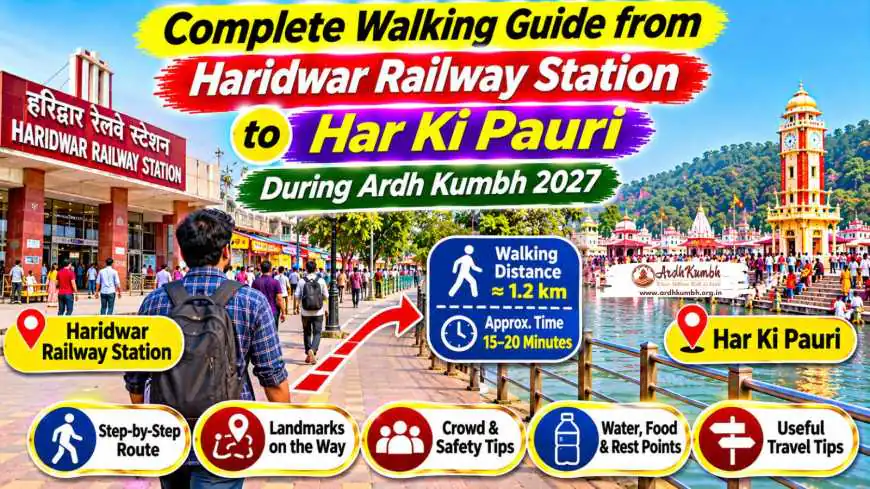
Complete Walking Guide from Haridwar Railway Station to Har Ki Pauri During Ardh Kumbh 2027
Quick Answer ⚡
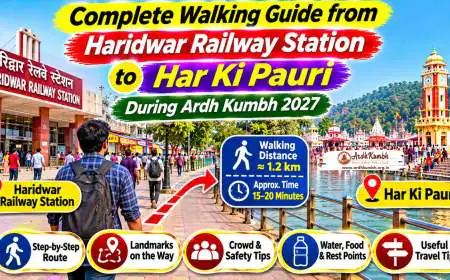
The Haridwar Railway Station to Har Ki Pauri walking distance is approximately 2 km (2.1 km on foot) , and the walk takes 25–30 minutes at an easy pace on an ordinary day . The route runs from the station through Shivmurti, across Laltaro Pul, past Valmiki Chowk and the Post Office, then along lanes beside Old National Highway 58 to the ghat. During Ardh Kumbh 2027, walking becomes the most reliable option on Amrit Snan dates (6 March, 8 March, and 14 April) because vehicle movement is restricted near Har Ki Pauri and the Upper Road from the Post Office to Har Ki Pauri has been declared a zero zone .
At a Glance 🔎
The Route, Step by Step: Every Landmark Explained
The walking route from Haridwar Railway Station to Har Ki Pauri is not complicated, but knowing each landmark turns a stressful first walk into a predictable one. Here is the sequence, measured from the station exit.
Stage 1: Station Exit to Shivmurti (0 km to 0.2 km)
Exit Haridwar Junction and head east. The first landmark is Shivmurti — a Shiva statue at roughly 200 metres from the station. This is your orientation point. If you are walking, you are on the correct road. If you are taking an e-rickshaw or auto, this is where the shared-ride negotiations typically begin.
Local Insight 📍 During Kumbh, the station may operate separated entry and exit routes to manage pilgrim flow. Follow the exit signage rather than trying to cut back through the platform side.
Trending Guides Now

Haridwar Railway Station Retiring Rooms: Booking Process, Charges and Facilities
Read Guide →
Electric Bus Services in Haridwar: Routes, Timings and Fares
Read Guide →
Haridwar Bus Stand to Har Ki Pauri During Ardh Kumbh 2027: Complete Local Transport Guide
Read Guide →
Haridwar Shuttle Bus Services During Ardh Kumbh 2027: Routes, Timings and Fare Guide
Read Guide →
Ardh Kumbh 2027 Dates (Official) - Haridwar Snan Schedule
Read Guide →
Dharamshala Stay During Ardh Kumbh: Free & Budget Guide
Read Guide →
Essential Safety Tips for Women Using Public Transport in Haridwar During Ardh Kumbh 2027
Read Guide →
History of Mansa Devi Temple Haridwar and Its Sacred Traditions During Ardh Kumbh 2027
Read Guide →Stage 2: Shivmurti to Laltaro Pul (0.2 km to 0.6 km)
Continue east to Laltaro Pul (also spelled Lalitarao bridge) at roughly 600 metres. This bridge is a natural bottleneck during mela days. Police may channel pedestrians into a single direction here. Keep your group together and do not stop on the bridge to take photos.
Expert Tip 💡 If you are walking with elderly parents, treat Laltaro Pul as a rest checkpoint. There is usually shade on the approach, and the bridge crossing itself is short. Slow down before the bridge, not on it.
Stage 3: Laltaro Pul to Bhagwan Valmiki Chowk (0.6 km to 0.7 km)
Just past the bridge lies Bhagwan Valmiki Chowk at about 700 metres. This is a junction point where local traffic and pedestrians mix. On crowded days, police barricades may redirect you away from the shortest line. Follow the barricades, not your phone map. The mela administration prioritises one-way pedestrian movement near the ghats.
Stage 4: Valmiki Chowk to Post Office (0.7 km to 1 km)
The Post Office sits at roughly 1 km from the station. This is the most important landmark on the route for Ardh Kumbh 2027. The Upper Road from the Post Office to Har Ki Pauri is the zero zone boundary. Beyond this point, private vehicles are not permitted, and even e-rickshaws may be restricted on peak days.
Expert Advice ✨ If you are carrying luggage or travelling with someone who cannot walk the final kilometre, the Post Office is your last practical drop-off point for a vehicle. Plan your e-rickshaw or auto ride to end here, not at the ghat.
Stage 5: Post Office to Mansa Devi Ropeway Lower Station (1 km to 1.3 km)
From the Post Office, the route continues toward the Mansa Devi ropeway lower station at roughly 1.3 km. This is a useful orientation marker: if you see the ropeway station, you are one-third of the way from the ghat in terms of remaining walking time, but the crowd density usually increases from here.
Pro Tip 🧭 The ropeway itself is a senior-friendly way to visit Mansa Devi, but it is not part of the walking route to Har Ki Pauri. Do not confuse the ropeway queue with the ghat walking queue on busy days.
Stage 6: Mansa Devi Ropeway to Raja Birla Clock Tower (1.3 km to 2 km)
Continue to the Raja Birla Clock Tower at roughly 2 km. The clock tower is the final visual landmark before Har Ki Pauri. From here, the ghat is within sight on most days, but the final approach can be slow because of crowd channeling.
Stage 7: Raja Birla Clock Tower to Har Ki Pauri (2 km)
The last stretch brings you to Har Ki Pauri. On ordinary days, this is a straightforward walk. On Shahi Snan days, expect barricaded lanes, holding areas, and police-directed one-way flow. The final 200–300 metres may take longer than the previous kilometre if the ghat is at capacity.
How Ardh Kumbh 2027 Changes the Walk
The walking route itself does not change dramatically. What changes is the management of the route.
The Zero Zone and Vehicle Restrictions
The area around Har Ki Pauri, including Upper Road from the Post Office to Har Ki Pauri and the Bhimgoda area beyond it, has been declared a zero zone for vehicles. This means:
-
Private cars and taxis cannot enter the final kilometre.
-
E-rickshaws may be restricted near the ghat, especially during aarti and Shahi Snan.
-
Ganga Sarathi electric golf carts operate from the Post Office to Har Ki Pauri and onward to the Bhimgoda barrier at a fare of ₹25 per person, introduced specifically with the 2027 Kumbh in mind.
Expert Tip 💡 The Ganga Sarathi cart is a useful backup for elderly parents who can walk 1 km but not 2 km. Walk from the station to the Post Office, then take the cart for the zero-zone stretch. Confirm operating hours on the day, as services may pause during peak aarti or processions.
Pedestrian Corridors and Holding Areas
The inner city near Har Ki Pauri becomes a pedestrian-only zone during the mela. The administration is building barricaded walking lanes, one-way pedestrian movement, emergency diversion gates, and rope-channeling near ghats. On Shahi Snan days, pilgrims may be directed into holding areas before being released toward the ghat in batches.
Local Insight 📍 On 6 March, 8 March, and 14 April 2027, plan for significantly longer walking times and possible waits in holding zones. The mela administration has not published a fixed walking route from the station as of the latest available information, so follow police directions on the day rather than relying on a static map.
Walking vs. Other Transport: A Practical Comparison
Walking is not the only option, but during Ardh Kumbh 2027 it is often the most predictable one.
Expert Advice ✨ On Amrit Snan dates, do not plan around taxis or autos reaching the ghat. The last 1–1.5 km is pedestrian-only, and vehicle queues can add 30–60 minutes to a journey that walking would complete in 25 minutes. Walk, or walk to the Post Office and use the Ganga Sarathi cart.
Best Time to Walk: Timing That Protects Your Energy
The time of day changes the walking experience more than the distance does.
Morning Walk (5:00 AM to 8:00 AM)
-
Coolest temperatures, especially in February and March.
-
Highest crowd density near the ghat because of morning snan and aarti.
-
Best for: Pilgrims attending Mangala Aarti or early snan who are steady on their feet.
Mid-Morning Walk (8:00 AM to 11:00 AM)
-
Comfortable temperatures in February; warming by late March.
-
Crowds begin to thin after the morning snan rush.
-
Best for: Elderly parents and families who want darshan without the pre-dawn crush.
Afternoon Walk (12:00 PM to 4:00 PM)
-
Hottest window, especially in April when temperatures can reach 35°C.
-
Less crowded, but heat exhaustion risk is real for senior pilgrims.
-
Avoid if your parents have blood pressure or heart conditions.
Evening Walk (5:00 PM to 8:00 PM)
-
Comfortable temperatures after sunset.
-
Ganga Aarti crowd builds rapidly between 5:30 PM and 6:30 PM.
-
Best for: Aarti attendance if you arrive early and claim a seated spot before the crush.
Pro Tip 🧭 For elderly parents, the mid-morning window (9–11 AM) is usually the sweet spot: the worst heat has not arrived, the pre-dawn crowd has dispersed, and the ghat is still active with ritual life.
Safety and Comfort Tips for the Walk
Footwear and Clothing
-
Non-slip rubber-soled shoes are essential. The ghat steps and bazaar lanes can be wet and uneven.
-
Loose cotton clothing for February–March; light layers for January mornings; sun hat and sunglasses for April.
-
Avoid new footwear on the walking day. Break in your shoes before travelling.
What to Carry
| Item | Why It Matters |
|---|---|
| Water bottle | Dehydration is the most common pilgrim health issue; refill at hotel or trusted water points |
| ORS sachets | For elderly parents or children if heat or fatigue sets in |
| Small snacks | Dry fruits or biscuits for energy during holding-area waits |
| Charged phone | For emergency calls, maps, and contacting separated group members |
| Emergency numbers | 112 (police), 108 (ambulance), 01334-223999 (District Emergency Operations Centre) |
| Printed hotel address | In case your phone dies or network is congested |
| Light rain jacket | February can bring unexpected showers |
Group Coordination
-
Set a meeting point before starting the walk — the Raja Birla Clock Tower or the Post Office are easy to find.
-
Keep children and elderly parents in the middle of the group, not at the front or back.
-
Agree on a check-in time if the group separates — every 30 minutes is practical on crowded days.
-
Write the hotel name and phone number on a piece of paper and keep it in your parent’s pocket.
Expert Tip 💡 In a crowd, visual contact is more reliable than phone calls. Network congestion near Har Ki Pauri can make calls and messages fail. Teach your group to stop and look at the agreed landmark rather than walking in circles while calling.
Walking with Elderly Parents: Pace, Rest, and Realistic Expectations
The station-to-ghat walk is flat for most of its length, but 2 km in a crowd is not the same as 2 km in a park.
A Realistic Pace Plan for Seniors
| Stage | Action | Time |
|---|---|---|
| Station to Shivmurti | Walk slowly, observe the road, adjust footwear | 5–7 min |
| Shivmurti to Laltaro Pul | Rest on the approach to the bridge if needed | 8–10 min |
| Laltaro Pul to Post Office | Walk at a conversational pace; stop for water | 10–12 min |
| Post Office to Clock Tower | Use the Ganga Sarathi cart if fatigue sets in | 10–15 min or cart |
| Clock Tower to Har Ki Pauri | Slow, steady final approach; hold hands in crowd | 5–10 min |
| Total | With rests and cart | 40–55 min |
Local Insight 📍 The Post Office is the most practical rest point on the route. There is shade, space to stand aside from the main flow, and access to the Ganga Sarathi cart. If your parents are struggling before the Post Office, stop and reassess rather than pushing to the ghat.
When Walking Is Not the Right Choice
-
Wheelchair users without a dedicated attendant: the crowd and uneven surfaces make the final kilometre difficult.
-
Parents with advanced heart or lung conditions: crowd stress and heat can trigger breathlessness.
-
Heavy luggage: the walk is not designed for trolley bags on crowded days.
-
Late arrival after dark: unfamiliar lanes and crowd movement are harder to navigate at night.
Expert Advice ✨ If any of these apply, stay closer to the ghat rather than saving on accommodation. A hotel near Har Ki Pauri or Ram Ghat reduces the walking burden to 5–10 minutes, which is a better investment than saving ₹500 on a distant room.
Luggage, Toilets, and Practical Logistics
Luggage Storage at the Station
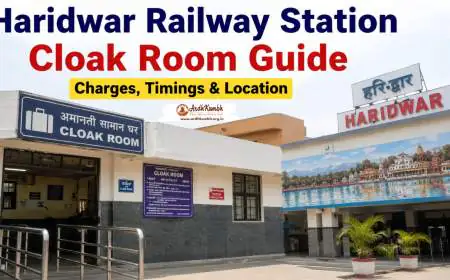
Haridwar Junction has a cloak room where you can store luggage for a few hours while you walk to the ghat and return. This is useful for same-day pilgrims who arrive by train and plan to bathe before travelling onward. Confirm timings and charges at the cloak room counter on arrival, as Kumbh demand may affect availability.
Toilets on the Route
-
Station toilets are available but crowded on peak days.
-
Hotel and dharamshala toilets are for guests, not public use.
-
Public toilet blocks near the Post Office and ghat area are the practical options; carry tissue and hand sanitiser.
-
First aid tents near the ghat may have basic facilities, but do not rely on them for toilet access.
Pro Tip 🧭 Use the toilet at the station before starting the walk. The next reliable public toilet may be 1 km away, and queue times can be long during aarti hours.
Drinking Water
Carry a refillable bottle. Hotel water is safer than unknown public taps. First aid tents may provide ORS, but do not assume they have drinking water for everyone.
Night Walking: Is It Safe?
Walking from the station to Har Ki Pauri after dark is generally safe because the route is busy and well-lit in normal times. During Kumbh, the mela area is crowded and police-patrolled, but unfamiliar lanes off the main route can be confusing.
Night Walking Rules
-
Stick to the main road — Station → Shivmurti → Laltaro Pul → Valmiki Chowk → Post Office — rather than shortcuts through dark lanes.
-
Walk in a group if possible.
-
Keep your phone charged and emergency numbers saved.
-
Avoid isolated stretches after 10 PM if you are alone.
-
Follow police directions if a route is closed for crowd management.
Expert Tip 💡 If you arrive by a late train, consider taking a shared auto or e-rickshaw to your hotel rather than walking with luggage at night. The walk is safe in daylight and crowd hours; late-night luggage walking is unnecessary risk.
What to Do If You Get Separated in the Crowd
Crowd separation is the most common problem families face near Har Ki Pauri. The mela administration operates lost-and-found centres and police help booths, but prevention is better than searching.
Prevention Steps
-
Dress children in bright colours and write a phone number on a paper slip in their pocket.
-
Give elderly parents a whistle if they can use one; it cuts through crowd noise.
-
Agree on two meeting points: one before the ghat (e.g., Raja Birla Clock Tower) and one near the hotel.
-
Take a photo of your group at the start of the walk so you have a recent reference.
If Separation Happens
-
Do not keep walking in the crowd. Move to the side or a police booth.
-
Call the emergency number and state your location using the nearest landmark.
-
Ask a police officer or mela volunteer for help. Do not leave the area to search randomly.
-
Use the lost-and-found announcement system if available at the ghat or station.
Local Insight 📍 The police booths near Har Ki Pauri and the Post Office are the fastest points of help. In a separation, governance of the crowd is easier from a fixed point than from inside the flow.
Final Walking Checklist Before You Leave the Station
-
☑ Use the toilet at the station before starting.
-
☑ Store heavy luggage in the cloak room if you are returning the same day.
-
☑ Fill water bottles and carry ORS.
-
☑ Confirm the route with a police officer or station help desk if it is a Shahi Snan day.
-
☑ Set the meeting point — Raja Birla Clock Tower or Post Office.
-
☑ Check footwear — non-slip soles, secured laces.
-
☑ Keep emergency numbers (112, 108, 01334-223999) on the lock screen of your phone.
-
☑ Walk at a pace that allows conversation; if anyone is breathless, stop.
-
☑ Follow barricades and police direction — do not rely on a static map during crowd management.
-
☑ Stay together — the walk is short, but the crowd rewards patience over speed.
Expert Tip 💡 The walk from Haridwar Railway Station to Har Ki Pauri is one of the simplest pilgrim routes in India when planned well. The distance is short, the landmarks are clear, and the mela administration is investing in pedestrian infrastructure for 2027. The families who struggle are usually the ones who rush, carry too much, or ignore the zero-zone rules. Walk slowly, follow the flow, and treat the 2 km as the first ritual of your Kumbh — not an obstacle between you and the Ganga.
Frequently Asked Questions