























































Why Collective Living Is Encouraged at Kumbh
Discover why Kumbh Mela encourages collective living. Community bonds, ego dissolution, shared resources, and spiritual growth through togetherness.

The Death of the Private Self - Why Sharing Space Matters
Let me start with the deepest reason why collective living is encouraged at Kumbh. Because your private self is an illusion. Not a lie. An illusion. You have been taught, by modern society, that you are a separate individual. That your body is a container. That what happens inside your body stays inside. That your thoughts, your feelings, your struggles are yours alone.
Kumbh disagrees. At Kumbh, you cannot hide. You sleep in a tent with twenty other people. You hear them snore. You smell their bodies. You see them cry. You see them laugh. You see them at their worst - exhausted, irritated, sick, scared. And you see them at their best - generous, patient, kind, brave.
When you share space like this, the walls between you and others start to dissolve. You realize that the person snoring next to you is not a stranger. They are a human being with the same fears, the same hopes, the same exhaustion as you. You realize that your private struggles are not private at all. Everyone is struggling. Everyone is tired. Everyone is scared. You are not alone. You never were.
This is collective living as spiritual practice. It is the antidote to the loneliness of modern life. We live in houses with locked doors. We live in cars with tinted windows. We live in headphones that block out the world. We have built a world where we can live without ever truly being seen by another person. And we are miserable because of it.
Trending Guides Now

Har Ki Pauri Ganga Aarti Time Today in Haridwar
Read Guide →
Complete Guide to Ardh Kumbh Rituals
Read Guide →
Ardh Kumbh Mela Rituals Explained Shahi Snan & Akhara Traditions
Read Guide →
Why Order and Cleanliness Are Strictly Enforced
Read Guide →
Best Routes to Reach Haridwar for Ardh Kumbh Mela
Read Guide →
Essential Rules Every Ardh Kumbh 2027 Pilgrim Must Follow
Read Guide →
Who Are Naga Sadhus and Why They Lead Kumbh
Read Guide →
Biggest Crowds Ever Recorded at Ardh Kumbh
Read Guide →Kumbh throws you into the deep end of collective living. You cannot lock your door because there is no door. You cannot hide in your headphones because you need to hear the announcements about the dip. You cannot pretend that you are fine when you are not, because the person next to you will see right through you.
This visibility is terrifying at first. And then it is liberating. Because when you stop trying to protect your private self, you realize that you have nothing to protect. The self that you thought was so precious, so fragile, so in need of privacy - it is not real. It is a construction. And collective living tears down that construction. What remains is something simpler. Something connected. Something peaceful.
That is why collective living is encouraged at Kumbh. Not because there is not enough space (though there is not). Because you need to be broken open. And sharing space with strangers is the most effective hammer ever invented.
The End of Specialness - How Collective Living Humiliates the Ego
Let me talk about something that collective living at Kumbh does better than almost anything else. It destroys your ego. Not through violence or humiliation. Through ordinary, everyday, unavoidable togetherness.
In your normal life, you are special. You have your own room. Your own things. Your own schedule. Your own preferences. You have arranged the world to accommodate your specialness. The temperature is set to what you like. The food is cooked to your taste. The bed is firm or soft according to your preference.
At Kumbh, none of that exists. The tent is too hot or too cold for everyone. The food is simple and the same for everyone. The ground is hard for everyone. You have no control. You have no special privileges. You are not special. You are one among millions.
Your ego will hate this at first. Your ego will complain. "I deserve a better spot. I deserve softer ground. I deserve food that I actually like." Listen to that complaint. That is your ego screaming because it is being starved. Collective living at Kumbh is an ego diet. And like any diet, it is uncomfortable at first. But eventually, the ego stops screaming. It shrinks. It becomes quieter. It stops demanding special treatment.
And when the ego shrinks, something beautiful happens. You start to enjoy the collective. You stop noticing that the ground is hard because you are too busy talking to the person next to you. You stop caring that the food is simple because you are too grateful to be eating at all. You stop wanting special treatment because you have discovered that being ordinary is actually a relief.
This is the spiritual genius of collective living at Kumbh. It does not try to convince you that your ego is bad. It just creates conditions where the ego cannot survive. And when the ego dies a little, your heart opens a little. And that opening is the whole point of the pilgrimage.
Shared Resources - The Practical Genius of Living Together
Let me move from the spiritual to the practical. Because collective living at Kumbh is not just about ego dissolution. It is also about survival. Fifty million people cannot each have their own tent, their own kitchen, their own bathroom. There is simply not enough space. Not enough resources. Not enough anything.
So collective living is not just encouraged. It is necessary. And what begins as necessity becomes virtue. Let me explain.
When you live collectively, you share everything. You share the tent. You share the space. You share the water. You share the food. You share the blankets when someone is cold. You share the phone when someone needs to call home. You share the information about when the dip will happen.
Sharing reduces waste. One kitchen can feed a hundred people with less fuel than a hundred individual kitchens. One tent can shelter twenty people with less material than twenty individual tents. One water tap can serve a thousand people with less infrastructure than a thousand individual taps.
Sharing also reduces inequality. At Kumbh, the richest person and the poorest person sleep in the same tent. They eat the same food. They wait in the same line. There is no VIP section for sleeping. There is no first class for eating. Collective living is the great leveler. It reminds everyone that at the most basic level - the need for shelter, food, water, warmth - we are all the same.
This is a lesson that the modern world has forgotten. We have built a society of extreme inequality where the rich live in bubbles and the poor live in squalor. Kumbh shows a different way. Not a way of forced equality through laws and taxes. A way of voluntary sharing through collective living. When you choose to live collectively, you choose to share. Not because you are forced. Because you see that sharing makes life better for everyone, including yourself.
This is the practical wisdom of collective living at Kumbh. It is not just spiritual. It is economic. It is social. It is environmental. And it is a model that the rest of the world could learn from. If we lived more collectively, we would need less stuff. We would waste less. We would fight less. We would be happier. Kumbh proves this every six years with fifty million witnesses.
The Disappearance of Loneliness - Finding Your Tribe
Let me talk about something that collective living at Kumbh does that is deeply healing. It cures loneliness. Not the loneliness of being alone. The loneliness of being surrounded by people who do not see you.
Modern life is full of this kind of loneliness. You can live in a city of millions, ride a packed train every day, work in an office full of people, and still feel completely alone. Because the people around you are not connected to you. You are just bodies occupying the same space. You do not share struggles. You do not share purpose. You do not share vulnerability.
At Kumbh, collective living changes this. You share struggles - the cold, the fatigue, the waiting. You share purpose - the dip, the blessings, the pilgrimage. You share vulnerability - you see each other tired, messy, emotional, real.
When you share these things, loneliness disappears. Not because you are never alone. Because you are never invisible. The people around you see you. They know you. They have held your place in line while you ran to the bathroom. They have shared their chai with you when you had nothing. They have helped you find your lost child. These are not strangers anymore. They are your tribe. Temporary, maybe. But real.
Collective living at Kumbh creates tribes out of crowds. It transforms millions of individuals into one community. Not a community of shared belief - though that helps. A community of shared experience. The experience of Kumbh. The dip. The wait. The cold. The walk . The sleep on hard ground. These experiences bind people together in ways that words cannot.
When you leave Kumbh, you will not remember the names of most people you lived with. But you will remember their faces. You will remember their kindness. You will remember that you were not alone. And that memory will stay with you. On the hard days. On the lonely days. You will remember that you once belonged to a community of fifty million. And that belonging will keep you going.
This is why collective living is encouraged at Kumbh. Not for the spiritual alone. For the human. Because humans need belonging more than they need almost anything else. And Kumbh gives belonging in abundance.
The Transmission of Skills - Learning from the Collective
Let me talk about a practical benefit of collective living that is rarely discussed. Skill transmission. When you live collectively, you learn from the people around you. You learn how to make a better tent. How to start a fire with wet wood. How to treat blisters. How to find your way in the dark. How to stay calm when the crowd surges.
These are not skills you can learn from a book or a video. They are embodied skills. Passed from person to person through observation and imitation. The collective is a school. And the teachers are the experienced pilgrims who have been coming to Kumbh for decades.
Watch an old pilgrim set up their sleeping space. They do it quickly, efficiently, with minimal movement. They know exactly where to put their blanket to avoid the cold draft. They know how to arrange their belongings so nothing gets lost. They know how to roll everything up in the morning so it fits in a small bag.
A first-timer watches and learns. By the end of Kumbh, the first-timer has absorbed these skills. Not through formal instruction. Through collective living. Through being in the same space as people who know more than them.
This is how pilgrimage knowledge has been transmitted for thousands of years. Not through books. Through bodies living together. Through observation. Through imitation. Through collective practice.
Modern education has forgotten this. We put people in classrooms. We give them textbooks. We test them on information. But we do not teach them how to live together. How to share space. How to help a stranger. How to endure discomfort. Kumbh teaches these things because collective living teaches these things. And the skills you learn at Kumbh - patience, adaptability, resourcefulness, generosity - are useful everywhere. Not just at pilgrimages. At home. At work. In life.
Collective living is not just a spiritual practice. It is a practical education. And Kumbh is the world's largest classroom.
The Joy of Shared Suffering - Why Misery Loves Company
Let me be honest about something that sounds strange but is deeply true. Collective living at Kumbh involves shared suffering. You are cold. So is everyone else. You are tired. So is everyone else. You are hungry. So is everyone else. You are frustrated. So is everyone else.
This shared suffering does not make the suffering worse. It makes it bearable. When you are cold alone, you feel miserable. When you are cold with a hundred other people who are also cold, you feel connected. The suffering does not disappear. But the isolation does. And isolation is often worse than the suffering itself.
Think about it. Why is surgery less painful when you are awake and the doctor is talking to you? Why is exercise easier in a group than alone? Why is grief lighter when shared with friends? Because shared suffering is not suffering multiplied. It is suffering divided. The collective carries the weight together. No one person bears the whole burden.
At Kumbh, this division of suffering is visible everywhere. You see a family huddled together against the cold. You see a group of sadhus sharing a thin blanket. You see strangers holding hands as they walk through a difficult path. They are not just enduring together. They are transforming their suffering into connection.
This is one of the deepest reasons why collective living is encouraged at Kumbh. Because suffering is inevitable at Kumbh. The cold. The crowds. The discomfort. They cannot be avoided. But they can be shared. And when they are shared, they become something else. Something almost sacred.
The joy of shared suffering is real. It is the joy of knowing that you are not alone. That others are going through the same thing. That you are part of something larger than your own pain. This joy is not the loud, laughing kind. It is the quiet, tearful kind. The kind that comes from connection. The kind that Kumbh gives freely to everyone who lives collectively.
The Rhythm of Collective Life - How Routine Creates Harmony
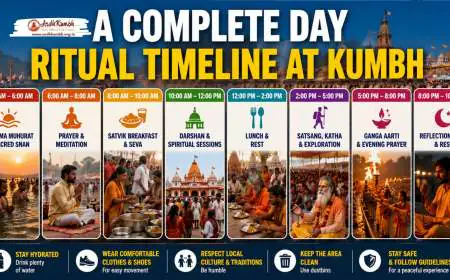
Let me end this section with a reflection on routine. Collective living at Kumbh has a rhythm. You wake up at the same time as everyone else - early, before the sun. You walk to the Ganga with the crowd. You wait in line together. You take your dip together. You eat together. You rest together. You sleep together.
This rhythm is not imposed by any authority. It emerges from the collective. Everyone wakes up early because the dip is best at dawn. Everyone eats at similar times because the bhandaras serve at set hours. Everyone sleeps when it gets dark because there is nothing else to do.
This shared rhythm creates harmony. When everyone is doing the same thing at the same time, there is less friction. You are not trying to sleep while someone else is cooking. You are not trying to meditate while someone else is shouting. The collective moves together, like a flock of birds or a school of fish. No one is leading. Everyone is following the rhythm.
This rhythm is soothing. It quiets the mind. You do not have to make decisions about when to wake, when to eat, when to sleep. The collective decides for you. You just follow. And in following, you find peace.
Modern life has no rhythm like this. Everyone wakes at different times. Eats at different times. Sleeps at different times. Works at different times. This asynchrony is exhausting. You are always negotiating. Always planning. Always trying to coordinate with people who are on different schedules.
Kumbh offers a break from this exhaustion. For a few days or weeks, you surrender to the collective rhythm. You stop making decisions. You stop negotiating. You just flow with the crowd. And in that flow, you find a rest that is deeper than sleep.
This is another reason why collective living is encouraged at Kumbh. It gives you a rhythm to live by. A rhythm that is older than you. Larger than you. And infinitely more peaceful than the chaotic rhythm of modern life.
The Web of Care - Why No One Is Left Behind
Let me leave you with this final reflection on collective living at Kumbh. The web of care. When you live collectively, you become responsible for the people around you. Not because anyone told you to be. Because you see their need. And you respond.
At Kumbh, this web of care is everywhere. A woman faints in the crowd. Strangers carry her to the medical tent. A child gets lost. A dozen people stop to help find the parents. An elderly pilgrim cannot walk. A young man offers his shoulder. A family runs out of food. Their neighbor shares their meal.
No one is in charge of this care. It is not organized. It is not mandated. It emerges from the collective because the collective has learned that care is the only way to survive. When you live collectively, you cannot afford to be selfish. Because your selfishness will come back to hurt you. If you do not help the person next to you today, who will help you tomorrow?
This web of care is the heart of collective living at Kumbh. It is what transforms a crowd into a community. A community where no one is left behind. Where the weak are supported by the strong. Where the young care for the old. Where strangers become family.
You cannot learn this care from a book. You cannot learn it from a lecture. You can only learn it by living collectively. By being in a situation where you need others, and others need you. Kumbh provides that situation. That is why collective living is encouraged at Kumbh. Not as an abstract ideal. As a living practice. A practice that teaches you how to be human in the fullest sense of the word.
Go to Kumbh. Live collectively. Let the crowd break you open. Let the rhythm carry you. Let the web of care hold you. And come home different. Not because you learned new information. Because you learned how to live with others. And that is a lesson that will serve you forever.
Frequently Asked Questions