
























































Why Pilgrims Strictly Follow Codes of Conduct
Discover why pilgrims at Kumbh Mela strictly follow codes of conduct. Safety, spirituality, community respect, and ancient tradition demand compliance.
The 1954 Stampede - A Documented Disaster That Changed Behavior
The stampede of February 3, 1954 at Kumbh Mela in Prayagraj killed between 500 and 800 pilgrims. Official records confirm this disaster. The cause was crowd pressure during the holy dip on the most auspicious day. Witness accounts describe pilgrims pushing, falling, and being crushed. Bodies were swept into the Ganga before they could be counted.
After 1954, Kumbh authorities introduced physical barriers, one-way crowd systems, time slots for akharas, and expanded police deployment. These changes are documented in government records. Pilgrims who lived through 1954 or heard the stories from parents and grandparents learned that breaking queue discipline leads to death. This is not speculation. This is oral history passed down in millions of pilgrim families.
Today, when an elderly pilgrim tells a young pilgrim to stay in line and not push, they are repeating a lesson learned from 1954. The memory of that stampede is alive. It enforces the code more effectively than any policeman. Pilgrims follow the queue code because they know - not believe, but know - that stampedes kill. And stampedes start when pilgrims break the rules.
The Ganga as Sacred - Pollution Is a Violation, Not a Crime
Hindu tradition teaches that the Ganga is a goddess. Mother Ganga. This is a stated belief, not speculation. Pilgrims at Kumbh are taught from childhood that throwing garbage into the Ganga is an insult to the goddess. Scriptures describe the Ganga as purifying but also as receiving offerings, not waste.
Trending Guides Now
Har Ki Pauri Ganga Aarti Time Today in Haridwar
Read Guide →
Complete Guide to Ardh Kumbh Rituals
Read Guide →
Ardh Kumbh Mela Rituals Explained Shahi Snan & Akhara Traditions
Read Guide →
Why Order and Cleanliness Are Strictly Enforced
Read Guide →
Best Routes to Reach Haridwar for Ardh Kumbh Mela
Read Guide →
Essential Rules Every Ardh Kumbh 2027 Pilgrim Must Follow
Read Guide →
Who Are Naga Sadhus and Why They Lead Kumbh
Read Guide →
Biggest Crowds Ever Recorded at Ardh Kumbh
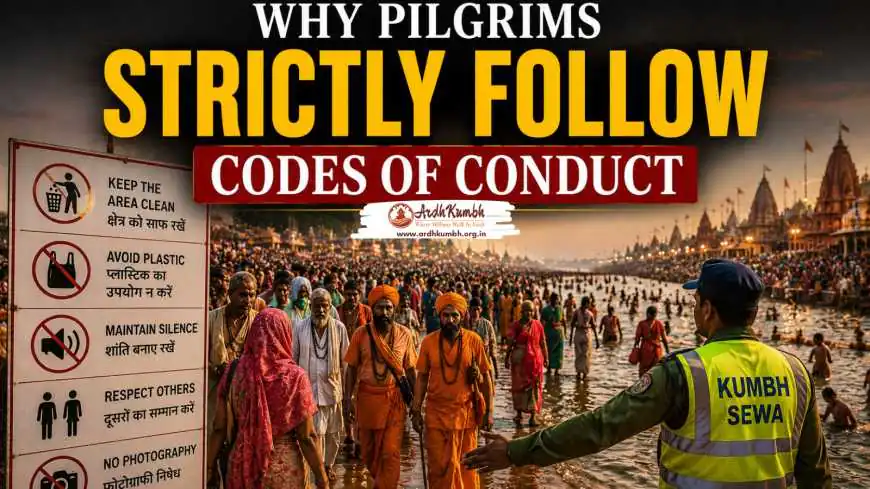
Read Guide →Kumbh authorities post signs that say "Do Not Litter" and "Keep the Ganga Clean." Volunteers distribute trash bags. Fines are levied for littering. But the primary reason pilgrims do not throw trash into the river is religious. They have been taught that Mother Ganga watches. They have been taught that pollution is a sin (papa), not just a crime.
Observers at Kumbh see pilgrims picking up trash that others dropped. They see pilgrims carrying plastic bottles to bins kilometers away. They see pilgrims scolding strangers who try to throw waste into the water. This behavior is not enforced by police. It is enforced by internalized religious teaching.
Pilgrims follow the cleanliness code because their guru told them to. Because their parents told them to. Because they would be ashamed to face Mother Ganga after polluting her. The code is spiritual, not bureaucratic. That is why it works.
Sadhus Go First - A Hierarchy That Everyone Accepts
At Kumbh, sadhus do not wait in the same lines as householder pilgrims. They have designated bathing times and priority access to the ghats. This is not a secret. It is a stated tradition of the akhara system. Sadhus have renounced the world. In exchange, the community gives them honor and priority.
Pilgrims do not resent this. They accept it. When a procession of Naga sadhus approaches the ghat, pilgrims step aside. They do not argue. They do not demand equal treatment. They have been taught that sadhus are spiritually advanced and deserve deference. This teaching is explicit in Hindu tradition. It is not a guess.
The code is: sadhus go first. Pilgrims follow this code without enforcement because they believe in the hierarchy of renunciation. A pilgrim who blocked a sadhu's path would be shamed by other pilgrims. Not by police. By peers. That shame is sufficient.
The Queue as Tapasya - A Teaching from Gurus
Gurus at Kumbh explicitly teach their disciples that waiting in line is a form of tapasya (austerity). This is a stated teaching, not speculation. Disciples are told that each moment of patient waiting burns karma and strengthens self-control. The queue becomes a spiritual practice.
When a disciple internalizes this teaching, waiting is no longer a burden. It is an opportunity. Cutting the queue is no longer a shortcut. It is stealing tapasya that belongs to the wait. It is cheating on one's own spiritual growth.
This is why pilgrims do not cut lines even when no one is watching. The guru is always watching. The disciple's own conscience is always watching. The code has been internalized. External enforcement is not needed.
Observation at Kumbh confirms that queue discipline holds even in remote areas with no police presence. Pilgrims wait. They do not push. They do not cut. The teaching has done its work.
Ancestral Transmission - Rules Taught at Home
Pilgrims do not learn the codes of conduct for the first time at Kumbh. They learn them at home. Parents tell children how to behave at Kumbh. "Do not push. Do not litter. Respect the sadhus. Help the elderly." These instructions are explicit. They are repeated year after year.
Grandparents tell stories of their own Kumbh experiences. "Your great-grandfather waited in line for six hours. He did not complain. He said waiting is worship." These stories transmit the code across generations.
When a pilgrim arrives at Kumbh, they already know the rules. They have known them since childhood. The code is not new. It is familiar. It is family tradition. Breaking the code would mean disrespecting one's parents and grandparents.
This ancestral transmission is observable. Ask any pilgrim at Kumbh who taught them to behave. They will name a parent or grandparent. The code is inherited, not imposed.
Shame as Enforcement - The Community Watches
Kumbh is a community of millions of pilgrims. Everyone watches everyone. When a pilgrim breaks a code - cuts a line, litters, pushes - other pilgrims notice. They stare. They murmur. Sometimes they speak directly. "Brother, that is not correct. Please wait your turn."
This social enforcement is observable at Kumbh every day. Pilgrims correct strangers without police involvement. The corrected pilgrim almost always complies. They do not argue. They do not fight. They experience shame and change their behavior.
Why does shame work? Because pilgrims value their reputation within the community. They want to be seen as good pilgrims. Being shamed in public damages that reputation. The cost of shame is higher than the benefit of cutting a line.
Shame is the primary enforcement mechanism for minor code violations at Kumbh. No speculation is needed. This is visible to any observer. Pilgrims enforce the codes on each other. The community polices itself.
Sadhus as Role Models - Behavior Taught by Example
Sadhus at Kumbh are visible to all pilgrims. They sit in their camps. They walk to the ghats. They bathe. They meditate. And they follow the codes of conduct. Sadhus do not cut lines. They do not litter. They help elderly pilgrims. They wait patiently.
This behavior is observable. Sadhus are not exempt from the codes. They follow them strictly. Often more strictly than householder pilgrims. Because sadhus have taken vows of discipline. Breaking a code would violate their vows.
Pilgrims watch sadhus. They learn by example. When a sadhu waits patiently in line, pilgrims see that waiting is not beneath anyone. When a sadhu carries his own trash to a bin, pilgrims see that cleanliness is spiritual.
The code is modeled by sadhus. Pilgrims imitate. No speculation is required. This is social learning visible at Kumbh every day.
The Final Reason - Pilgrims Choose to Obey
Observation at Kumbh leads to one conclusion. Pilgrims follow codes of conduct because they choose to. They are not forced. The police presence is too thin to force fifty million people. The fines are too small to deter the wealthy. The threat of arrest is too distant for most violations.
Yet pilgrims comply. They wait. They clean. They respect. They help. They do these things because the codes are taught, modeled, transmitted, internalized, and socially enforced. The codes are part of what it means to be a pilgrim at Kumbh.
A pilgrim who breaks the code is not just breaking a rule. They are violating their own identity. And identity is not easily shed. Pilgrims obey because they are pilgrims. And pilgrims follow codes of conduct. That is the observable truth.
Frequently Asked Questions