












































































Amrit Snan Meaning: Why This Bath Is Considered Rare
Discover the profound meaning of Amrit Snan and why this celestial bath is considered so rare. Learn the exact astrological alignments, spiritual significance, and the difference between Amrit Snan and Shahi Snan.
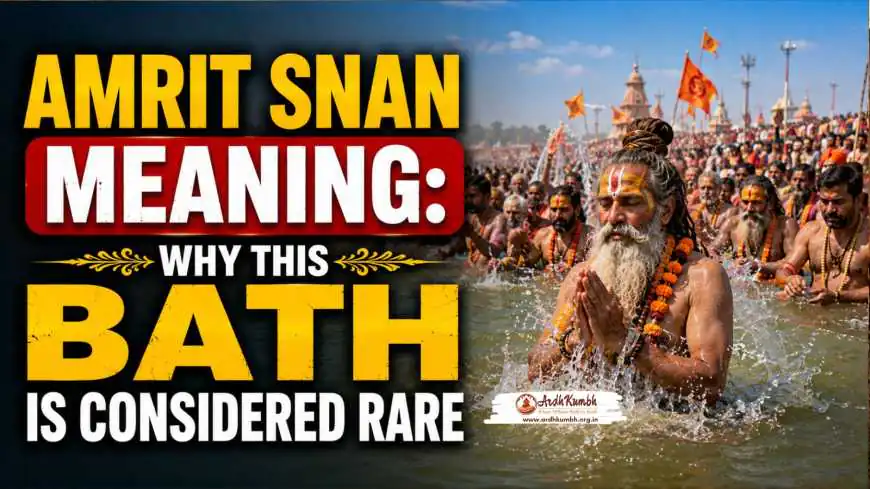
Amrit Snan Meaning: Why This Bath Is Considered Rare
There are moments in the grand theater of the cosmos when the curtain between the mortal and the divine becomes whisper-thin. The Amrit Snan is that exact pinpoint of time. It is not simply about lowering your body into a river; it is about consciously stepping into a liquid portal when the heavens have mechanically aligned to drip the essence of spiritual immortality directly into the water. The rarity of this bath doesn't stem from a religious committee’s calendar decision, but from a complex, pin-drop silence of planetary geometry. When the sun enters a specific zodiac sign, when the moon holds a particular phase, and when Jupiter—the great benefic—locks into a position of power, the water physically and metaphysically transforms. Calling it just a dip is an injustice; this is a planetary supercharge, a rare cosmic download that cannot be replicated artificially. If you miss this exact window, you miss the transformation of the molecular memory of the river itself.
The Deep-Rooted Linguistic Soul of the Word
To understand why this event is the crown jewel of spiritual cleansing, we have to break the phrase down to its raw bone structure. It is a combination of two words that hold the entire Vedantic cosmos within them.
Amrit: The Deathless Frequency
People commonly translate Amrit as nectar, but this is a gross oversimplification that loses the depth of the concept. Amrit is the absence of friction—the friction that causes decay. In the ancient texts, when the Samudra Manthan or the churning of the cosmic ocean took place, a vicious battle between the forces of light and darkness erupted over the pot of this substance. It wasn't just a sweet liquid; it was a vibrational technology. Amrit is that state of consciousness where the cells of your body stop screaming the song of death. When a seeker enters the water during the Amrit Snan, the belief is not that the water becomes sweet, but that the water molecules rearrange to carry the Mrityunjaya frequency—the vibration that conquers death. It is the liquid state of the mantra that silences mortality. This is why the bath is seen as a direct participation in the physics of spiritual alchemy, not just a symbolic gesture.
Snan: The Dissolving of Crust
The second word, Snan, is often cheaply translated as a bath. A bath is what you take to remove physical dirt after a long day. Snan is a systemic dissolution. It implies a conscious act where the body is used as a tool to purify the subtle sheaths or Koshas. When the Amrit Snan is performed, you aren't washing your skin; you are letting the charged water penetrate the Pranamaya Kosha (the energy body) and the Manomaya Kosha (the mental body). The physical act of dipping three times represents the cleansing of the three types of debt or Rina—the debt to the ancestors, the sages, and the divine. But because the water is astronomically charged as Amrit, this isn't just a cleaning; it’s a complete burning of karmic sludge that would otherwise take lifetimes to scrub off.
Trending Guides Now

Har Ki Pauri Ganga Aarti Time Today in Haridwar
Read Guide →
Complete Guide to Ardh Kumbh Rituals
Read Guide →
Why Sacred Bathing Is the Heart of Ardh Kumbh
Read Guide →
Why Many Pilgrims Observe Silence at Kumbh
Read Guide →
Ardh Kumbh 2027 Dates (Official) - Haridwar Snan Schedule
Read Guide →
Dharamshala Stay During Ardh Kumbh: Free & Budget Guide
Read Guide →
Official Progress Report of Haridwar Ardh Kumbh 2027 Infrastructure Projects
Read Guide →
Where to Find 24-Hour Pharmacies in Haridwar During Ardh Kumbh 2027 Emergencies
Read Guide →The Science of Rarity: Why You Can't Just Plan It
Why is this specific bath considered so scarce and impossibly rare? It is not a weekly ritual or a convenient holiday weekend plunge. The rarity is dictated by a celestial clockwork that does not care for human convenience. It’s a waiting game that stretches years, sometimes 144 years, for a specific configuration.
The Perfect Storm of Time
The Amrit Snan is not an isolated date; it is the peak of a massive tidal wave of spiritual energy that occurs during the Kumbh Mela. The calculation is brutally precise. It occurs when the planet Brihaspati (Jupiter) transits a specific zodiac sign, and simultaneously, the Surya (Sun) and Chandra (Moon) enter specific houses. The most potent of these rare alignments happen when Jupiter is in Aquarius (Kumbha Rashi) and the Sun and Moon are in Aries and Capricorn, respectively, or variations depending on the location—Haridwar, Prayagraj, Nashik, or Ujjain.
You must realize that an ordinary Shahi Snan involves the majestic march of the Akharas. But an Amrit Snan is the absolute holiest of the holy within those dates. It’s the millisecond of the cosmic clock where the Siddhi of the moment is instantly accessible. Imagine a complex lock with 27 pins; only when every single pin—the month, the star, the ascendant, the planetary degree—clicks into place does the lock open. That opening is the Amrit Snan. This is why it is rare. You cannot buy it, you cannot influence the planets, you can only surrender to the timing.
The Invisible Chemistry of Planetary Transits
It is easy to dismiss astrology as superstition, but the ancient Sages were the original astrophysicists. They understood that the human body is a liquid crystalline structure, and the rivers are the earth’s circulatory system. During the Amrit Snan, the sheer electromagnetic torque exerted by the alignment of the Sun and Jupiter alters the water's memory.
The Sun is the father of the solar system, the source of the physical soul. Jupiter is the guru, the indicator of wisdom and expansion. When the Sun’s vital life force and Jupiter’s expansive wisdom merge in exact harmonic resonance over a sacred water body, a phenomenon occurs that is akin to a planetary-scale Soma ritual. The water molecules gain the capacity to hold information of higher consciousness. Bathing in that moment means your own bio-water—which constitutes over 70% of your body—syncs with that cosmic intelligence. The body stops acting as a prison of dense matter and starts acting as a luminous vehicle. The rarity lies in the fact that this specific electromagnetic harmony between the Karakas (significators) of soul and wisdom cannot be mantained on a daily basis. It’s a fleeting, elusive breath of the universe.
Distinguishing the Royal from the Divine
A massive point of confusion among pilgrims is the difference between a Shahi Snan and an Amrit Snan. Treating them as interchangeable is a critical mistake. The Shahi Snan is a royal procession. It is the grand spectacle of the Akharas, the naked Naga Sadhus smeared in ash, riding elephants, horses, and chariots, roaring with the spirit of renunciation. It is a declaration of sovereignty over the spiritual realm. It’s visually stunning, loud, and profoundly powerful. But it’s a human entry into the water, however majestic.
The Amrit Snan, however, is a cosmic entry into the water. It is dictated purely by the Tithi (lunar day) and the planetary positions. Sometimes, the administrative schedule of the Shahi Snan of the Akharas is adjusted, but the Amrit Snan belongs strictly to the heavens. Once the Akharas finish their royal dip during the designated Shahi Snan, the gates of the bathing area technically open for the common Amrit Snan. It is the rarest form because it merges the sacred rights of the renunciant orders with the most astronomically potent window. While the Shahi Snan honors the hierarchical structure of the Sanyasi orders, the Amrit Snan honors the structure of the sky. The sky doesn't bow to a schedule; hence, the occurrence of a true Amrit Snan remains an elusive treasure that a soul might be lucky to catch once in a lifespan.
The Invisible Chemistry of Planetary Transits
It is easy to dismiss astrology as superstition, but the ancient Sages were the original astrophysicists. They understood that the human body is a liquid crystalline structure, and the rivers are the earth’s circulatory system. During the Amrit Snan, the sheer electromagnetic torque exerted by the alignment of the Sun and Jupiter alters the water's memory.
The Sun is the father of the solar system, the source of the physical soul. Jupiter is the guru, the indicator of wisdom and expansion. When the Sun’s vital life force and Jupiter’s expansive wisdom merge in exact harmonic resonance over a sacred water body, a phenomenon occurs that is akin to a planetary-scale Soma ritual. The water molecules gain the capacity to hold information of higher consciousness. Bathing in that moment means your own bio-water—which constitutes over 70% of your body—syncs with that cosmic intelligence. The body stops acting as a prison of dense matter and starts acting as a luminous vehicle. The rarity lies in the fact that this specific electromagnetic harmony between the Karakas (significators) of soul and wisdom cannot be mantained on a daily basis. It’s a fleeting, elusive breath of the universe.
The Unwavering Role of the Naga Warriors
It is the Naga Sadhus—the naked, ash-covered, dread-locked protectors of the faith—who hold the key to the sanctity of the Amrit Snan. Their presence is not decorative; it is essential to the ritual’s spiritual thermodynamics. They are the embodiments of unadulterated Shiva consciousness. When they charge into the freezing waters at the crack of dawn, swords and tridents held high, they are not just bathing. They are performing a Tantric operation. They are energizing the water body with the fire of their Tapasya (austerities).
The rarity of the Amrit Snan is amplified by their participation because their bodies are living crucibles of concentrated celibacy and penance. When a human being who has not slept lying down for years, who has renounced fire and society, enters the river, they release billions of cells of stored spiritual heat into the water. This primes the river. Before the general public enters, the Akharas have essentially consecrated the fluid. If a layperson bathed in the same river without the Naga Sadhus having performed their Peshwai, the impact would be psychologically and spiritually muted. The brave, uncompromising energy of these warrior monks is the secret sauce that makes the celestial alignment accessible to the common man’s soul.
The Geographic Anatomies of Immortality
The location is never arbitrary. You cannot perform an Amrit Snan in your rooftop pool, even if the planetary alignment is right. The geography is a living organism. There are four sites, and each is linked to a specific part of the spiritual anatomy of the universe.
The Amrit Snan rotates between the sacred crucibles of Haridwar, Prayagraj, Ujjain, and Nashik. Each location has its own specific astrological trigger.
-
When Jupiter is in Aquarius and the Sun enters Aries, the drop of nectar fell in Haridwar, by the banks of the swift Ganga.
-
At Prayagraj, the king of all Kumbhs, the confluence of the visible Ganga, Yamuna, and the invisible Saraswati is the designated vessel. This is where the Amrit falls during the Makar Sankranti transition, specifically when Jupiter is in Taurus and the Sun and Moon are in Capricorn.
-
Ujjain, the city of Mahakal, hosts the rare Simhastha when Jupiter roars in Leo.
-
Nashik, on the banks of the Godavari, sees the celestial nectar bath when Jupiter and the Sun align in Leo.
This rotation means a specific configuration in a specific place may not repeat for 144 years. This is the pinnacle of rarity. It’s a human pilgrimage that dances to the tune of a 144-year cosmic waltz.
A Direct Transaction with Karma
Why do millions risk stampedes, extreme cold, and immense logistical hardship to make it to this bath? Because the Amrit Snan is seen as the ultimate loophole in the law of karma. Karma is a tough contract; every action has an equal reaction, and the debt accumulates interest over births. But the scriptures offer a window of grace.
During the Amrit Snan, the Karmic accounts are audited by a universal intelligence that is predisposed to forgiveness due to the opening of the celestial gates. The act of taking the dip with complete faith and a silent mind allows the charged water to penetrate the Chitta (memory bank). It burns the seeds of stored impressions without having to sprout them into painful experiences. This is not a metaphorical cleaning. When performed with the correct Sankalpa (sacred vow), it is believed that the Prarabdha Karma—the destiny that you are born into—is physically softened. The rare bath grants you breathing room. It loosens the hold of negative planetary influences in your birth chart. It’s a spiritual bankruptcy discharge that the cosmos only allows when the planets are acting as the trustees of divine nectar.
The Sankalpa: The Razor’s Edge of the Ritual
Wading into the water without a Sankalpa is just physical exercise, a swim dressed up as religion. The reason the Amrit Snan is so effective is the anchoring of a specific intent. The moment you touch the water, you cup your hands, close your eyes, and declare your lineage (Gotra), your time, your place, and the specific purpose of your birth.
You state, “I am bathing in this sacred Kshetra at this divine Muhurta for the purification of my ancestors, for the dissolution of my sins, and for the attainment of Moksha.” This is a binding verbal contract with the subtler realms. The water acts as the fluid medium to carry this vibrational intent into the cosmic accounting system. The reason the bath is rare is not just the water’s quality, but the alignment of the water’s highest charge with the human will’s highest focus. If the Amrit Snan is the rarest time-chemistry, the Sankalpa is the catalyst that triggers the reaction. Without the catalyst, the chemical remains inert.
The Undistorted Transmission of an Ancient Sound
Long before the planets align, the air around the Kumbh camps vibrates with a continuous loop of specific mantras. The Mahamrityunjaya Mantra, the Gayatri Mantra, and the sounds of conch shells fill the air. Sound is a structural force. The Amrit Snan is rare because it is not silent; it is sonically sealed.
The water, being a tetrahedral molecule, is a proven receptor of sound vibration. The high-frequency chants of thousands of Vedic Brahmins alter the geometric order of the water clusters. When a seeker enters this sonic envelope, the bones in the skull and the spine pick up these sympathetic vibrations. The Amrit effect is thus twofold: downloaded from the planets and uploaded by the human voice. This synergy is why attending a proper Amrit Snan cannot be replicated through a solitary meditation at home. The group consciousness, the collective sonic tapestry, and the river’s reception of that sound create a singularity of purity. This is a rare acoustic architecture, a temple made entirely of sound waves and fluid, built only at a specific time and demolished by time itself once the planets drift apart.
The Dawn That Silences the Mind
There is a specific moment during the Amrit Snan—usually the Brahma Muhurta, roughly an hour and a half before sunrise—when the darkness is still blue and deep. The air is at its minimum mental chatter. Psychologically, this is the hour of maximum silence in the collective consciousness. The rarity of the Amrit Snan is hidden in this hour.
When the celestial alignment is layered upon the psychological stillness of pre-dawn, the mirror of the mind is clean. Entering the icy water at this time forces a total physiological shock that stops the internal dialogue instantly. That stoppage of thought is Yoga. In that one, two, or three seconds of cold shock and celestial embrace, the practitioner experiences a void. This void is the carrier wave of the nectar. The rare bath is thus a forced entry into a meditative state that takes monks decades to master. For the ordinary person, the freezing water and the planetary influx work as a natural defibrillator for the soul, restarting the heart’s connection to the universal field.
The Coolness of the Earthen Pot
After the final dip, the most neglected but vital part of the Amrit Snan is the offering. You cannot leave the river empty-handed in a spiritual sense. The ritual of filling a simple earthen pot or Lota with the charged river water and offering it to the Sun or a nearby Peepal tree completes the circuit.
In the philosophy of the Amrit Snan, this is the act of sealing the energy. You have taken the water into your body; now you must offer your gratitude back to the source to avoid spiritual indigestion. The earthen pot represents the physical body—porous, temporary, and sourced from the earth. Pouring water over the Peepal tree, which is believed to exhale pure life force continuously, ensures that the nectar you absorbed is not hoarded but circulated. The rarity of the bath implies a massive responsibility. You are a carrier of a high-voltage frequency. The grounding ritual is critical because taking an Amrit Snan without offering Tarpan (water oblations to ancestors) is like receiving a million-volt shock without an earth wire. The ancestors in the ethereal plane drink that water through your offering, and in doing so, you release them.
The Serpent Coil and the Breath of Eternity
Look at the imagery of Lord Vishnu floating on the infinite ocean of milk, the coils of the serpent Shesha serving as his bed. The Amrit Snan brings you into a microcosmic alignment with that very image. When you float or dip in the sacred river during this time, you are metaphorically resting on the serpent of time itself.
The water becomes the Kshira Sagara, the milk ocean of consciousness. The rare alignment of Jupiter and the Sun calms the serpentine mental fluctuations of the Ida and Pingala nadis (energy channels) in your body. The breath naturally syncs. The Amrit Snan is thus a real-time living metaphor for the Yoga Nidra of Lord Vishnu—a state of deep rest that generates universes. You enter the water as a fragmented individual and, for a split second, you exit the water as a unified field of potential. The rareness is in the preservation of this state. It fades as you dry off, but the cellular memory of unity remains imprinted, pulling you back toward the divine for the rest of your incarnations until you finally dissolve completely.
The River Doesn't Forget, Nor Does the Sky
The Amrit Snan is the rarest form of spiritual hygiene because it is not bound by the human calendar. It is dictated by a very personal, intimate, and mathematically precise conversation between the river and the sky. The river is the earth’s memory, the blood plasma of the planet, and the sky is the ever-turning wheel of time. When time drips its nectar into the flowing blood of the earth, a third substance is born in that confluence—the possibility of absolute freedom. If you miss it, the river keeps flowing, the sky keeps turning, but the bridge collapses. The Amrit Snan is that temporary bridge made of starlight, water, and mantra. It is rare because it is a work of art composed by the cosmos for just a single, fleeting heartbeat of eternity. To be present there, shivering and breathless, is to know that you were not just bathing in a river, but in a stream of endless, conscious light that has recognized you.
Frequently Asked Questions