









































































Common Online Scams to Avoid During Ardh Kumbh 2027
Protect yourself from online scams during Ardh Kumbh 2027. Learn about fake bookings, UPI fraud, phishing, fake websites, and official helpline numbers for cyber safety
The Digital Trap: Why Cybercriminals Target Ardhkumbh.org.in/significance-of-bathing-in-the-ganges-during-kumbh" class="contextual-link" data-post-id="22">Ardh Kumbh 2027 Pilgrims 🎯💻
Let's be honest — when you're planning your sacred journey to Ardh Kumbh 2027, the last thing on your mind is online scams. You're thinking about the Ganga Aarti at Har Ki Pauri, the Amrit Snan, the spiritual energy of millions of devotees. But here's the hard truth: where there are millions of pilgrims, there are cybercriminals waiting to exploit their faith, urgency, and trust.
Uttarakhand Police and the Special Task Force (STF) have already issued detailed advisories warning pilgrims about the growing threat of cyber fraud during the upcoming Kumbh Mela. The Governor of Uttarakhand has personally emphasized that cyber security awareness campaigns must be conducted extensively, with special focus on protecting senior citizens from cybercrimes.
The numbers are staggering. During the Maha Kumbh 2025 in Prayagraj, cybercriminals created dozens of fake websites, duped devotees of lakhs of rupees, and operated fraudulent social media accounts to spread misinformation. In one case, a Mumbai businesswoman lost ₹3.78 lakh while trying to book a tent and flight tickets. In another, a group lost over ₹4 lakh to fake booking websites.
For Ardh Kumbh 2027, the stakes are even higher. With an estimated 10 to 17 crore pilgrims expected in Haridwar, cybercriminals are already sharpening their tools. But don't worry — this guide will arm you with everything you need to stay safe online during your spiritual journey. Let's dive in! 🛡️🙏
Trending Guides Now

Hidden Health Risks at Kumbh and How to Stay Safe
Read Guide →
Essential Government Advisories Every Ardh Kumbh 2027 Visitor Should Know
Read Guide →
Safe Ganga Snan Tips During Heavy Rain at Ardh Kumbh 2027
Read Guide →
Essential Monsoon Safety Tips for Ardh Kumbh 2027 Pilgrims
Read Guide →
Ardh Kumbh 2027 Dates (Official) - Haridwar Snan Schedule
Read Guide →
Dharamshala Stay During Ardh Kumbh: Free & Budget Guide
Read Guide →
Official Progress Report of Haridwar Ardh Kumbh 2027 Infrastructure Projects
Read Guide →
Where to Find 24-Hour Pharmacies in Haridwar During Ardh Kumbh 2027 Emergencies
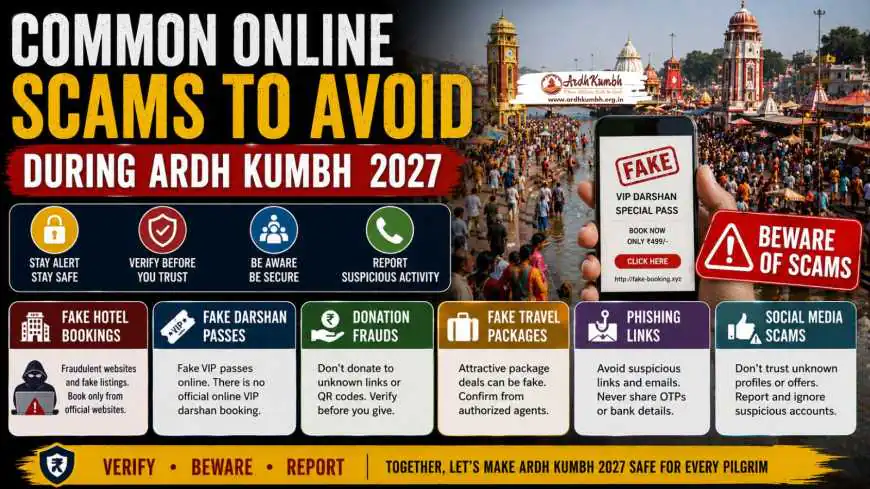
Read Guide →Fake Booking Websites: The Number One Threat 🏨💀
This is the most common and dangerous scam targeting Kumbh pilgrims. Cybercriminals create convincing fake websites that look exactly like official government portals or legitimate hotel booking sites.
How the Scam Works
-
Fake websites are created with names like "kumbhcottagebooking.com" or "mahakumbhtentreservation.com"
-
These sites use official-looking logos, government emblems, and professional design
-
They offer "exclusive deals" , "VIP tents" , or "limited-time offers" to create urgency
-
Pilgrims are asked to pay the full amount upfront through UPI or bank transfer
-
Once payment is made, the website disappears or the contact number becomes unreachable
Real-Life Examples
During the Maha Kumbh 2025, cybercriminals created fake websites offering helicopter rides and VIP tent bookings. The Prayagraj cyber cell arrested a man who created a fake website to cheat devotees by offering fraudulent cottage, tent, and hotel bookings. Another gang operated multiple fake websites including www.kumbhcottagebooking.com and [email protected].
How to Protect Yourself ✅
-
Always verify the website URL — official government websites end with .gov.in
-
Never pay the full amount upfront — pay a small deposit first and ask for a receipt
-
Check for GST compliance — ask for a GST invoice and verify the GSTIN on the official portal
-
Call the company directly — use phone numbers from official sources, not the website
-
Do a reverse image search — scammers often use photos from luxury resorts
-
If a deal seems too good to be true, it probably is
Pro Tip: Book only through official Kumbh Mela websites or reputed travel portals. Avoid clicking on unknown links shared through WhatsApp or messaging apps.
Fake Accommodation and Tent Booking Scams ⛺🏕️
With millions of pilgrims descending on Haridwar, accommodation is in huge demand — and scammers know it.
How the Scam Works
-
Fraudsters create social media pages or websites claiming to offer luxury tents at very low prices
-
They use attractive photos and pressure you by saying, "Book now, or you'll miss out!"
-
Once you pay, you discover the tent doesn't exist or the contact number is invalid
-
Some scammers promise "all-inclusive packages" at unusually low rates
-
A major red flag is when an agent asks you to pay the full amount upfront without providing official paperwork
How to Protect Yourself ✅
-
Book with trusted companies that have reliable websites, verified reviews, and customer support
-
Avoid paying full amounts upfront — pay a small deposit first
-
Double-check before you pay — call the company, ask for photos or videos of the tent or hotel, and verify the location
-
Check reviews on multiple platforms — don't rely on reviews on the scammer's own website
-
Ask for a physical address — genuine properties have a verifiable location
The Uttarakhand Police Advisory
The Uttarakhand STF has warned that cybercriminals are operating fake websites, Facebook pages, Instagram accounts, and WhatsApp numbers posing as authorized helicopter service agents and hotel booking providers. They lure pilgrims with promises of "confirmed tickets," "VIP darshan," and "limited seats" — only to disappear after receiving payment.
UPI and QR Code Frauds: The Digital Payment Danger 📱💳
With the widespread use of UPI and QR code payments, scammers have found new ways to exploit devotees.
How the Scam Works
-
Fake QR codes are placed at temples, ghats, and crowded areas
-
Scammers share fraudulent donation links and unauthorised payment requests
-
Phishing emails and fake UPI payment requests trick individuals into revealing sensitive information
-
Some scammers send fake payment confirmation messages to trick vendors
How to Protect Yourself ✅
-
Never scan QR codes from unidentified sources
-
Verify the UPI ID before making any payment
-
Don't share your UPI PIN with anyone — ever
-
Use only trusted payment gateways
-
Check the transaction details before confirming any payment
-
Never pay via UPI links from random messages
What Uttarakhand Police Is Doing
The state has deployed 35 trained cyber commandos for the first time to ensure digital security. These commandos are divided into four units:
-
Cyber Security Unit
-
Social Media Monitoring Unit
-
Cyber Intelligence Unit
-
Incident Response Unit
These teams work 24/7 to monitor cyberspace for fake news, rumors, misleading content, and suspicious activities. They specifically focus on online hotel and travel booking frauds, UPI and QR code-based frauds, phishing, and fake social media.
Phishing Scams: Fake Emails, SMS, and WhatsApp Messages 📧📱
Phishing is one of the oldest tricks in the book — but it still works because scammers are getting more sophisticated.
How the Scam Works
-
Scammers send emails or WhatsApp messages with fake links promising exclusive deals for Kumbh attendees
-
These messages often create a sense of urgency — "Limited offer! Book now!"
-
The links lead to fake websites that steal your personal and financial information
-
Some scammers pose as "Kumbh Mela officials" asking for personal details
How to Protect Yourself ✅
-
Don't click on suspicious links — even if they look official
-
Verify the sender's identity — official organizations don't send unsolicited messages asking for payments
-
Check the email address — scammers use addresses that look similar to official ones
-
Be wary of unsolicited offers — scammers often use pop-ups, ads, or phishing emails to direct users to fraudulent sites
-
No legitimate official will hunt you down in a Telegram group to ask for a UPI transfer — if they do, it's a scam. Period.
Fake Donation Scams: Exploiting Faith for Profit 🙏💰
Scammers know that pilgrims are generous and devout — and they exploit this kindness.
How the Scam Works
-
Fake websites and social media pages collect donations in the name of temple trusts or spiritual organizations
-
Scammers create fraudulent donation links and share them through WhatsApp and social media
-
Some even create fake donation boxes with QR codes at crowded areas
-
They use emotional appeals — "Help the poor," "Support the temple," "Donate for the sacred yajna"
How to Protect Yourself ✅
-
Donate only through official channels — verified temple websites or physical donation boxes at the temple
-
Verify the organization before making any online donation
-
Never share your UPI PIN or card details for donations
-
Check for government registration — legitimate charitable organizations are registered
What Authorities Are Doing
The Telangana Cyber Security Bureau (TGCSB) has already issued advisories cautioning residents about fraudulent websites swindling people on the pretext of online bookings or seeking donations. The Pimpri Chinchwad cybercrime police has also warned that fraudulent websites, links, and other platforms can cheat people on the pretext of collecting donations from devotees.
Social Media Scams: Fake Pages and Misinformation 📱❌
Social media is a double-edged sword — it connects devotees but also spreads misinformation and scams.
How the Scam Works
-
Fake Facebook pages and Instagram accounts are created posing as official Kumbh Mela organizers
-
Scammers post fake offers — "VIP darshan," "special passes," "helicopter bookings"
-
They use paid advertisements to reach more pilgrims
-
Some spread misinformation about the mela to create panic or confusion
What Authorities Are Doing
During the Maha Kumbh 2025, legal action was initiated against 101 social media accounts for spreading misleading information. The Kumbh Mela administration and Uttarakhand Police have officially stated that they will refute false claims on their official social media handles.
How to Protect Yourself ✅
-
Follow only official social media handles — look for verified badges
-
Don't believe everything you see — verify information from official sources
-
Report suspicious pages to the platform and to cyber authorities
-
Don't share unverified information — it could be part of a scam
Fake Wi-Fi Hotspots: The Hidden Danger 📶⚠️
Public Wi-Fi networks at crowded events like the Kumbh Mela are a goldmine for cybercriminals.
How the Scam Works
-
Scammers set up fake Wi-Fi hotspots with names like "Free Kumbh Wi-Fi" or "Mela Free Internet"
-
When you connect, they can steal your personal data or hack your device
-
They can capture your passwords, banking details, and personal information
How to Protect Yourself ✅
-
Rely on your mobile data instead of public Wi-Fi or hotspots
-
Use a VPN if you must use public Wi-Fi
-
Turn off auto-connect for Wi-Fi networks
-
Don't access banking apps or make financial transactions on public Wi-Fi
Fake Ticket and Travel Scams 🎫✈️
Scammers exploit the high demand for travel and accommodation during the Kumbh Mela.
How the Scam Works
-
Scammers promise confirmed flight tickets, helicopter rides, or train bookings at discounted rates
-
They ask for full payment upfront
-
After receiving payment, they either send a fake ticket or disappear entirely
-
Some even claim to offer "VIP darshan" or "special access" to restricted areas
Real-Life Examples
A Mumbai businesswoman lost ₹3.78 lakh while attempting to book a tent and flight tickets. The scammer claimed the flight tickets were canceled and asked for ₹93,018 more for rebooking. In another case, a group lost over ₹4.25 lakh in a similar scam.
How to Protect Yourself ✅
-
Book only through official channels — authorized travel agents and government portals
-
Never pay the full amount upfront — pay a deposit and verify the booking
-
Get everything in writing — ask for official invoices and confirmations
-
Verify the booking directly with the airline, railway, or hotel
What to Do If You've Been Scammed: The Golden Hour ⏰🆘
If you've fallen victim to an online scam, time is of the essence. The "golden hour" — the first hour after the fraud — is critical for recovering your money.
Immediate Steps to Take
-
Call 1930 immediately — this is the National Cyber Crime Helpline, operating 24/7/365
-
Report on the cybercrime.gov.in portal — file an online complaint
-
Contact your bank — inform them about the fraudulent transaction
-
Freeze your account if necessary — to prevent further losses
-
Save all evidence — screenshots, emails, payment receipts, and messages
-
Visit the nearest police station — file an FIR
Important Helpline Numbers 📞
| Helpline | Purpose |
|---|---|
| 1930 | National Cyber Crime Helpline (24/7) |
| 155260 | Cyber Financial Fraud (golden hour reporting) |
| 112 | National Police Emergency |
| cybercrime.gov.in | Online Cyber Crime Reporting Portal |
What Uttarakhand Police Is Doing
The state has established a high-tech control room at the Kumbh complex with CCTV, public address systems, and digital monitoring for real-time surveillance. AI-based crowd management and real-time data monitoring will also be deployed. The cyber security unit will conduct technical analysis of complaints received on the NCRP portal and ensure swift action.
10 Golden Rules for Online Safety During Ardh Kumbh 2027 🛡️✅
-
Book only through official websites — look for .gov.in domains
-
Never share your UPI PIN, OTP, or bank details with anyone
-
Verify before you pay — call, confirm, and double-check
-
Don't click on suspicious links — even if they look official
-
Use mobile data instead of public Wi-Fi
-
Pay only a deposit upfront — never the full amount
-
Keep screenshots and records of all transactions
-
Follow only official social media handles — look for verified badges
-
Report suspicious activity immediately — call 1930
-
Trust your instincts — if it feels wrong, it probably is
Final Thoughts: Stay Safe, Stay Blessed 🙏✨
Your spiritual journey to Ardh Kumbh 2027 should be a transformative experience — not a nightmare of financial loss. The Uttarakhand government, Uttarakhand Police, and cyber security agencies are working tirelessly to protect you. 35 cyber commandos are already deployed, a cyber police station is being established, and awareness campaigns are being conducted.
But your safety ultimately depends on you. Stay vigilant, stay informed, and stay safe. Share this guide with fellow pilgrims — especially elderly devotees who may be more vulnerable to these scams.
The Ganga awaits you. The Amrit Snan awaits you. The divine energy of millions of devotees awaits you. Don't let a cybercriminal steal that experience from you.
Jai Ganga Maiya! 🙌🌊🕉️
Frequently Asked Questions